What Engine Does the 2002 Volvo XC90 Have?

The 2002 Volvo XC90 was Volvo’s very first SUV, and it launched with an engine lineup that’s smaller and simpler than most people expect from a car this old.
This guide draws on Volvo’s official first-generation XC90 archive and cross-referenced automotive specification databases, so the numbers reflect the car as it actually left the factory, not a later facelifted version.
TL;DR
- The 2002 XC90 launched with just two engine options: the 2.5T and the T6.
- The 2.5T uses a turbocharged 2.5-liter inline-five, making around 208 horsepower.
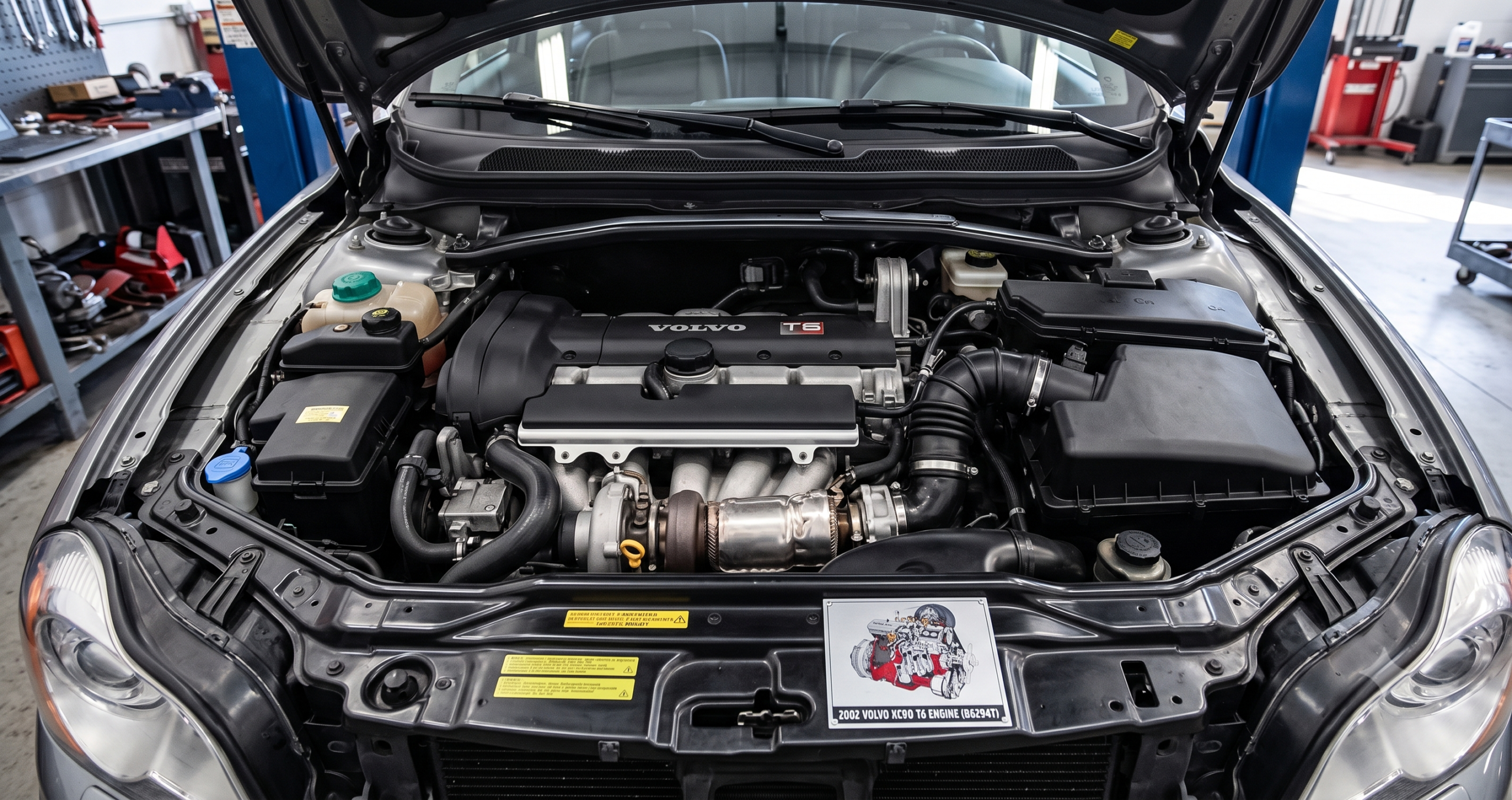
- The T6 uses a twin-turbocharged 2.9-liter inline-six, making roughly 268–272 horsepower.
- There was no V8 or 3.2L option yet — those came in later model years.
- Both engines are mounted transversely and paired with an automatic transmission.
Here’s the short answer: the 2002 Volvo XC90 came with two engines at launch — a turbocharged 2.5-liter five-cylinder in the base 2.5T, and a more powerful twin-turbo 2.9-liter six-cylinder in the T6 trim.
The 2002 XC90’s Two Launch Engines
Volvo kept things simple for the XC90’s debut, offering exactly two engines rather than the sprawling lineup the model would eventually grow into. Both were part of Volvo’s modular five- and six-cylinder engine family shared across the P2 platform.
The 2.5T was the entry-level engine, while the T6 sat above it as the performance-oriented choice. Neither the naturally aspirated six-cylinder nor the V8 that later XC90s are known for existed yet in the 2002 lineup — those arrived in 2005 (V8) and 2007 (3.2L six) respectively.
Quick Tip: If you’re shopping for an early XC90 and see a “V8” badge, double check the year — that engine wasn’t available until the 2005 model year at the earliest.
2.5T: The Turbocharged Five-Cylinder
The 2.5T answers the “which one is more common” question for most buyers, since it was the standard, lower-cost engine at launch. It uses a turbocharged and intercooled inline-five, producing around 208 horsepower and 236 lb-ft of torque.
This engine was available in both front-wheel-drive and all-wheel-drive configurations, which made it the more flexible and budget-friendly option of the two. It’s the engine you’ll find under the hood of the majority of early XC90s on the used market today.
T6: The Twin-Turbo Six-Cylinder
The T6 is where Volvo flexed a bit more muscle for the XC90’s debut. It’s built around a twin-turbocharged and intercooled 2.9-liter inline-six, delivering roughly 268 to 272 horsepower depending on the exact source and model year, along with noticeably stronger torque than the five-cylinder.
Bold takeaway: the T6 was AWD-only at launch, so if you want the six-cylinder engine, all-wheel drive comes as part of the package, not an optional extra.
Comparison Table: 2.5T vs. T6
| Spec | 2.5T | T6 |
|---|---|---|
| Engine | 2.5L turbocharged inline-5 | 2.9L twin-turbocharged inline-6 |
| Horsepower | ~208 hp | ~268–272 hp |
| Torque | ~236 lb-ft | ~280 lb-ft |
| Drivetrain | FWD or AWD | AWD only |
| Positioning | Base/value trim | Performance trim |
The takeaway: the horsepower gap between the two engines is significant — roughly 60 additional horsepower for the T6 — which explains why it commanded a real price premium when new.
Real-World Scenario: Buying a Used 2002 XC90
Say you’re browsing listings for an early XC90 and see two nearly identical-looking SUVs at different price points. The cheaper one is almost certainly the 2.5T, and the pricier one the T6 — the badge on the tailgate (2.5T vs. T6) is the fastest way to confirm which engine you’re actually looking at without popping the hood.
It’s worth checking, since the performance difference between the two is noticeable in daily driving, especially when merging onto highways or towing.
Pros & Cons by Buyer Type
The Budget-Conscious Buyer
- Pros: 2.5T models are generally more affordable and offer the flexibility of FWD or AWD
- Cons: Less power for towing or highway passing compared to the T6
The Performance-Minded Buyer
- Pros: T6’s twin-turbo six-cylinder offers noticeably stronger acceleration and towing capability
- Cons: AWD-only means no FWD option, and typically higher purchase and maintenance costs
The Long-Term Owner
- Pros: Both engines are well documented in Volvo enthusiast communities, making parts and repair knowledge easy to find
- Cons: These are 20+ year old turbocharged engines, so expect wear-related maintenance regardless of which one you choose
Alternatives Worth Considering
A later model year (2005+) — choose this if you specifically want the Yamaha-designed V8, which wasn’t available until the 2005 model year.
A 2007+ model — choose this if you’d prefer the naturally aspirated 3.2L inline-six that replaced the 2.5T as the base engine starting in 2007.
Quick Tip: If engine choice matters more than model year nostalgia, it’s worth cross-shopping a slightly newer first-generation XC90 to access the broader engine lineup Volvo added over time.
FAQ
What engines were available in the 2002 Volvo XC90? Just two at launch: the turbocharged 2.5-liter five-cylinder in the 2.5T, and the twin-turbocharged 2.9-liter six-cylinder in the T6.
Did the 2002 XC90 have a V8 option? No — the Yamaha-designed 4.4-liter V8 wasn’t added to the XC90 lineup until the 2005 model year.
Is the T6 engine only available with all-wheel drive? Yes, the T6 was AWD-only from launch, while the 2.5T offered both front-wheel-drive and all-wheel-drive versions.
How much horsepower does the 2002 XC90 T6 have? Approximately 268 to 272 horsepower, depending on the specific spec source, compared to around 208 horsepower for the 2.5T.
What platform is the 2002 XC90 built on? It uses Volvo’s P2 platform, shared with the S60, S80, V70, and XC70 of the same era.
Key Takeaways
- The 2002 XC90 launched with exactly two engines: the 2.5T and the T6.
- The 2.5T is a turbocharged 2.5L inline-five making around 208 hp, available in FWD or AWD.
- The T6 is a twin-turbo 2.9L inline-six making roughly 268–272 hp, available only in AWD.
- No V8 or naturally aspirated six-cylinder existed yet — those came in 2005 and 2007 respectively.
- The badge on the tailgate is the quickest way to identify which engine a used XC90 has.
Next Step
If you’re shopping for a first-generation XC90, check the tailgate badge or VIN decode to confirm whether you’re looking at a 2.5T or T6 before you fall in love with the price tag.