Volvo Geartronic vs Automatic?

The Question Almost Every Volvo Shopper Gets Wrong
You’re browsing Volvo listings and one says “Automatic” while another says “Geartronic,” and now you’re wondering if you’re comparing two completely different gearboxes. Here’s the twist: you’re not choosing between two rival systems — Geartronic is Volvo’s own name for its automatic transmission.
I’ve spent time in Volvo service documentation and transmission technical guides to clear up exactly what Geartronic is, how it differs from a plain automatic elsewhere, and where it fits next to Volvo’s other gearbox, Powershift. No jargon, just clarity.
TL;DR
- Geartronic is Volvo’s automatic transmission — the two terms aren’t rival options, they describe the same gearbox.
- It’s a “manumatic”: a torque-converter automatic that also lets you shift manually with the lever or paddles.
- Geartronic differs from a fully manual gearbox (clutch pedal) and from Volvo’s other automatic, Powershift (a dual-clutch design).
- In everyday “D” mode, Geartronic drives exactly like any conventional automatic — you’ll rarely notice a difference.
- The manual mode adds real usefulness for towing, hill descents, and overtaking, without giving up automatic convenience.
So if a listing says “Automatic,” it likely means Geartronic, since <cite index=”32-1″>Geartronic is Volvo Cars’ name for its manumatic transmission, offered in 4-, 5-, 6-, and 8-speed versions and controlled by a microprocessor</cite>. The “versus” in the title isn’t really a rivalry — it’s a translation problem. Once you know that, the more useful comparison becomes Geartronic’s manual mode versus its plain automatic mode, and Geartronic versus Volvo’s other gearbox family, Powershift.
What Geartronic Actually Is
Geartronic is a torque-converter automatic gearbox with an added manual-shift mode — Volvo’s version of what other brands call “Tiptronic” or “Steptronic.”
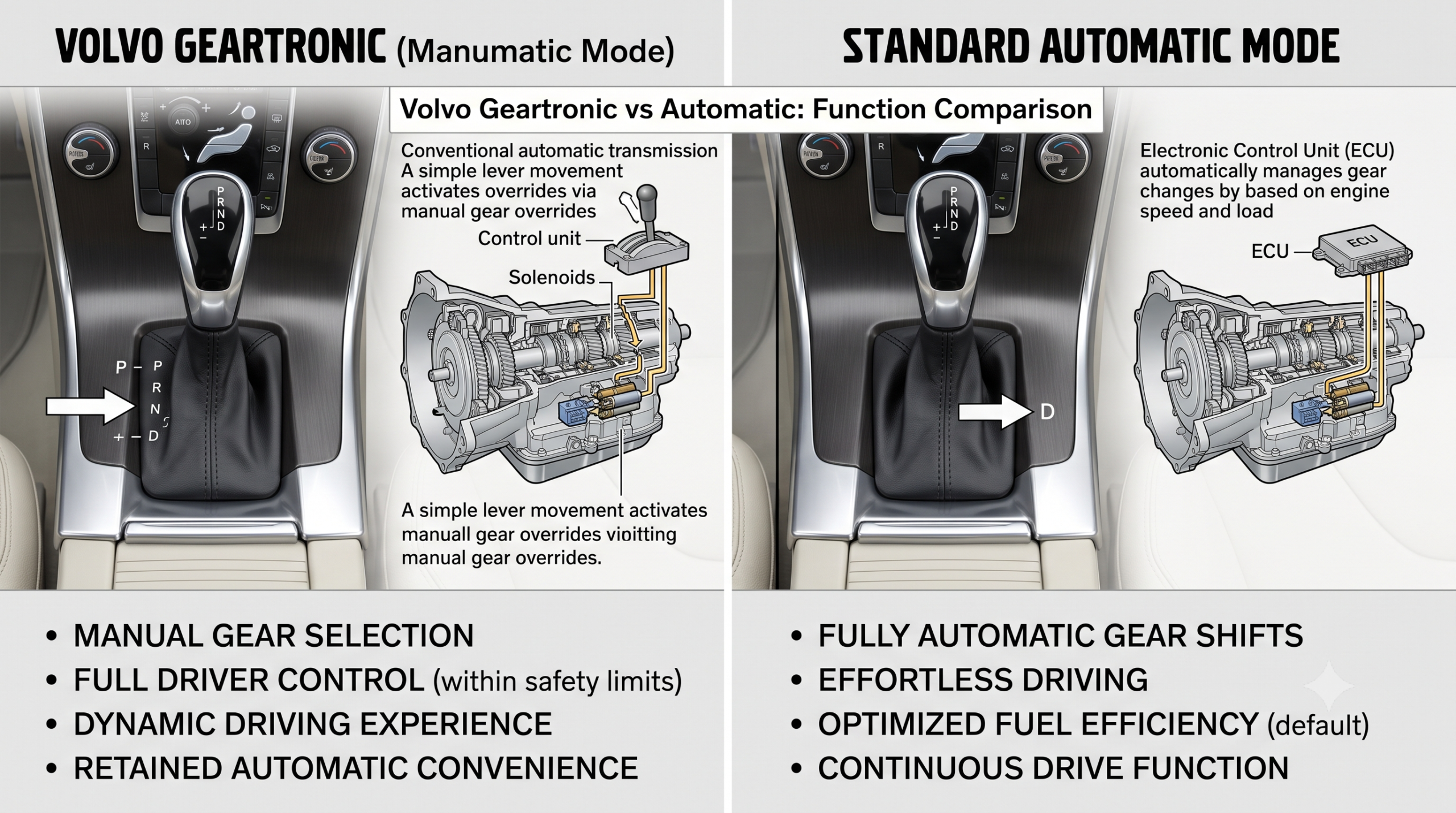
Mechanically, it’s a conventional automatic at heart. It <cite index=”35-1″>operates using two gear modes — Automatic and Manual — selected via the gear lever</cite>, and <cite index=”36-1″>by default runs as a standard automatic, independently calculating and changing gear ratio without driver input</cite>. That “by default” part is the key: unless you deliberately move the lever into manual mode, a Geartronic-equipped Volvo behaves exactly like any other automatic car.
Under the hood, Geartronic uses a hydraulic torque converter rather than clutch plates, which is part of why it’s known for smooth, seamless shifts. It’s a proven design too — Geartronic dates back to the 1990s and has been continuously refined since, with <cite index=”37-1″>the system debuting with five-speed units and evolving to include six- and eight-speed variants for later, more powerful models</cite>.
Quick Tip: If a Volvo listing just says “Automatic” with no further detail, assume it’s Geartronic unless the spec sheet specifically names Powershift — Geartronic has been the far more common automatic across Volvo’s lineup for decades.
Automatic Mode vs Manual Mode: The Real Comparison
Since Geartronic is the automatic, the meaningful comparison is what changes when you switch between its two modes.
In Automatic (“D”) mode: The gearbox handles everything. <cite index=”35-1″>Shifting up and down happens automatically based on acceleration level and speed</cite>, and the system includes a kick-down function for quick acceleration, plus a protective downshift inhibitor so you can’t accidentally over-rev the engine even under hard braking.
In Manual (“+/-“) mode: You take control of upshifts and downshifts using the lever or, on many newer models, steering wheel paddles. But Geartronic still won’t let you damage the engine — <cite index=”35-1″>it prevents downshifts that would push engine speed high enough to cause damage, simply ignoring the request if you try</cite>. That built-in guardrail is a meaningful safety difference from a true manual gearbox with a clutch pedal, where over-revving is entirely on the driver.
Expert Insight: Manual mode isn’t about being sporty for its own sake — it’s genuinely useful for engine braking on long descents, maintaining a gear through a series of corners, or keeping the transmission from hunting for gears on a steep, loaded climb.
Geartronic vs Powershift: Volvo’s Other Automatic
If you’re cross-shopping used Volvos, you may also run into “Powershift” — Volvo’s other automatic gearbox family, and this is where a genuine mechanical difference exists.
The core distinction is in how power gets from the engine to the wheels: <cite index=”38-1″>Powershift uses double mechanical clutch discs to transmit power, while Geartronic instead uses a hydraulic torque converter</cite>. In practice, this means Powershift (a dual-clutch design) can shift slightly faster and more efficiently at times, but some owners have reported it feels less smooth at low speeds, particularly in stop-start traffic, compared to Geartronic’s torque-converter feel.
Geartronic vs Automatic: Side-by-Side Comparison
| Feature | Geartronic (Automatic Mode) | Geartronic (Manual Mode) |
|---|---|---|
| Gear selection | Fully automatic | Driver-selected via lever/paddles |
| Mechanism | Hydraulic torque converter | Same torque converter |
| Over-rev protection | Built-in kick-down limits | Built-in downshift inhibitor |
| Best for | Everyday driving, commuting | Towing, hill descents, overtaking |
| Driver effort | None | Light — no clutch pedal needed |
| Feel | Smooth, seamless | Sportier, more direct |
The honest takeaway: you’re not sacrificing anything by choosing Geartronic over a “plain” automatic, because there usually isn’t a plainer alternative on a given Volvo model — Geartronic simply adds an optional manual layer on top of standard automatic operation.
Pros and Cons by Driver Type
The Commuter Who Never Touches the Manual Mode
- ✅ Gets all the convenience of a standard automatic, no learning curve required.
- ✅ Kick-down function handles overtaking without any driver input.
- ❌ Pays for manual-mode hardware and paddle shifters that may go unused.
The Enthusiast Who Wants Engagement
- ✅ Manual mode offers real control for spirited driving or technical roads.
- ✅ Steering wheel paddles (on newer models) make quick manual shifts easy.
- ❌ Still not a true manual — no clutch pedal, and the system overrides risky downshifts.
The Tower or Mountain-Road Driver
- ✅ Manual mode allows holding a lower gear for engine braking on long descents.
- ✅ Protective downshift inhibitor prevents engine damage even under heavy load.
- ❌ Requires manually re-engaging D mode after finishing a descent or climb, an easy step to forget.
Real-World Scenario: The Mountain Descent
Picture a Volvo V70 owner heading down a long, winding mountain pass with a full load of camping gear. Left in D mode, the automatic transmission would rely mostly on the brakes to control speed, risking brake fade on a long descent. Switching to manual mode and holding a lower gear lets the engine do more of the braking work — a small habit that saves brake pads and adds a real margin of safety on a loaded descent.
Choose Geartronic’s Automatic Mode If…
You want the classic hands-off driving experience for daily commuting and errands. Choose this if convenience and smoothness matter more than driver engagement.
Choose Geartronic’s Manual Mode If…
You’re towing, tackling a mountain road, or just want more control over engine braking and acceleration timing. Choose this if you want manual-style control without giving up an automatic’s safety net.
FAQ
Is Geartronic the same as automatic? Yes — Geartronic is Volvo’s brand name for its automatic transmission. It’s not a separate or competing gearbox; any Volvo listed as “automatic” almost certainly has Geartronic underneath, unless it specifically lists Powershift.
Can you drive a Geartronic Volvo like a normal automatic? Absolutely. Left in “D,” Geartronic operates exactly like a conventional automatic — the gearbox calculates and executes every shift without any driver input needed.
What’s the difference between Geartronic and Powershift? Geartronic uses a hydraulic torque converter, while Powershift uses a dual-clutch mechanical system. Geartronic tends to feel smoother at low speeds, while Powershift can shift more quickly at higher speeds.
Does Geartronic’s manual mode require a clutch pedal? No. There’s no clutch pedal at all — you shift using the gear lever’s “+/-” gate or steering wheel paddles, and the transmission’s torque converter handles the actual clutch work automatically.
Is Geartronic reliable? Geartronic has a long track record, having been in continuous use and refinement since the 1990s across most of Volvo’s lineup, and is generally considered a dependable, low-drama automatic when properly serviced with the correct transmission fluid.
Key Takeaways
- Geartronic is Volvo’s automatic transmission — there’s no real “versus” between the two terms.
- It’s a manumatic: automatic by default, with an optional manual-shift mode via lever or paddles.
- The real point of comparison is Geartronic’s automatic mode vs. its manual mode, or Geartronic vs. Volvo’s other gearbox, Powershift.
- Built-in safeguards mean manual mode can’t over-rev or damage the engine, unlike a true manual gearbox.
- Most everyday drivers will spend 100% of their time in automatic mode and never notice a difference from any other automatic car.
Ready to Decide?
If you’re shopping for a used Volvo, don’t let “Geartronic” vs. “Automatic” wording on a listing confuse your decision — check instead whether the car has Geartronic or Powershift, since that’s the comparison that actually affects driving feel and maintenance.