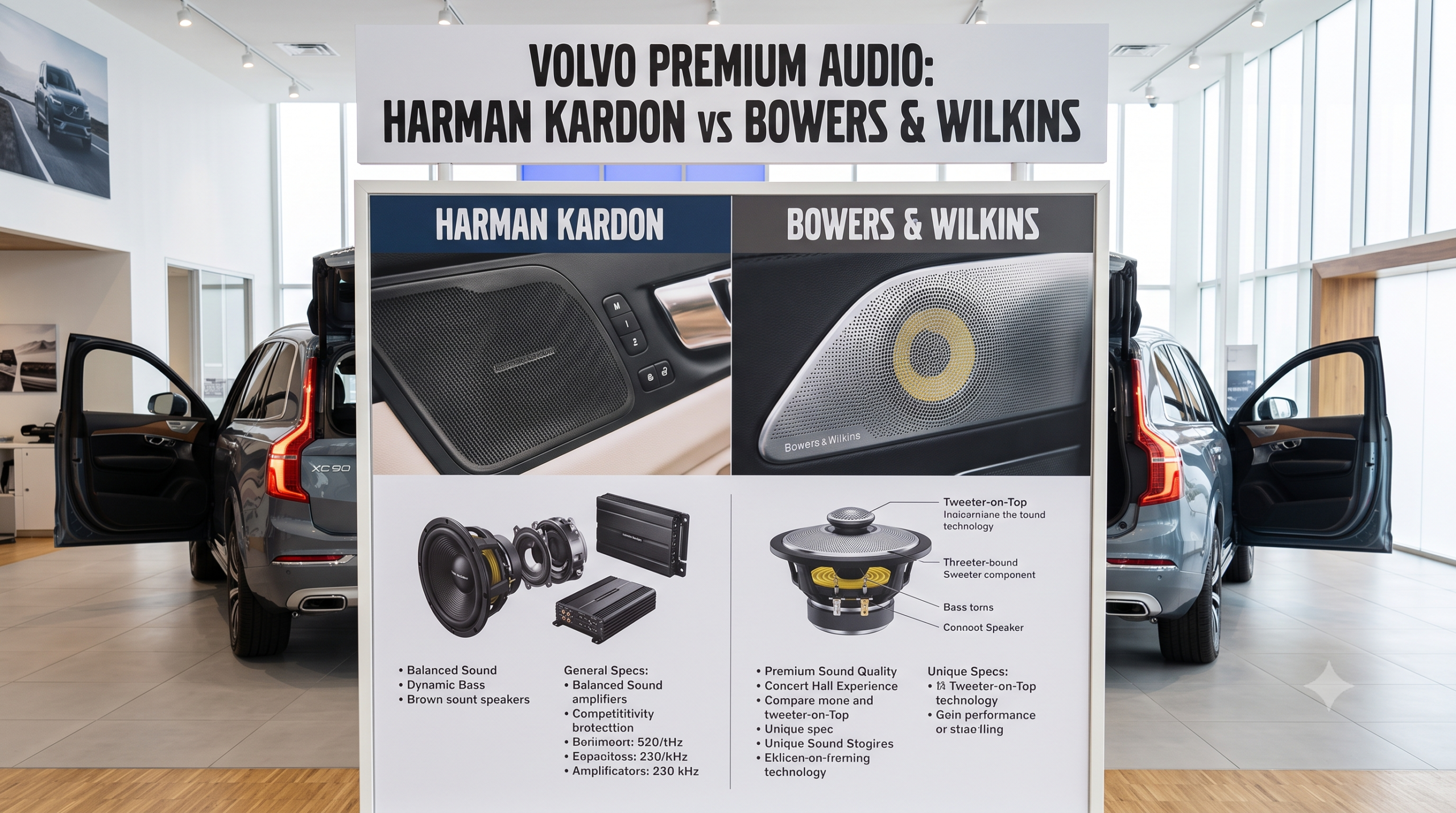
Volvo Harman Kardon vs Bowers & Wilkins?

You’re staring at a $3,000 option box on your Volvo build sheet, and the salesperson just told you it’s “worth it” — but worth it compared to what, exactly?
TL;DR
- Harman Kardon Premium Sound typically delivers 13-14 speakers, 12 channels, and 600 watts, and is often standard on Ultra trims or available on Plus trims.
- Bowers & Wilkins High Fidelity steps up to 15-19 speakers, 15 channels, and 1,410 watts in most models, with the EX90’s top system reaching 25 speakers and 1,610 watts.
- The price gap for B&W over Harman Kardon has historically run $3,000-$3,200 as an upgrade.
- Owner forums are split: some hear a dramatic difference, others find Harman Kardon “nicely comparable” once properly tuned.
- B&W uses studio-derived tech like diamond tweeters, Kevlar cones, and a “fresh air” subwoofer; Harman Kardon focuses on broader speaker coverage at a lower price point.
If you’ve read Volvo’s marketing copy for both systems, you’ve probably noticed it all sounds impressive — which doesn’t help you decide if the upgrade is worth real money. This guide compares the actual specs, technology, and owner experiences behind Volvo’s Harman Kardon and Bowers & Wilkins systems so you know what you’re really paying for.
The Three-Tier System: Where Each Option Sits
Volvo actually offers three audio tiers, not two, and understanding the baseline helps put the Harman Kardon vs. B&W debate in context. The standard High Performance system, included on base trims, typically features 10 speakers, 6 channels, and 220 watts of amplification — adequate for casual listening but limited in dynamic range for serious music fans.
Harman Kardon Premium Sound sits in the middle: 14 speakers, 12 channels, and 600 watts in most larger models, with the compact XC40 and electric EX40/EC40 offering a 13-speaker version tuned for their smaller cabins. It’s typically available on Plus trims and standard on Ultra trims across models like the XC90, XC60, and both Cross Country wagons.
Bowers & Wilkins High Fidelity tops the lineup at 15-19 speakers, 15 channels, and 1,410 watts in most vehicles, reserved for Ultra trims or offered as a paid upgrade — and standard on the XC60 Polestar Engineered variant. The EX90 pushes furthest with a 25-speaker, 1,610-watt B&W system as its top offering, well above its standard 14-speaker Bose setup.
| Harman Kardon Premium Sound | Bowers & Wilkins High Fidelity | |
|---|---|---|
| Speaker count | 13-14 (most models) | 15-19 (up to 25 on EX90) |
| Channels | 12 | 15 |
| Power output | 600 watts | 1,410 watts (1,610 on EX90) |
| Typical trim availability | Plus (optional) / Ultra (standard) | Ultra (standard or optional upgrade) |
| Notable tech | 7.1-channel surround, vehicle noise compensation | Diamond tweeters, Kevlar cones, “fresh air” subwoofer, Dirac Unison tuning |
| Historical price premium | Baseline premium tier | ~$3,000-$3,200 over Harman Kardon |
Quick Tip: The EX30 is a notable exception to the wattage pattern — its Harman Kardon sound bar system actually delivers 1,410 watts across 9 speakers, matching B&W’s power output in larger models despite being the “lower” tier badge. If you’re shopping the EX30 specifically, don’t assume Harman Kardon automatically means less power.
The Technology Gap: What B&W Actually Does Differently
Bowers & Wilkins isn’t just a louder version of Harman Kardon — it uses fundamentally different engineering. Each B&W speaker is individually tuned and positioned based on the specific acoustics of the vehicle’s interior, using materials like diamond tweeters and Kevlar cones borrowed from professional recording studio and high-end home audio technology. The system also includes a “fresh air” subwoofer design that uses the vehicle’s structure itself to enhance bass response without consuming cargo space.
Volvo’s collaboration with Dirac Research adds another layer: the Dirac Unison tuning technology performs an active acoustic treatment of the cabin using real-time acoustic measurements, correcting for the “phasy,” muddy sound and doors-trapped soundstage that plague typical car audio. B&W’s Room Transformation modes, including a distinctive Gothenburg Concert Hall setting, let drivers reshape how the cabin sounds entirely.
Harman Kardon’s approach is more conventional: broader speaker coverage, a 7.1-channel surround configuration, and vehicle noise compensation and automatic level adjustment that reacts to road and wind noise. It’s genuinely capable audio engineering, just without the boutique materials and acoustic-modeling depth that B&W brings.
What Owners Actually Hear
Real-world owner impressions are more split than the spec sheets suggest, and tuning matters enormously. One Volvo forum thread captured this directly: an XC90 owner who cross-tested both systems side by side described the sound difference as “not really big,” concluding Harman Kardon Premium was “nicely comparable” to B&W and deciding the extra cost wasn’t worth it for their ears.
Other owners disagree sharply. One XC60 owner initially found their Harman Kardon system lacking in bass and sub-bass, but discovered that switching the sound focus setting from “All passengers” to “Driver” dramatically improved performance — closing much of the gap with B&W. That same owner ultimately still upgraded to an aftermarket B&W installation, citing B&W’s more powerful amplifier and additional dashboard tweeter as noticeably better above 50% volume in direct comparison.
Real-world scenario: Picture two commuters, both driving the same XC60 trim level. One mostly listens to podcasts and talk radio at moderate volume — for them, Harman Kardon likely sounds indistinguishable from B&W in daily use. The other streams high-resolution music from Tidal and cranks the volume on long highway drives — that’s exactly the use case where B&W’s extra headroom and clarity at higher volumes becomes genuinely audible.
Expert Insight: Source material quality changes this comparison significantly. Streaming at maximum quality from services like Tidal or Apple Music reveals a system’s real capability, while compressed audio from standard Spotify streaming or terrestrial radio tends to hide the differences between a good system and a great one.
Pros and Cons by Buyer Type
Casual listeners and daily commuters:
- Harman Kardon: ✅ Strong value, capable sound for podcasts, radio, and moderate-quality streaming. ❌ Bass response can feel thin without manual tuning adjustments.
- Bowers & Wilkins: ✅ Won’t be a bottleneck no matter what you listen to. ❌ Hard to justify the cost premium if you’re not pushing the system hard.
Serious music listeners and audiophiles:
- Harman Kardon: ✅ Some owners report it holds up surprisingly well once properly tuned. ❌ Lacks B&W’s dedicated dashboard tweeter and boutique driver materials.
- Bowers & Wilkins: ✅ Purpose-built for high-resolution source material and nuanced soundstage. ❌ Significant added cost, historically $3,000+ over Harman Kardon.
Resale-value-focused buyers:
- Harman Kardon: ✅ Solid standard feature on Ultra trims across much of the lineup, no extra spend needed. ❌ Less of a standout selling point on a used listing.
- Bowers & Wilkins: ✅ A genuine differentiator that can help a used Volvo stand out and hold value slightly better. ❌ The dollar-for-dollar payback on resale is typically partial, not full.
FAQ
Is Bowers & Wilkins really worth the extra cost over Harman Kardon in a Volvo? It depends on how you listen. Owners who stream high-resolution audio and listen at higher volumes tend to notice a real difference, while casual or moderate-volume listeners often find Harman Kardon “nicely comparable” once properly tuned.
How many speakers does Volvo’s Harman Kardon system have? Most larger Volvo models get a 14-speaker Harman Kardon system, while compact models like the XC40 and electric EX40/EC40 use a 13-speaker version tuned for smaller cabins.
What makes Bowers & Wilkins sound different from Harman Kardon in a Volvo? B&W uses studio-derived materials like diamond tweeters and Kevlar cones, individually tuned speaker positioning, a structure-integrated “fresh air” subwoofer, and Dirac Unison acoustic correction technology — a more elaborate engineering approach than Harman Kardon’s broader-coverage design.
Can I improve my Harman Kardon system’s sound without upgrading to B&W? Yes — some owners report a significant improvement simply by switching the sound focus setting from “All passengers” to “Driver,” which can noticeably boost bass response.
Which Volvo models offer the most powerful Bowers & Wilkins system? The EX90 offers the most powerful current B&W system at 25 speakers and 1,610 watts, and Volvo has discussed a future 28-speaker B&W system with Dolby Atmos and headrest speakers for an upcoming model, though this hasn’t launched yet.
Key Takeaways
- Harman Kardon Premium Sound delivers 13-14 speakers and 600 watts, while Bowers & Wilkins High Fidelity reaches 15-19 speakers and 1,410 watts in most Volvo models.
- The B&W upgrade has historically cost $3,000-$3,200 more than Harman Kardon.
- B&W’s advantage is most audible at higher volumes and with high-quality source material — casual listeners may not notice much difference.
- Simple settings changes, like switching sound focus to “Driver,” can meaningfully improve a Harman Kardon system’s bass performance.
- The EX30’s Harman Kardon soundbar is an exception, matching B&W-level wattage (1,410W) despite being the lower-tier badge.
Trying to decide before you order? If your dealer has demo vehicles with both systems, request a side-by-side listen using a familiar high-resolution track at real-world volume — that fifteen-minute test will tell you more than any spec sheet comparison.