Volvo M46 vs M47?

The Gearbox Debate Every Classic Volvo Owner Eventually Has
If you own a Volvo 240, 740, or 940 and you’re staring at a worn-out gearbox, you’ve probably hit the same fork in the road as thousands of owners before you: rebuild what’s in there, or swap to the other one. The M46 and M47 look similar on paper, but ask any long-time Volvo brick owner and you’ll get strong, sometimes contradictory opinions about which one actually holds up.
I’ve dug through Volvo owner forums, factory workshop documentation, and years of accumulated brick-community wisdom to sort fact from folklore on this one. Here’s what the evidence actually shows.
TL;DR
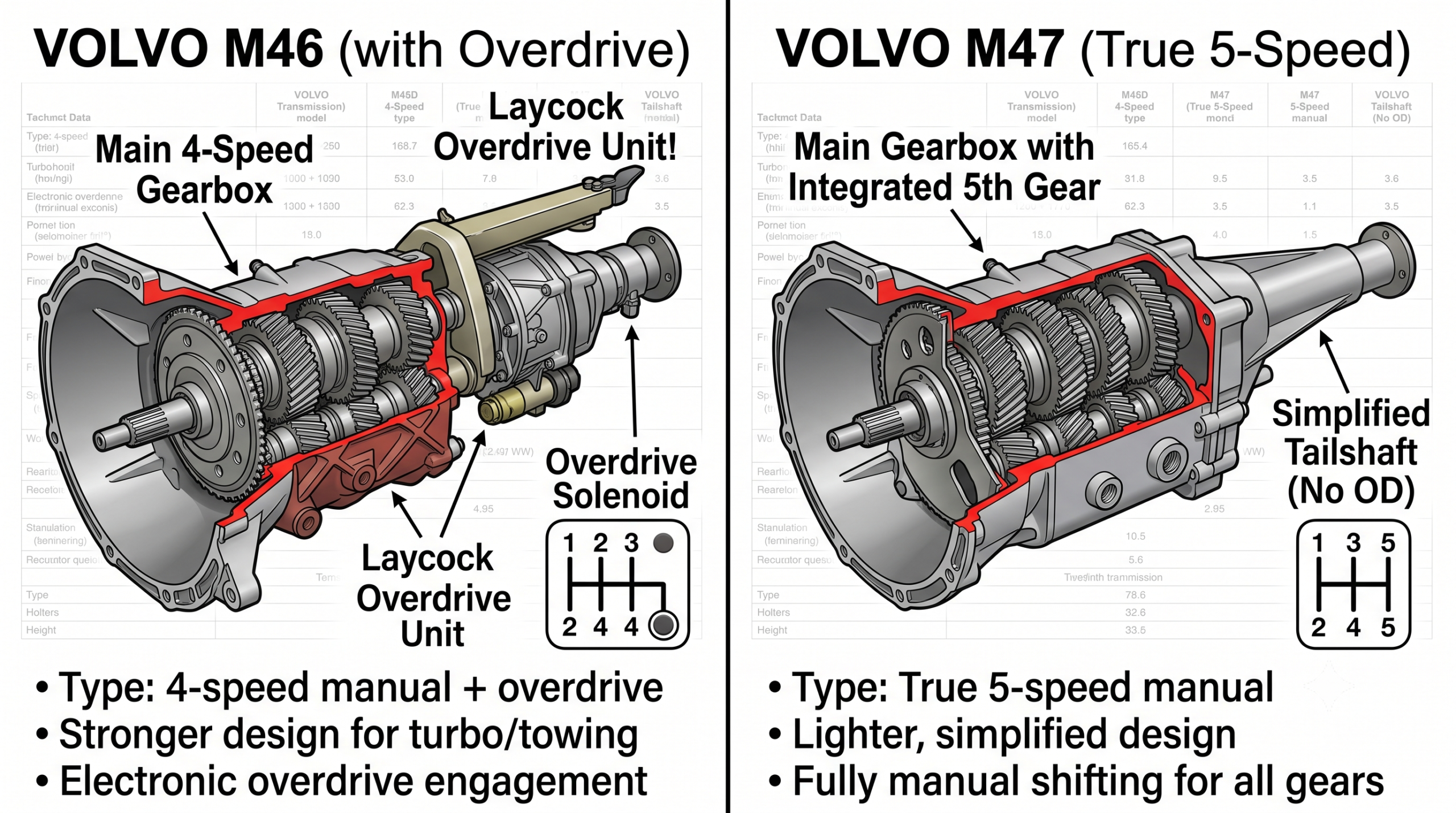
- M46 is a 4-speed manual with a separate electrically-operated overdrive unit bolted to the back — effectively giving you a usable 5th gear.
- M47 is a genuine 5-speed manual, with the 5th gear integrated directly into the main gearbox housing.
- Owner consensus (with real disagreement) leans toward the M46 being the more robust unit, which is why Volvo paired it with turbocharged engines.
- M47 was factory-reserved for naturally aspirated, lower-torque engines — it wasn’t built to handle turbo power.
- Swaps between the two are common and well-documented in the classic Volvo community, but require matching bellhousings, driveshafts, and crossmembers.
The short answer: the M46 is generally considered the stronger, more turbo-friendly gearbox, while the M47 offers a more integrated 5-speed design that some owners find shifts more smoothly — at the cost of being built for less torque. Neither is a bad gearbox; Volvo simply built them for different engines, and that factory pairing is the biggest clue to which one is right for your build.
What Is the Volvo M46?
The M46 is a 4-speed manual transmission with a bolt-on, electrically-operated overdrive unit — essentially giving drivers a functional 5th gear without redesigning the core gearbox.
Mechanically, it’s described in Volvo’s own workshop documentation as a <cite index=”87-1″>four-speed transmission with electrically-operated overdrive, using a transmission housing of either cast iron or aluminum</cite>. There were two overdrive variants used over the M46’s production run: <cite index=”87-1″>Type J, engaged by a solenoid that redirects oil flow through a planetary gear, and the stronger Type P, used specifically with high-torque engines</cite>.
That detail about Type P being reserved for high-torque applications is the whole story in miniature: Volvo built the M46 to handle real power. It’s the gearbox you’ll find behind turbocharged engines like the 740 Turbo and 940 Turbo, which is exactly why the enthusiast community treats it as the tougher of the two units.
Quick Tip: If you’re inheriting an early M46 with the original Type J overdrive, know that Volvo <cite index=”90-1″>switched to the more robust Type P unit in 1987, and the two overdrive types are not interchangeable</cite> — check which one you have before ordering parts.
What Is the Volvo M47?
The M47 is a true 5-speed manual, with the fifth gear built directly into the transmission rather than bolted on as a separate unit.
According to Volvo’s technical documentation, it’s a <cite index=”87-1″>five-speed transmission with the fifth gear assembly located in the rear extension, with an additional shaft and shift fork used to engage and disengage fifth gear</cite>. A later revision, designated M47 II, relocated the fifth gear synchronizer from the main shaft to the countershaft starting in 1986 — a running design change worth knowing if you’re sourcing parts for a specific model year.
Where the M47 earns its reputation for smoothness is in that integrated design. Multiple owners comparing the two directly note that the <cite index=”85-1″>M47 seemed to shift more smoothly than the 4+1 M46 setup</cite>, though opinions differ on whether that’s due to the design itself or simply the condition of the specific gearbox being compared.
Expert Insight: The M47’s smoother shift feel comes with a tradeoff — Volvo built it into cars without turbos for a reason. It’s a genuinely nice gearbox to drive, but it wasn’t engineered for turbocharged torque loads.
M46 vs M47: Side-by-Side Comparison
| Spec | Volvo M46 | Volvo M47 |
|---|---|---|
| Configuration | 4-speed + bolt-on overdrive | True 5-speed, integrated |
| Overdrive/5th gear location | Separate rear-mounted unit | Built into main housing |
| Factory pairing | Turbocharged engines (740T, 940T) | Naturally aspirated engines |
| Owner-reported strength | Generally considered more robust | Generally considered less torque-tolerant |
| Shift feel | Slightly less smooth per some owners | Often described as smoother |
| Fluid type | Type F automatic transmission fluid | Type F automatic transmission fluid |
| Interchangeability | Overdrive/5th gear units reportedly swappable between the two main cases | Same |
The pattern that emerges from owner experience is consistent: M46 for torque tolerance, M47 for shift feel — which is really just Volvo’s original engineering intent showing through decades later.
Pros and Cons by Builder Type
The Turbo Build / High-Torque Project
- ✅ M46: Factory-proven behind turbocharged engines, built to handle more torque.
- ✅ M46: Later Type P overdrive units specifically engineered for high-torque applications.
- ❌ M46: Owner reports on M46 longevity are mixed — some units fail even under modest power if not properly rebuilt.
- ❌ M47: Community consensus is clear that it wasn’t designed for turbo power; several owners report M47 failures behind boosted engines.
The Driver Who Wants Smooth, Reliable Daily Shifting
- ✅ M47: Integrated 5-speed design often described as shifting more smoothly.
- ✅ M47: No separate overdrive electronics or wiring to troubleshoot.
- ❌ M46: The electric overdrive engagement can develop wiring issues over time, though they’re usually straightforward to fix.
- ❌ M46: Best practice with the M46 is to use the clutch when engaging or disengaging overdrive, an extra step some drivers find less intuitive.
The Long-Term Reliability Seeker
- ✅ M46: One long-time owner reported that most transmissions would be scrap after 150,000–200,000 miles without a proper rebuild — true of both, but the M46’s reputation for handling abuse tends to edge it ahead.
- ❌ M47: Owner reports of sourcing several used M47 units before finding one that didn’t grind, pop out of gear, or fail outright suggest inconsistent used-market quality.
- ✅ Both: A properly rebuilt unit of either type, using correct parts and fluid, can significantly outlast a neglected one.
Real-World Scenario: The Turbo Swap Dilemma
A 740 Turbo owner whose original M46 developed a worn overdrive piston seal — a known M46 issue that shows up as the overdrive slipping out in hot weather — faced the classic decision. Sourcing a fresh M47 was cheaper and more readily available locally, and forum research confirmed the bellhousings were compatible using the correct crossmember and driveshaft. But knowing the M47 wasn’t factory-rated for turbo torque, the owner chose to rebuild the M46 instead, replacing the actuating piston seals rather than risk a transmission not built for the engine’s power.
Choose M46 If…
You’re running a turbocharged engine or simply want the gearbox with the strongest factory reputation for handling higher torque. Choose this if long-term durability under load matters more than shift smoothness or mechanical simplicity.
Choose M47 If…
Your engine is naturally aspirated and you value a smoother-shifting, more integrated 5-speed design without separate overdrive electronics. Choose this if daily-driving feel and mechanical simplicity matter more than maximum torque capacity.
FAQ
Can I swap an M47 into a car that originally had an M46? Owners report this is a well-documented swap in the classic Volvo community, generally requiring the correct transmission crossmember and driveshaft. However, if the engine is turbocharged, most experienced owners recommend against it due to the M47’s lower torque tolerance.
Which gearbox is stronger, the M46 or M47? Owner consensus generally favors the M46 as the stronger unit, which lines up with Volvo’s factory decision to pair it exclusively with turbocharged, higher-torque engines, while the M47 was reserved for naturally aspirated applications.
What transmission fluid do the M46 and M47 use? Both transmissions call for Type F automatic transmission fluid rather than standard gear oil or Dexron/Mercon ATF, according to long-standing owner and technical documentation for these gearboxes.
Is the M46’s overdrive the same as the M47’s fifth gear? Functionally similar but mechanically different — the M46’s overdrive is a separate, electrically-operated unit bolted to the rear of a 4-speed case, while the M47’s fifth gear is built directly into the transmission housing as a true 5-speed design.
What’s the difference between M47 and M47 II? The M47 II, introduced in 1986, relocated the fifth gear synchronizer and gear wheel from the main shaft to the countershaft, changing the shift fork design slightly. It’s important to know which version you have when sourcing rebuild parts.
Key Takeaways
- M46 is a 4-speed manual with a bolt-on electric overdrive, factory-paired with turbocharged engines for its higher torque tolerance.
- M47 is a true integrated 5-speed, factory-paired with naturally aspirated engines, and often praised for smoother shifting.
- Both require Type F automatic transmission fluid, not standard gear oil.
- Swaps between the two are common in the classic Volvo community but require matching the right supporting parts.
- For turbo builds specifically, owner consensus strongly favors sticking with (or upgrading to) the M46 over the M47.
Ready to Decide?
Before committing to a rebuild or swap, confirm which overdrive type your M46 uses (Type J or Type P) and which generation of M47 you’re sourcing — getting these details wrong is the single most common mistake owners report when ordering rebuild parts.