Volvo XC60 vs BMW X3?

Two of the best-selling luxury compact SUVs on the market split almost evenly on price — but the moment you look past the sticker, the BMW X3 and Volvo XC60 turn out to be built for genuinely different priorities.
TL;DR
- Starting prices are close: the XC60 runs roughly $50,995–$51,095, the X3 roughly $50,900–$52,650 depending on the source and trim comparison
- X3’s base engine makes 255 hp; XC60’s base engine makes 247 hp — a near-even standard power match
- XC60 offers a PHEV variant with 455 hp; the X3 has no PHEV counterpart
- XC60 offers noticeably more rear legroom (38 in vs 36.3 in); the X3 offers more cargo space in some comparisons
- X3 leans sportier and more customizable; XC60 leans more standard-feature-rich and passenger-focused
I compared pricing and specs across TrueCar, Edmunds, CarsDirect, and NewCars.com, along with manufacturer-published figures, since Volvo- and BMW-branded dealer comparison pages each tend to favor their own brand in framing.
So which is the better buy — Volvo XC60 or BMW X3? It’s genuinely close on paper, and the right answer depends heavily on what you’re optimizing for. Both rely on a 2.0-liter four-cylinder engine and 48-volt mild-hybrid system, have comparable horsepower and torque outputs, and both SUVs offer standard all-wheel drive, so the deciding factors come down to cabin philosophy, passenger space, and whether a plug-in hybrid option matters to you.
Quick Tip: Because starting prices land within a few hundred dollars of each other depending on the exact trim and source you check, don’t let base MSRP alone be your deciding factor — look at what’s standard versus what costs extra on each.
Pricing: A Genuinely Close Race
Unlike some luxury SUV comparisons where one brand clearly undercuts the other, XC60 vs X3 pricing is close enough to come down to the specific trims being compared. One comparison shows the new Volvo XC60 coming in at $50,995 against the BMW X3 at $50,900 — essentially a dead heat — while another source lists the BMW X3 as more expensive with a starting MSRP of $52,650 versus $51,095 for the Volvo XC60.
The more consistent theme across sources isn’t the sticker price itself, but how each brand structures its options. For the Volvo XC60, there are three trims — Core, Plus, and Ultra — that gradually improve your comforts and increase costs by about $5,000 per upgrade package, while BMW’s trim structure is described by the same source as more complicated, with many desirable components available only as add-ons or in bundled packages.
Pull-quote: The X3 and XC60 start at nearly the same price — the real cost difference shows up once you start checking option boxes.
Performance: Nearly Matched at Base, Different at the Top
Standard output is genuinely comparable between these two. The BMW X3’s standard engine produces 255 horsepower and 295 lb-ft of torque with an EPA-estimated 29 mpg combined, while the Volvo XC60’s base engine produces 247 horsepower — close enough that most drivers won’t notice the difference in daily use.
Where the two diverge sharply is at the top of each lineup. BMW offers a 393-horsepower engine option on higher X3 trims for buyers who want more outright punch. Volvo’s answer comes from a completely different direction: the XC60’s plug-in hybrid variant produces 455 horsepower and 523 lb-ft of torque, a figure that outpaces anything on the BMW X3 menu, gas or otherwise — and does it while adding roughly 35 miles of electric-only range rather than sacrificing efficiency for power.
Expert Insight: If you want maximum horsepower without sacrificing fuel economy, the XC60’s T8 plug-in hybrid is worth serious consideration — it’s the rare case where the more powerful option in this comparison is also the more efficient one around town.
Space and Passenger Comfort
This is one of the clearer differentiators in Volvo’s favor. With its 38 inches of backseat legroom, the Volvo XC60 can comfortably transport adults, tall teens, or car seats, while the BMW X3’s 36.3 inches of second-row leg space makes the same task a noticeably tighter fit.
Cargo space tells a more mixed story depending on which comparison you check. One source credits the BMW X3 with an edge on cargo space, citing 31.5 cubic feet in the trunk, while Volvo’s own comparison cites 63.3 cubic feet of maximum cargo capacity for the XC60 with seats folded — figures that likely reflect different measurement conditions (seats-up trunk space versus maximum folded cargo volume) rather than a direct apples-to-apples comparison, so treat any single cargo figure with some caution until you’ve confirmed the measurement basis.
Space Comparison
| Spec | Volvo XC60 | BMW X3 |
|---|---|---|
| Overall length | 185.4 in | 187.2 in |
| Rear legroom | 38.0 in | 36.3 in |
| Max cargo space | 63.3 cu ft | 31.5 cu ft (seats-up figure per one source) |
Choose the XC60 if rear-seat passenger comfort and outright cargo volume are priorities for your household. Choose the X3 instead if overall vehicle footprint and a slightly tighter turning radius in crowded parking matter more to you.
Interior Philosophy: Sport Cockpit vs Scandinavian Calm
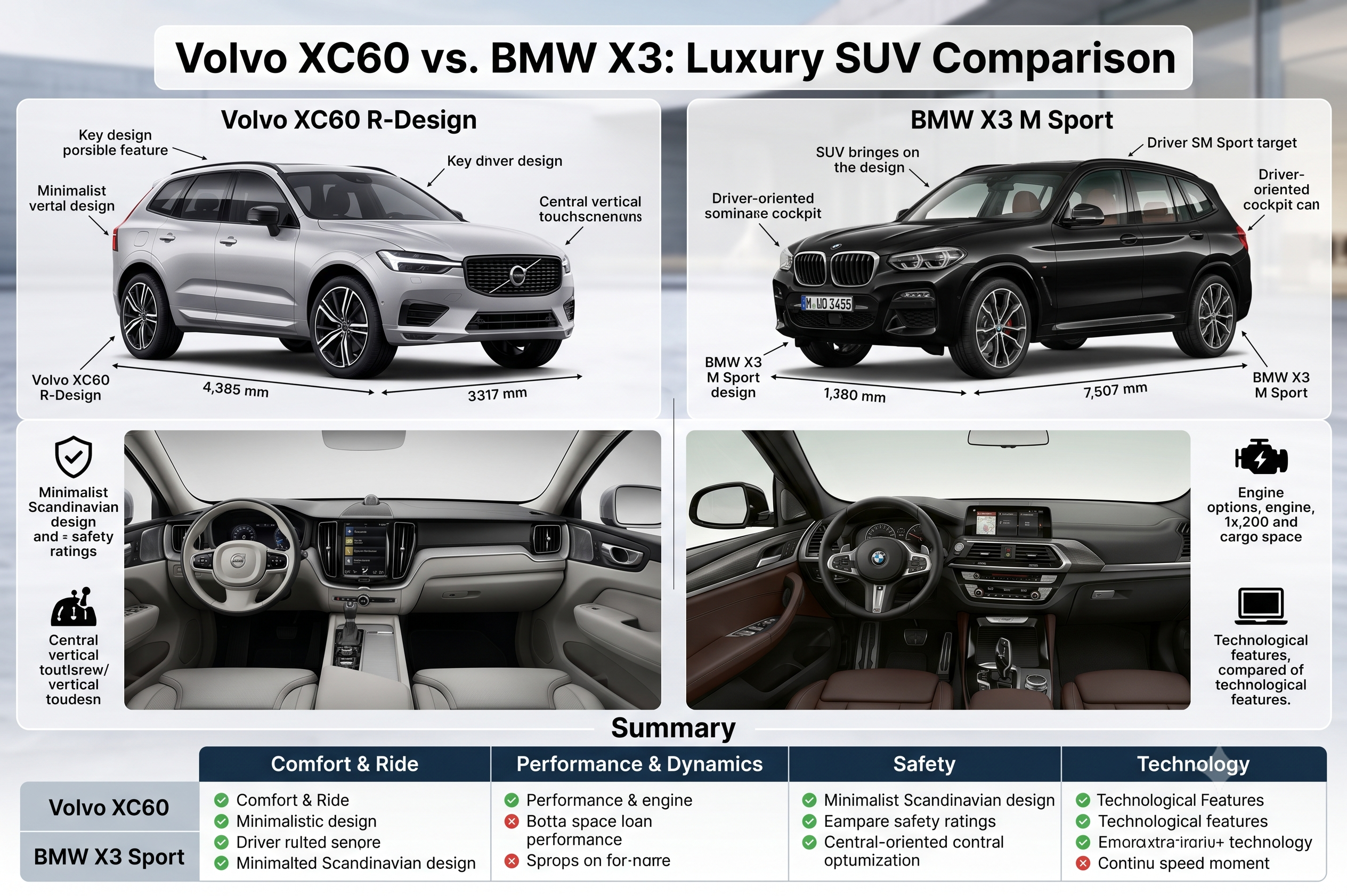
The two cabins genuinely feel designed around different priorities, and reviewers across multiple sources land on the same framing. The BMW X3 leans on the sportier side, with a driver-focused cockpit, a flat-bottom wheel, and a large curved display setup, while the Volvo XC60 understands that it’s a luxury SUV first, prioritizing calm materials like an Orrefors crystal gear selector and natural driftwood decor over a performance-focused layout.
That philosophy extends to standard equipment. The Volvo XC60 leads with more standard safety and comfort tech — including four-zone climate control on higher trims and Google built-in services — while several BMW cabin upgrades, such as ventilated front seats, come as pricier add-ons rather than standard equipment.
Quick Tip: If Google Maps, Assistant, and Play Store integration built directly into the infotainment system matters to your daily use, that’s a genuine and often-overlooked advantage on the Volvo’s side — BMW’s system doesn’t offer the same native Google integration.
Safety and Driver-Assist Tech
The Volvo XC60 comes with more standard safety tech and a five-star NHTSA rating, and the BMW X3 requires extra packages for some advanced driver-assistance systems that come standard on the Volvo — a meaningful consideration if you don’t plan to option up to BMW’s higher trims.
Pros and Cons by Buyer Type
The Family Hauler
- ✅ XC60: More rear legroom, more standard cargo capacity, four-zone climate available
- ✅ XC60: More advanced driver-assist features standard rather than optional
- ❌ X3: Tighter rear seat space, though a smaller overall footprint for parking
The Performance-Focused Driver
- ✅ X3: Sportier standard driving dynamics and a 393-hp engine option
- ✅ X3: More aggressive, driver-focused cabin styling
- ❌ X3: Many desirable features cost extra rather than coming standard
The Efficiency-Minded Power Seeker
- ✅ XC60 PHEV: 455 hp and 523 lb-ft with roughly 35 miles of EV-only range
- ❌ X3: No PHEV variant currently offered, so more power means more fuel burned
FAQ
Which is cheaper, the Volvo XC60 or BMW X3? It’s close enough to vary by source and trim — some comparisons show the XC60 slightly cheaper (~$51,000 vs ~$52,650), while others show the two SUVs within a few hundred dollars of each other at the base trim.
Does the BMW X3 have a plug-in hybrid option? No. As of the 2026 model year, the BMW X3 doesn’t offer a PHEV variant, while the Volvo XC60 offers a T8 plug-in hybrid with 455 horsepower and roughly 35 miles of EV-only range.
Which has more rear legroom, XC60 or X3? The Volvo XC60 offers more rear legroom at 38 inches, compared to 36.3 inches in the BMW X3.
Is the BMW X3 faster than the Volvo XC60? At base trim, horsepower is close (255 hp for the X3 vs 247 hp for the XC60). BMW’s top X3 trim reaches 393 hp, though Volvo’s PHEV variant reaches 455 hp if you’re comparing peak available power across each lineup.
Which SUV has more standard safety features? The Volvo XC60 comes with more standard safety tech out of the box, while some advanced driver-assistance features on the BMW X3 require additional option packages.
Key Takeaways
- Pricing is close enough between the XC60 and X3 that it varies by trim and source rather than showing a clear winner
- Base-trim horsepower is nearly matched (247 hp XC60 vs 255 hp X3), but the XC60’s PHEV variant tops both lineups at 455 hp
- The XC60 offers meaningfully more rear legroom; cargo space comparisons vary by measurement method
- The X3 leans sportier with a driver-focused cabin; the XC60 leans toward calm, feature-rich luxury
- The XC60 includes more advanced safety tech as standard equipment versus optional on the X3
Which Should You Buy?
If you want more standard safety tech, more rear-seat space, and the option of a genuinely powerful PHEV, the XC60 is the stronger all-around pick. If you prioritize a sportier driving feel and don’t mind paying extra for specific comfort features, the X3 is worth cross-shopping closely.