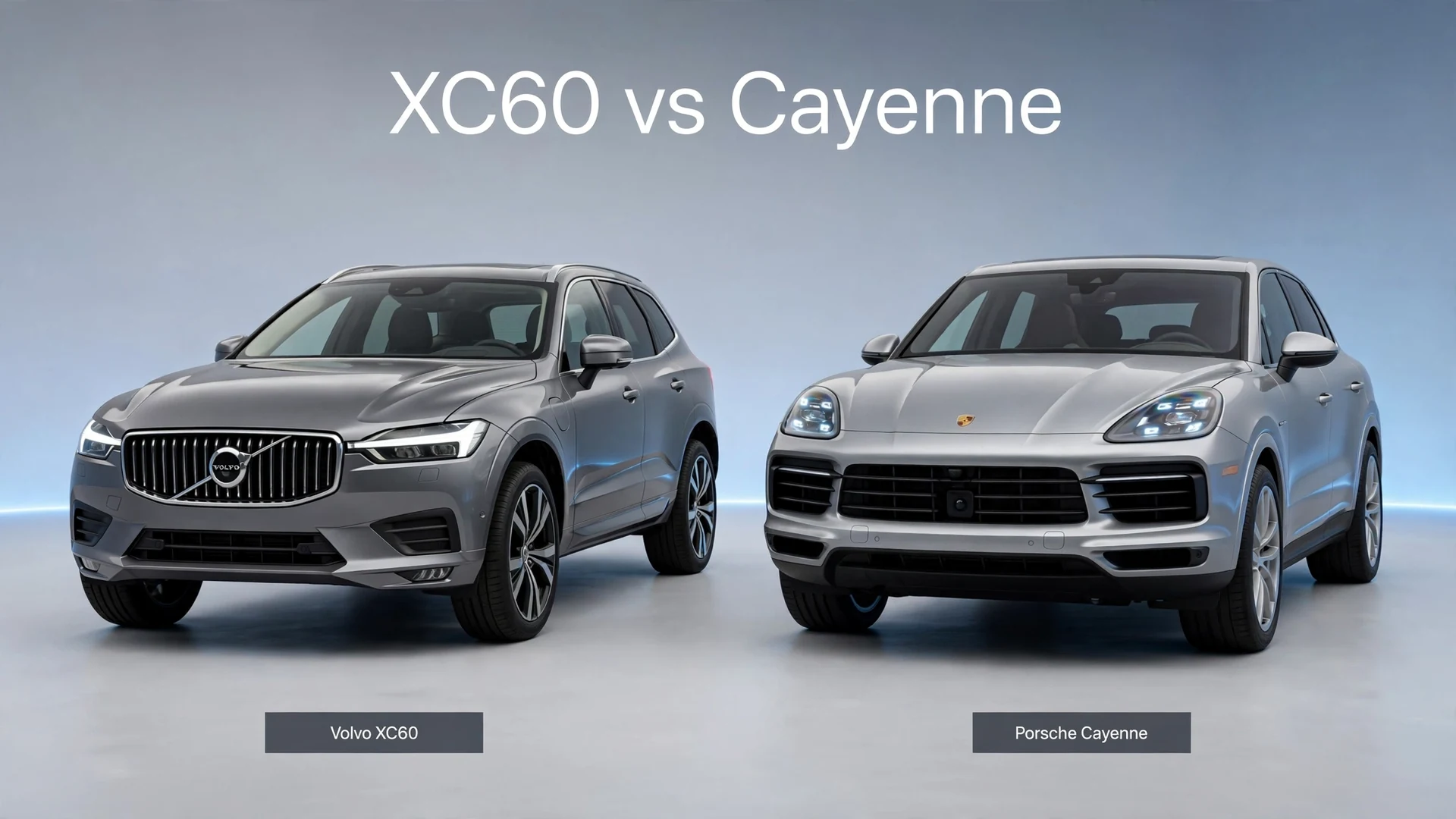
Volvo XC60 vs Porsche Cayenne?

Volvo XC60 vs Porsche Cayenne?
The sensible Swede against the sports-car SUV: a 2025 Volvo XC60 runs $47,050–$75,200; a 2025 Porsche Cayenne starts at $84,700 and climbs past $157,000. The Cayenne is the better driver’s car by a wide margin — 348 hp base, 468-hp V8 S, 7,716-lb towing, and chassis tuning no Volvo can match. The XC60 counters with lower purchase and running costs, a plug-in hybrid the base Cayenne can’t touch on economy, and calmer ownership. Verdict: buy the Cayenne if driving dynamics are your priority and the budget is real; buy the XC60 T8 if you want 455 hp and 35 miles of electric range for less than a base Cayenne.
- Price: XC60 $47,050–$75,200 vs Cayenne $84,700–$157,000 (plus $1,995 destination). A base Cayenne costs more than a loaded XC60 T8.
- Performance: Cayenne base 348 hp / 5.7 s; Cayenne S V8 468 hp / 4.7 s. XC60 B5 247 hp / ~6.9 s; T8 455 hp / ~5.0 s.
- Economy: Cayenne base 19 mpg combined vs XC60 B5 26 mpg; the T8’s 35-mile EV range has no base-Cayenne answer.
- Towing: Cayenne 7,716 lb vs XC60 3,500 lb — the Porsche is the serious tow vehicle.
- Ownership: Porsche options inflate prices fast; Volvo servicing and insurance cost less. Both depreciate, but the Cayenne holds value better.
Price: Nearly Double the Money
Start with the uncomfortable arithmetic. The 2025 Cayenne base starts at $84,700 before Porsche’s $1,995 delivery fee; the Cayenne S is $101,600; the GTS $124,900; the Turbo E-Hybrid $157,000. The entire XC60 range — B5 Core at $47,050 to T8 Polestar Engineered at $75,200 — fits underneath the Cayenne’s entry price. You can buy the quickest, most luxurious XC60 Volvo makes and still have $9,500 left over versus a base Cayenne with no options.
And “no options” is doing heavy lifting, because Porsche’s options list is where the real money disappears (more on that below). A typically equipped Cayenne S with Premium Package Plus, air suspension, and a few choice extras easily crests $120,000 — XC60 T8 money times 1.6. The price gap isn’t a trim-level difference; it’s a class difference.
Performance: Where the Porsche Earns It
This is the Cayenne’s home ground, and it shows. The base Cayenne’s 3.0-liter turbo V6 makes 348 hp and 368 lb-ft, good for 0–60 in 5.7 seconds — quicker than the XC60 B5 (247 hp, ~6.9 s) and within a second of the XC60 T8. Step to the Cayenne S and its 4.0-liter twin-turbo V8 delivers 468 hp and 442 lb-ft for a 4.7-second sprint, with the chassis — rear-biased all-wheel drive, optional rear-axle steering, Porsche Dynamic Chassis Control — to use it. Reviewers consistently call the Cayenne the best-driving SUV in the class, full stop.
The XC60’s answer is the T8: 455 hp, 523 lb-ft, and 0–60 in about 5.0 seconds — genuinely quick, and quicker than the base Cayenne. But straight-line speed is the only performance metric where the Volvo competes. The Cayenne steers, brakes, and corners like a tall sports car; the XC60 is a comfortable cruiser that happens to be fast in a straight line. If you care about the difference, you already know which you want.
| Specification | XC60 B5 / T8 | Cayenne / Cayenne S |
|---|---|---|
| Engine | 2.0L turbo MHEV / turbo PHEV | 3.0L turbo V6 / 4.0L twin-turbo V8 |
| Power | 247 hp / 455 hp | 348 hp / 468 hp |
| Torque | 266 lb-ft / 523 lb-ft | 368 lb-ft / 442 lb-ft |
| 0–60 mph | ~6.9 s / ~5.0 s | 5.7 s / 4.7 s |
| EPA combined | 26 mpg / 28 mpg + EV range | 19 mpg / ~17 mpg (est.) |
| Max towing | 3,500 lb | 7,716 lb |
| Cargo (seats up) | 17.1 cu ft | 27.3 cu ft |
| Curb weight | ~4,400 lb (B5) | 4,678 lb |
The Options Game: Porsche’s Hidden Tax
A base Cayenne at $84,700 sounds almost reasonable until you open the configurator. Adaptive cruise control — standard on every XC60 — costs extra on the Cayenne. So do ventilated seats, a heated steering wheel on some trims, and the Premium Package Plus ($6,600+) that bundles the desirable LED matrix headlights. Air suspension, rear-axle steering ($1,330), and Porsche Dynamic Chassis Control ($3,710) are all extra. It’s entirely normal for a Cayenne’s options to total $20,000–$30,000.
The XC60’s options list is short and cheap by comparison. The B5 Ultra at $58,295 includes Pilot Assist, a 360-degree camera, and heated everything; the T8 Plus at $62,600 adds the plug-in powertrain. Volvo’s pricing is honest in a way Porsche’s isn’t: what you see is close to what you pay. Budget a Cayenne at $15,000–$25,000 over its base price for a realistic transaction; budget an XC60 at roughly its sticker.
Everyday Life: Space, Comfort, Infotainment
Despite costing far less, the XC60 isn’t embarrassed inside. Its cabin is quieter at cruise, its seats are famously comfortable, and its Google-based infotainment (11.2-inch screen from the 2026 facelift) is more intuitive than Porsche’s system — though the Cayenne’s 12.6-inch curved cluster and 12.3-inch central display look the part, and build quality is exquisite on both.
Space favors the Porsche: 27.3 cu ft behind the second row versus the XC60’s 17.1, and 60.3 cu ft maximum versus ~63 — closer folded, but the Cayenne’s everyday boot is far more useful. The Cayenne is also the bigger vehicle (194.1 inches long versus 185.4) with a more commanding driving position. For ride comfort on standard suspension, the XC60 has the edge; option the Cayenne’s air suspension and it rides beautifully too — for another few thousand dollars.
Reliability and Running Costs
Neither brand tops reliability surveys, but their failure modes differ. The Cayenne’s 3.0L V6 and 8-speed are proven units; Porsche’s issues tend toward expensive electronics and air-suspension components rather than powertrain meltdowns. The XC60 B5 is similarly solid mechanically; the T8 carries the ERAD and battery-recall caveats documented elsewhere (March 2025 global recall of ~73,000 plug-in hybrids).
Running costs favor the Volvo decisively. The Cayenne base manages 17/23/19 mpg city/highway/combined on required premium fuel; the XC60 B5 does 23/30/26. At 15,000 miles a year, that’s roughly $1,100 more in fuel for the Porsche — before pricier servicing, pricier tires (21–22-inch wheels), and higher insurance. The T8’s 35-mile electric range can erase fuel costs for short commutes entirely, something no Cayenne under $97,200 (E-Hybrid) can claim.
Resale is the Cayenne’s financial consolation: Porsches hold value better than almost anything, with KBB fair-purchase data showing strong retained values. The XC60 depreciates like a normal luxury SUV — 50–55% retained after three years. Over a typical ownership cycle, the Cayenne’s slower depreciation offsets some of its higher running costs, but not the purchase-price chasm.
Used-Buying Verdict
Used XC60 guidance: the B5 (2022+) is the safe pick; T8s need battery-recall and ERAD verification. Used Cayenne guidance: service history is everything — a neglected Cayenne is a financial trap, while a maintained one is a 200,000-mile car. Avoid heavily optioned cars with aftermarket modifications.
Verdict: Pay for the Drive, or Pay Less for Everything Else
The Porsche Cayenne is the better machine. It drives better, tows more (7,716 lb), holds more (27.3 cu ft), and holds its value better. If driving dynamics top your priority list and the budget stretches, nothing here touches it — buy the S if you can.
But the Volvo XC60 is the better purchase for almost everyone else. The T8 gives you 455 hp and genuine electric running for less than a base Cayenne; the B5 gives you luxury transport for $47,050 with 26 mpg combined. The Cayenne’s excellence is real, but it’s priced like it — and the XC60’s competence costs half as much.
A final word on Porsche’s options list, because it changes the math: a base Cayenne with the options most buyers actually want — panoramic roof, Bose, adaptive cruise, air suspension — quickly costs S money, and at that point the Volvo T8 at similar money with 455 hp and electric range starts to look like the rational escape hatch. This is also why used Cayennes are the smart way in: the first owner absorbs both the options cost and the steepest depreciation, leaving you the driving dynamics for XC60 money. Just budget for Porsche servicing and check the options sticker — a stripped base car and a loaded one are very different ownership propositions.
Sources
- edmunds.com — 2025 Cayenne base specs: $84,700 MSRP, 3.0L V6 348 hp/368 lb-ft, 17/23/19 mpg, 7,716-lb towing, 27.3 cu ft cargo, 4,678-lb curb weight.
- carbuzz.com — 2025 Cayenne pricing: base $84,700, E-Hybrid $97,200, S $101,600, GTS $124,900, Turbo E-Hybrid $157,000; $1,995 destination.
- autoblog.com — 2025 Cayenne overview: trim pricing, standard equipment additions.
- kbb.com — 2025 Cayenne pricing with destination ($86,695 base); fair purchase pricing and resale notes.
- motortrend.com — 2025 Cayenne cargo figures; GTS pricing.
- carbuzz.com / truecar.com — 2025 XC60: B5 $47,050, 247 hp/266 lb-ft, 3,500-lb towing; T8 $62,600–$75,200, 455 hp/523 lb-ft, 35-mi EV range.
- carscoops.com — March 2025 Volvo PHEV battery recall (~73,000 vehicles).
Frequently Asked Questions
Is the Porsche Cayenne worth twice the price of a Volvo XC60?
Only for driving enthusiasts. The Cayenne drives better, tows 7,716 lb vs 3,500 lb, and holds value better — but a base Cayenne ($84,700) costs more than a loaded XC60 T8 ($75,200), and Porsche options inflate prices fast. For most buyers, the XC60 is the better purchase.
Which is faster, XC60 T8 or base Cayenne?
The XC60 T8: 455 hp and ~5.0 s 0–60 versus the base Cayenne’s 348 hp and 5.7 s. The Cayenne S (468 hp, 4.7 s) retakes the crown — for $101,600 plus options.
Can the Volvo XC60 tow as much as the Porsche Cayenne?
No. The Cayenne tows up to 7,716 lb; the XC60 is rated at 3,500 lb. For serious towing, the Porsche is in a different league.
What does a realistic Porsche Cayenne cost with options?
Budget $15,000–$25,000 over base price. Adaptive cruise, air suspension, premium lighting packages, and chassis options are all extra — items that are standard or cheap on the XC60.
Which is cheaper to run, XC60 or Cayenne?
The XC60: 26 mpg combined (B5) vs 19 mpg (Cayenne base), cheaper servicing, cheaper tires, lower insurance. The T8’s 35-mile electric range can cut fuel costs further for short commutes.
Should I buy a used Porsche Cayenne or a new Volvo XC60?
A 2021–2023 Cayenne offers 90% of the new car’s dynamics after its depreciation hit — but demand full service history and a Porsche-specialist inspection. A new XC60 T8 gives you warranty, 455 hp, and electric range for similar money with lower risk.