Volvo XC60 vs Ford Explorer ?

You’ve got two very different SUV philosophies staring you down: Swedish minimalism with a two-row cabin, or an American three-row hauler built for soccer practice and road trips alike. Picking wrong means either cramming a third kid into a trunk that doesn’t exist, or overpaying for space you’ll never use.
TL;DR
- Ford Explorer starts around $38,330–$40,465 and seats up to 7, making it the better value for families needing three rows.
- Volvo XC60 starts around $49,700–$54,300 and seats 5, but wins on interior materials, seat comfort, and safety tech.
- Explorer’s optional 3.0L V6 (400 hp) outguns every XC60 gas trim except the Polestar Engineered plug-in hybrid (455 hp).
- XC60 has better fuel economy on the base engine (26 mpg combined) vs. Explorer’s V6 option.
- Choose Explorer if you need three rows and towing flexibility; choose XC60 if you want a plush two-row daily driver with a luxury badge.
Volvo XC60 vs Ford Explorer: Quick Answer
If you need to seat seven people or tow regularly on a moderate budget, the Ford Explorer is the more practical pick. If you want a quieter cabin, nicer materials, and don’t need a third row, the Volvo XC60 justifies its higher price tag with comfort and safety credentials.
Pricing: What You’ll Actually Pay
Volvo’s 2026 XC60 lineup starts at a base MSRP of $49,700 for the B5 Core trim, climbing to $54,300 for the Plus and higher for Ultra and Polestar Engineered variants. Ford’s 2026 Explorer starts much lower, with the Active trim beginning around $38,465 and topping out near $56,905 for the performance-oriented ST trim.
Quick Tip: Don’t just compare sticker prices. Real-world transaction data shows Volvo shoppers are paying about 6.6% below MSRP on average based on recent transactions, so a bit of negotiating room exists on both sides.
Choose the Explorer if: you want the lowest possible entry price and don’t mind a less plush cabin. Choose the XC60 if: you’re willing to pay a premium for materials and refinement and don’t need three rows.
Performance & Powertrain
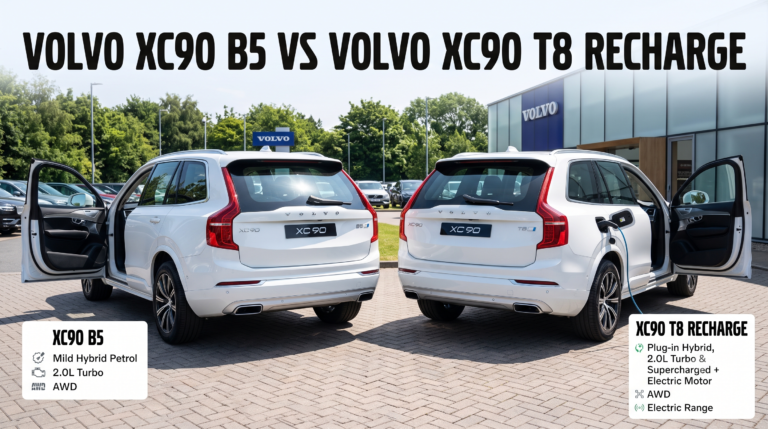
Every XC60 trim runs the same 2.0-liter turbocharged four-cylinder mild-hybrid engine, though the T8 plug-in hybrid variant is treated as a separate model with far more power. The base B5 Core makes 247 horsepower with a 0-60 time of about 6.5 seconds, while the range-topping T8 Polestar Engineered reaches 455 horsepower.
Ford’s Explorer offers a simpler but punchier choice: a standard turbocharged 2.3-liter four-cylinder producing 300 horsepower and 311 lb-ft of torque, or an optional turbocharged 3.0-liter V6 making 400 horsepower and 415 lb-ft. That V6 is quick — Edmunds clocked the Explorer ST at 0-60 mph in 5.6 seconds during testing.
Pull quote: “For raw horsepower per dollar, the Explorer’s optional V6 is hard to beat in this comparison.”
Comfort, Cargo & Family Practicality
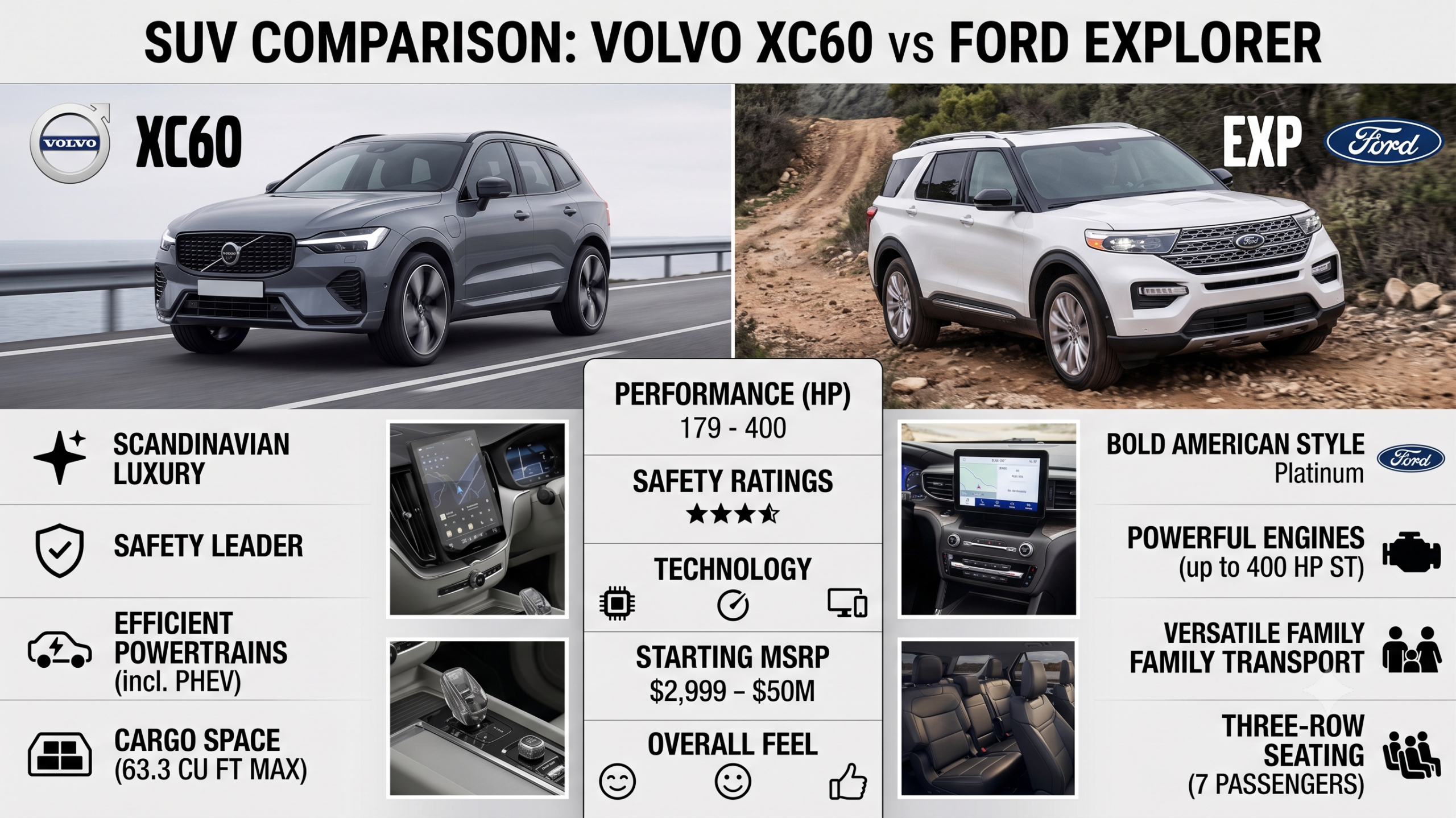
Here’s where the two SUVs really diverge. A 2025 industry buyer-comfort report often cites XC60 seating as class-leading, and testers consistently note the rear cabin is roomy, though cargo space isn’t especially generous at 22.4 cubic feet behind the second row, expanding to 63.3 cubic feet with seats folded.
Ford’s Explorer, by contrast, is built around volume: it offers seating for up to seven passengers and up to 85.8 cubic feet of cargo space. That’s simply a different mission — this is a vehicle designed to swallow strollers, hockey bags, and a weekend’s worth of luggage without complaint.
| Feature | Volvo XC60 | Ford Explorer |
|---|---|---|
| Starting MSRP | $49,700 | $38,330 |
| Seating | 5 | Up to 7 |
| Base engine | 2.0L turbo I4, 247 hp | 2.3L turbo I4, 300 hp |
| Max horsepower (non-hybrid top trim) | 455 hp (T8 Polestar) | 400 hp (3.0L V6, ST) |
| Cargo space (max) | 63.3 cu ft | 85.8 cu ft |
| Fuel economy (base engine) | 26 mpg combined | Up to 29 mpg highway |
| Towing capacity | Not a primary use case | 5,000 lbs standard |
| Infotainment screen | 11.2-inch | 13.2-inch |
Expert Insight: A family that road-trips with two kids and a dog will feel the Explorer’s extra cargo room every single weekend. A couple without kids will barely notice the XC60’s smaller trunk.
Real-world scenario: Imagine a family of five heading to a lake house for the weekend with two coolers, camping gear, and a stroller. The XC60’s 63.3 cubic feet works fine — but only with the rear seats folded down, meaning no room for passengers back there. The Explorer handles the same load with all three rows still usable, or converts to hauling everything solo when the rows fold flat.
Safety & Driver-Assist Tech
Both automakers lean hard on driver-assist suites as a selling point. Volvo’s XC60 includes standard adaptive cruise control, automatic emergency braking, blind-spot monitoring, and lane-keeping assist across every trim, backed by the brand’s long-standing safety reputation.
Ford counters with Ford Co-Pilot360 standard across the Explorer lineup, plus optional BlueCruise hands-free highway driving on Platinum and ST trims. BlueCruise is advanced enough to allow hands-off driving on designated highway stretches, and it can brake, steer, accelerate, and even change lanes on its own.
Choose this if: you want true hands-free highway driving — go Explorer Platinum or ST with BlueCruise. Choose this if: you want safety tech standard on every single trim without upgrading — go XC60.
Pros & Cons by Buyer Type
The Young Professional Couple (no kids)
- Volvo XC60: ✅ Upscale materials, quieter cabin, brand prestige. ❌ Higher starting price, smaller cargo area.
- Ford Explorer: ✅ Cheaper entry point, more tech-per-dollar. ❌ Feels like overkill without a family to fill it.
The Growing Family (3+ kids)
- Volvo XC60: ❌ No third row — a dealbreaker for most families this size.
- Ford Explorer: ✅ Seats seven, huge cargo hold, standard towing package.
The Weekend Adventurer / Off-Roader
- Volvo XC60: ❌ Not built for off-road use; ground clearance is modest at 8.5 inches.
- Ford Explorer: ✅ New Tremor trim adds 8.7-inch ground clearance, a Torsen limited-slip rear axle, and all-terrain tires for genuinely capable light off-roading.
Alternatives Worth a Look
If neither of these quite fits, consider the BMW X3 — it’s noticeably sportier to drive than the XC60, though the ride firms up on rough pavement, according to comparative reviews. Choose this if you want German handling over Scandinavian calm.
Also worth cross-shopping: the Kia Telluride, which competes directly with the Explorer on three-row space and value pricing, often undercutting Ford on features-per-dollar. Choose this if three-row practicality matters more than brand cachet.
Frequently Asked Questions
Is the Volvo XC60 more reliable than the Ford Explorer? Reliability data varies by source and model year, and both brands have had mixed reliability scores historically. Check current J.D. Power or Consumer Reports ratings for the specific model year you’re buying, since scores shift year to year.
Does the Ford Explorer have a plug-in hybrid option like the Volvo XC60? No, not for 2026 — the Explorer’s powertrains are gas-only (2.3L turbo four or 3.0L turbo V6), while the XC60 offers a T8 plug-in hybrid alongside its standard B5 mild-hybrid engine.
Can the Volvo XC60 tow as much as the Ford Explorer? The Explorer is the clear winner here, with a standard 5,000-lb towing capacity across all trims. Volvo doesn’t market the XC60 as a dedicated tow vehicle in the same way.
Which SUV has a better warranty? Ford’s Explorer comes with a 3-year/36,000-mile bumper-to-bumper warranty and 5-year/60,000-mile powertrain warranty, edging out Volvo’s shorter 4-year/50,000-mile coverage on both fronts by mileage allowance, though Volvo’s number of years is slightly higher.
Is the Ford Explorer or Volvo XC60 better for city driving? The XC60’s smaller footprint and tighter turning radius make it easier to park and maneuver in dense city environments, while the Explorer’s extra length and three rows can feel unwieldy in tight garages.
Key Takeaways
- The Explorer wins on price, space, and towing — it’s the practical family choice.
- The XC60 wins on comfort, materials, and standard safety tech — it’s the luxury daily-driver choice.
- Neither vehicle is objectively “better” — the right pick depends entirely on whether you need a third row.
- Both offer strong optional performance engines (Explorer’s 400-hp V6 vs. XC60’s 455-hp Polestar hybrid).
- Real-world pricing on both models tends to run below MSRP, so negotiate before assuming sticker price is final.
Next Step
Test-drive both back-to-back at a dealer this weekend — cargo space and seat comfort are things spec sheets can’t fully capture, and 20 minutes behind the wheel of each will make the decision obvious.