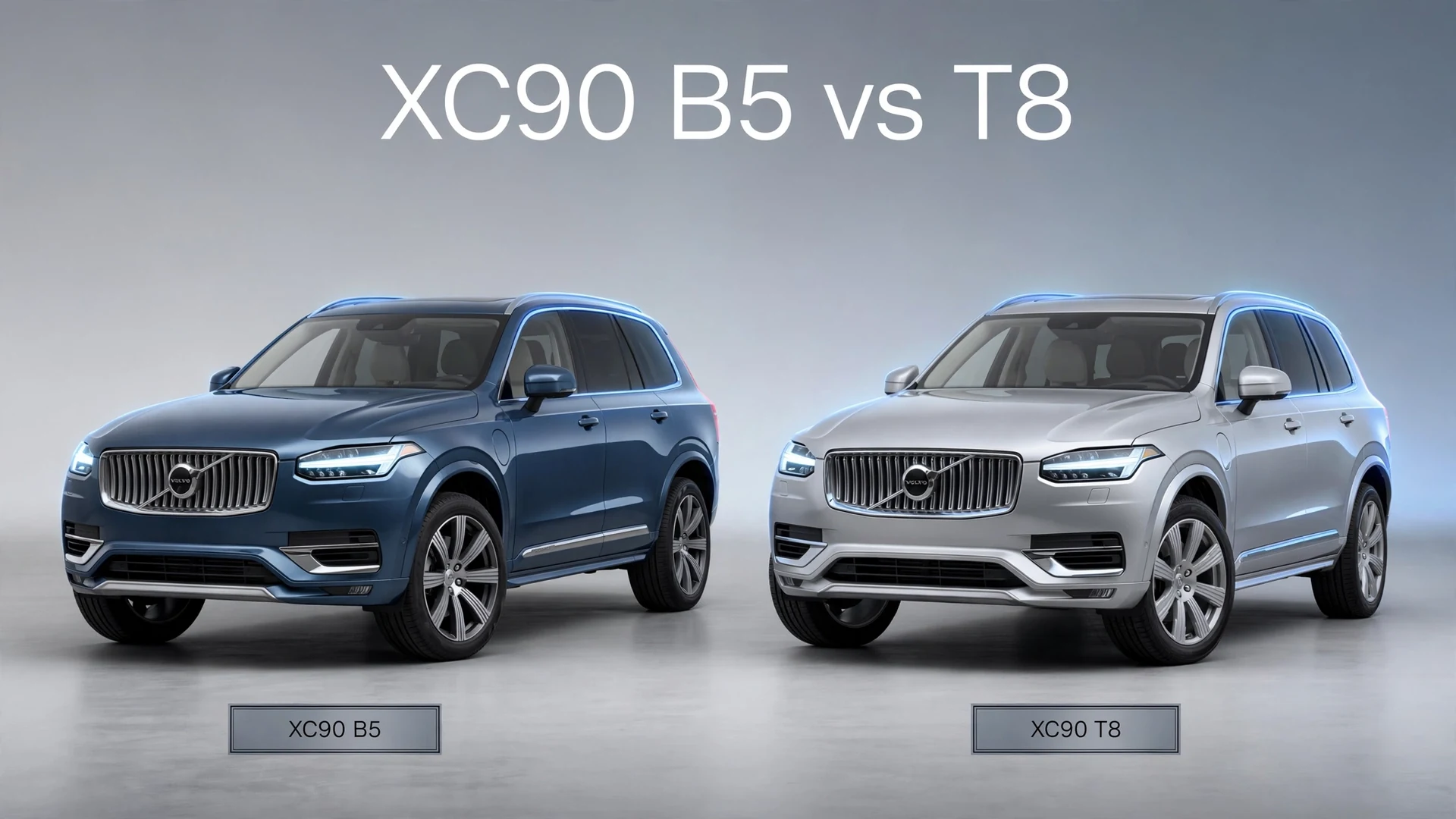
Volvo XC90 B5 vs T8?

Volvo XC90 B5 vs T8?
The XC90’s powertrain range spans two philosophies: the B5 mild hybrid (247 hp, 266 lb-ft) — a conventional turbo four with 48-volt assistance — and the T8 Recharge plug-in hybrid (455 hp, 523 lb-ft) with an 18.8 kWh battery and ~33 miles of EPA electric range. The verdict depends entirely on your charging habits: if you can plug in nightly, the T8 is transformative — near-silent electric commuting plus 5.0-second pace when you want it. If you can’t or won’t charge, buy the B5: it’s simpler, lighter, cheaper to buy, and barely less efficient than an uncharged T8. The T8 also carries the well-documented ERAD rear-drive-unit weak spot on earlier cars — a critical used-buying consideration.
- Power: B5 247 hp / 266 lb-ft (0–60 in 7.3 s) vs T8 455 hp / 523 lb-ft (0–60 in 5.0 s).
- Electric range: T8 offers ~33 miles EPA (2025.5) from its 18.8 kWh battery; the B5 has no plug-in capability.
- Economy: B5 EPA 23/30/26 mpg; T8 27/26/27 mpg plus 58 MPGe — but an uncharged T8 is barely thriftier than the B5.
- The 2022 upgrade: T8 battery grew from 11.6 to 18.8 kWh, rear motor from 87 to 143 hp, output to 455 hp. Pre-2022 T8s are a different, weaker proposition.
- Reliability: B5 is the simpler, safer bet; early T8s suffer ERAD (electric rear axle drive) failures — expensive out of warranty.
- Verdict: T8 for home chargers who want the flagship; B5 for everyone else, especially used buyers on a budget.
The Powertrains, Side by Side
| Specification | B5 (mild hybrid) | T8 Recharge (plug-in hybrid) |
|---|---|---|
| Engine | 2.0L turbo 4-cyl + 48V ISG | 2.0L turbo 4-cyl + rear e-motor |
| Battery | 0.4 kWh (48V) | 18.8 kWh (14.7 usable) |
| System power | 247 hp | 455 hp |
| System torque | 266 lb-ft | 523 lb-ft |
| 0–60 mph | 7.3 s | 5.0 s |
| EPA electric range | — | ~33 miles (2025.5) |
| EPA economy | 23/30/26 mpg | 27/26/27 mpg + 58 MPGe |
| Max towing | 5,000 lb | 5,000 lb |
| Curb weight | 4,442 lb | 4,910 lb |
| Payload | 1,565 lb | 1,440 lb |
| Fuel requirement | Premium recommended | Premium recommended |
Both use the same 8-speed automatic and standard all-wheel drive, but the AWD is delivered differently: the B5 drives all four wheels mechanically, while the T8 is a “through-the-road” hybrid — the gasoline engine drives the front wheels and the electric motor drives the rears, with no mechanical connection between them. It works seamlessly, but it means the T8’s rear-drive hardware (the ERAD unit) is a unique component with its own failure modes, covered below.
The 2022 Transformation: Why T8 Model Year Matters Enormously
You cannot compare “a T8” as a single thing, because Volvo fundamentally re-engineered the powertrain for 2022. The changes, confirmed in Volvo’s 2022 powertrain announcement:
- Battery: grew from 11.6 kWh to 18.8 kWh (a third cell layer added), with 14.7 kWh usable.
- Rear motor: uprated from 87 hp to 143 hp — the electric drive went from assist to genuinely capable.
- Engine: simplified from twincharged (turbo + supercharger) to turbo-only.
- Output: total system power rose to 455 hp and 523 lb-ft — Volvo’s most powerful production powertrain at the time.
- Range: EPA electric range jumped from ~18 miles to ~32–35 miles (33 miles for the 2025.5).
The practical message: a 2016–2021 T8 is a 400-hp car with a token 18 miles of electric range and the earliest, most failure-prone ERAD units. A 2022+ T8 is a 455-hp car with genuinely useful electric range and revised hardware. On the used market, the price gap between a 2021 and a 2022 T8 is often smaller than the capability gap — stretch to the 2022+ car if you can.
Real-World Economy: The Charging Caveat
EPA figures flatter plug-in hybrids by assuming regular charging. Here’s the honest math:
| Driving pattern | B5 | T8 Recharge |
|---|---|---|
| Daily commute < 30 mi, charged nightly | ~26 mpg combined | Near-zero fuel use; ~58 MPGe |
| Mixed driving, charged when convenient | ~26 mpg combined | 30–40 mpg equivalent |
| Long highway trips, battery depleted | ~30 mpg hwy | ~27 mpg hwy (heavier car) |
| Never charged | ~26 mpg combined | ~27 mpg combined |
The last row is the one most buyers miss: a T8 that is never plugged in is barely more efficient than a B5 (27 vs 26 mpg combined) while carrying 468 lb of extra battery and motor, costing more to buy, and exposing you to the ERAD failure mode. The T8 only earns its premium if electrons actually flow into it. Volvo’s own data suggests many PHEV owners don’t charge regularly — don’t buy a T8 on good intentions; buy it on a realistic assessment of your charging access.
On long highway runs, the B5 can actually beat the T8: its lighter weight and 30 mpg highway rating edge the T8’s 27 mpg once the battery is depleted. The T8’s economy advantage lives entirely in the first ~33 miles of each trip.
Reliability: ERAD vs Mild-Hybrid Simplicity
B5: The mild-hybrid powertrain is the safe choice. The 48-volt integrated starter-generator assists the turbo four with torque fill and enables smooth stop-start; there’s no plug-in hardware, no high-voltage battery to degrade, and no ERAD. The Drive-E 2.0T itself is a mature unit by now. Watch for the usual direct-injection items (carbon buildup on intake valves over high mileages, PCV/breather service) and keep up with oil changes — the turbo works hard. Nothing here is exotic or ruinous.
T8: The headline issue is the ERAD — the electric rear axle drive, the combined electric motor and single-speed transmission driving the rear wheels. Failure is well documented across owner forums and specialist press: symptoms start as grinding, clicking, or knocking from the rear, hesitation or juddering on pull-away, and can end in complete loss of rear-wheel propulsion (the car remains drivable on the front engine). Root causes identified by specialists include bearing wear, circlip failure, and degraded “lifetime” transmission oil contaminated with metal debris.
The costs are serious: owners have been quoted around £9,000 for full ERAD replacement in the UK, with independent repair-and-modification kits bringing a repair to roughly £3,500. Volvo extended goodwill coverage on the unit to 5 years in some markets (100% to 4 years, 50% to 5 in the UK, strictly enforced) — which tells you how real the problem is. Specialists recommend changing the ERAD’s oil (a ~£31 job) far earlier than Volvo’s “lifetime” claim, and note that constant engage/disengage cycling in Hybrid mode accelerates wear versus Pure mode.
Battery degradation on the T8 is less of a worry than feared: the 18.8 kWh pack is liquid-cooled and conservatively managed (14.7 kWh usable), and Volvo warranties the hybrid battery for 8 years/100,000 miles in the US. The 12-volt auxiliary battery and the usual SPA electronics (infotainment glitches) affect both powertrains equally.
Price, Tax Credits, and Total Cost
The 2025.5 XC90 range runs from $59,745 to $81,195 including destination, with the T8 commanding roughly a $10,000–$13,000 premium over an equivalent B5/B6. Whether that premium pays back depends on fuel prices, your mileage, and — critically — charging discipline. A 30-mile daily commuter charging nightly can cut fuel costs by 70–80% versus the B5; a 15,000-mile-a-year highway driver will barely notice the difference.
On tax incentives: the XC90 Recharge is built in Sweden, so it did not qualify for the US federal $7,500 purchase credit under post-2022 Inflation Reduction Act rules (North American assembly required). However, leased T8s could benefit from the commercial-credit pass-through that dealers applied as lease cash in 2023–2024 — one reason T8 lease deals were occasionally startling. Incentive rules change frequently; verify current eligibility before buying, and don’t assume a credit exists until it’s in writing.
Insurance runs slightly higher on the T8 (higher value, more complex repairs). Servicing is broadly similar, though brake wear is lower on the T8 thanks to regenerative braking — a small but real saving over high mileages.
Which Powertrain for You?
Verdict: Match the Powertrain to the Plug
The T8 Recharge is the better XC90 if and only if you charge it — then it’s faster, quieter, cheaper to run, and more refined than the B5 in every way that matters daily. The B5 is the better XC90 for everyone else: simpler, lighter, nearly as efficient when the T8 goes uncharged, thousands cheaper, and free of the ERAD question mark. And whatever you choose, remember the 2022 dividing line — on the T8, it separates two fundamentally different cars.
Sources
- zzdsport.com — 2025.5 Volvo XC90 review (B5 247 hp/266 lb-ft, T8 455 hp/523 lb-ft, 0–60 times, EPA figures, weights, towing, MSRP range $59,745–$81,195).
- greencarreports.com — 2022 Volvo PHEV powertrain overhaul (11.6 → 18.8 kWh battery, 87 → 143 hp rear motor, turbo-only engine, 455 hp total).
- insideevs.com — “The Biggest Problem With Volvo Plug-In Hybrids: Volvo ERAD Failures Explained” (symptoms, causes, repair vs replace).
- volvoforums.org.uk — T8 ERAD failure thread (replacement ~£9k, repair kit ~£3.5k, Volvo 5-year extended goodwill terms).
- businesscar.co.uk — XC90 T8 Recharge Plus update (18.8 kWh battery, 42-mile WLTP range, real-world ~30 mpg depleted).
- iseecars.com — XC90 vs XC90 Recharge comparison (power, economy, resale value retention).
Frequently Asked Questions
What is the electric range of the XC90 T8 Recharge?
About 33 miles EPA on the 2025.5 model (earlier 2022–2024 cars were rated 32–35 miles). Pre-2022 T8s with the 11.6 kWh battery managed only about 18 miles — the 2022 battery upgrade to 18.8 kWh transformed the car.
Is the XC90 T8 reliable?
Mostly, with one major caveat: the ERAD electric rear axle drive is a documented weak spot, with failures causing grinding noises, hesitation, or loss of rear drive. Repairs run into the thousands out of warranty. The B5 mild hybrid is the simpler, safer reliability bet.
Should I buy a used XC90 T8?
Only a 2022-or-newer car, with ERAD oil-service history and a hybrid-battery health check. Avoid 2016–2021 T8s: small battery (~18-mile range), earliest ERAD units, and expiring manufacturer goodwill. The B5 is the lower-risk used buy.
Does the XC90 T8 qualify for the federal EV tax credit?
Not for purchase under current rules — it’s assembled in Sweden, and post-2022 US rules require North American assembly. Leased T8s benefited from a commercial-credit pass-through in 2023–2024. Verify current rules before buying; they change often.
What happens if you never charge the XC90 T8?
It becomes a heavy, expensive B5: about 27 mpg combined versus the B5’s 26, with 468 lb of extra weight and the ERAD failure exposure. The T8 only earns its premium if you charge it regularly.
Which is faster, B5 or T8?
The T8, by a wide margin: 455 hp and 523 lb-ft deliver 0–60 mph in 5.0 seconds versus 7.3 for the 247-hp B5. The T8’s instant electric torque also makes it feel even quicker in daily driving.