Volvo C30 vs C40?

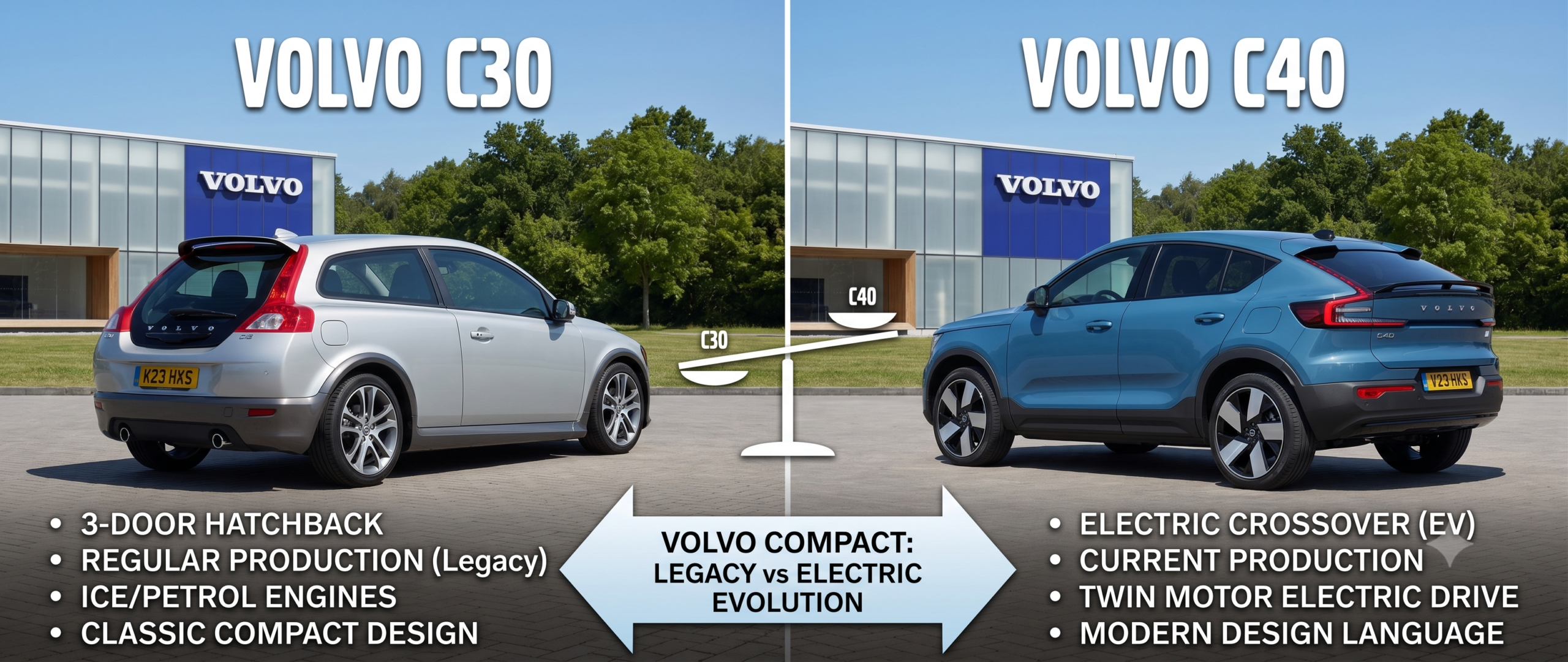
Notice both a “C30” and a “C40” in Volvo’s history and wonder if they’re related? They share a letter and not much else — the C30 was a gas-powered three-door hot hatch from the 2000s, while the C40 is a fully electric coupe-SUV built on an entirely different platform, over a decade later.
TL;DR
- The Volvo C30 (2006–2013) was a gas-powered three-door hatchback sharing its platform with the Ford Focus
- The Volvo C40 Recharge (2021–present) is a fully electric coupe-SUV with up to 402 hp in dual-motor form
- Both use the “C” prefix for coupe-styled, design-first models — that’s essentially where the similarity ends
- The C40 accelerates 0-60 in as little as 4.5 seconds, quicker than a Ford Mustang Mach-E or Tesla Model Y Long Range
- The C40 starts around $56,545 new, dramatically more than the C30 ever cost
Volvo C30 vs C40: The Short Answer
These cars share a naming convention, not a lineage. Volvo’s “C” prefix has always signaled a coupe-styled, design-first model — the C30 was a sporty hatchback, and the C40 continues that spirit as a sleek electric SUV. But the powertrains, platforms, and eras couldn’t be more different, so there’s no real upgrade path or direct comparison to make beyond the badge.
I’ve pulled specs and reviews from both cars’ respective eras to lay out exactly what the “C” naming does and doesn’t tell you, since it’s easy to assume more continuity than actually exists.
What “C” Has Always Meant at Volvo
Volvo has used the C prefix for style-first models going back to the C30 and C70 — cars where design led the engineering brief rather than following it. The C40 continues that tradition explicitly: even Volvo could no longer resist the lure of the coupe-crossover shape, giving the C40 a sloping fastback roofline that trades some cargo space for a distinctive silhouette.
Pull quote: The “C” in Volvo’s naming has always meant “style comes first” — the C30 and C40 just apply that idea to completely different eras of car.
Specs at a Glance
| Feature | Volvo C30 | Volvo C40 Recharge |
|---|---|---|
| Era | 2006–2013 | 2021–present |
| Powertrain | Gas (up to 230 hp T5) | Fully electric, up to 402 hp |
| Body style | 3-door hatchback | 5-door coupe-SUV |
| 0-60 mph | ~6.2–6.7 sec (T5) | As little as 4.5 sec (dual-motor) |
| Platform | Shared with Ford Focus (Mk2) | Volvo’s dedicated EV platform |
| Original starting price | ~$25,500 (T5, new) | ~$56,545 (new) |
| Interior material | Standard leather/cloth options | Leather-free interior |
The performance gap is dramatic in the C40’s favor — its dual-motor sprint to 60 mph actually beats out well-known EV rivals like the Mustang Mach-E and Tesla Model Y Long Range, according to Edmunds’ own testing.
Where the C40 Pulls Ahead
It leads on nearly every measurable spec, reflecting 15 years of automotive progress. Dual motors power all four wheels with a combined 402 hp in the C40’s top configuration — output that would have been unthinkable in a compact Volvo during the C30’s production run.
A few things the C40 offers that the C30 never could:
- Instant electric torque and genuinely quick acceleration for its class
- A leather-free interior aligned with Volvo’s modern sustainability push
- One-pedal driving and effortless everyday drivability, per Edmunds’ testing
Quick Tip: If you’re drawn to the C40 for its styling, know that its sloping roofline does cut into cargo capacity compared to the mechanically similar XC40 — a tradeoff the C30 buyers of the 2000s would recognize instantly from that car’s own three-door compromises.
Where the C30 Still Has Appeal
It leads on affordability and that distinctive early-2000s hot-hatch character. The C30 T5’s shared underpinnings with the Ford Focus ST gave it genuine turbocharged five-cylinder performance at a used-market price point the C40 simply can’t match today.
Expert Insight: The C30 was Volvo experimenting with youth appeal on a budget; the C40 is Volvo experimenting with EV style at a premium. Both were bets on design mattering as much as substance — just for very different buyers and budgets.
Real-world scenario: A budget-conscious enthusiast hunting for characterful, affordable performance will find far more value in a used C30 T5, while a buyer prioritizing modern EV tech, safety features, and daily usability will find the C40 the more sensible — if considerably pricier — choice.
Pros and Cons by Buyer Type
The Budget Enthusiast
- ✅ Volvo C30: affordable used prices, characterful turbo five-cylinder engine
- ❌ Volvo C40: significantly higher cost of entry, even on the used market
The Modern EV Shopper
- ✅ Volvo C40: genuine performance, one-pedal driving, contemporary safety tech
- ❌ Volvo C30: no electric option ever existed for this model
The Style-First Buyer
- ✅ Either: both prioritize distinctive design within Volvo’s practical, safety-first DNA
- ❌ Either: both sacrifice some practicality (cargo space, rear visibility) for their respective looks
Alternatives Worth Considering
Choose the XC40 Recharge if you want the C40’s electric powertrain with more conventional SUV proportions and better cargo space.
Choose a Focus ST if you want C30-era performance without paying the Volvo styling premium — they share the same platform and engine.
FAQ
Is the Volvo C40 an electric version of the C30? No — they’re unrelated beyond sharing Volvo’s “C” naming convention for style-first models; the C40 is built on a modern dedicated EV platform, while the C30 was a gas-powered hatchback sharing its underpinnings with the Ford Focus.
How much faster is the C40 than the C30? Significantly — the dual-motor C40 can hit 60 mph in as little as 4.5 seconds, compared to roughly 6.2–6.7 seconds for the quickest C30 T5 variants.
Is the C40 based on the XC40? Yes — it’s a near-mechanical twin to the more conventional XC40 Recharge, sharing the same platform and powertrain but with a sportier, sloped-roof body style.
Why did Volvo discontinue the C30? The C30 ended production in 2013 as part of Volvo’s broader lineup restructuring, well before the company’s shift toward electrification that eventually produced the C40.
Is the C40 worth the price premium over a used C30? It depends on priorities — the C40 offers vastly more modern performance, safety tech, and electric efficiency, while the C30 remains a genuinely fun, affordable way to get turbocharged Volvo character on a budget.
Key Takeaways
- The C30 and C40 share Volvo’s “C” naming philosophy but nothing mechanically
- The C40 dramatically outperforms the C30 across nearly every spec, reflecting 15 years of progress
- The C30 remains an affordable, characterful used-market performance hatchback
- The C40 is a near-twin to the XC40 Recharge with sportier, sloped styling
- Neither car should be mistaken for a direct predecessor or successor of the other
Next Step
If you’re drawn to the “C” badge specifically for its styling philosophy, decide first whether you want modern EV technology (C40) or affordable turbocharged character (C30) — the two serve genuinely different goals.