Volvo FH vs FM

Picking the wrong Volvo truck doesn’t just cost you comfort — it costs you payload, fuel, and thousands of euros over a multi-year lease, and the FH and FM look similar enough on a dealer lot that plenty of buyers get it wrong.
TL;DR
- The Volvo FH is built for long-haul: a high-mounted Globetrotter cab, engines up to 750 hp (FH16), and pricing from roughly €110,000 to €160,000.
- The Volvo FM is built for regional distribution and construction: a lower-mounted cab for easier access and better maneuverability, engines up to 500 hp, and pricing that generally lands below the FH.
- Cab height is the biggest physical difference — FH access height runs about 58 inches versus roughly 46.5 inches on the FM.
- Both trucks share much of the same chassis, driveline components, and electrical architecture, so the choice usually comes down to route type, not raw capability.
- Electric versions exist for both: the FH Aero Electric reaches up to 700 km of range for long-haul, while FM Electric variants top out around 470 km for regional work.
If you’ve cross-shopped these two, you already know Volvo doesn’t make it obvious which one you actually need — both trucks share so much engineering that the marketing materials can blur together. This guide breaks down the real differences in cab design, powertrain options, payload, and pricing so you can match the truck to your route, not just your budget.
The Core Difference: Cab Height and Mission
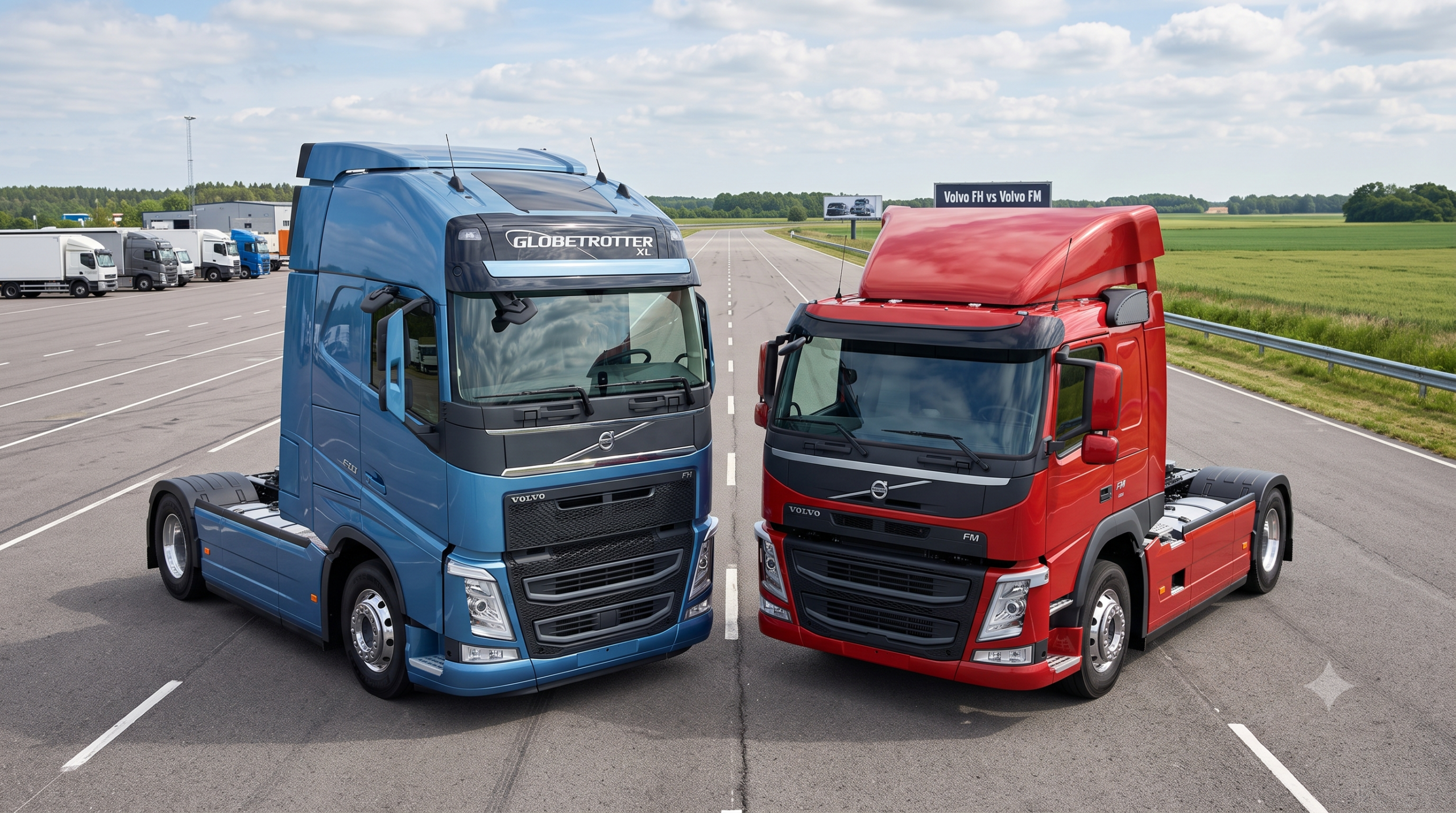
The single biggest difference between these two trucks is where the driver sits, and that one design choice shapes everything else about how each truck is used. FH stands for “Forward control High entry,” while FM stands for “Forward control Medium height cab” — and that naming convention isn’t marketing fluff, it’s the actual engineering distinction. A 2011 comparison test between a Volvo FM 410 and FH 500 found the FH uses a high-mounted Globetrotter XL cab with an access height of about 58 inches, while the FM uses a notably lower Globetrotter cab at roughly 46.5 inches.
That height difference determines the job each truck does best. The FH’s elevated cab improves aerodynamics and driver sightlines on the motorway, which is why Volvo positions it for long-haul freight. The FM’s lower cab makes it easier and faster to climb in and out of repeatedly, which matters enormously for regional distribution drivers making dozens of stops a day, or construction operators who need to hop in and out at job sites.
Engine and Power Options
The FH offers more headroom at the top of the power range, but the two overlap significantly in the middle. The standard FH uses Volvo’s D13K engine in 420, 460, 500, and 540 hp configurations, all Euro 6 compliant. Step up to the flagship FH16, and you get the 16-liter D16K engine rated at 550, 650, or 750 hp with 3,550 Nm of torque, making it one of the most powerful production trucks available.
The FM covers a narrower but still substantial band: D11K engines rated at 330, 380, 430, and 460 hp, or D13K engines offering 420, 460, and 500 hp. A recent road test noted that most FH buyers actually skip the extreme ends of the power range in practice, with 460 hp and 540 hp variants being the sweet spot for typical long-haul work, while the FH16’s 550-750 hp outputs are reserved for heavy-haulage specialists who genuinely need that much muscle.
| Volvo FH | Volvo FM | |
|---|---|---|
| Cab designation | Forward control High entry | Forward control Medium height |
| Cab access height | ~58 in (1,470 mm) | ~46.5 in (1,180 mm) |
| Standard engine | D13K: 420-540 hp | D11K: 330-460 hp, or D13K: 420-500 hp |
| Flagship engine option | D16K (FH16): 550-750 hp | Not available |
| Primary use case | Long-haul, motorway freight | Regional distribution, construction, mixed transport |
| GCW range | Up to 120 tonnes | 44-120 tonnes |
| Typical price range (EU) | ~€110,000-€160,000 | Generally below FH pricing |
Quick Tip: If your routes are 80% motorway with occasional regional stops, don’t default to the FH just because it’s the “senior” model. A well-specced FM with the D13K engine can handle mixed-duty work at a lower purchase price and easier day-to-day cab access.
Payload and Practical Handling
Counterintuitively, the lower-cab FM can actually carry more payload than a comparably equipped FH in some configurations. The same 2011 head-to-head test found the FM 410 offered roughly 770 pounds (350 kg) more payload capacity than the FH 500 despite the two trucks having largely equivalent equipment — a difference driven mainly by the FH’s heavier, more aerodynamically optimized cab structure.
That’s a meaningful detail for operators hauling weight-sensitive freight rather than volume-sensitive freight. A 2025 industry pricing analysis of European truck buyers found that fleet operators increasingly weigh total cost of ownership, including payload efficiency, more heavily than sticker price alone when choosing between closely related models like the FH and FM.
Real-world scenario: Picture a regional beverage distributor running dense, heavy pallets on short routes with dozens of daily stops. The FM’s lower cab cuts seconds off every driver entry and exit, which adds up across a full shift, and its payload edge means fewer partially loaded runs. Now picture a long-haul freight company running overnight routes between major cities — the FH’s aerodynamic high cab and available FH16 power make far more sense there, where fuel efficiency at sustained highway speeds matters more than in-and-out convenience.
Electric Versions: Both Trucks Now Have Battery Options
Volvo has extended its electric lineup to both the FH and FM, but the range and charging specs still track each truck’s traditional mission. The FH Aero Electric, aimed at long-distance and intercity freight, delivers up to 460 kW (623 hp) and claims a driving range of up to 700 km, supporting a gross combination weight of up to 48 tonnes. It uses Volvo’s new e-axle driveline and supports the Megawatt Charging System, recharging from 20% to 80% in around 50 minutes at 700 kW.
The FM Electric, along with the FMX Electric, targets regional distribution, construction, and urban logistics work instead. These trucks reach up to 470 km of range with a dual-motor driveline delivering up to 540 kW (731 hp), and charge from 20% to 80% in about 65 minutes using 350 kW CCS charging — slower charging hardware than the FH Aero Electric, but adequate for shorter regional duty cycles that return to a depot nightly.
Expert Insight: Don’t assume the electric FM is simply a “smaller” version of the electric FH. The FM Electric’s dual-motor setup can actually out-power the base FH Aero Electric on paper, since regional trucks often need strong torque for repeated stop-start driving rather than sustained highway cruising.
Pricing: FH Commands a Real Premium
Expect to pay noticeably more for an FH than a comparably equipped FM, and that premium tracks the cab, engine, and long-haul-focused equipment rather than any fundamental engineering advantage. New Volvo FH trucks in the EU market typically range from about €110,000 to €160,000 depending on engine power, cab configuration, and equipment level, with Globetrotter variants and higher-horsepower engines pushing toward the top of that range.
FM pricing generally lands below the FH across comparable configurations, reflecting its more compact cab options and broader range of applications. Buyers should note that FMX pricing — Volvo’s dedicated construction variant — often meets or exceeds FM pricing, since off-road-focused reinforcement and heavy-duty axles add cost regardless of the more modest cab.
Pros and Cons by Buyer Type
Long-haul freight operators:
- FH: ✅ Best aerodynamics and driver comfort for extended highway stints, FH16 available for heavy-haulage. ❌ Higher purchase price and less nimble in tight urban environments.
- FM: ✅ Lower cost of entry. ❌ Lacks the FH16’s extreme power ceiling for specialized heavy-haulage work.
Regional distribution fleets:
- FH: ✅ Still capable of mixed-duty work if routes include highway stretches. ❌ Higher cab means slower driver in-and-out on multi-stop routes.
- FM: ✅ Lower cab access dramatically speeds up frequent stops, slightly better payload in some configurations. ❌ Not optimized for extended high-speed cruising.
Construction and heavy-duty transport:
- FH: ✅ Available in high-GCW configurations for specialized hauling. ❌ Cab height and on-road focus don’t suit off-road-heavy applications as well as FMX.
- FM: ✅ More versatile chassis options for mixed on/off-road work. ❌ For serious off-road duty, the dedicated FMX variant is usually the better fit than either FH or FM.
FAQ
What does FH stand for on a Volvo truck? FH stands for “Forward control High entry,” referring to its high-mounted cab designed for long-haul comfort and aerodynamics.
Is the Volvo FM cheaper than the FH? Generally, yes. FM pricing typically sits below comparably equipped FH trucks in the EU market, largely because of its more compact cab and broader application range.
Which Volvo truck is better for regional distribution, FH or FM? The FM is usually the better fit for regional distribution, since its lower cab height speeds up driver access on multi-stop routes and it offers a slight payload advantage in some configurations.
Can the Volvo FM handle long-haul routes? It can, especially with the D13K engine option, but it’s not optimized for sustained high-speed highway cruising the way the FH’s aerodynamic high cab is.
Do Volvo FH and FM trucks share the same engines? They overlap significantly — both can be equipped with D13K engines — but only the FH offers the flagship D16K engine used in the FH16, with outputs up to 750 hp.
Key Takeaways
- The FH’s high-mounted cab suits long-haul, high-speed motorway freight, while the FM’s lower cab favors frequent-stop regional and construction work.
- Engine power overlaps in the middle of the range, but only the FH offers the 750-hp FH16 flagship configuration.
- The FM can offer a modest payload advantage over comparably equipped FH trucks due to its lighter cab structure.
- FH pricing in the EU typically runs €110,000-€160,000, with FM pricing generally landing below that range.
- Both trucks now offer electric variants, with the FH Aero Electric reaching up to 700 km range for long-haul and the FM Electric topping out near 470 km for regional work.
- The right choice comes down to route profile and stop frequency more than raw horsepower or brand prestige.
Still deciding? Map out your typical route mix — highway miles versus stop frequency — before requesting quotes, since that single factor will point you toward the FH or FM faster than any spec sheet comparison.