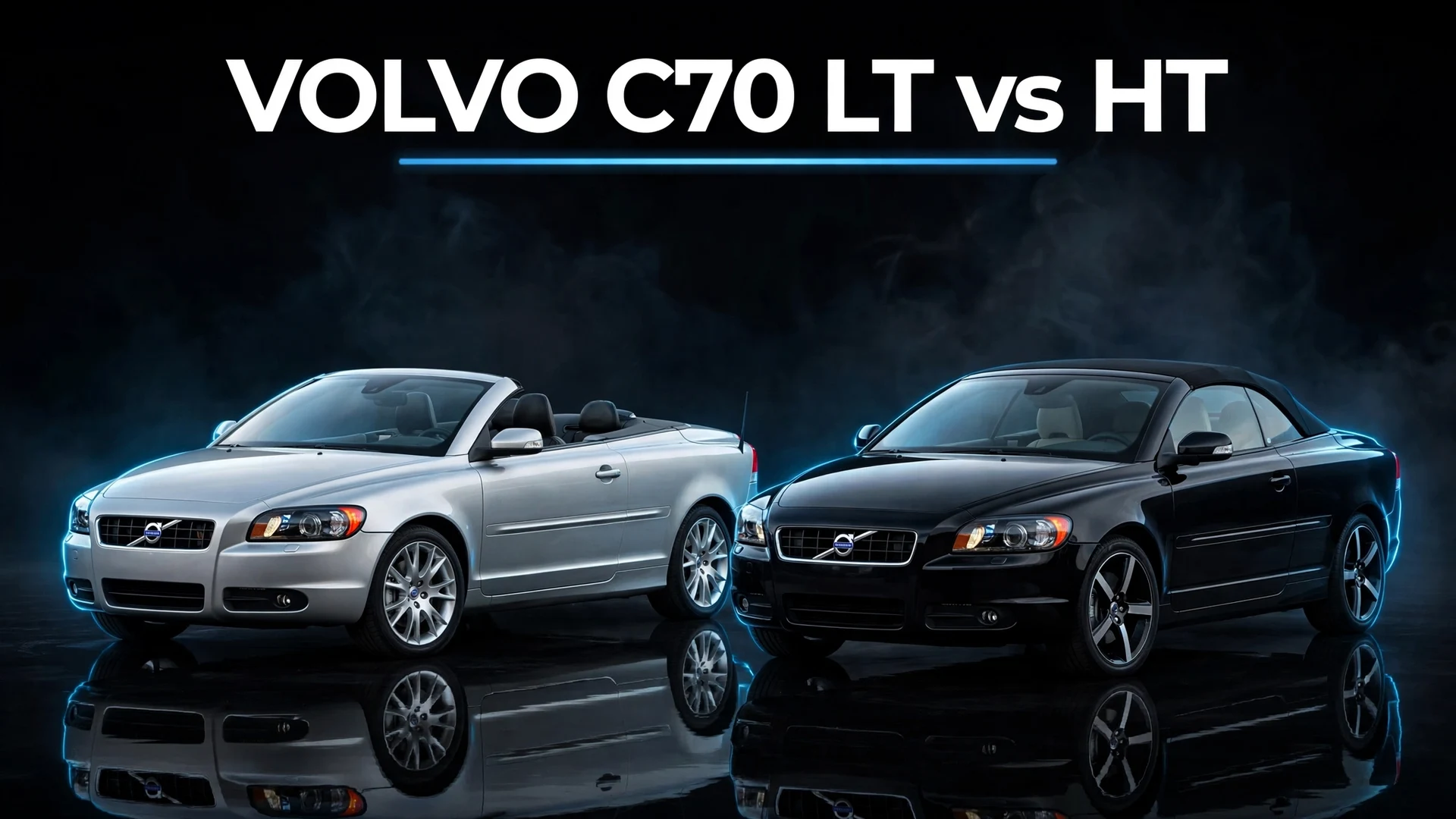
Volvo C70 LT vs HT: Which Turbo Makes the Better Used Buy?

You are scrolling through used listings for a first-generation Volvo C70 — the handsome 1998–2005 coupe and convertible — and you keep seeing the same two letters in ad copy and forum threads: LT and HT. They are not trim levels, option packages, or roof styles. They are shorthand for the two completely different turbocharger setups Volvo offered, and picking the wrong one for your needs is the most common regret among first-time C70 buyers.
The quick verdict
LT (Light-Pressure Turbo, badged 2.4T) is the smoother, cheaper-to-run, easier-to-live-with C70 — the right pick for most buyers who want a comfortable used convertible. HT (High-Pressure Turbo, badged T5) is the genuinely quicker car with real passing power and tuning headroom — the right pick if you want performance and can pay the premium. Read on for the full breakdown before you decide.
Key Takeaways
- LT = Light-Pressure Turbo (badged 2.4T): a 2.4-litre five-cylinder at about 0.6 bar of boost, making 197 hp and 210 lb-ft (2003 spec). Smooth, lag-free, the easier daily driver.
- HT = High-Pressure Turbo (badged T5): a smaller 2.3-litre five-cylinder with thicker cylinder liners at about 1.0 bar, making 242 hp and 243 lb-ft (2003 spec). Noticeably stronger at speed.
- The HT was the only way to get a manual gearbox in the first-gen C70; the LT was automatic-only in the US.
- LTs cost less used, return better fuel economy, and attract gentler previous owners; HTs command a premium and were more likely driven hard.
- Watch-outs are the same on both: the 1999–2001 electronic throttle module, convertible-top sensors and hydraulics, and front-suspension wear.
What LT and HT Actually Mean
Volvo never stamped “LT” or “HT” on the trunk lid. The cars were badged 2.4T (LT) and T5 (HT), and the letters are owner-forum and listing shorthand — used even by outlets like Edmunds in trim descriptions — for the two turbo philosophies:
- LT — Light-Pressure Turbo: a 2.4-litre five-cylinder (B5244T) with a smaller turbo at modest boost and a higher compression ratio (~9.0:1), so power arrives almost invisibly. Volvo’s 2003 press material lists the “Light Pressure turbo model” at 197 hp.
- HT — High-Pressure Turbo: a 2.3-litre five-cylinder (B5234T) with thicker cylinder liners, a larger turbo at about 1 bar of boost, and a lower compression ratio. Volvo’s 2003 press material lists the “High pressure turbo model” at 242 hp and 243 lb-ft.
The engineering trade-off is classic: the LT gets its performance from displacement and compression, so it needs little boost; the HT gets its performance from boost, so it needs a tougher block and accepts more lag in exchange for a much bigger top end.
By the Numbers: LT vs HT Specs
Figures below are Volvo’s published 2003-model-year numbers for the C70 Convertible — the cleanest official LT/HT comparison. Earlier cars (1998–2002) were rated slightly lower (193 hp LT / 240 hp HT).
| Spec | C70 LT (2.4T) | C70 HT (T5) |
|---|---|---|
| Engine code | B5244T | B5234T |
| Displacement | 2.4 L (2,435 cc) | 2.3 L (2,319 cc) |
| Turbo setup | Light-pressure, ~0.6 bar boost | High-pressure, ~1.0 bar boost |
| Compression ratio | ~9.0:1 (higher) | Lower (built for boost) |
| Cylinder liners | Standard | Thicker, for higher combustion pressure |
| Horsepower (2003) | 197 hp | 242 hp |
| Torque (2003) | 210 lb-ft | 243 lb-ft |
| Transmission (US) | Automatic only | 5-speed manual or automatic |
| Character | Smooth, lag-free, strong off the line | Softer off boost, explosive once spooled |
Power and torque, 2003 Volvo factory figures. The HT’s ~23% power advantage is real — but it arrives differently, as the next section explains.
How They Feel on the Road
On paper the HT wins. Behind the wheel, the story splits — and this is exactly where owner-forum experience matters more than spec sheets.
The LT feels quicker than it is. Because the light-pressure turbo spools almost immediately and the engine runs higher compression, torque is available from just off idle. The widely quoted forum summary puts it as “LTs are faster to 35 mph, HTs are faster after that” — and Volvo’s early LPT marketing made much of the near-nonexistent turbo lag. The LT is the transparent, effortless car in stop-and-go traffic.
The HT feels sleepy, then violent. Off boost, the smaller-displacement, lower-compression engine is comparatively soft — one owner review notes “low end acceleration is dismal because of turbo-lag.” But once the turbo spools, especially in the mid-to-upper rev range where owners have documented a brief overboost spike well above the nominal 1 bar, the HT shoves you back in the seat. At 50 mph and above it is a different league: passing power is the HT’s signature party trick.
The Engineering Differences That Matter
It is worth understanding why the two engines behave this way, because it explains the reliability and tuning stories too. Compression vs. boost is a seesaw: an engine can only tolerate so much total cylinder pressure. The LT runs a higher compression ratio (~9.0:1), which gives it crisp off-boost response and good efficiency — but leaves little headroom for extra boost. The HT runs lower compression and thicker cylinder liners, deliberately sacrificing off-boost efficiency to survive much higher boost. As one engine builder on the forums explains, the HPT runs about 1 bar of boost versus the LPT’s roughly 0.6 bar, with considerably different ECU software to match.
That seesaw decides tuning headroom. The HT block was engineered for pressure, so it responds well to more of it: owners report the HPT five-cylinder can approach 300 hp on stock internals before connecting rods become the concern, with just a bigger turbo, exhaust, and ECU tune. The LT block, with its higher compression, is far less tolerant — pushing much past 10–12 psi without lowering compression risks detonation.
Transmissions tell the same story. In the US, the LT was automatic-only while the HT could be had with a 5-speed manual — Volvo’s own product planning acknowledged which engine the enthusiast buyer wanted.
Ownership, Reliability, and Costs
Here is the honest part: both engines are fundamentally tough Volvo five-cylinders, but the cars around them are now 20+ years old, and the LT/HT choice changes the ownership equation.
HTs cost more to buy and are more likely to have lived hard. The high-pressure cars command a clear premium on the used market, and as forum veterans bluntly note, an HT was probably bought by someone who used the power — expect greater engine wear and budget for lower fuel economy. If you do not need a race car, the LT is the rational buy.
The 1999–2001 electronic throttle module (ETM) affects both. The Magneti Marelli ETMs wear out internally — lumpy throttle and idle/cruise faults are the classic symptoms. Volvo extended the warranty to 10 years, long since expired, but rebuilt units with non-contact sensors are the permanent fix. Check service records for a replacement.
Convertible-top trouble is the other big one. The power top depends on position sensors, potentiometers, and hydraulics; when it misbehaves (stopping short of the windshield is the famous symptom), diagnosis needs Volvo-specific scan tools and recalibration. Cycle the top fully several times on any test drive.
Then the usual first-gen C70 wear items: front suspension bushings and top engine mounts wear quickly (the cars are hard on front tires if alignment is off), rear brake calipers can seize, A/C evaporators fail, and the long doors mean window and seat switches plus interior rattles as the cars age. None of this is LT/HT specific — but it is why buying the best-maintained example matters more than which turbo badge it wears.
A Note on the 2006–2013 C70
The LT/HT shorthand belongs to the first-generation C70 (1998–2005). The second-generation retractable-hardtop C70 (2006–2013) used different badging — 2.4i, 2.5T, and T5 — and the tidy low-boost/high-boost split of the earlier car does not map onto it the same way. If a seller advertises a 2008 as an “LT,” they are borrowing first-gen slang; check the actual engine instead.
Frequently Asked Questions
What do LT and HT mean on a Volvo C70?
LT stands for Light-Pressure Turbo (badged 2.4T, a 2.4-litre five-cylinder with about 0.6 bar of boost) and HT stands for High-Pressure Turbo (badged T5, a 2.3-litre five-cylinder with about 1 bar of boost and thicker cylinder liners). They describe the turbocharging setup, not trim level or roof style, and the shorthand comes from owner forums and listings rather than official Volvo badging.
Which is faster, the C70 LT or the C70 HT?
The HT is faster overall — 242 hp and 243 lb-ft versus the LT’s 197 hp and 210 lb-ft in 2003 factory figures. But the LT feels more responsive off the line thanks to its higher compression and near-zero turbo lag, while the HT’s advantage shows at highway speeds once the bigger turbo is fully spooled.
Is the C70 LT more reliable than the HT?
Neither engine has a fundamentally worse reputation — both are tough Volvo five-cylinders. The LT’s advantages are indirect: lower boost means less thermal stress, and LT cars were typically bought by less aggressive drivers. The big-ticket risks (1999-2001 electronic throttle module, convertible-top hydraulics and sensors, front suspension wear) affect both equally, so service history matters more than the badge.
Can you get a manual gearbox with the LT engine?
No — in the US market, the first-generation C70 LT (2.4T) was automatic-only. The 5-speed manual was exclusive to the HT (T5). Manual first-gen C70s are rare, with only around 600 believed to have reached the US.
Does the LT vs HT distinction apply to the 2006-2013 C70?
No. LT/HT shorthand belongs to the 1998-2005 first-generation car. The second-generation retractable-hardtop C70 (2006-2013) used 2.4i, 2.5T, and T5 badging with different engine hardware, so the low-boost/high-boost comparison does not transfer directly.
The Final Call
Twenty-plus years on, the LT vs HT debate has settled into a clear consensus among people who have owned both: the LT is the better car for most buyers, and the HT is the better car for the few who know they want it. The light-pressure car does everything a comfortable used convertible should do — smooth, quiet, responsive in traffic, cheaper to buy and run. The high-pressure car trades some of that ease for the shove in the back when the big turbo wakes up at 70 mph.
Either way, buy on condition first and badge second. A pampered LT with a fresh throttle module, a healthy top, and tight suspension will make you happier than a tired HT with deferred maintenance — every single time.