Volvo XC60 Recharge?

Imagine a car that can silently drop your kid at school on electricity alone, then turn around and hit 60 mph in 4.5 seconds on the highway ramp. That’s the pitch behind the Volvo XC60 Recharge, and for the most part, it delivers.
TL;DR
- The XC60 Recharge (now badged XC60 Plug-In Hybrid) pairs a 2.0L turbo four with an electric motor for a combined 455 horsepower and 523 lb-ft of torque
- EPA-estimated 35 miles of all-electric range from an 18.8-kWh battery
- Pricing starts around $61,150 for the Core trim, up to $79,800 for the Polestar Engineered
- It no longer qualifies for any federal EV tax credit as of October 2025
- Best for buyers who want a genuinely quiet, comfortable luxury SUV that happens to also be quick
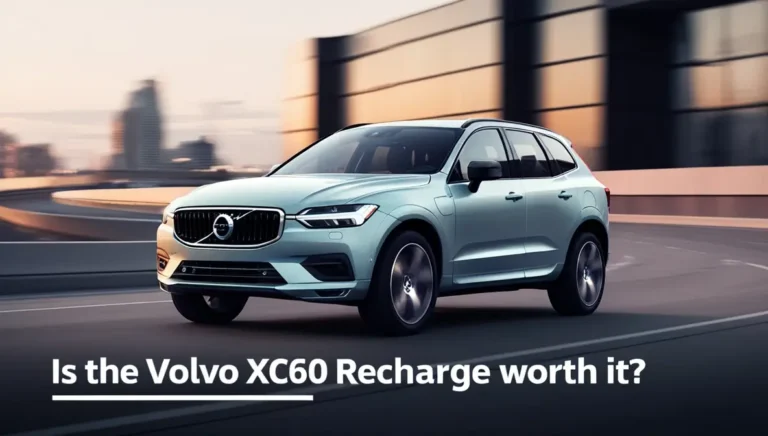
So, is the XC60 Recharge worth it? In short: yes, if you want a plug-in hybrid that drives like a sport sedan around town and doesn’t feel like a compromise on long trips. The plug-in hybrid pairs a turbocharged 2.0-liter four-cylinder engine with an electric motor for a combined 455 horsepower and 523 lb-ft, with an 18.8-kWh battery delivering 35 miles of EPA-estimated all-electric range, and it still runs on gasoline alone once the battery’s depleted. That combination is rare in this segment — you’re not choosing between “fast” and “efficient.”
Quick Tip: If your daily commute is under 35 miles round trip, you could realistically go weeks without visiting a gas station.
What Is the Volvo XC60 Recharge, Exactly?
The XC60 Recharge is Volvo’s plug-in hybrid version of its best-selling midsize SUV, and it’s been sold in this form since 2018. This generation launched for 2018 but was briefly relabeled as the XC60 Recharge — so if you’re cross-shopping listings, you’ll see it called both “XC60 Recharge” and “XC60 Plug-In Hybrid,” depending on the model year and dealer. They’re the same car.
For 2026, Volvo gave it a light refresh rather than a redesign. It continues as the same basic XC60 that’s been on sale for nine years, but with Volvo’s latest T8 PHEV powertrain. Changes include a new grille, darkened taillights, three new paint colors, and — most notably — a completely overhauled infotainment screen.
Pull-quote: A plug-in hybrid that drives like a sport sedan in town and never runs out of gas on the highway — that’s the XC60 Recharge in one sentence.
How Much Does the XC60 Recharge Cost?
Pricing starts just above $61,000 and climbs quickly if you want the performance-focused trim. The 2026 Volvo XC60 Plug-In Hybrid is offered in Core, Plus, Ultra, and Polestar trims, all powered by a 2.0-liter turbocharged inline-4 engine paired with an electric motor, and the Core trim starts at $61,150 including destination, while the Plus begins at $65,600. The Ultra trim is priced at $70,950, and the Polestar edition tops the range at $79,800.
Here’s the thing most shoppers miss: sticker price isn’t always transaction price. Shoppers are paying an average of $58,988 based on recent transactions — about 5.7% below MSRP. A 2025 industry pricing report suggests plug-in hybrids in general are seeing softer demand than pure EVs, which gives buyers a bit more negotiating leverage.
Trim-by-Trim Comparison
| Trim | Starting MSRP | Standout Features |
|---|---|---|
| Core | $61,150 | AWD, full safety suite, 19-inch wheels |
| Plus | $65,600 | Upgraded interior finishes, added driver-assist tech |
| Ultra | $70,950 | Ventilated seats, Nappa leather, Harman Kardon audio, head-up display, air suspension |
| Polestar Engineered | $79,800 | Öhlins dampers, gold Akebono brakes, 21-inch wheels, sport-tuned chassis |
Expert Insight: The Ultra trim is the sweet spot for most buyers — it makes the most sense at just over $70K, providing all the important features without threatening the near-$80K flagship.
Does the XC60 Recharge Qualify for a Tax Credit?
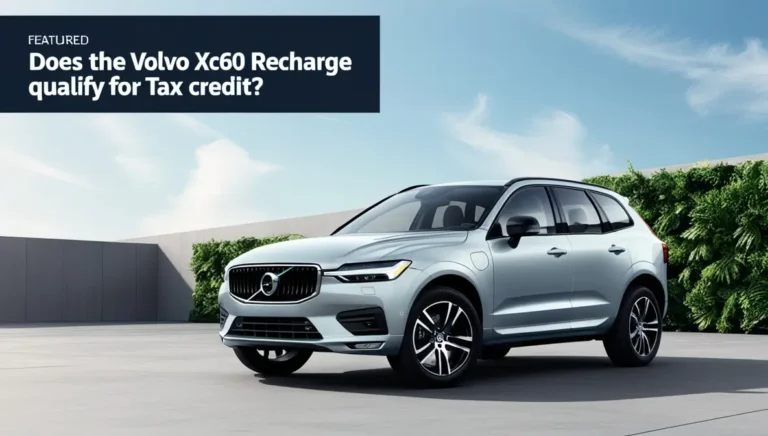
No — as of October 1, 2025, the federal EV/PHEV tax credit was eliminated under the One Big Beautiful Bill Act, so the XC60 Recharge doesn’t qualify for any federal incentive regardless of trim or income level. If you’re budgeting around a credit you saw referenced in older reviews, cross it off; it no longer applies. This is not tax advice — check with a tax professional for guidance specific to your situation.
Performance and Real-World Driving
This is where the XC60 Recharge genuinely surprises people who expect a “hybrid” to mean “slow.” The XC60 Plug-In Hybrid is able to go from 0 to 60 mph in just 4.5 seconds — a full two seconds quicker than the conventional XC60. On the track, that translates to serious numbers: its 455 horses ran free at the test track to the tune of a 4.7-second sprint to 60 mph and an eye-popping speed of 107.6 mph at the quarter-mile mark.
Picture this: you’re merging onto the highway behind a slow-moving truck, foot to the floor, and the XC60 just… goes. No turbo lag drama, no hesitation — the electric motor fills in instantly while the gas engine spools up. It’s the kind of thing you don’t expect from a car that also sips gas on a Costco run.
On efficiency, it achieves 63 MPGe combined in hybrid mode and 28 mpg on gas alone, and this year the XC60 hybrid is rated for 35 miles of fully electric range from its 18.8-kWh battery, down one mile from last year’s version.
Charging: What to Expect
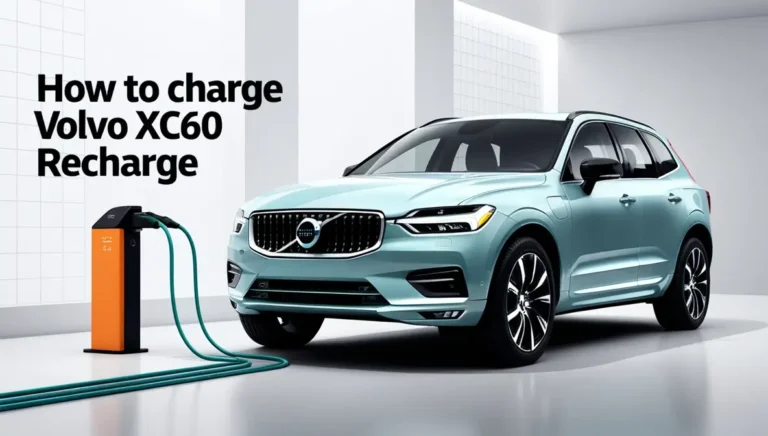
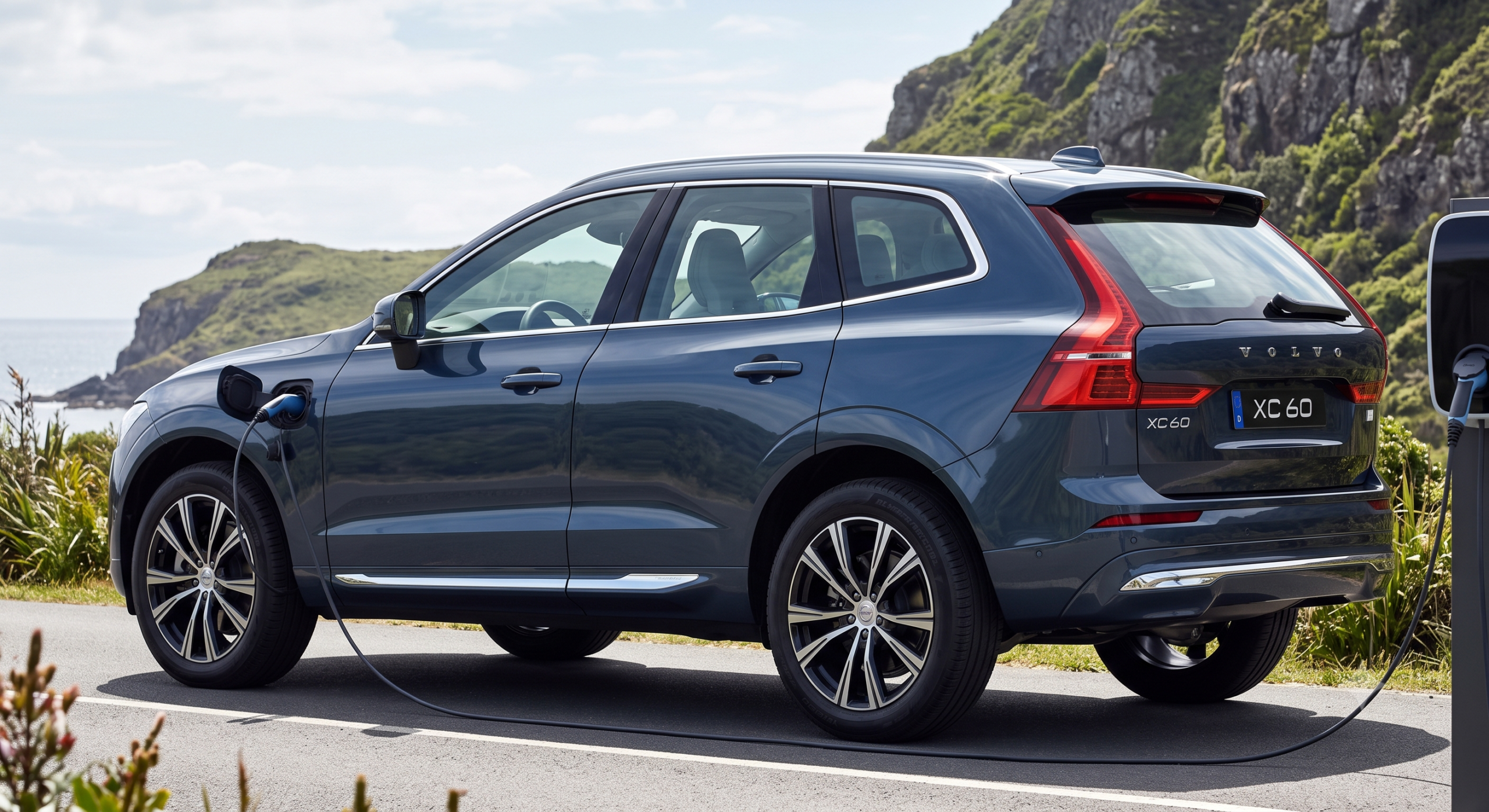
Charging is straightforward but not fast by EV standards — this is a PHEV, not a full EV, so DC fast charging isn’t part of the equation. The XC60 plug-in hybrid can recharge in 3 to 5 hours on a Level 2 home charger with a 16-amp circuit, while Level 1 charging with a regular household plug takes 6 to 8 hours. A portable charger is included, capable of charging at both 120 volts and 240 volts.
Quick Tip: Plug in every night on a standard 240V Level 2 charger and you’ll wake up to a full battery. It’s genuinely a “set it and forget it” routine.
How Does It Compare to Rivals?
The XC60 Recharge’s biggest weakness against the competition is electric range — several rivals simply go further on a charge. This year the XC60 hybrid’s 35 miles compares to 37 miles for the NX plug-in hybrid, 54 for the Mercedes GLC 350e, and 33 for the Alfa Romeo Tonale. The plug-in GLC’s most direct rival edge is that it offers a much longer electric range and can charge on DC fast chargers away from home, greatly expanding where you can go on electric power.
Head-to-Head Snapshot
| Vehicle | EV Range | 0-60 mph | Starting Price |
|---|---|---|---|
| Volvo XC60 Recharge | 35 miles | 4.5 sec | ~$61,150 |
| Mercedes GLC 350e | 54 miles | ~5.5 sec | ~$62,000 |
| Lexus NX 450h+ | 37 miles | ~6.0 sec | ~$59,000 |
| Alfa Romeo Tonale PHEV | 33 miles | ~5.5 sec | ~$54,000 |
Choose the XC60 Recharge if you want the strongest straight-line performance in the class and prioritize cabin comfort. Choose the Mercedes GLC 350e instead if maximizing electric-only range and DC fast-charging flexibility matters more to you than outright speed.
Interior, Tech, and Cargo Space
Volvo’s interior remains one of the class leaders for material quality and comfort. The updated cabin exudes Swedish minimalism, with seating for up to five people and a useful 63.3 cubic feet of maximum cargo capacity.
The tech story got notably better for 2026. The overhauled infotainment system now has an 11.2-inch touchscreen and runs Google Built-In software, with Google Maps, Assistant, and Play Store, and supports Apple CarPlay and Android Auto, Wi-Fi, and a 10-speaker audio system. That’s a meaningful jump — the 2026 XC60 PHEV’s new infotainment system is universally praised as being better than the old version, and simpler than those in some of the automaker’s EVs.
One caveat worth flagging: older model years had more limited smartphone integration, so if you’re shopping used, double-check which infotainment generation the specific car has before assuming it matches the latest reviews.
Quick Tip: Test the wired CarPlay connection during your test drive — some owners of pre-2026 model years report it disconnecting mid-drive, so it’s worth confirming on the exact car you’re buying.
Reliability and Safety
Volvo’s safety reputation carries into the XC60 Recharge with a comprehensive standard suite. Adaptive cruise control, blind spot information system and cross-traffic alert, and front and rear park assist are standard, and a full suite of driver assistance is standard, including automatic emergency braking and lane-keeping assist.
If you’re shopping a used 2020–2022 XC60 Recharge specifically, do your due diligence on NHTSA recall R10312, which covers potential battery-module issues in PHEV models from those model years. It’s worth confirming with the dealer or a Volvo service center that the recall repair has been completed before you buy.
On new-car reliability, the 2026 Volvo XC60 has a 4 years / 50,000 miles basic warranty and no recalls as of this review — though PHEV batteries typically carry a separate, longer warranty term, so confirm those specifics with your dealer.
Pros and Cons by Buyer Type
The Daily Commuter
- ✅ 35 miles of EV range likely covers your whole commute gas-free
- ✅ Quiet, comfortable ride for stop-and-go traffic
- ❌ No DC fast charging means road trips still rely on gas
The Family Hauler
- ✅ 63.3 cubic feet of cargo space with seats folded
- ✅ Class-leading seat comfort for long drives
- ❌ Pricier than a comparable gas-only XC60
The Performance Enthusiast
- ✅ 4.5-second 0-60 mph is genuinely quick for the segment
- ✅ Polestar Engineered trim adds real chassis upgrades
- ❌ At $79,800, the Polestar trim edges into flagship SUV territory
FAQ
Is the Volvo XC60 Recharge the same as the XC60 Plug-In Hybrid? Yes. Volvo has used both names for the same PHEV drivetrain across different model years — “Recharge” was the branding used through roughly 2024, with “Plug-In Hybrid” now the more common label.
How far can the XC60 Recharge go on electric power alone? The 2026 model is rated for 35 miles of fully electric range from its 18.8-kWh battery.
Does the XC60 Recharge qualify for a federal tax credit? No. The federal EV/PHEV tax credit was eliminated as of October 1, 2025, so no current-year purchase qualifies. This isn’t tax advice — consult a professional for your specific situation.
How long does it take to charge the XC60 Recharge? On a Level 2 home charger it takes 3 to 5 hours, while a standard household outlet takes 6 to 8 hours.
Can the XC60 Recharge tow? Yes — it can tow up to 3,500 pounds, which covers small trailers, jet skis, and light utility loads, though it’s not built for heavy-duty towing.
Key Takeaways
- The XC60 Recharge combines 455 horsepower with 35 miles of EV range — a rare blend of speed and efficiency
- Pricing runs $61,150 to $79,800 depending on trim, with average transaction prices running below MSRP
- It no longer qualifies for any federal tax credit as of October 2025
- Its main weakness versus rivals is electric range and the lack of DC fast charging
- Used 2020–2022 model year buyers should confirm recall R10312 has been addressed
Should You Buy One?
If you want a luxury SUV that’s quiet around town, quick on the highway, and comfortable on long trips, the XC60 Recharge earns its price tag. If maximizing EV-only range or DC fast-charging convenience is your top priority, it’s worth cross-shopping the Mercedes GLC 350e first.