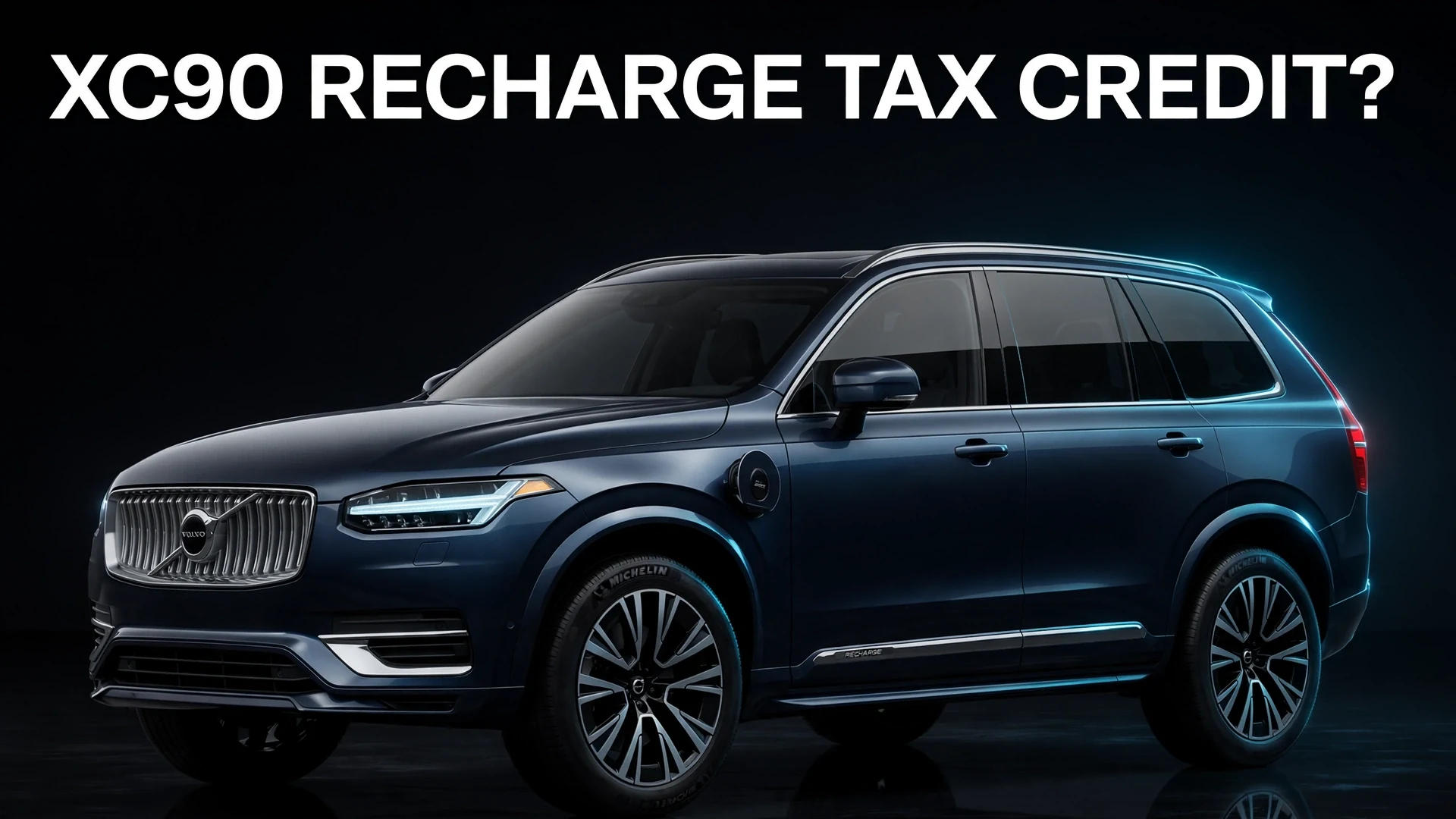
Does the Volvo XC90 Recharge Qualify for a Tax Credit? 2026 Answer: No — Here’s Its Full History

No. As of 2026, the Volvo XC90 Recharge does not qualify for any federal EV tax credit. The story of how it got here is worth knowing, though, because this flagship plug-in hybrid went from a nearly $4,600 credit at launch, to a full $7,500 with its 2022 extended-range battery, to zero — and the reasons it lost eligibility are different from what a lot of older articles (including the previous version of this page) claim.
A correction worth making: some articles about this topic — the earlier version of this one included — state that the XC90 Recharge is assembled in Ridgeville, South Carolina, and therefore qualifies for the newer auto-loan interest deduction. That is incorrect. The XC90 has always been built at Volvo’s Torslanda plant in Gothenburg, Sweden (with some production in Daqing, China). Ridgeville, South Carolina builds the EX90 and previously the S60 — never the XC90. Because the loan deduction requires final assembly in the United States, the Swedish-built XC90 Recharge does not qualify for it either. What follows is the corrected, fully sourced picture.
Key Takeaways
- 2026 answer: No. The XC90 Recharge is not eligible for the federal clean-vehicle credit, and the program itself ended for vehicles acquired after September 30, 2025.
- It did qualify for years: about $4,585 for 2016–2019 models, $5,002 for 2020, $5,419 for 2021, and the full $7,500 for the 2022 extended-range version under pre-IRA rules.
- It lost eligibility on August 16, 2022, when the Inflation Reduction Act required North American final assembly. The XC90 Recharge is built in Sweden, not South Carolina.
- The auto-loan interest deduction (2025–2028, up to $10,000/year) also requires US final assembly — so the XC90 Recharge does not qualify for that either.
- What remains in 2026: the 30C home-charger credit through June 30, 2026, plus state programs like Colorado’s $750 PHEV credit — always verify current terms on official program pages.
The flagship’s credit story, era by era
When the XC90 T8 Twin Engine launched for the 2016 model year, it was Volvo’s technology flagship: a twin-charged 2.0-liter four-cylinder plus a rear-axle electric motor, 400 horsepower, and a 9.2 kWh battery good for about 14 miles of EPA-rated electric range. Volvo’s own launch announcements estimated buyers could claim roughly $4,600 in federal tax credit (Automotive Fleet, April 2015), and Edmunds’ published plug-in credit list put the XC90 T8 at $4,585.
The battery grew in steps — 10.4 kWh for 2018–2019 (per EPA window stickers), 11.6 kWh for 2020–2021 — and the published credit amounts climbed with it: $5,002 for the 2020 model (Autoweb) and $5,419 for 2021 (widely discussed in buyer forums such as Leasehackr). Then came the big one: for 2022, Volvo fitted an 18.8 kWh battery, boosting output to 455 horsepower and EPA electric range to 35 miles. MotorTrend reported in March 2022 that the updated T8 models were now eligible for the full $7,500 federal credit under the rules then in effect.
| Model years | Battery | EPA electric range | Published federal credit | Source |
|---|---|---|---|---|
| 2016–2019 | 9.2–10.4 kWh | 14–18 miles | $4,585 | Edmunds published PHEV credit list (Volvo’s launch estimate: ~$4,600) |
| 2020 | 11.6 kWh | 18 miles | $5,002 | Autoweb |
| 2021 | 11.6 kWh | 18 miles | $5,419 | Buyer reports (Leasehackr) |
| 2022 (extended range) | 18.8 kWh | 35 miles | $7,500* | MotorTrend (*under pre-IRA rules; eligibility ended Aug 16, 2022) |
| 2023–2025 | 18.8 kWh | 32–35 miles | $0 | IRA North America final-assembly rule (Swedish-built) |
| 2026 | 18.8 kWh | ~32 miles | $0 | 30D program ended for acquisitions after Sept 30, 2025 |
Why it lost eligibility: the Sweden problem
The Inflation Reduction Act, signed August 16, 2022, added a hard requirement that qualifying clean vehicles be finally assembled in North America. The XC90 Recharge is built at Torslanda in Gothenburg, Sweden — it has never been assembled in North America. So it dropped off the eligible list overnight, along with most other European and Asian imports. A telling contrast: the Volvo S60 sedan survived on the post-IRA qualifier list precisely because it was built at Ridgeville, South Carolina (Jalopnik’s August 2022 roundup of the ~20 surviving models names the S60, not the XC90). Assembly location, not technology, was the deciding factor.
There was a transition rule: buyers who signed a binding written contract to purchase before August 16, 2022 could still claim the old-rules credit even if delivery came later. But that exception only preserves eligibility for vehicles that were on the qualifying list — it cannot create eligibility for a car bought in, say, 2023 or 2024 that never qualified under IRA-era rules.
The rise and fall, in one chart
Published federal credit by era, relative to the $7,500 maximum. The 2022 figure applied only under pre-IRA rules before August 16, 2022.
What 2026 buyers can still get
With the 30D new-vehicle credit, the 25E used-vehicle credit, and the 45W commercial credit all ended for vehicles acquired after September 30, 2025 (Public Law 119-21), the federal well is nearly dry. And here the XC90 Recharge has a specific disadvantage versus its newer sibling: the 2025–2028 auto-loan interest deduction (up to $10,000 per year in loan interest, above the line) requires final assembly in the United States — plus a new vehicle, personal use, a first-lien loan originated after December 31, 2024, and income phaseouts starting at $100,000 single / $200,000 joint. The South Carolina-built EX90 can qualify; the Swedish-built XC90 Recharge cannot. Leases are excluded in any case.
| Federal benefit | Status for the XC90 Recharge in 2026 |
|---|---|
| 30D new clean-vehicle credit | Ended — for vehicles acquired after Sept 30, 2025 |
| 25E used clean-vehicle credit | Ended — same cutoff; no used-EV credit remains |
| 45W commercial / lease credit | Ended — same cutoff |
| Auto-loan interest deduction (up to $10k/yr, 2025–2028) | Not eligible — requires US final assembly; the XC90 Recharge is Swedish-built |
| 30C home-charger credit (30%, up to $1,000) | Available — runs through June 30, 2026, subject to location and other rules |
| State incentives | Varies — e.g., Colorado’s $750 new-PHEV credit; New York Drive Clean’s $500 tier; verify current terms on official program pages |
One more practical note for used buyers: with no federal credit left on either side of the transaction, a used XC90 Recharge’s value comes down to condition — especially the battery. Get a State of Health (SoH) reading from a dealer diagnostic or independent inspection; Volvo’s 8-year/100,000-mile hybrid-component warranty covers the pack if capacity drops below 70%. The 2022-and-newer 18.8 kWh cars (455 hp, 35 miles of EPA range when new) are the ones to target; budget for a full-charge range test against the EPA figure.
Frequently asked questions
Did the Volvo XC90 Recharge ever qualify for the federal tax credit?
Yes, for years. Published amounts were about $4,585 for 2016–2019 models (Edmunds’ PHEV credit list; Volvo’s launch estimate was ~$4,600), $5,002 for 2020 (Autoweb), $5,419 for 2021 (buyer reports), and the full $7,500 for the 2022 extended-range 18.8 kWh version under pre-IRA rules (MotorTrend). It lost eligibility on August 16, 2022, when the Inflation Reduction Act required North American final assembly.
Is the XC90 Recharge built in the United States?
No. The XC90 is built at Volvo’s Torslanda plant in Gothenburg, Sweden (with some production in Daqing, China). It has never been assembled at Ridgeville, South Carolina — that plant builds the EX90 and previously the S60. This is why the XC90 Recharge fails both the old IRA assembly test and the new auto-loan interest deduction’s US-assembly requirement.
Can I still claim the credit if I bought my XC90 Recharge before September 30, 2025?
Only if it was an eligible vehicle under the rules then in effect. A 2016–2021 model bought new qualified at the time; a 2022 model delivered before August 16, 2022 (or under a binding contract signed before that date) qualified for $7,500. But an XC90 Recharge acquired from August 2022 through September 2025 was not a qualifying vehicle, so no credit was available for those purchases.
Does the auto loan interest deduction apply to the XC90 Recharge?
No. The 2025–2028 deduction of up to $10,000 per year in auto loan interest requires final assembly in the United States, along with a new vehicle, personal use, a first-lien loan originated after December 31, 2024, and income below the phaseout thresholds ($100,000 single / $200,000 joint, fully gone at $150,000/$250,000). The Swedish-built XC90 Recharge fails the assembly test, and leases are excluded regardless.
What about buying a used XC90 Recharge in 2026?
There’s no federal used-EV credit left — the 25E credit ended for vehicles acquired after September 30, 2025, just like the new-vehicle credit. Judge a used XC90 Recharge on condition instead: get a battery State of Health reading (Volvo’s 8-year/100,000-mile warranty covers the pack below 70% capacity), run a full-charge range test, and favor 2022-and-newer cars with the 18.8 kWh / 455-hp powertrain. The 30C home-charger credit (30%, up to $1,000) runs through June 30, 2026.