Does the Volvo XC40 Qualify for a Tax Credit? (2026 Answer: No — Here’s the Full History)

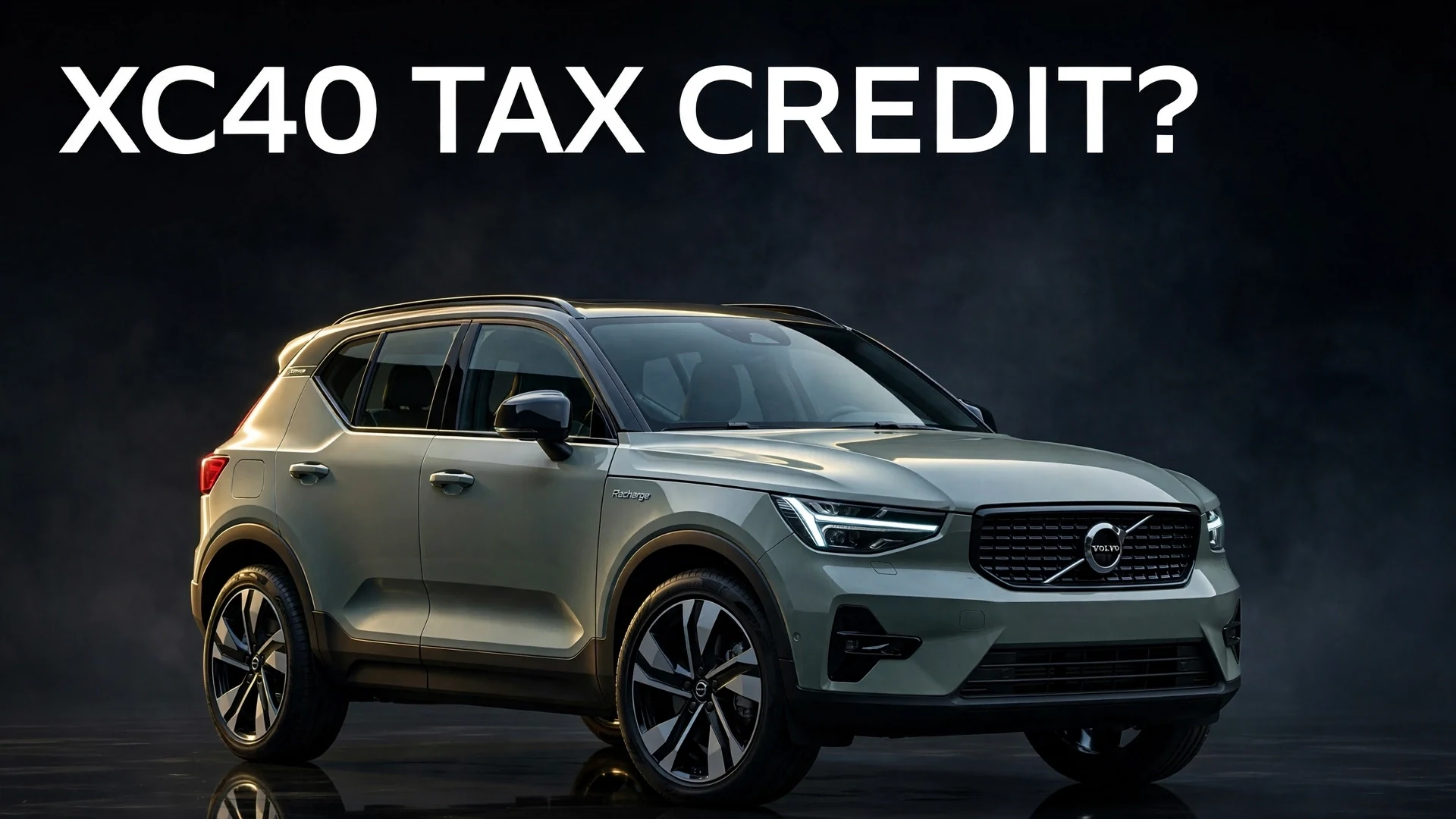
The gas XC40 never qualified (the credit only ever covered electrified vehicles). The electric XC40 Recharge — now sold as the EX40 — qualified for the full $7,500 only on early models bought before August 2022, lost eligibility when the Inflation Reduction Act added a North-America assembly rule, and then every remaining federal clean-vehicle credit was repealed for vehicles acquired after September 30, 2025.
- Gas XC40: never. Federal clean-vehicle credits only ever covered EVs, plug-in hybrids, and fuel-cell vehicles.
- XC40 Recharge (now EX40): yes, but only briefly. It earned the full $7,500 on 2021 models and 2022 models bought before the IRA’s North American final-assembly rule took effect on August 16, 2022.
- August 2022 – September 2025: $0 on a purchase. The Recharge is built in Ghent, Belgium, so it failed the IRA’s final-assembly requirement for the entire IRA era.
- Since September 30, 2025: $0 for everyone. The 30D new, 25E used, and 45W commercial credits were all terminated for vehicles acquired after that date under Public Law 119-21.
- The new auto-loan interest deduction won’t help either — it requires U.S. final assembly, and the XC40/EX40 is built in Belgium.
- What remains in 2026: state rebates (New York up to $2,000, Colorado up to $3,250, Massachusetts $3,500–$6,000), the federal home-charger credit (30C) through June 30, 2026, utility rebates, and dealer incentives.
Search results and dealer pages still claim the XC40 Recharge “qualifies for up to $7,500.” That was true — for about a year and a half, ending in 2022. Here is the complete, current picture: what the car used to qualify for, exactly when and why that ended, the one lease workaround that existed for a while, and what money is genuinely still on the table in 2026.
The short answer, by XC40 version
The two versions have completely different tax-credit histories:
The gasoline XC40 (B5 mild hybrid and earlier T4/T5) has never qualified for any federal clean-vehicle tax credit. Every version of the federal plug-in credit — from 2008 through its 2025 repeal — required significant propulsion by an electric motor drawing from a rechargeable battery. A gas crossover, mild-hybrid system included, was never an eligible vehicle category.
The electric XC40 Recharge (renamed EX40 for 2025) is the real story: a battery-electric SUV that qualified for the full $7,500 at its 2021 launch — then lost eligibility when the rules changed, and never qualified again.
Timeline: how the XC40 Recharge gained — and lost — the credit
The XC40 Recharge arrives in the U.S. Under the pre-IRA rules, any qualifying plug-in vehicle from a manufacturer under the 200,000-unit cap earned the credit — Volvo was nowhere near the cap, and the Recharge’s 78 kWh battery cleared the threshold easily. Buyers claimed the full $7,500.
The Inflation Reduction Act’s North American final-assembly requirement takes effect immediately. The XC40 Recharge is built in Ghent, Belgium (with additional production in China) — not North America. From this day, no new XC40 Recharge qualified for the 30D credit on purchase.
The credit continues for EVs with North American assembly, MSRP caps, income caps, and battery-sourcing rules — none of which matter for the Recharge, because it fails at the first hurdle: assembly location. The one exception was leasing.
Public Law 119-21 terminates the 30D new-vehicle, 25E used-vehicle, and 45W commercial credits for vehicles acquired after this date. The question becomes moot for every EV, not just Volvo’s.
No federal credit exists for buying any XC40 or EX40 — new, used, or leased. State programs and the surviving home-charger credit are the remaining incentives.
Credit-by-credit: where the XC40 Recharge stood
Five federal programs touched this question over the years:
| Program | XC40 Recharge eligibility | Why | Status in 2026 |
|---|---|---|---|
| 30D — New Clean Vehicle Credit (pre-IRA, before Aug 2022) | Yes — $7,500 (2021 MY; 2022 MY bought before Aug 16, 2022) | No assembly requirement existed yet; Volvo was under the manufacturer cap | Repealed |
| 30D — New Clean Vehicle Credit (IRA era, Aug 2022 – Sept 2025) | No | Built in Ghent, Belgium — failed the North American final-assembly rule | Repealed |
| 25E — Used Clean Vehicle Credit (up to $4,000) | Yes, if conditions met (2021–2022 models, price $25,000 or less, licensed dealer) | 25E had no assembly requirement — only age, price, and seller rules | Repealed for vehicles acquired after Sept 30, 2025 |
| 45W — Commercial Clean Vehicle Credit (lease passthrough) | Yes, indirectly — lessors could claim it on any EV and share it via lower lease payments | No assembly requirement, so Belgium-built EVs qualified for the lessor | Repealed for vehicles acquired after Sept 30, 2025 |
| Auto loan interest deduction (2025–2028, up to $10,000/yr) | No | Requires U.S. final assembly; XC40/EX40 is assembled in Belgium | Active, but XC40 doesn’t qualify |
The lease workaround that existed — and why it’s gone
One nuance most coverage missed: during the IRA years, when buying an XC40 Recharge earned $0 in federal credit, leasing one could still carry a federal subsidy. The 45W Commercial Clean Vehicle Credit applied to vehicles acquired by businesses — including leasing companies — and unlike 30D it had no North American assembly requirement. A leasing company could claim up to $7,500 on an XC40 Recharge or EX40 and pass some of it through as lower lease payments.
Whether any particular lessor passed the savings through varied by deal — it was never guaranteed. But the mechanism was real, and it was the only federal money touching Belgium-built EVs during the IRA era. Public Law 119-21 ended 45W on the same September 30, 2025 cutoff, so those subsidized lease structures are gone too.
The new auto loan interest deduction — and why the XC40 misses it
When Congress repealed the EV credits, it created a different car-related tax break in the same law: for tax years 2025–2028, buyers financing a qualifying new vehicle can deduct up to $10,000 per year in loan interest — above the line, so no itemizing needed. The catch list is specific:
- The vehicle must be new (you’re the first owner), for personal use, with the loan originated after December 31, 2024.
- It must have undergone final assembly in the United States — verifiable by VIN — and weigh under 14,000 lbs GVWR.
- Income phaseouts start at $100,000 modified adjusted gross income ($200,000 joint); the deduction disappears at $150,000 single / $250,000 joint.
The XC40 and EX40 sold in the U.S. are assembled at Volvo’s plant in Ghent, Belgium — so they fail the assembly test and the deduction is off the table. If you’re cross-shopping, this is one place where a U.S.-assembled rival genuinely has a tax edge the Volvo can’t match. Verify any vehicle’s assembly location with the NHTSA VIN decoder or the factory label on the window sticker.
What you can still get in 2026
Three other sources of money are still real for XC40 and EX40 shoppers:
1. State incentives. Verified this year: New York’s Drive Clean Rebate offers up to $2,000 at point of sale; Colorado offers up to $3,250 in state tax credits; Massachusetts’ MOR-EV pays a $3,500 standard rebate, stackable to $6,000 for income-qualified buyers. Amounts and funding change often — check your state’s official program page before counting on a number.
2. The federal home-charger credit (30C). The one federal EV-adjacent credit that survived: 30% of home charging equipment and installation costs, up to $1,000, for installations completed through June 30, 2026. If you’re buying an EX40, a Level 2 charger is close to essential — installing one before the deadline discounts it by nearly a third.
3. Utility rebates and dealer incentives. Many electric utilities offer $250–$1,000+ for Level 2 charger installation or discounted EV charging rates — these stack with state programs and are the most commonly overlooked savings. And with no federal credit to advertise, dealers have shifted to factory cash, subsidized financing, and lease specials to move electric inventory.
Which scenario are you in?
Pick the situation that matches yours:
A note on dealer websites and outdated articles
If a dealer page or an older article tells you the XC40 Recharge “qualifies for the federal EV tax credit,” it’s frozen in time — written during the brief 2021–2022 window when the car did qualify. Two questions settle it for any vehicle: when was it acquired? and where was it finally assembled? For a new XC40 Recharge or EX40 today, the answers are “after September 30, 2025” and “Ghent, Belgium” — and either answer alone ends the discussion.
Frequently asked questions
Did the Volvo XC40 Recharge ever qualify for the $7,500 federal tax credit?
Yes — briefly. It earned the full $7,500 on 2021 models and 2022 models bought before August 16, 2022, under pre-IRA rules that had no assembly requirement. Once the IRA’s final-assembly rule took effect, the Belgium-built Recharge never qualified again.
Does the gas-powered Volvo XC40 qualify for any federal tax credit?
No. Federal clean-vehicle credits only ever applied to battery-electric vehicles, plug-in hybrids, and fuel-cell vehicles. The gasoline XC40 — including the B5 mild hybrid — was never an eligible vehicle category.
I bought an XC40 Recharge before the credits ended. Can I still claim anything?
Possibly. If you acquired it on or before September 30, 2025 and it was otherwise eligible — a 2021 model bought under the pre-IRA rules, for example — you can still claim the credit on the return covering that purchase. Keep your documentation and confirm eligibility with a tax professional.
Does the new auto loan interest deduction apply to the XC40 or EX40?
No. The deduction (up to $10,000/year in loan interest, tax years 2025–2028) requires final assembly in the United States. The XC40 and EX40 sold in the U.S. are assembled in Ghent, Belgium, so they don’t meet that requirement.
What is the best incentive left for an XC40 Recharge or EX40 buyer in 2026?
State programs: New York offers up to $2,000 at point of sale, Colorado up to $3,250 in state tax credits, and Massachusetts $3,500–$6,000 through MOR-EV. Add the federal home-charger credit (30C, 30% up to $1,000 through June 30, 2026), utility rebates, and dealer incentives.