Volvo 164 Review?

Long before the S90 wore the “flagship” badge, Volvo’s first real shot at a luxury sedan was a 140-series family car with a six-cylinder engine stuffed under a stretched hood — and it actually worked.
TL;DR
- The Volvo 164 was Volvo’s first six-cylinder luxury sedan for private buyers in nearly 20 years, built from 1968 to 1975 with 146,008 units produced.
- Power came from a 3.0-liter B30 inline-six making 135–175 hp, depending on carburetor or fuel-injected (164E) configuration.
- It was based heavily on the 140-series platform with a longer hood and unique front-end styling to justify its more prestigious positioning.
- The US was a major export market, and most 1975 production specifically went to America to meet tightening emissions rules before the successor 264 arrived.
- Common issues include temperamental early Bosch D-Jetronic fuel injection, rough-shifting automatics, and the usual rust concerns of an unibody European car from this era.
If you’re weighing a Volvo 164 against a period BMW E3, a Mercedes-Benz 250, or a Jaguar XJ6, the honest take is: it’s a comfortable, mechanically simple six-cylinder classic that never quite escaped its humbler 140-series roots, but that’s also exactly why it remains one of the more affordable ways into 1970s six-cylinder European luxury motoring today.
What Was the Volvo 164, Exactly?
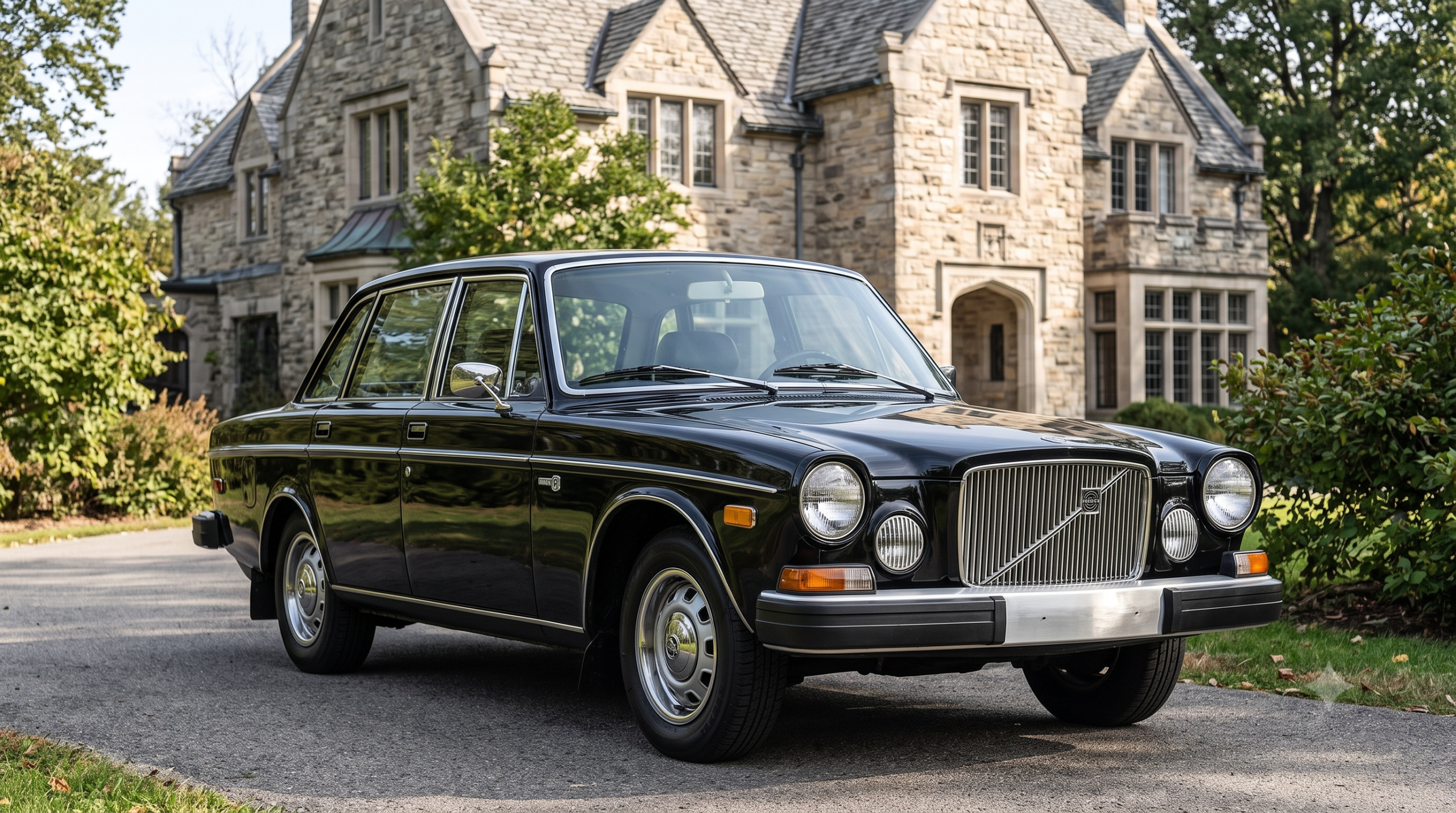
The Volvo 164 debuted at the 1968 Paris Motor Show as Volvo’s first six-cylinder model for private buyers since the PV60 ended production in 1950. It was built on the 140-series platform, sharing nearly all its body sheetmetal from the cowl rearward — Volvo stretched the front six centimeters and added ten centimeters to the wheelbase specifically to fit the longer inline-six engine.
Unlike the 440 covered elsewhere in this series, the 164 was very much a US-market car: America became one of its most important export markets, and most of the final 1975 model year’s production was actually earmarked specifically for the US to meet emissions deadlines before the V6-powered 264 took over.
Quick Tip: If you want the “real” 1975 US-spec 164, look specifically for the final model-year cars — Volvo kept the 164 in limited production an extra year just for America and Japan while its 264 replacement’s engine caught up to emissions rules.
164 Engines and Specs
Every 164 used a version of the 3.0-liter B30 inline-six, derived from the four-cylinder B20 engine that also powered the 140-series. Early cars (1969–1971) ran twin Zenith-Stromberg carburetors and made 145 hp. From 1972, Volvo introduced the 164E, using Bosch D-Jetronic electronic fuel injection — one of the first production fuel-injection systems on the road — bumping output as high as 175 hp before emissions-driven detuning brought later US-spec cars down closer to 138 hp by 1974–1975.
Transmission choices included a four-speed manual, the same manual with an electric overdrive, or a three-speed Borg-Warner BW35 automatic — popular in North America despite a reputation for rough, inefficient shifts. The 164 was sedan-only; Volvo never built a factory 164 wagon, estate, or coupe, though a one-off two-door prototype (nicknamed the “162”) survives today in the Volvo Museum in Gothenburg.
Expert Insight: Fuel-injected 164E cars are quicker and smoother day to day, but the D-Jetronic system’s early-1970s electronics have a well-earned reputation for being finicky to keep properly tuned — factor specialist diagnostic knowledge into your buying decision.
164 vs. Its Contemporaries
| Volvo 164 (1968-75) | BMW E3 (2500-3.3Li) | Mercedes-Benz 250 (W114) | |
|---|---|---|---|
| Engine | 3.0L inline-six, 135–175 hp | 2.5L–3.3L inline-six | 2.5L inline-six |
| Layout | Sedan only | Sedan only | Sedan, coupe |
| Fuel injection option | Yes (164E, from 1972) | Later models | Yes (250CE) |
| Positioning | Prestige version of a family-car platform | Purpose-built luxury sedan | Purpose-built luxury sedan |
| Sold in the US | Yes — a key export market | Yes | Yes |
The 164’s biggest handicap against these purpose-built rivals was always visual: buyers and journalists at the time noted it never fully disguised its 140-series origins, no matter how much chrome and wood-effect trim Volvo added inside.
Pros and Cons by Buyer Type
The classic-car hobbyist who wants six-cylinder smoothness on a budget
- ✅ Genuinely comfortable, smooth-running inline-six for the era
- ✅ Mechanically straightforward compared with contemporary German rivals, aside from the D-Jetronic system
- ❌ Never shed the perception of being a dressed-up family car rather than a true purpose-built luxury sedan
The buyer who wants a period-correct US-market classic
- ✅ Strong factory support for the US market historically, including a final extended model year built specifically for America
- ✅ Parts and community knowledge benefit from Volvo’s large 140-series parts pool, since so many components are shared
- ❌ Later low-compression, emissions-detuned US-spec engines are notably less powerful than European market cars
The collector chasing rarity or investment upside
- ✅ With roughly 146,000 built over seven years, clean survivors are increasingly uncommon
- ❌ It still trades well below more sought-after Volvo classics like the P1800 or Amazon, so don’t expect rapid appreciation
A Real-World Scenario
Picture a longtime Volvo enthusiast who already owns a 140-series wagon for practicality and wants a smoother, six-cylinder weekend cruiser that still shares parts bins and specialist knowledge with their daily classic. A well-sorted 164, ideally a fuel-injected 164E with documented D-Jetronic servicing, fits that role: quieter and quicker than the four-cylinder 140s, without stepping into a completely unfamiliar parts and service ecosystem.
According to Honest John’s classics coverage, the top-spec TE model — with leather, air conditioning, and power steering — represented the most fully-equipped and most enticing version of the range for period buyers, and remains the most desirable trim for collectors today.
What to Check Before You Buy
The D-Jetronic fuel-injection system on 164E models is the single biggest mechanical concern. It was groundbreaking for its time but has a well-documented reputation for being difficult to keep properly calibrated; confirm any car you’re considering has been serviced by someone with specific D-Jetronic experience, not a generalist classic-car mechanic.
The Borg-Warner BW35 automatic is known for rough, inefficient shifting even when working correctly — don’t mistake normal behavior for a fault, but do have a specialist confirm it isn’t slipping or leaking. As with any 55-year-old unibody European car, rust in the sills, floor pans, and rear wheel arches should be checked closely, along with the condition of the wiring harness given the car’s age.
Quick Tip: Ask specifically whether a 164E’s fuel injection system has been converted to a more modern, easier-to-maintain setup by a previous owner — a documented sympathetic upgrade can be a genuine selling point rather than a red flag, as long as it’s done well.
Alternatives Worth Cross-Shopping
Choose a standard Volvo 140-series if you want the same basic platform and era of Volvo engineering at a lower price point, without the six-cylinder complexity.
Choose a Volvo 264 if you want the 164’s direct successor, with a V6 engine and updated styling that moved further away from the 140-series look.
Frequently Asked Questions
Was the Volvo 164 sold in the United States? Yes. The US was one of the 164’s most important export markets, and Volvo specifically extended 164 production into 1975 largely to supply American and Japanese buyers while its 264 replacement’s engine met new emissions standards.
What’s the difference between the Volvo 164 and 164E? The standard 164 used twin carburetors, while the 164E (from 1972) used Bosch D-Jetronic electronic fuel injection for more power and better driveability, at the cost of more finicky maintenance.
How much horsepower does a Volvo 164 have? Output ranged from 135 to 175 hp depending on model year and configuration, with fuel-injected European-market cars generally making more power than later, emissions-detuned US-spec versions.
Is the Volvo 164 reliable? It’s mechanically simple overall, but the early D-Jetronic fuel injection system on 164E models has a known reputation for being difficult to keep properly tuned, and the automatic transmission shifts roughly even when functioning normally.
What replaced the Volvo 164? The Volvo 264, powered by the PRV V6 engine, replaced the 164 in most markets in 1975, though the 164 continued in limited US and Japanese production for one additional year.
Key Takeaways
- The Volvo 164 was Volvo’s first six-cylinder private-buyer luxury sedan in nearly 20 years, built on a stretched 140-series platform from 1968 to 1975.
- The US was a genuinely important market for this car, unlike some other classic Volvos in this series that never officially reached America.
- Fuel-injected 164E models offer more power but demand specialist D-Jetronic maintenance knowledge.
- Rust, wiring age, and rough (but often normal) automatic-transmission behavior are the key inspection points.
- It remains more affordable than more sought-after Volvo classics like the P1800 or Amazon, making it an accessible entry point into 1970s six-cylinder motoring.