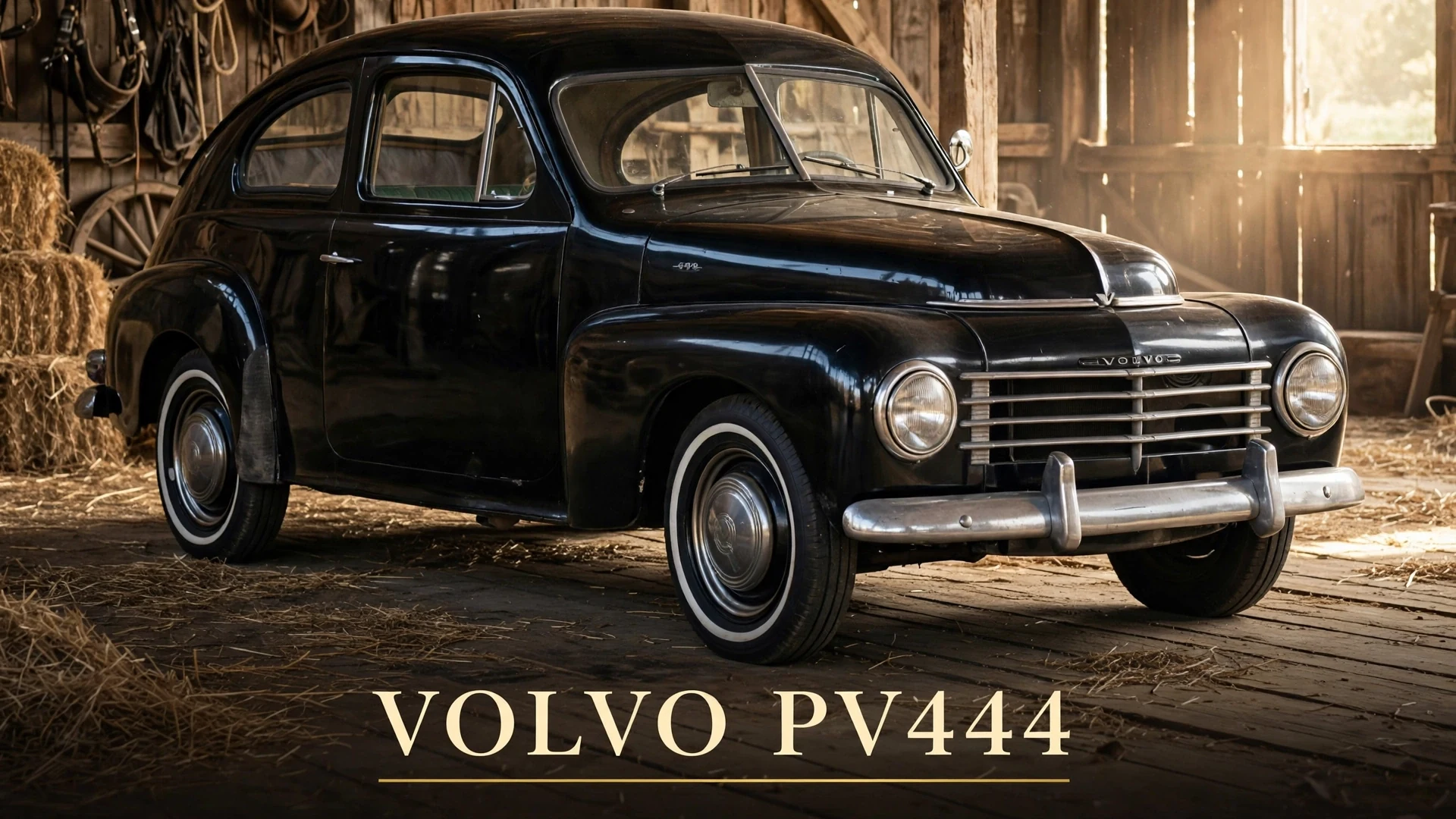
Volvo PV444 Review (1944–1958): Specs, History & 2026 Buying Guide

In 1944, Volvo drew up a plan to build 8,000 of a small, cheap new car and called it done. Fourteen years later, nearly 200,000 PV444s had rolled out of Gothenburg, and the little fastback had done something no Volvo before it had managed: it made Americans want a Swedish car. This is the story of the PV444 — the unibody pioneer that turned Volvo from a regional truck-and-taxi builder into a global car company.
Key Takeaways
- The PV444 was unveiled in September 1944 in Stockholm at SEK 4,800 and built from 1947 to 1958, with 196,005 produced — roughly 25 times the original 8,000-car plan.
- It was Volvo’s first car with a unitary body (no separate chassis frame), the company’s first four-cylinder engine in nearly two decades, and one of the first cars in the world with a laminated windscreen as standard.
- PV444 stands for 4 cylinders, 40 hp, 4 seats. Power climbed from 40 hp to 85 hp across the B4B, B14A and B16 engine generations.
- The first cars reached the United States in August 1955 (Los Angeles), and Volvo sold more than 125,000 PV-series cars in America — the beachhead that made Volvo a household name stateside.
- Rust is the dealbreaker when buying in 2026. Buy the most solid body you can afford; mechanicals are simple, cheap and well supported by owners’ clubs.
The 8,000-Car Plan That Built 200,000
To understand why the PV444 matters, forget the car for a moment and look at Volvo in 1943. The company had been building big, slow, side-valve six-cylinder sedans for the Swedish establishment since 1927, plus a thriving truck business. A small team of 40 engineers and designers led by Helmer Pettersson and Erik Jern began work on something completely different in May 1943: a compact, affordable car with a modern overhead-valve four-cylinder engine and — radically for Volvo — a single welded body shell instead of a separate ladder frame.
On September 1, 1944, Volvo exhibited the finished show car at the Royal Tennis Hall in Stockholm. The exhibition drew 148,437 visitors, and 2,300 of them signed up for a car that cost SEK 4,800 — deliberately the same price Volvo’s very first car, the ÖV4, had carried in 1927. The show car had no engine under the hood, and post-war shortages of steel and rubber meant real production would not begin for nearly three years.
Volvo honored the SEK 4,800 price for those first 2,300 buyers even though actual production costs had risen past SEK 6,000 — the company simply absorbed the loss. The first customer registration came on February 3, 1947, and demand was so intense that Volvo stopped taking new orders for two years while 10,000 back-orders were worked through. Only 1,920 cars were built in 1947 and 2,176 in 1948, largely assembled by hand. The original production ceiling of 8,000 cars became a joke the factory was happy to tell: by the time the PV444 handed over to the facelifted PV544 in 1958, the official count stood at 196,005.
PV444 timeline
Cracking the Code: What PV444 Actually Means
Volvo’s model names of the era were a small spec sheet in disguise. PV is personvagn, Swedish for passenger car. The three fours are the headline figures: 4 cylinders, 40 horsepower, 4 seats. That 40 hp figure belongs to the original B4B engine, and the name stuck even as power more than doubled over the car’s life. The fastback shape earned the car affectionate nicknames — Germans called it the Buckel (hump), and in period American advertising it was simply the car that looked like a shrunken 1942 Ford.
The engine story is really three chapters, and it is worth getting right because sellers mix these up constantly:
| Engine | Years | Displacement | Power | Notes |
|---|---|---|---|---|
| B4B | 1947–1955 | 1.4 L (1,414 cc) | 40 hp → 44 hp (1950) → 51 hp (1955) | Volvo’s first overhead-valve engine; single downdraft carburetor, three main bearings |
| B14A | 1955–1957 | 1.4 L (1,414 cc) | 70 hp | Twin side-draft 1½-in SU carburetors; fitted to US-market cars from 1955 |
| B16A / B16B | 1957–1958 | 1.6 L (1,583 cc) | 60–75 hp (B16A) / 85 hp (B16B) | Enlarged engine; B16B twin-carb version made the late 444 genuinely brisk |
| B18 (PV544 only) | 1962–1965 | 1.8 L | 75–95 hp | First of Volvo’s legendary red-block family; never fitted to a true PV444 |
Volvo’s own heritage specifications summarize the whole run as engines of 1,414 or 1,583 cc producing 40–85 bhp, driving through a three-speed manual with a floor-mounted lever to hydraulic drum brakes on all four wheels. The wheelbase measured 2,600 mm, and period road tests put the curb weight at roughly 2,100 lb — light enough that even 70 hp felt lively.
Why It Mattered: Three Firsts That Changed Volvo
The PV444 carried three innovations that each deserve their own plaque. First, the unitary body — a single welded shell with no separate chassis frame. Volvo engineers studied a purchased 1939 Hanomag 1.3-litre to learn the technique, and the result was a stiffer, lighter structure that made the car feel solid decades later. It was the first Volvo built this way, and every Volvo since has followed.
Second, the laminated windscreen. At a time when most affordable cars used plain toughened glass that shattered into the cabin, the 444’s laminated screen was a genuine safety innovation — the beginning of the safety story that would define the brand.
Third, the car itself was the breakthrough: Volvo’s first small car, its first four-cylinder in nearly twenty years, and the model that, in Volvo’s own words, “really set car production at Volvo moving.” The company had built roughly 2,000 vehicles total when the 444 was unveiled; by the end of the PV era (444 plus 544, 1947–1965) the count was around 440,000.
Rally Pedigree: The Little Car That Won
The PV444 was not just a sensible commuter — it raced. In 1951 the uprated PV444 B swept all three podium places at the Monte Carlo Rally and repeated the feat at the Tour de Belgique. The stiff unibody and light weight that made it a good road car made it a tough rally car, and the competition record fed directly into the car’s reputation for indestructibility.
What It’s Like to Drive Today
Behind the wheel, the PV444 surprises first-timers. The cabin is tall and narrow — broad-shouldered drivers will brush elbows with a passenger — but the seats earn consistent praise, and that giant steering wheel and ribbon speedometer quickly become part of the theater. At 2,100 lb, the car feels nimble rather than ponderous, and the twin-carb cars can genuinely keep pace with modern city traffic.
The compromises are period-correct and you should go in with eyes open: a three-speed manual with no synchromesh on first, drum brakes that need respect on long descents, and a heater that treats Swedish winters as a personal challenge. None of this is a flaw — it is 1950s motoring, honestly presented.
Buying a PV444 in 2026: The Buyer’s Guide
Here is the single most important sentence in this guide: buy the most solid, rust-free body you can afford, because everything else is cheap and fixable and bodywork is not. The 444’s unibody means structural rust in the floors, sills, rocker panels, inner fenders and the spare-wheel well is a structural problem, not a cosmetic one. Volvo’s rustproofing was respectable for the 1950s, which is to say it is now seventy years old and largely theoretical.
- Floors and sills first. Lift the carpets and poke the floor pans, jacking points and rocker panels with a screwdriver. Soft metal here is the walk-away signal.
- Check the spare-wheel well and trunk floor. Water pools here; repairs are fiddly and rarely cheap.
- Fenders and lower doors. Bolt-on panels are available, but inner fender rot spreads to the unibody.
- Engine numbers vs. chassis plate. B4B, B14A and B16 engines get swapped freely; a “numbers-matching” claim needs the plate to back it up. A B16 in an early car is common and not a sin — just price it honestly.
- Split windscreen cars (pre-1958). The two-piece windscreen is a PV444 signature, but replacement glass and rubbers are harder to source than the PV544’s one-piece unit.
- Electrics are simple 6-volt (early) or 12-volt. Check for melted insulation and amateur rewiring; a full rewire is a weekend job, not a fortune.
- Drum brakes and kingpins. Budget for a full brake overhaul and front-suspension bushing refresh on any car that has sat.
Parts support is genuinely good. The global Volvo owners’-club network, plus specialists in Sweden, the UK and the US, keeps mechanical parts — gaskets, brake parts, suspension bushes, clutch components — available and affordable. Trim and body panels are the constraint; buy a car with complete brightwork and intact glass.
Frequently Asked Questions
When was the Volvo PV444 made?
Volvo unveiled the PV444 in September 1944 and built it from 1947 to 1958 in Gothenburg, Sweden, with 196,005 cars produced. The facelifted PV544 continued the line until 1965, taking the combined PV total to around 440,000.
What does PV444 stand for?
PV is personvagn (Swedish for passenger car), and the three fours stand for 4 cylinders, 40 horsepower and 4 seats — the specification of the original B4B-engined car.
How much horsepower does a Volvo PV444 have?
Power ranged from 40 hp on the original 1.4-liter B4B to 85 hp on the twin-carburetor 1.6-liter B16B fitted to late cars. Volvo’s official heritage range for the model is 40–85 bhp.
What is the difference between a PV444 and a PV544?
The PV544 is the 1958 facelift of the PV444, with a one-piece windscreen instead of the split screen, and later a bigger 1.8-liter B18 engine. From 1959 the PV544 was also the first car in the world fitted with three-point seatbelts as standard — a Volvo invention.
How much is a Volvo PV444 worth in 2026?
Values depend heavily on condition and documentation: project cars run roughly $4,000–$10,000, solid drivers $15,000–$40,000, and documented exceptional examples have sold well into six figures. Always compare against recent auction results before agreeing a price.