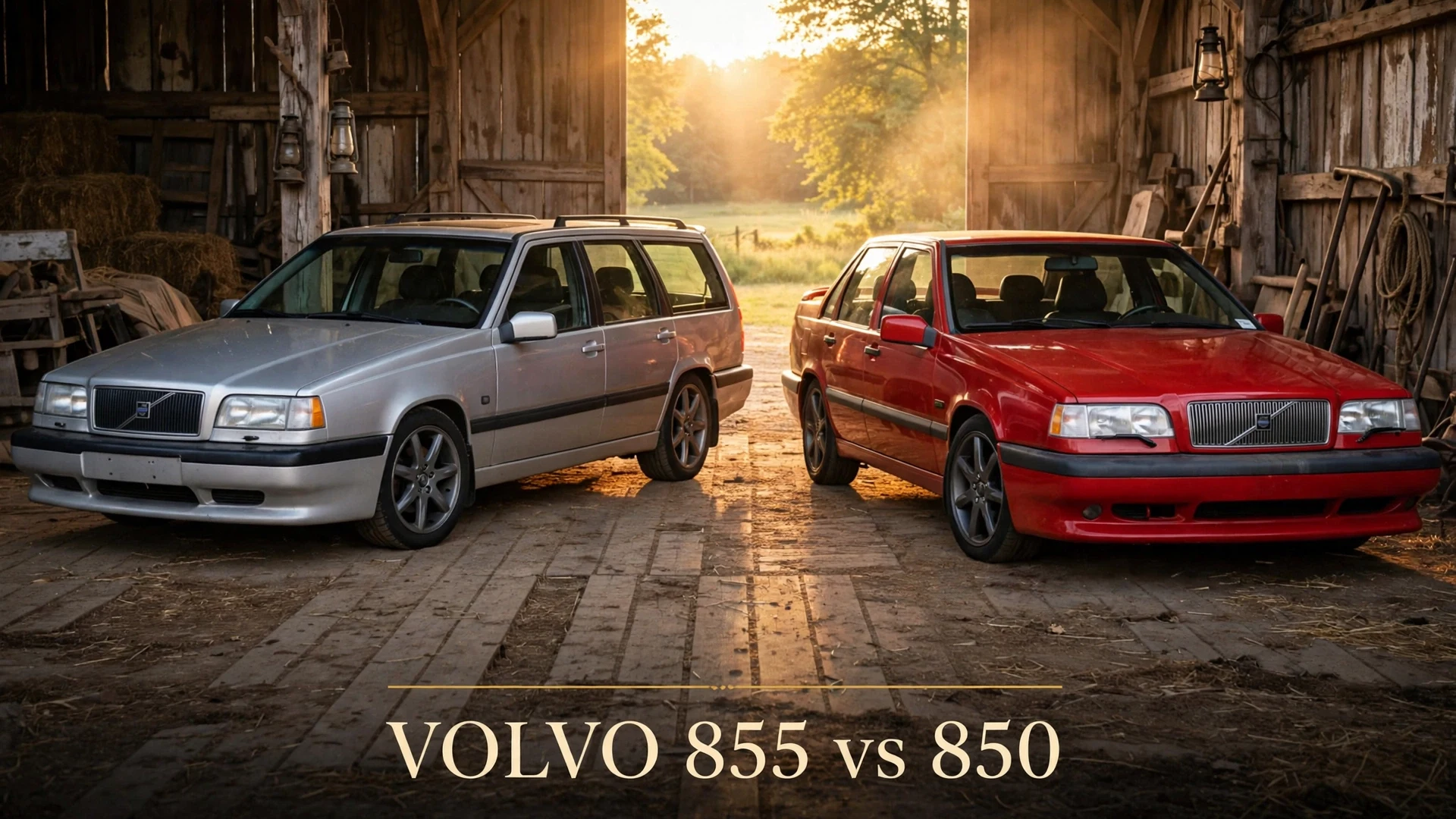
Volvo 855 vs 850?

Volvo 855 vs 850?
There is no “855” model and no “850” model as separate cars. 850 is the model; 854 and 855 are Volvo’s internal chassis codes for its two body styles — 854 is the four-door sedan, 855 is the five-door wagon. Same platform, same engines, same front-wheel-drive layout, same model years (1991–1997). The only real differences are the body behind the B-pillar: the wagon adds roughly 100 kg of weight, a few thousand dollars on the original sticker, and more than four times the cargo space.
- 855 = wagon, 854 = sedan. The digits decode as 8 (series), 5 (five-cylinder), 4 or 5 (door count), per Volvo’s own technical documentation filed with NHTSA.
- Same mechanicals. Every engine offered in the sedan was offered in the wagon, including the 225-hp T5 turbo.
- Cargo is the whole story: 1,051 litres seats-up and 1,897 litres folded in the wagon versus a 416-litre sedan trunk.
- Price gap was modest: about $1,555–$1,970 more for the wagon at 1995 US MSRP.
- Buy the 855 wagon unless you specifically want the lighter, slightly sharper sedan — which is rarer today in good condition.
Where the 854 / 855 Numbering Comes From
Volvo’s internal model coding in the 1990s was more logical than it looks. A Volvo Cars of North America technical journal filed with NHTSA lists the range as “850 / 854 / 1993–1997 / five cylinder, four door” and “850 / 855 / 1994–1997 / five cylinder, five door.” Read the three digits as series / cylinder count / door count: the 8-series, a five-cylinder engine, four or five doors.
This is why you’ll find “855” stamped on data plates, in parts catalogues, and in VIN-decoding tools for cars that wear an “850” badge on the trunk. It is not a trim level, not a special edition, and not a different generation — it is simply how Volvo’s factory systems distinguished the wagon body from the sedan body. The same convention applied across the range: the S70 sedan that replaced the 850 was coded 874, and the V70 wagon 875.
The confusion is understandable because Volvo itself was inconsistent. Marketing material, owner’s manuals, and most of the motoring press just said “850” for both bodies, while service literature, crash-test reports, and insurance databases used the three-digit codes. Three decades later, that split still sends buyers down a rabbit hole of thinking they’ve found some rare variant. They haven’t — but the wagon they found might still be worth buying, which is the more useful question.
Production History and Sales Split
The 850 sedan launched in 1991 as Volvo’s first front-wheel-drive executive car and the car that arguably saved the company’s reputation for building anything other than boxy rear-drive tanks. The wagon followed in February 1993 and reached the US as a 1994 model. Both bodies ran through the 1996 model year in most markets (with 1997-model-year cars in some regions) before the S70 sedan and V70 wagon took over.
Volvo built 716,903 examples of the 850 in total: 390,835 sedans and 326,068 wagons. The wagon was the slower seller when new — Americans in the mid-1990s were already migrating to SUVs — but it is the body style collectors and enthusiasts chase today. Survivors in good condition skew heavily toward wagons, partly because wagon buyers tended to be careful long-term owners and partly because the 850 wagon, especially in T5 and T-5R form, earned genuine performance credibility that the sedan never quite matched in the public imagination.
Specs at a Glance: 854 Sedan vs 855 Wagon
Mechanically the two bodies are identical. The differences below come from Volvo’s own press kits and period technical data:
| Specification | 854 Sedan | 855 Wagon |
|---|---|---|
| Production | 1991–1996 | 1993–1996 (US from 1994 MY) |
| Engines | 2.0 20V, 2.5 10V/20V, 2.3 T5 turbo, 2.5 TDI | Same engine range as sedan |
| T5 output | 225 hp / 300 Nm (US: 222 hp / 221 lb-ft) | Identical |
| Curb weight | 1,442–1,487 kg | 1,497–1,536 kg |
| Cargo capacity | 416 L trunk | 1,051 L seats up / 1,897 L folded |
| 0–62 mph, T5 | 7.4 s | 7.5 s |
| 0–62 mph, 2.5 GLT | 9.3 s | 9.5 s |
| 1995 US base MSRP | $25,140 | $26,695 |
| 1995 US GLT MSRP | $27,570 | $29,540 |
| Total built | 390,835 | 326,068 (rarer today) |
The weight penalty for the wagon body is roughly 50–100 kg depending on trim — about the weight of one adult passenger. Volvo’s own press-kit acceleration figures show what that costs: one tenth of a second to 62 mph for the T5, two tenths for the naturally aspirated GLT. In real driving, you will never feel it.
Cargo Space Visualized
This is the chart that settles the debate. The wagon doesn’t just beat the sedan on cargo — it more than quadruples it with the rear seats folded:
Where the Wagon (855) Pulls Ahead
The case for the wagon is almost entirely practical, and it is overwhelming. With 1,051 litres behind the rear seats and 1,897 litres with them folded, the 855 swallows things the sedan simply cannot: flat-pack furniture, bicycles upright, a full camping setup, a large dog crate. The load floor is flat, the tailgate opening is wide and square, and the rear seat folds in a 60/40 split. Period reviews praised the wagon’s cargo bay as best-in-class, and three decades of owners have confirmed it.
There is also a market argument. Because fewer wagons were built (326,068 versus 390,835 sedans) and because the fast wagons — T5 and especially T-5R — became cult cars, clean 855s command stronger prices today than equivalent sedans. If you buy well, the wagon is the safer place to put your money. Insurance and parts costs are effectively identical between the bodies: same engines, same transmissions, same suspension, same brakes. The only wagon-specific parts are body panels, glass, and interior trim aft of the B-pillar.
Finally, there is the intangible: the 850 wagon is the car that made Volvo cool in the 1990s. The BTCC racing estates, the T-5R in Cream Yellow — the wagon carries the cultural weight of the entire 850 legend. The sedan is a very good car. The wagon is the icon.
Where the Sedan (854) Still Makes Sense
The sedan’s advantages are real but narrow. It is lighter by roughly a passenger’s weight, which gives it the tenth-of-a-second edge in acceleration and a barely perceptible advantage in agility. Its drag coefficient of 0.32 is respectable for the era, and the enclosed trunk is more secure than a wagon’s cargo bay for valuables — out of sight, out of mind. Road noise is marginally lower without the big echo chamber of a wagon’s load area, and the sedan’s rear styling has aged gracefully.
Price is the other factor. When new, the sedan undercut the wagon by $1,555 at base trim and $1,970 in GLT trim — real money in 1995. On the used market today, sedans still tend to trade at a discount to comparable wagons, which makes the 854 the value play: same engines, same safety structure, same driving experience, less money. If you don’t need the cargo space, the sedan gives you 95 percent of the 850 experience for 80 percent of the price.
One caveat: because sedans were cheaper and more common, they were more likely to be bought as disposable transport and run into the ground. A larger share of surviving sedans are worn out. Budget for a thorough pre-purchase inspection either way, but be extra skeptical of cheap sedans.
Which 850 Should You Buy?
Pick the scenario that matches you:
Verdict: Buy the Wagon, Unless You Won’t Use It
For most buyers, the 855 wagon is the right 850. It does everything the sedan does, carries four times the cargo, holds its value better, and owns the cultural legacy. The price premium when new was modest, and on today’s market the gap is small enough that the wagon’s advantages cost you almost nothing.
Buy the 854 sedan if you genuinely don’t need a wagon’s space and you’d rather pocket the discount — or if you find a genuinely clean, well-documented sedan, which is becoming the rarer find in enthusiast condition. Either way, buy on condition and service history, not on body style: a neglected wagon is a worse car than a cherished sedan, every time.
Sources
- Volvo Cars heritage media releases — 850 production figures (716,903 total; 390,835 sedan / 326,068 wagon) and production years.
- Volvo Cars of North America Technical Journal via NHTSA (SB-10054947-7568) — 854/855 body-code definitions.
- Volvo UK October 1993 T-5 press kit — engine outputs (2.5 20V 170 hp, T5 225 hp / 300 Nm), weights, 0–62 mph times.
- CarGurus / J.D. Power historical pricing data — 1995 US MSRP figures.
- Autoblog — original 1994 window-sticker reference ($30,985 loaded Turbo wagon).
Frequently Asked Questions
Is the Volvo 855 a different car from the Volvo 850?
No. 850 is the model name; 855 is Volvo’s internal chassis code for the five-door wagon version of the 850. The sedan version is coded 854. They share the same platform, engines, and transmissions.
What does 855 mean on a Volvo?
It decodes as 8 (the model series), 5 (five-cylinder engine), 5 (five doors) — i.e., the wagon body style of the 850, per Volvo’s technical documentation. The sedan is 854: same series and engine, four doors.
Are parts interchangeable between the 854 sedan and 855 wagon?
Almost entirely, yes. Engines, gearboxes, suspension, brakes, electrics, and all front bodywork are identical. Only wagon-specific items — tailgate, rear glass, rear side panels, and cargo-area trim — differ.
Which is worth more today, the 850 sedan or wagon?
The 855 wagon, consistently. Fewer were built, demand from enthusiasts is stronger — especially for T5 and T-5R wagons — and clean examples command a clear premium over equivalent sedans.
Did the wagon come with the T5 turbo engine?
Yes. Every engine in the 850 range, including the 225-hp 2.3-litre T5 turbo, was available in both the 854 sedan and the 855 wagon. The T5 wagon does 0–62 mph in 7.5 seconds, just a tenth behind the sedan.
How much cargo space does the 850 wagon have?
1,051 litres with the rear seats up and 1,897 litres with them folded — more than four times the sedan’s 416-litre trunk. Figures are per period Volvo technical data; US sources quote 37.1 and 67.0 cubic feet.