Volvo Amazon vs Ferrari 599: Which Classic Deserves Your Garage?

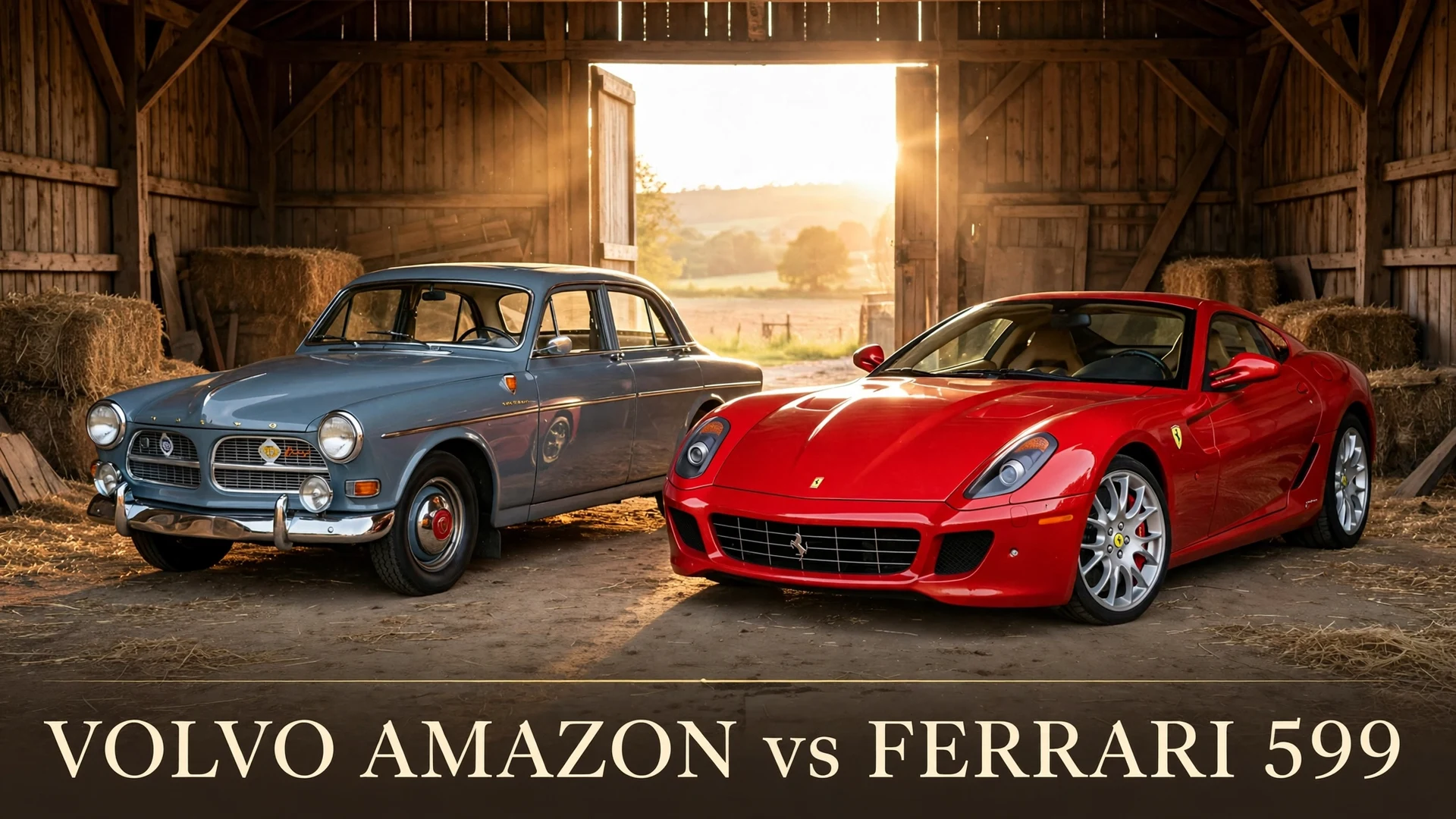
Nobody cross-shops a Volvo Amazon against a Ferrari 599 — and that is exactly why the comparison is interesting. One is a boxy, safety-obsessed Swedish family car from the 1950s; the other is a 612-horsepower Italian V12 grand tourer built half a century later. Put them side by side and you stop comparing cars and start comparing philosophies: what Volvo optimized for in 1956 versus what Ferrari optimized for in 2006. This is a dream-garage thought experiment, not a buyer’s guide for the undecided — but it turns out both cars teach the same lesson about what makes a classic worth owning.
Key Takeaways
- Volvo built 667,791 Amazons from 1956 to 1970; Ferrari built roughly 3,500 599 GTBs from 2006 to 2012. Scarcity is priced into everything about the Ferrari.
- The Amazon’s power output across its life ranged from 66 to 115 hp — about one-ninth of the 599’s 612 hp.
- The Amazon was among the first production cars to make the three-point seatbelt standard equipment; the 599 debuted Ferrari’s F1-Trac traction control and magnetorheological dampers on a road car.
- A nice driver-quality Amazon costs $12,000–$20,000; a nice 599 GTB costs roughly $140,000–$180,000 — ten times as much, and ten times the maintenance budget.
- Both cars are mechanically honest in their own way: the Amazon is simple to fix, the 599 rewards owners who keep up with specialist maintenance.
The question behind the question
Comparisons usually start with a buyer torn between two options. This one starts somewhere better: curiosity. The Amazon and the 599 are each arguably the purest expression of their maker’s philosophy. Volvo in 1956 was a small Swedish company that had decided — almost perversely, given the market — that safety and durability would be its religion. Ferrari in 2006 was a company that had decided speed would be its poetry. Each car is the company talking about itself, loudly.
And there is a hidden connection. The Amazon arrived at exactly the moment the modern family car was being invented; the 599 arrived as the front-engined supercar was being reinvented. Both were transitional flagships, both were built to be used hard — the Amazon on Swedish gravel in winter, the 599 on the Fiorano test track.
The case for the Swede: Volvo Amazon (1956–1970)
The Amazon — known as the 122S in the United States, where it debuted at the New York International Auto Show in April 1959 — was Jan Wilsgaard’s first major design for Volvo. Underneath was a ladder of four-cylinder pushrod engines that became legendary for high mileage: the 1.6-liter B16 (66–85 hp), the 1.8-liter B18 (75–115 hp), and from 1968 the 2.0-liter B20.
The variant collectors chase is the 123GT, built in 1967–1968: about 1,500 two-doors fitted with the P1800’s high-compression B18B engine, a four-speed with overdrive, front disc brakes, and a rev counter. It is, depending on your generosity, the car that invented the sports sedan before anyone gave it a name.
Safety is where the Amazon made history. It was among the very first production cars in the world to make the three-point seatbelt standard equipment — the Nils Bohlin design Volvo famously gave away to the industry. Add a padded upper dashboard, a laminated windscreen, and genuine rustproofing, and you have a car engineered as if its passengers mattered more than its stylists.
The case for the Italian: Ferrari 599 GTB Fiorano (2006–2012)
The 599 GTB Fiorano replaced the 575M Maranello as Ferrari’s front-engined V12 flagship, debuting at the Geneva Motor Show in February 2006 and named for Ferrari’s private test circuit. Its party trick was the engine: the Tipo F140C, a 5,999 cc V12 derived from the Enzo hypercar’s powerplant, producing 612 bhp at 7,600 rpm with an 8,400 rpm redline. At the time it was the most powerful series-production Ferrari road engine ever built — and the first naturally aspirated production engine at Ferrari to crack 100 bhp per liter.
But the 599’s real significance is technological. It was the first Ferrari road car with SCM magnetorheological dampers — shocks filled with fluid that changes viscosity almost instantly under a magnetic field — and the debut of F1-Trac, the predictive traction control system previously reserved for Ferrari’s Formula 1 drivers. The five-position manettino dial on the steering wheel bundled throttle mapping, stability intervention, and damper calibration into one gesture. The aluminum space frame was 100 kg lighter than the 575’s chassis, and the underbody aero produced real downforce: 160 kg at 300 km/h.
Most buyers chose the F1 SuperFast automated gearbox, whose 100-millisecond shifts were twice as fast as the Enzo’s. A traditional six-speed manual was offered — and almost nobody took it: only about 30 of the roughly 3,500 cars built left Maranello with a clutch pedal. Those factory manuals are among the most valuable modern Ferraris in existence.
Specs at a glance
| Specification | Volvo Amazon 122S (B18) | Ferrari 599 GTB Fiorano |
|---|---|---|
| Production years | 1956–1970 (all Amazons) | 2006–2012 |
| Total production | 667,791 | ~3,500 |
| Engine | 1.8 L B18 inline-4, pushrod | 6.0 L Tipo F140C V12, DOHC |
| Power | 85 hp @ 5,500 rpm (122S) | 612 bhp @ 7,600 rpm |
| Torque | ~108 lb-ft | 448 lb-ft @ 5,600 rpm |
| 0–60 mph | ~13.5 seconds | 3.7 seconds |
| Top speed | ~99 mph (160 km/h) | 205 mph (330 km/h) |
| Transmission | 3- or 4-speed manual, optional overdrive; 3-speed auto | 6-speed F1 SuperFast automated; rare 6-speed manual |
| Curb weight | ~2,400 lb (1,100 kg) | ~3,700 lb (1,690 kg, dry figure quoted) |
| Layout | Front engine, rear-wheel drive | Front engine, rear-wheel drive |
| Signature technology | Standard three-point seatbelts, padded dash | F1-Trac, magnetorheological dampers, manettino |
| Price when new | ~$2,795 (1967 US price) | ~$300,000 |
| Typical value today | $12,000–$20,000 driver; up to ~$44,000 concours | ~$140,000–$180,000 for good cars |
Fifty years apart, on one timeline
Fifty years separate the Amazon’s debut from the 599’s.
Power, visualized
It is hard to internalize the gap between these cars until you see it as bars:
Horsepower at the flywheel. The 599 makes more power than five 123GTs combined — and revs to 8,400 rpm doing it.
What they cost to actually own
This is where the dream meets the spreadsheet. The Amazon is one of the cheapest classic cars in the world to keep running: the B-series engines are mechanically simple, parts availability is genuinely good (mechanical parts are easier to find than trim), and any competent independent shop can work on one. Owners typically budget a few hundred to a few thousand dollars a year for a well-sorted driver.
The 599 is, by supercar standards, not a fragile car — the F140 V12 is a robust engine — but everything is priced in Ferrari currency. Annual servicing runs roughly $2,000–$4,000 at a specialist; an F1 clutch replacement is commonly quoted in the $6,000–$10,000 range. The car rewards owners who buy the best-maintained example they can afford and then keep maintaining it that way. Buy the cheapest 599 for sale and the deferred maintenance will find you.
Illustrative ranges from owner forums and specialist guidance, not quotes. Individual cars vary enormously.
Driving them back to back (in your imagination)
The Amazon drives like a memory: unhurried steering, a long-throw gear lever, an engine that makes a cheerful racket without ever hurrying. At 55 mph on a back road it is perfect; on the freeway it is working hard and you are part of the machine. That participation is the point.
The 599 drives like a prophecy: the V12 climbs toward its 8,400 rpm redline with a shriek no turbocharged car has matched. The magnetorheological dampers give it a ride its predecessors could not have dreamed of, and F1-Trac lets mortals use most of the 612 hp. It flatters you; the Amazon includes you.
Collectibility: who wins the long game?
The Amazon is the affordable classic done right: values have risen steadily but sanely, the 123GT leads the market, and there is no cliff edge — Hagerty’s valuation for a 1967 122S runs from about $12,100 in fair condition to $43,700 at concours. Buy on condition, keep it original, drive it.
The 599 sits in the classic modern-supercar sweet spot: old enough to feel analog, new enough to use. Good driver-quality cars trade in the mid-$100,000s; the factory-manual cars, of which roughly 30 exist, trade at enormous premiums.
Verdict
The honest verdict is that these cars are not competing with each other; they are competing with every other way you could spend the money. Against a modern hot hatch, the Amazon offers soul at the cost of pace. Against a modern supercar, the 599 offers an analog V12 at the cost of warranty. The Amazon endures because it was built to be kept. The 599 endures because it was built to be remembered.
Frequently asked questions
How many Volvo Amazons were built?
Volvo built 667,791 Amazons between July 1956 and July 1970 — 359,917 two-door saloons, 234,653 four-door saloons, and 73,221 estates. The commonly quoted 1.1-million figure confuses the Amazon with Volvo’s total output of the era.
How much is a Volvo Amazon worth today?
A driver-quality Amazon typically sells for $12,000–$20,000. Hagerty’s valuation for a 1967 122S ranges from about $12,100 in fair condition to $43,700 at concours level, with the rare 123GT commanding a premium over standard cars.
How fast is the Ferrari 599 GTB Fiorano?
Ferrari quoted 0–62 mph in 3.7 seconds and a top speed of 205 mph (330 km/h) from the 612-bhp 6.0-liter V12. Independent testers have recorded the sprint slightly quicker, in the mid-3.5-second range.
How many Ferrari 599 GTBs were built, and how rare is the manual?
Ferrari built roughly 3,500 examples of the 599 GTB between 2006 and 2012. Only about 30 left the factory with the traditional six-speed manual gearbox — the rest used the F1 SuperFast automated transmission — making the manual one of the rarest modern Ferraris.
Which is cheaper to own: the Amazon or the 599?
The Amazon, by an order of magnitude. A well-sorted Amazon typically costs a few hundred to a few thousand dollars a year to run, while a 599’s annual servicing runs $2,000–$4,000 at a specialist — before big-ticket items like an F1 clutch ($6,000–$10,000) or carbon-ceramic brake rotors.