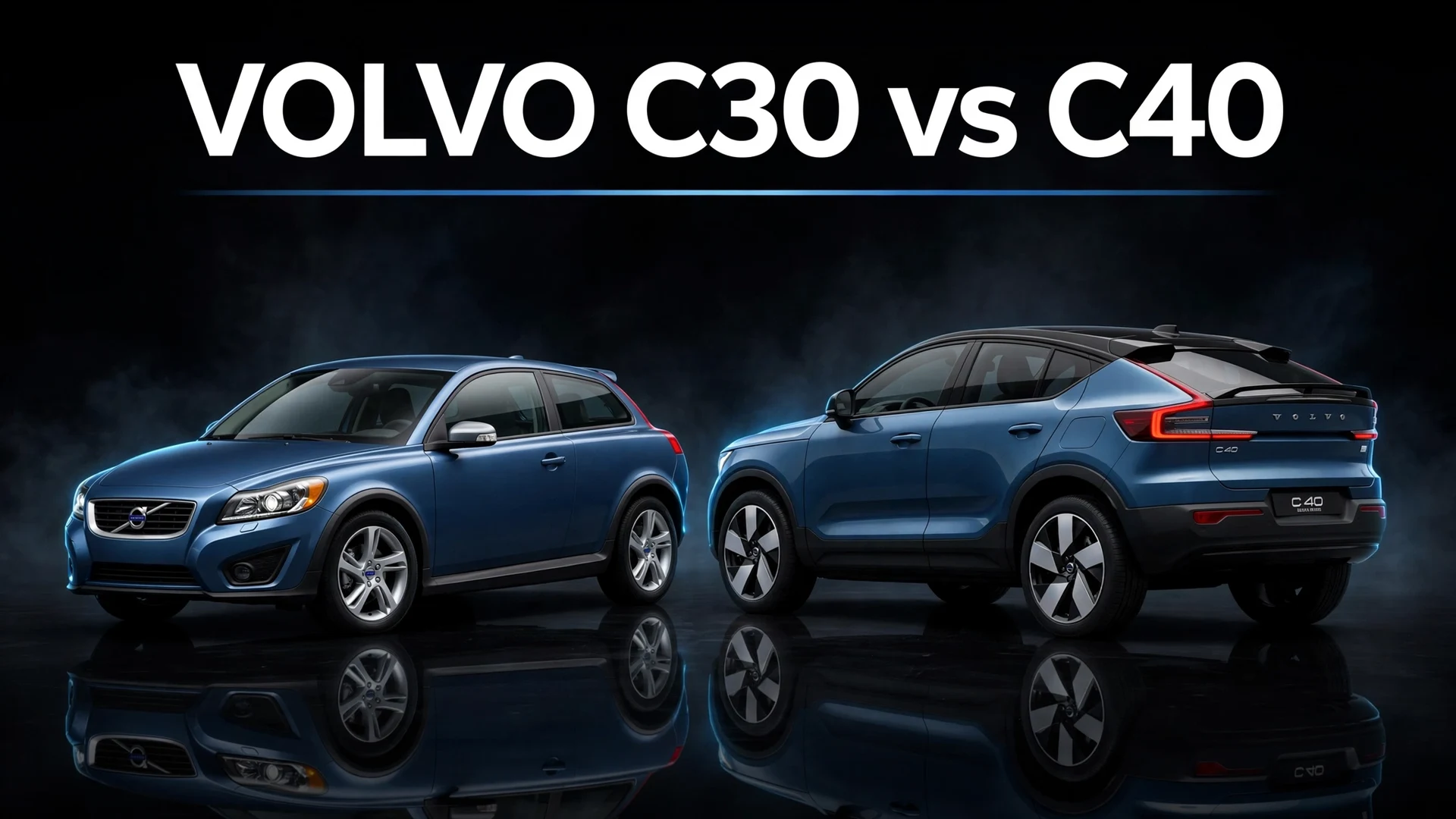
Volvo C30 vs C40: Same Letter, Different Century — Which Should You Buy?

Notice a C30 and a C40 in Volvo’s history and assume they’re related? They share a letter — and almost nothing else. The C30 was a gas-powered three-door hot hatch from the late 2000s; the C40 was a fully electric coupe-SUV from the 2020s. This isn’t an old-vs-new comparison of the same car. It’s two completely different answers to the same question: what should a style-first Volvo be?
- Same letter, different century: the “C” badge has always meant “style comes first” at Volvo — the C30 and C40 are unrelated mechanically, built nine years apart on different platforms.
- The C40 is far quicker: the twin-motor C40 hits 60 mph in 4.6 seconds with 402 hp; the quickest C30 T5 needs about 6.2 seconds with 227 hp.
- The C30 is far lighter: 2,970 lbs vs. roughly 4,780 lbs for the C40 — nearly a ton of batteries and modern safety structure separates them.
- Both are used-only in the US now: the C40 badge ran 2022–2024 and its EC40 successor was never sold stateside, while the C30 left in 2013.
- Pick by mission: weekend fun and character for hot-hatch money goes to the C30 T5; silent daily pace and modern safety go to the C40.
What “C” Has Always Meant at Volvo
Volvo’s naming logic is famously literal: S for sedan, V for versatile (wagon), XC for cross-country. C stands for coupe — or at least coupe-flavored. The badge debuted on the C70 (1997–2013), Volvo’s elegant convertible and coupe built with Pininfarina, then moved to the C30 in 2006: a three-door hatch with a frameless glass tailgate that was Volvo’s deliberate play for younger buyers. The C40, revealed in 2021, carried the letter into the electric age as a sloped-roof crossover — and in 2025 Volvo renamed it the EC40 to fit the new EX30/EX90 naming family, retiring the “Recharge” name entirely.
So the “C” promises design leadership, not mechanical lineage. The C70 was a Pininfarina collaboration, the C30 was a Ford-platform hatch, and the C40 is a CMA-platform EV. The letter is a styling philosophy, not a bloodline.
Two Cars, Two Eras
The C30 lived in the Ford era. Launched in 2006 (US sales from 2008), it rode on Volvo’s P1 architecture — the Ford C1 platform shared with the Mk2 Focus and Mazda 3. The headline act was the T5: a 2.5-liter turbocharged inline-five making 227 hp and 236 lb-ft, the same basic engine family that powered the contemporary Focus ST. With a six-speed manual, a T5 could hit 60 mph in about 6.2 seconds — genuine hot-hatch pace in 2008, wrapped in a body with that famous frameless glass tailgate and seating for just four.
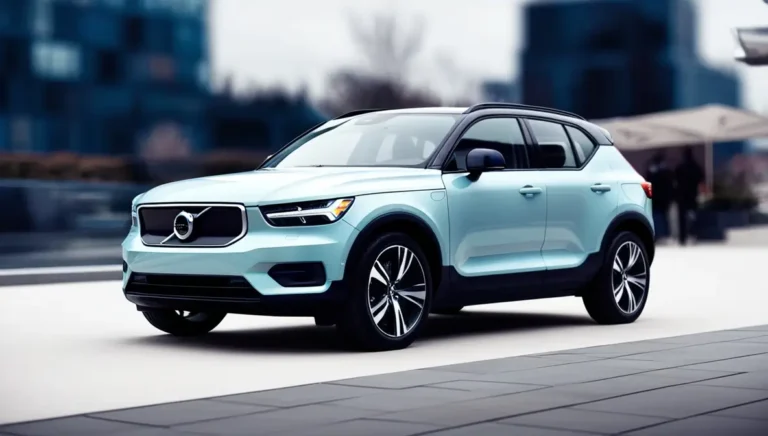
The C40 lived in the electrification era. Revealed in 2021 as Volvo’s first model designed electric-only from the start, it launched in the US for 2022 on the CMA compact platform — the same bones as the XC40 Recharge. The twin-motor version paired two electric motors for 402 hp and 494 lb-ft, good for 0–60 in 4.6 seconds (2024 spec), with a 78 kWh battery and 257 miles of EPA range. A 2024 single-motor extended-range version offered 248 hp, an 82 kWh pack, and 297 miles of range. For 2025 Volvo renamed it the EC40 and dropped the Recharge name — then decided not to bring the EC40 to the United States at all, making US-market C40s a 2022–2024 used proposition.
Specs at a Glance
| Spec | Volvo C30 T5 | Volvo C40 Twin Motor |
|---|---|---|
| Model years (US) | 2008–2013 | 2022–2024 (renamed EC40 for 2025, not sold in US) |
| Platform | P1 (Ford C1; shared with Mk2 Focus) | CMA (shared with XC40 Recharge) |
| Powertrain | 2.5L turbo inline-5, FWD | Dual-motor electric, AWD |
| Power / torque | 227 hp / 236 lb-ft | 402 hp / 494 lb-ft |
| 0–60 mph | ~6.2 sec (manual) | 4.6 sec (2024) |
| Battery / range | N/A (gas, 19/28 mpg) | 78 kWh; 257 mi EPA (2024) |
| Curb weight | 2,970 lbs | ~4,780 lbs |
| Length / wheelbase | 167.4 in / 103.9 in | 174.8 in / 106.4 in |
| Cargo (seats up / down) | 12.9 / 20.0 cu ft | 15 / 49 cu ft |
| Seating | 4 (2+2) | 5 |
| New price (US) | ~$22,700–$25,700 (2008 T5) | ~$56,000–$60,000 (2022–2024) |
| 2026 reality | Used: roughly $4,000–$10,000 | Used: roughly $24,000–$34,000 |
The Performance Gap, Visualized
Seventeen years of progress, in four pairs of bars. Note the 0–60 chart, where a shorter bar means a quicker car.
Figures: manufacturer and EPA data. 0–60 for the C30 is the six-speed manual; the C40 figure is 2024 twin-motor spec. Bars are proportional within each pair.
What the C30 Got Right That the C40 Doesn’t
Lightness and simplicity. At under 3,000 lbs, the C30 T5 is a genuinely small car — 7 inches shorter than the C40 and more than 1,800 lbs lighter. It has a manual gearbox, hydraulic-era steering feel, and a turbo five with real character. Nothing to charge, no software updates, no range math.
Price of entry. A decent C30 T5 costs what a set of tires costs for a modern EV — roughly $4,000 to $10,000 in 2026. Insurance is cheap, parts are shared with the high-volume P1 family (S40, V50, C70), and any independent Volvo shop knows the car inside out.
Distinctiveness. The frameless glass tailgate still turns heads, and the C30 is old enough now to be crossing into future-classic territory — especially final-year R-Design cars with the six-speed.
What the C40 Does Better
Speed and silence. The twin-motor C40 is nearly two seconds quicker to 60 than the C30 T5 while making no noise doing it. Instant torque, all-wheel drive, and one-pedal driving make it the effortless daily.
Safety and tech. Nearly two decades of progress: a full modern driver-assistance suite, a stiffer crash structure, and over-the-air updates that kept improving the car after purchase.
Running costs. Electricity and minimal maintenance (no oil, no timing belt, no spark plugs) vs. premium-adjacent fuel and aging-turbo upkeep. For high-mileage drivers, the math favors the EV even at a higher purchase price.
Buying Either in 2026
C30 T5: buy on condition, not mileage — rust, deferred maintenance, and tired suspension bushings matter more than the odometer. Budget for a timing-belt service (due around 120,000 miles) if there’s no record, and favor the six-speed manual over the five-speed automatic for both pace and resale. The five-cylinder is stout, but PCV and cooling-system items are the known watch points on higher-mile cars.
C40: the sweet spot is a 2024 single-motor extended-range car — 297 miles of range and the lowest used prices — or a twin-motor if you want the 4.6-second pace. Check battery health reports and tire wear (heavy EVs eat tires), and confirm which software version is installed, since Volvo improved efficiency and charging behavior over the air. Note that with the EC40 never sold in the US, parts and software support flow through the existing C40/Recharge channels — fine for now, but buy from a dealer or specialist who knows the platform.
Which C Should You Buy?
Tap your profile — each names a winner and the one thing to get right.
The Verdict
The C30 and C40 were never rivals and never will be — they’re two answers to “what should a stylish Volvo be?” from two different centuries of the company. If you want the drive, buy the C30 T5 and its turbo-five soundtrack. If you want the future, buy a used C40 and its silent 4.6-second shove. The letter on the tailgate is the only thing they share, and honestly, that’s enough to make the comparison fun.
FAQ
Is the Volvo C40 an electric version of the C30?
No. The C40 Recharge is built on the CMA platform it shares with the XC40 Recharge, while the C30 rode on Volvo’s P1 platform shared with the Mk2 Ford Focus. They were developed nine years apart and share no mechanical parts — only Volvo’s “C” naming convention for style-first models.
Which is faster, the C30 T5 or the C40 Twin?
The C40, by a wide margin. The twin-motor C40 reaches 60 mph in 4.6 seconds with 402 hp and 494 lb-ft of instant electric torque. The quickest C30 T5, with 227 hp from its turbocharged five-cylinder, needs about 6.2 seconds with the six-speed manual.
Can you still buy a new C40 in the United States?
No. The C40 badge was sold in the US for the 2022–2024 model years. For 2025 Volvo renamed it the EC40 to match the EX30/EX90 naming family, but the EC40 was never brought to the US market — so American buyers are limited to used C40s.
Is the C40 based on the XC40?
Effectively yes. The C40 is a near-mechanical twin of the XC40 Recharge, sharing the CMA platform, powertrains, and most hardware — but with a sloped coupe-style roofline that trades some cargo space and rear headroom for a sportier silhouette.
What should a used Volvo C30 T5 cost in 2026?
Roughly $4,000 to $10,000 depending on condition, mileage, and transmission — six-speed manuals and final-year R-Design cars command the top of the range. Budget for a timing-belt service around 120,000 miles if there’s no record of one, and buy on maintenance history rather than low mileage alone.