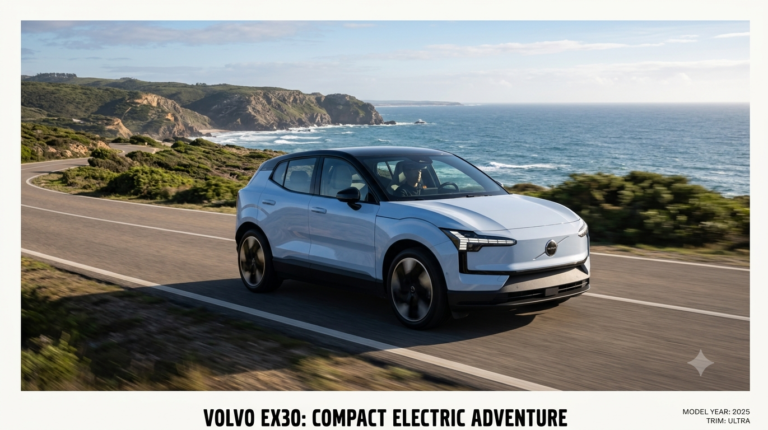
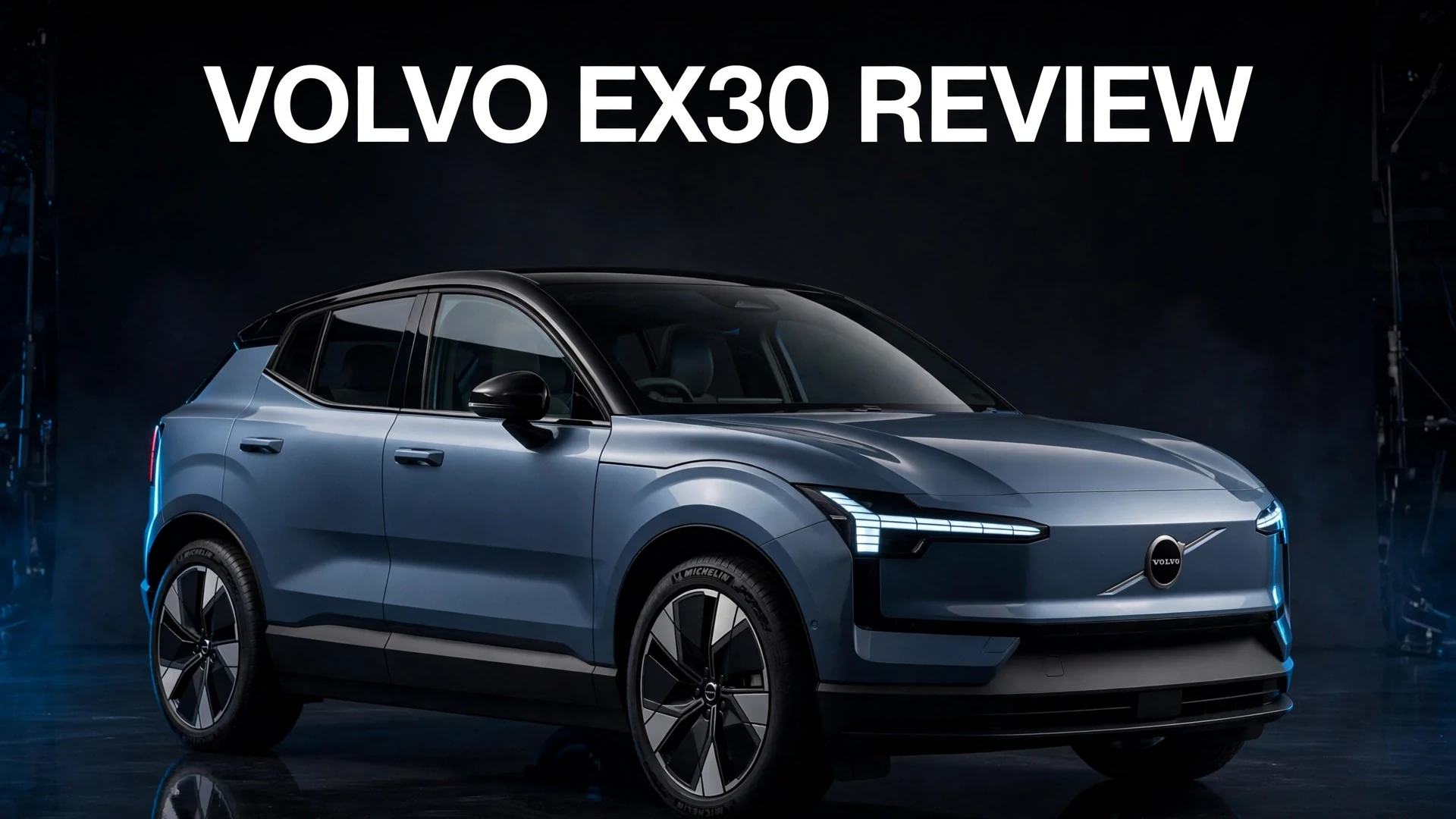
Volvo EX30 Review 2026: The Little Volvo That Conquered Europe and Died in America

Volvo EX30 Review 2026: The Little Volvo That Conquered Europe and Died in America
The short answer: the EX30 remains one of the most likeable small electric SUVs you can buy — startlingly quick, genuinely premium inside, five-star safe, and priced from around £33,060 in the UK. But if you live in the United States, this review comes with an obituary: Volvo discontinued the EX30 and EX30 Cross Country there after the 2026 model year, in March 2026. It is still on sale across Europe, Canada and Mexico, and the growing used market on both sides of the Atlantic is about to get interesting.
Key Takeaways
- The EX30 is Volvo’s smallest SUV and its first built on Geely’s Sustainable Experience Architecture (SEA), shared with the Smart #1.
- Three flavours: Single Motor (51 kWh, 272 hp), Single Motor Extended Range (69 kWh, 272 hp, up to 300 mi WLTP) and Twin Motor Performance (69 kWh, 422–428 hp, 0–62 mph in 3.6 s). A Cross Country lift-and-clad version tops the range.
- Five-star Euro NCAP rating (2024) and an 8-year/100,000-mile battery warranty keep the Volvo safety story intact.
- US buyers take note: Volvo confirmed in March 2026 that 2026 is the final model year in America after ~5,400 US sales in 2025; tariffs and the end of federal EV incentives killed it. The car lives on in Europe, Canada and Mexico.
- Real-world range lands at 200–240 miles on the big-battery cars and charging peaks at 153 kW (10–80% in under 30 minutes).
- The single-screen cabin is still the most divisive thing about it — there is no instrument cluster, and everything lives in the 12.3-inch touchscreen.
How the EX30 Went from $35,000 Promise to American Farewell
When Volvo unveiled the EX30 in mid-2023, then-CEO Jim Rowan called it “a small SUV doing Volvo things” and priced it to start at around $35,000 in the US — a figure that made the whole industry sit up. Reality, unfortunately, had other plans.
Tariffs on Chinese-built EVs torpedoed the original China-sourced plan, so Volvo moved US-bound production to Ghent, Belgium. Even Belgian-built cars then faced import tariffs, and when federal EV incentives disappeared for good after September 30, 2025, the arithmetic collapsed. Volvo sold roughly 5,400 EX30s in the US in 2025 — a fraction of what the Hyundai Ioniq 5 or Tesla Model 3 managed — and in March 2026 told dealers that 2026 would be the final model year stateside. Order books closed on March 20, 2026. Volvo stressed that existing owners keep full warranty, parts and software support, and that the car continues in Canada, Mexico and everywhere else.
EX30 Specs: The Three Powertrains, Explained
Every EX30 sits on the SEA platform and uses one of two battery packs: a 51 kWh LFP (lithium iron phosphate) pack in the cheapest cars, or a 69 kWh NMC pack in the rest. Single-motor cars are rear-wheel drive; Twin Motors add a front motor for all-wheel drive.
| Variant | Battery | Power | 0–62 mph | Official range | DC charging |
|---|---|---|---|---|---|
| Single Motor | 51 kWh | 272 hp | 5.7 s | 209 mi WLTP | 134 kW |
| Single Motor Extended Range | 69 kWh | 272 hp | 5.3 s | 296–300 mi WLTP | 153 kW |
| Twin Motor Performance | 69 kWh | 422 hp | 3.6 s | up to 279 mi WLTP | 153 kW |
| Cross Country (4WD) | 69 kWh | 422 hp | 3.7 s | ~270 mi WLTP | 153 kW |
The Twin Motor is the headline act: 422 hp in the US (434 PS in European metric reporting — same motor, different units) makes this 4,233-mm-long crossover the quickest-accelerating Volvo ever built. In America, the 2026 range was the $40,345 Single Motor (EPA 253–261 miles), the $46,345 dual-motor EX30, and the $49,545 Cross Country (EPA 227 miles). All now collector’s items of a sort, given the exit.
What’s Good and What’s Not
The good
- Performance that embarrasses cars twice the price — the Twin Motor hits 62 mph in 3.6 seconds.
- Interior materials feel genuinely premium: upcycled denim, recycled plastics, machined-metal door pulls, and four “room” themes with no leather.
- Remarkably quiet and composed over bad urban roads; reviewers rate it above the Smart #1 and Hyundai Kona Electric for refinement.
- Five-star Euro NCAP (2024) with high adult and child occupant scores — a proper Volvo in crash safety.
- 153 kW rapid charging gives 10–80% in 26–28 minutes on the big battery.
The not-so-good
- The cabin runs entirely through one 12.3-inch touchscreen — no instrument cluster, no head-up display as standard. Your speed lives sideways on a screen.
- Real-world range sits at 200–240 miles on the big-battery cars, noticeably short of the WLTP claims; efficiency of ~3.0–3.7 mi/kWh trails the best rivals.
- The 318-litre boot and tight rear legroom rule out family duty; it’s a two-adult car with occasional guests.
- Software gremlins and a battery recall have punctuated early ownership; Volvo’s vehicle warranty is 3 years/60,000 miles — half of Kia’s EV3 warranty.
- In the US it is now orphan stock: buy new-old-stock or used only, and budget for above-average depreciation.
Price and Value: Europe vs the American Goodbye
In the UK the EX30 starts at £33,060 for the Single Motor Core and runs to £47,060 for the Twin Motor Ultra, with the Cross Country from £41,260 to £46,650. At that money it undercuts the Smart #1’s platform-mate pricing advantage but lands squarely against the Kia EV3 (from ~£33,000), the class efficiency champion with a 7-year warranty and 372 miles of WLTP range.
In the US, the $40,345 starting price for the Single Motor was already well above the original $35,000 promise — and the car never regained momentum after federal incentives ended. If you’re an American shopper today, the sensible play is the used market: 2025–2026 examples with tiny mileage are likely to depreciate faster than average precisely because of the discontinuation, which is bad news for early buyers and potentially good news for bargain hunters who know a good EV when they see one. Volvo has publicly committed to continued warranty, parts and software support for all EX30 owners, so there is no Fisker-style abandonment risk.
Running Costs and Charging
The LFP-equipped base car is the cheapest to buy and its battery chemistry tolerates frequent full charges better than NMC. AC charging is handled by an 11 kW onboard charger; DC peaks are 134 kW (51 kWh) and 153 kW (69 kWh), so a 10–80% rapid session takes roughly 26–28 minutes at a capable charger. Cross Country models add a heat pump as standard, which helps winter efficiency. Tow ratings run from 1,000 to 1,600 kg depending on variant — respectable for a car this size.
Safety: Five Stars Where It Counts
Euro NCAP awarded the EX30 five stars in 2024, scoring 88 for adult occupants, 85 for children, 79 for vulnerable road users and 82 for safety assist. Automatic emergency braking, blind-spot monitoring and adaptive cruise are standard. Owners keep an 8-year/100,000-mile battery warranty (160,000 km in Australia) regardless of market.
The Rivals
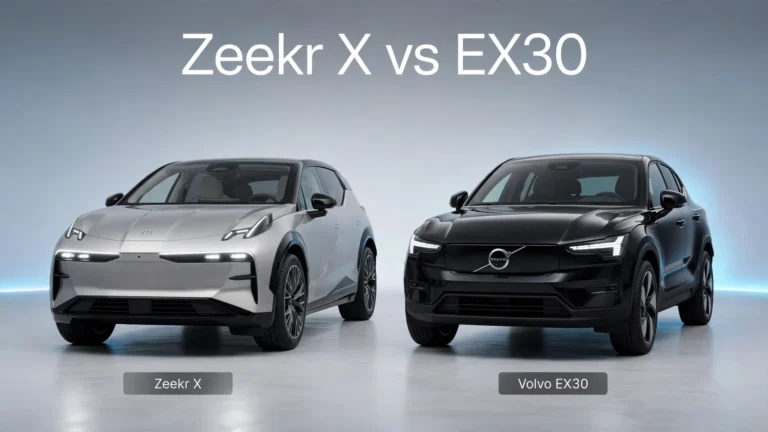
Kia EV3 — the logical choice: more range (up to 372 mi WLTP), bigger boot, 7-year warranty, and World Car of the Year 2025. Less exciting, more sensible. Smart #1 — same SEA platform and motors for less money, but build quality and safety credibility trail the Volvo. Mini Aceman — similar footprint and price, more character, less space and efficiency.
FAQ
Is the Volvo EX30 still on sale in the US?
No. Volvo confirmed in March 2026 that the EX30 and EX30 Cross Country would be discontinued in the United States after the 2026 model year, with new orders cut off on March 20, 2026. The car remains on sale in Europe, Canada, Mexico and other global markets, and existing US owners keep full warranty, parts and software support.
Which EX30 is the best value?
In the UK, the Single Motor Extended Range in Plus trim is the sweet spot: the 69 kWh battery for 200+ real-world miles, decent equipment, and it avoids the Ultra’s price jump. In the US market, the answer is now a used 2025–2026 Single Motor — depreciation from the discontinuation should make these the cheapest way into the car.
What is the real-world range of the Volvo EX30?
Expect 200–240 miles on the 69 kWh Extended Range and Twin Motor models in mixed driving, and closer to 180–200 on the 51 kWh base car. WLTP figures (up to 296–300 miles) are optimistic, as they are for most EVs. Motorway speeds and cold weather reduce range further.
How fast does the EX30 charge?
The 69 kWh battery accepts up to 153 kW DC, taking about 26–28 minutes for a 10–80% top-up at a capable rapid charger. The 51 kWh LFP car peaks at 134 kW. An 11 kW onboard AC charger handles home and destination charging.
Is the single-screen interior a dealbreaker?
It depends on you. Most reviewers report adapting within a few weeks, and the Google-based system is fast and well integrated. The real compromise is ergonomic: your speed is shown on a screen to your left rather than ahead of you. Higher trims don’t fix that, so test drive carefully — if it bothers you in 15 minutes, it will bother you for years.