Volvo EX30 vs Kia EV6?

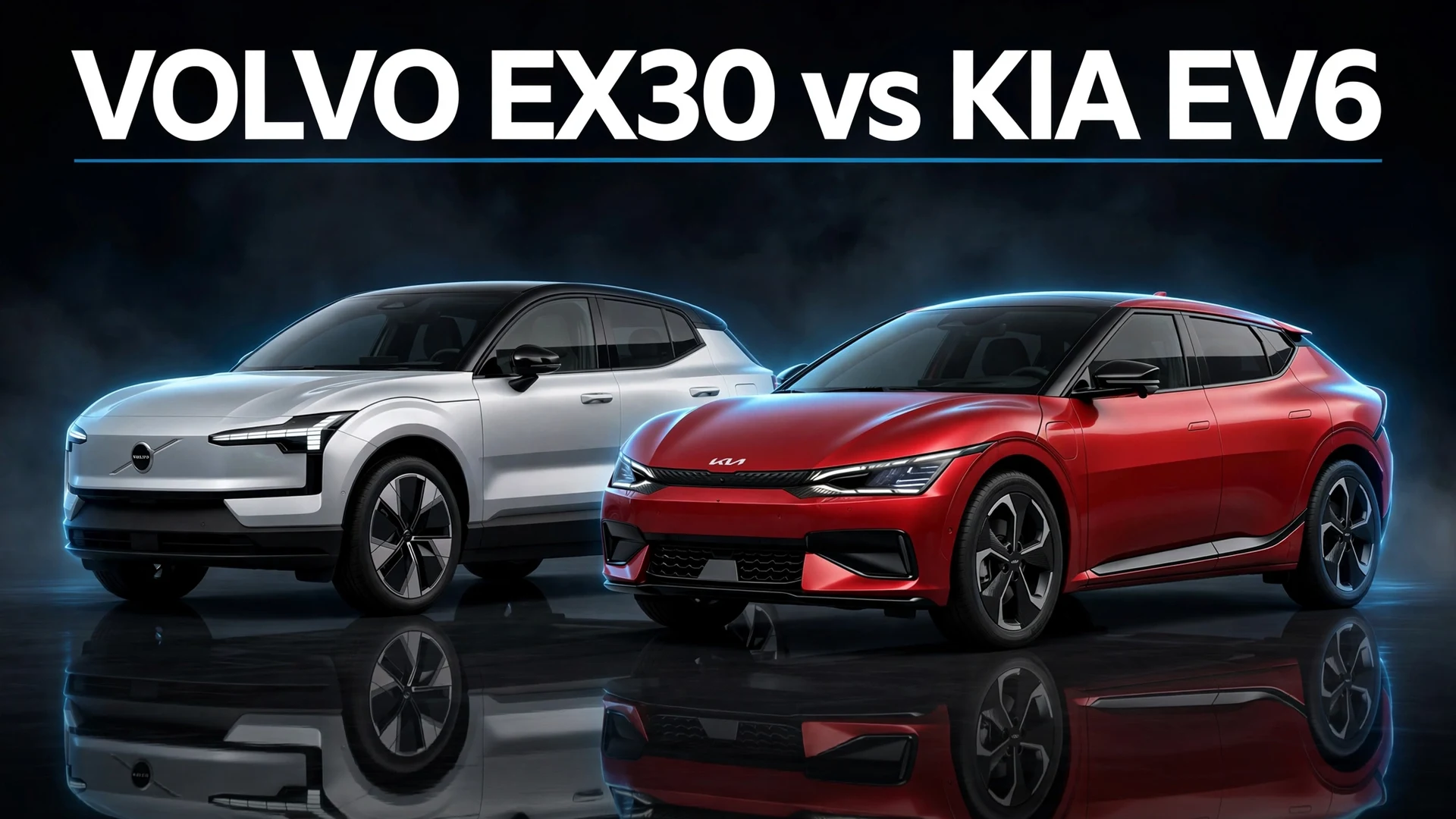
One’s a tiny, blisteringly quick Scandinavian hot hatch in SUV clothing. The other is a bigger, more practical crossover with genuinely long range. The Volvo EX30 and Kia EV6 sit in overlapping price territory, but they’re solving very different problems for very different buyers.
Quick answer: the Volvo EX30 is smaller, faster, and more style-focused, with a genuinely tiny back seat and modest range. The Kia EV6 is bigger, offers significantly longer range in its Light Long Range trim, and delivers more everyday practicality — at a comparable or even lower starting price.
TL;DR
- The EX30 starts around $38,950 and tops out near $48,150 for the Cross Country Ultra; the EV6 starts around $37,900–$39,445 and climbs into the mid-$50,000s for GT-Line AWD trims.
- The EX30’s dual-motor Twin Motor Performance hits 60 mph in about 3.4 seconds — genuinely supercar-quick for this price range.
- The EV6 offers up to 319 miles of EPA-estimated range in its Light Long Range trim, well beyond the EX30’s 227–261-mile range depending on configuration.
- The EX30’s back seat is famously tight — reviewers have called it “essentially uninhabitable by adults” — while the EV6 offers a genuinely usable back seat and larger cargo area.
- If raw speed and Scandinavian style are your priority, the EX30 wins. If range and practicality matter more, the EV6 has a clear edge.
Volvo EX30 vs Kia EV6: The Basics
These two EVs technically compete in similar price territory, but they’re not really the same size class. The EX30 is Volvo’s smallest and most affordable EV, built specifically for city driving and buyers who prioritize style and quickness over outright space. The EV6 sits a class up in practical terms — longer, roomier, and built with road-trip range in mind.
For 2026, the EX30 lineup includes Plus, Ultra, and a new off-road-styled Cross Country trim, with both single-motor and dual-motor configurations. The EV6 spans Light, Light Long Range, Wind, and GT-Line trims, with single- and dual-motor options across a wider power and range spread.
Quick Tip: If back-seat space for actual adult passengers is a requirement, this comparison is largely decided before you even look at price — the EV6 wins that category decisively.
Performance and Driving Feel
The EX30 is the quicker, more thrilling car to drive, full stop. The Twin Motor Performance EX30 produces 422 horsepower and reaches 60 mph in roughly 3.4 seconds — genuinely supercar-adjacent acceleration in a subcompact SUV body, and one of the fastest-accelerating Volvos ever built.
The EV6 counters with a wider spread of options rather than one headline number. Its single-motor variants make 225 horsepower (167 hp on the base Light Standard Range trim), while dual-motor versions produce 320 horsepower, and the top AWD configuration reaches a combined 641 horsepower in certain builds — putting its ceiling potentially even higher than the EX30’s, depending on trim.
Real-world scenario: A driver who wants their small EV to feel genuinely exciting on backroads and stoplight launches will love the EX30’s instant, aggressive acceleration. A driver who wants strong performance without necessarily chasing the absolute quickest 0-60 time, while keeping more flexibility across trims, will find the EV6 lineup more accommodating.
Range and Charging
This is where the EV6 pulls decisively ahead. The EX30’s range tops out at 261 miles for the Single Motor Extended Range trim, dropping to 253 miles for Twin Motor Performance and just 227 miles for the Cross Country variant. Edmunds testing found real-world range slightly beat those estimates, but the numbers still trail most rivals.
The EV6, by contrast, offers up to 319 miles of EPA-estimated range in its best configuration, with even the GT-Line AWD trim rated around 295 miles. Its 800-volt architecture also enables genuinely fast charging — 10% to 80% in under 18 minutes on a 350kW DC fast charger, versus the EX30’s roughly 26.5-minute 10-80% charge time.
Expert Insight: One review noted the EX30’s charging speeds are “below average” for the segment even though its efficiency is strong — meaning it uses energy well, but can’t replenish it as quickly as the EV6 when you’re on a road trip and need to get back on the road fast.
Interior Space and Practicality
The EV6 is meaningfully more practical, and reviewers have been blunt about the EX30’s limitations here. One review described the EX30’s back seat as “essentially uninhabitable by adults,” with cargo capacity behind the rear seats measuring just 12.4 cubic feet — less than a Toyota Corolla’s trunk.
The EV6, at 184.8 inches long with a 114.2-inch wheelbase, offers genuinely usable rear-seat space and a more conventional SUV-like cargo area, making it a far more realistic choice for anyone regularly carrying rear passengers or hauling cargo.
Comparison Table
| Category | Volvo EX30 | Kia EV6 |
|---|---|---|
| Starting price | $38,950 | $37,900–$39,445 |
| Top trim price | ~$48,150 (Cross Country Ultra) | Mid-$50,000s (GT-Line AWD) |
| Max horsepower | 422 hp (Twin Motor Performance) | Up to 641 hp (top AWD config) |
| 0–60 mph | ~3.4 seconds (Twin Motor) | ~5 seconds (GT-Line) |
| Max EPA range | 261 miles (Single Motor) | 319 miles (Light Long Range) |
| DC fast charge (10-80%) | ~26.5 minutes | Under 18 minutes (350kW) |
| Back seat space | Very tight, adult-unfriendly | Genuinely usable for adults |
| Cargo space | 12.4 cu ft | Notably larger |
Pros and Cons by Buyer Type
The City-Dwelling Style Enthusiast
- EX30 pros: Blistering acceleration, distinctive Scandinavian design, strong safety tech, easy to park and maneuver
- EX30 cons: Nearly unusable back seat and small cargo area
- EV6 pros: Still stylish and quick, with more everyday usability
- EV6 cons: Less overtly “premium boutique” feeling than the EX30’s design language
The Road-Trip and Range-Focused Buyer
- EV6 pros: Up to 319 miles of range and genuinely fast 800-volt charging
- EV6 cons: Slightly larger footprint may be less ideal for tight urban parking
- EX30 pros: Efficient use of the range it has
- EX30 cons: Range and charging speed both trail the EV6 meaningfully
The Family or Passenger-Focused Shopper
- EV6 pros: Usable back seat and cargo space for real passengers and gear
- EV6 cons: Interior material quality has drawn some criticism compared to rivals
- EX30 pros: None significant — this is the EV6’s clearest category win
- EX30 cons: Back seat and cargo space make it a poor fit for regular passenger duty
Which Should You Choose?
Choose the EX30 if you want the quickest, most style-forward small EV in this price range and mostly drive solo or with one passenger around town, where its size and speed are assets rather than limitations.
Choose the EV6 if you need real back-seat space, want longer range for road trips, and prioritize charging speed and everyday practicality over outright acceleration.
Alternative to consider: If you like the EX30’s size and price but want more range, the Volvo EX40 sits one step up in Volvo’s electric lineup with more space, starting around $54,000. Choose this if you want to stay within the Volvo brand but need more room than the EX30 offers.
FAQ
Which is faster, the Volvo EX30 or Kia EV6? The EX30’s Twin Motor Performance trim reaches 60 mph in about 3.4 seconds, quicker than the EV6 GT-Line’s roughly 5-second time — though the EV6’s top AWD configuration can reach as much as 641 combined horsepower in certain builds, so trim-for-trim comparisons matter.
Which has more range, the EX30 or the EV6? The Kia EV6 offers significantly more range, up to 319 miles in its Light Long Range trim, compared to the EX30’s maximum of 261 miles in Single Motor form.
Is the Volvo EX30’s back seat really that small? Yes, according to multiple reviews. Edmunds specifically described it as essentially unusable for adult passengers, making the EX30 better suited to solo or two-person driving rather than regular family use.
Which is more affordable, the EX30 or the EV6? Starting prices are close, with the EV6 typically starting slightly lower (around $37,900–$39,445) versus the EX30’s $38,950 starting point, though pricing shifts depending on trim and configuration.
Do both the EX30 and EV6 qualify for tax incentives? The federal EV tax credit was eliminated as of October 1, 2025, under the One Big Beautiful Bill Act, so neither vehicle currently qualifies for that former federal incentive. This isn’t tax advice — consult a tax professional for guidance on any state or local incentives that may still apply.
Key Takeaways
- The EX30 is quicker and more style-focused, but its back seat and cargo space are genuinely limiting for regular passenger use.
- The EV6 offers significantly more range and faster charging, along with real practicality for passengers and cargo.
- Starting prices are close between the two, making this largely a decision about priorities rather than budget.
- The EX30’s Cross Country trim adds off-road styling and capability the EV6 doesn’t directly match.
- Neither vehicle currently qualifies for the federal EV tax credit, which ended October 1, 2025.
Ready to Start Shopping?
Test drive both back-to-back with your actual passengers and cargo in mind — the EX30’s back seat limitation is the kind of thing that’s easy to underestimate on a spec sheet but obvious the moment someone tries to sit back there.