Volvo vs Kenworth vs Peterbilt?

Volvo vs Kenworth vs Peterbilt?
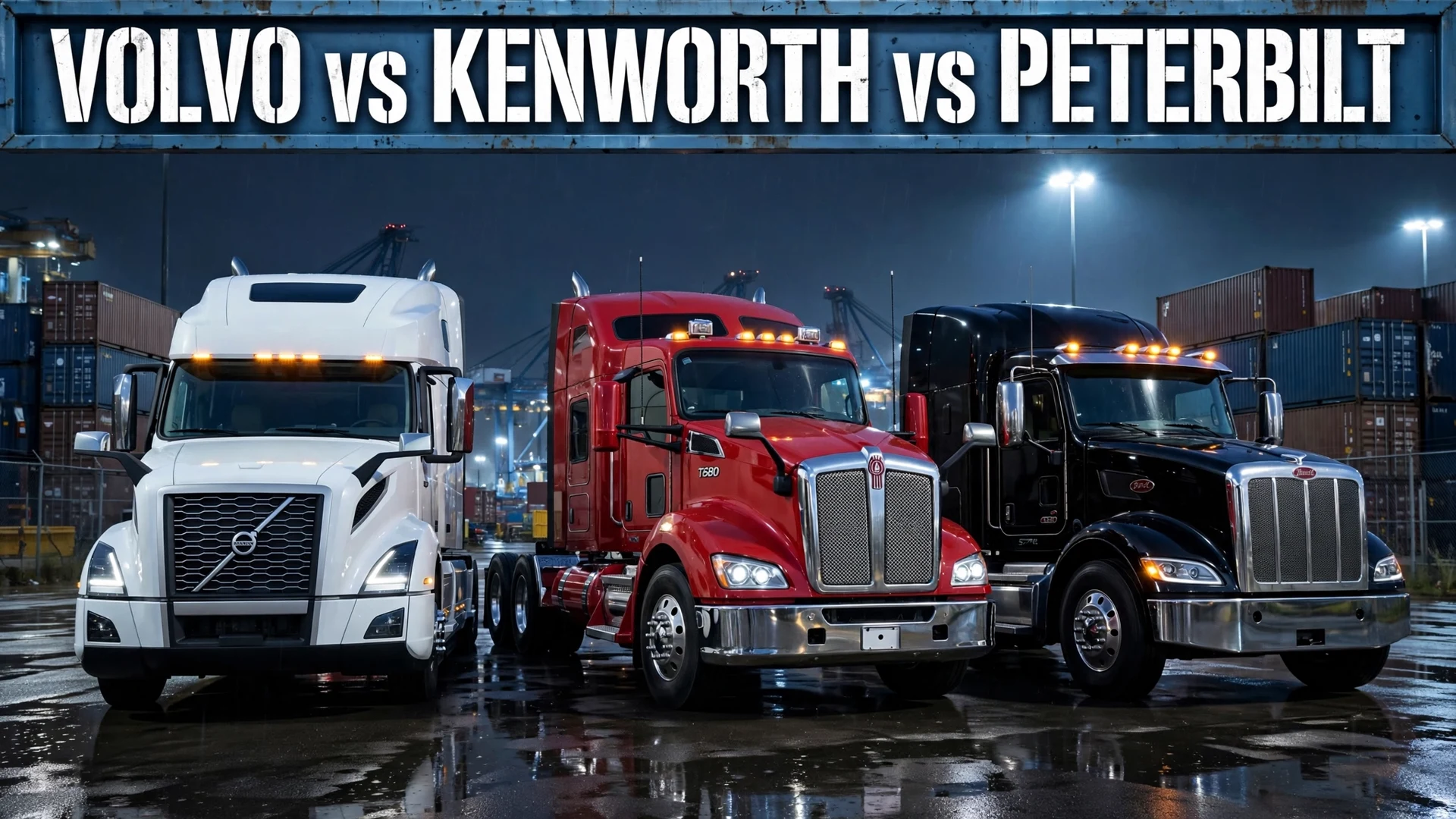
Volvo, Kenworth, and Peterbilt build the three most debated long-haul tractors in North America — the Volvo VNL, the Kenworth T680, and the Peterbilt 579. All three are Class 8 sleepers aimed at the same job, and all three can be spec’d with similar power. The differences that actually matter are fuel efficiency, driver comfort, dealer coverage, and resale value.
The short version: the Kenworth T680 has the strongest reputation for fuel efficiency thanks to its aerodynamics and predictive cruise; the Volvo VNL is the driver’s favorite for cab comfort and safety technology; and the Peterbilt 579 holds its value best on the used market and offers the most customization. Kenworth and Peterbilt are both PACCAR brands and share the MX-13 engine, so the choice between those two is mostly about priorities, not hardware.
- Kenworth and Peterbilt are sister brands under PACCAR and share the 12.9L MX-13 engine (405–510 hp, up to 1,850 lb-ft).
- The Volvo VNL runs Volvo’s own 12.8L D13 engine with the I-Shift 12-speed automated transmission.
- Kenworth claims the latest T680 is up to 7% more fuel efficient than the model it replaced; independent driver reports generally rank the T680 at or near the top for MPG.
- New-truck pricing overlaps heavily: roughly $160,000–$210,000 depending on spec, with the Peterbilt typically commanding the highest resale values.
- The VNL is widely regarded as the most comfortable and safety-focused cab of the three.
- Verdict: efficiency-focused fleets lean Kenworth, driver-retention operations lean Volvo, and owner-operators who care about resale and image lean Peterbilt.
The Brands and Their Flagships
It helps to be precise about what we are comparing, because each brand sells several models. This article compares the mainstream aerodynamic long-haul tractors: the Volvo VNL (most commonly the VNL 760/860 high-roof sleepers), the Kenworth T680 (typically the 76-inch mid-roof or high-roof sleeper), and the Peterbilt 579 (typically the 72- or 80-inch sleeper). These are the trucks that dominate fleet orders and used-truck listings, and the ones most buyers actually cross-shop.
One structural fact shapes the whole comparison: Kenworth and Peterbilt are both owned by PACCAR. That means the T680 and 579 share core powertrain hardware — the PACCAR MX-13 diesel and the PACCAR 12-speed automated transmission — and are built in the same engineering ecosystem. Volvo Trucks North America is a separate company with its own engines (the D13) and its own transmission (I-Shift). So a Volvo-vs-PACCAR comparison is a genuine hardware comparison, while Kenworth-vs-Peterbilt is largely a comparison of tuning, aerodynamics, cabs, and brand positioning.
Powertrains: Shared Hardware vs. Volvo’s Own Recipe
The PACCAR MX-13 is a 12.9-liter inline-six offered from 405 up to 510 horsepower with peak torque up to 1,850 lb-ft. Both the T680 and the 579 use it, usually paired with the PACCAR 12-speed automated manual or an Eaton Endurant AMT. Because the hardware is identical, published output figures do not separate the two — any performance difference between a T680 and a 579 comes down to axle ratios, aero packages, and software calibration, not the engine badge.
Volvo’s D13 is a 12.8-liter inline-six with ratings from 405 to 500 horsepower and torque up to 1,750 lb-ft in typical specs, paired almost exclusively with the Volvo I-Shift 12-speed. The I-Shift has a long reputation as one of the smoothest-shifting automated transmissions in the industry, and Volvo’s integrated powertrain (engine, transmission, and axles designed as one system) is a genuine engineering advantage — fewer integration compromises than mixing and matching components.
Fuel Economy: Kenworth’s Home Turf
Fuel is the largest operating cost in trucking, and this is where the T680 has built its reputation. Kenworth states the current-generation T680 is up to 7% more efficient than the truck it replaced, crediting aerodynamics, the MX-13’s downsped calibration, and predictive cruise control that reads the road ahead. Independent outlets consistently describe the T680 as the efficiency leader of the PACCAR pair, with the 579 close behind but tuned slightly more toward performance feel.
Volvo’s answer is the all-new VNL generation, for which Volvo Trucks claims up to a 10% fuel-efficiency improvement over its predecessor — a manufacturer claim that should be treated as a best-case figure until fleet data accumulates. In practice, driver-reported economy across all three brands clusters in the 7–8.5 mpg range for typical long-haul duty, and spec choices (axle ratio, tires, aero package, speed) move the needle more than the badge on the grille. The honest summary: Kenworth has the longest track record of efficiency leadership, Volvo is closing fast on paper, and Peterbilt trades a small efficiency margin for its other strengths.
Cab Comfort and Safety: Volvo’s Stronghold
Ask drivers which cab they would live in and the Volvo VNL wins most polls. The VNL’s cab is widely praised for its ergonomic driving position, excellent visibility, quiet ride, and thoughtful storage. Volvo’s safety story is also the strongest: the VNL’s cab meets the Swedish cab impact standard, and Volvo was early with standard stability control, collision warning with emergency braking, and lane-departure warning across the range.
The T680 counters with a quiet, well-sealed cab and a driver-centric dashboard that many drivers prefer for its straightforward ergonomics. The 579’s appeal is different: it feels the most “premium” of the three, with the best interior customization options and a classic Peterbilt sense of occasion. PACCAR trucks offer the Bendix Wingman Fusion collision-mitigation system, which reviewers have praised for its smooth, trustworthy intervention. All three can be spec’d to very high safety levels; Volvo simply makes more of it standard.
Dealer Network, Parts, and Uptime
Freightliner usually wins the dealer-network argument outright, but among these three the picture is nuanced. PACCAR’s combined Kenworth-Peterbilt dealer network is large and well distributed, and because the two brands share powertrains, a Kenworth dealer can generally service a Peterbilt’s MX-13 and vice versa. Volvo’s network is smaller in North America, and some owners report longer waits for proprietary Volvo parts — a real consideration if you run remote lanes.
On reliability reputation, Peterbilt scores well for build quality and is frequently cited by fleet managers as easy to keep on the road. Volvo’s D13 and I-Shift have a strong reliability record as an integrated powertrain. None of the three has a decisive, data-backed dependability advantage in published studies; treat brand-level reliability claims — in either direction — with skepticism unless they cite fleet data.
Price and Resale Value
New-truck pricing for all three lives in the same band: roughly $160,000 to $210,000 depending on sleeper size, powertrain spec, and options, with the Peterbilt 579 typically priced at the top of the range and the Volvo VNL often the most keenly priced of the three. Exact pricing is quote-dependent and moves with the market, so use these as bands, not stickers.
Resale is where Peterbilt earns its premium. The 579 consistently commands the strongest used values of the three, driven by brand desirability and owner-operator demand. Kenworth holds value well too. Volvos depreciate somewhat faster in the North American used market, which is good news for second owners hunting a comfortable used tractor and less good news for the first owner. Factor resale into total cost of ownership rather than looking at purchase price alone.
Head-to-Head Spec Table
| Specification | Volvo VNL | Kenworth T680 | Peterbilt 579 |
|---|---|---|---|
| Engine | Volvo D13 12.8L I6 | PACCAR MX-13 12.9L I6 | PACCAR MX-13 12.9L I6 |
| Max horsepower | 500 hp | 510 hp | |
| Max torque | 1,750 lb-ft | 1,850 lb-ft | |
| Transmission | Volvo I-Shift 12-spd | PACCAR 12-spd / Eaton Endurant | PACCAR 12-spd / Eaton Endurant |
| Typical sleeper | 77-in high-roof (VNL 860) | 76-in sleeper | 80-in sleeper available |
| Fuel-efficiency reputation | Strong (new gen claims +10%) | Class-leading record | Good, slightly behind T680 |
| Driver comfort reputation | Best in class | Very good | Very good, most customizable |
| Resale value | Good | Very good | Best of the three |
| New price band | $160k–$200k | $170k–$200k | $160k–$210k |
Verdict: Which Truck Should You Buy?
There is no universal winner, but there is a right answer for each buyer. Choose the Kenworth T680 if fuel economy is your top metric — for fleets running high annual miles, its efficiency record pays back every day. Choose the Volvo VNL if driver comfort, safety, and retention matter most — it is the nicest place to spend 11 hours, and happy drivers stay. Choose the Peterbilt 579 if you are an owner-operator who values resale protection, build quality reputation, and a truck with presence.
Between the two PACCAR siblings specifically: pick the T680 for maximum efficiency and the 579 for maximum resale and customization. And whatever you choose, remember that spec’ing matters more than branding — the right axle ratio, full aero package, and low-rolling-resistance tires will save more fuel than any badge ever will.
Sources
- PACCAR MX-13 ratings and Kenworth/Peterbilt shared powertrain — Jalopnik comparison of Kenworth and Peterbilt semi trucks.
- T680 vs 579 pricing ($160k–$210k), resale, and efficiency notes — SlashGear Kenworth T680 vs Peterbilt 579 comparison.
- Kenworth “up to 7% more efficient” claim and MPG reputation — Jalopnik; FleetWorld reporting referenced therein.
- PACCAR transmission drive impressions (T680 76-in, 579 72-in, MX-13 455 hp) — Truck News test drive.
- Volvo VNL 780 spec details (D13, I-Shift, 77-in sleeper, bunk dimensions) — Volvo Trucks America’s Road Team spec sheet.
- Volvo new-VNL “up to 10% fuel efficiency” manufacturer claim — FreightWaves Truck Tech via Castbox.
Frequently Asked Questions
Are Kenworth and Peterbilt the same company?
Both brands are owned by PACCAR Inc. They operate as separate brands with distinct styling, cabs, and dealer networks, but they share core powertrain hardware including the PACCAR MX-13 engine and PACCAR automated transmissions.
Which is more fuel efficient: Volvo VNL, Kenworth T680, or Peterbilt 579?
The Kenworth T680 has the strongest efficiency reputation, with Kenworth claiming the current generation is up to 7% more efficient than its predecessor. The Peterbilt 579 is close behind on shared hardware, and Volvo claims up to 10% improvement for its newest VNL generation — a manufacturer figure awaiting long-term fleet verification.
Which semi truck holds its value best?
The Peterbilt 579 typically commands the highest resale values of the three, driven by strong owner-operator demand and brand desirability. Kenworth also retains value well; Volvos tend to depreciate faster in the North American used market.
What engine does the Volvo VNL use?
The Volvo VNL uses Volvo’s own D13 12.8-liter inline-six diesel, rated from 405 to 500 horsepower, paired with the Volvo I-Shift 12-speed automated transmission. Unlike the PACCAR trucks, the powertrain is fully integrated by one manufacturer.
Is the Volvo VNL more comfortable than the Peterbilt 579?
By driver reputation, yes. The VNL is widely regarded as the most comfortable long-haul cab of the three, with an ergonomic driving position, good visibility, and a quiet ride. The 579 counters with more interior customization options and a more premium-feeling cabin.
How much does a new Volvo, Kenworth, or Peterbilt semi cost?
All three price in roughly the $160,000–$210,000 band depending on sleeper size, engine spec, and options. The Peterbilt 579 usually sits at the top of the range; actual transaction prices are quote-dependent and move with market conditions.