Volvo V40 vs Infiniti Q30?

Volvo V40 vs Infiniti Q30?
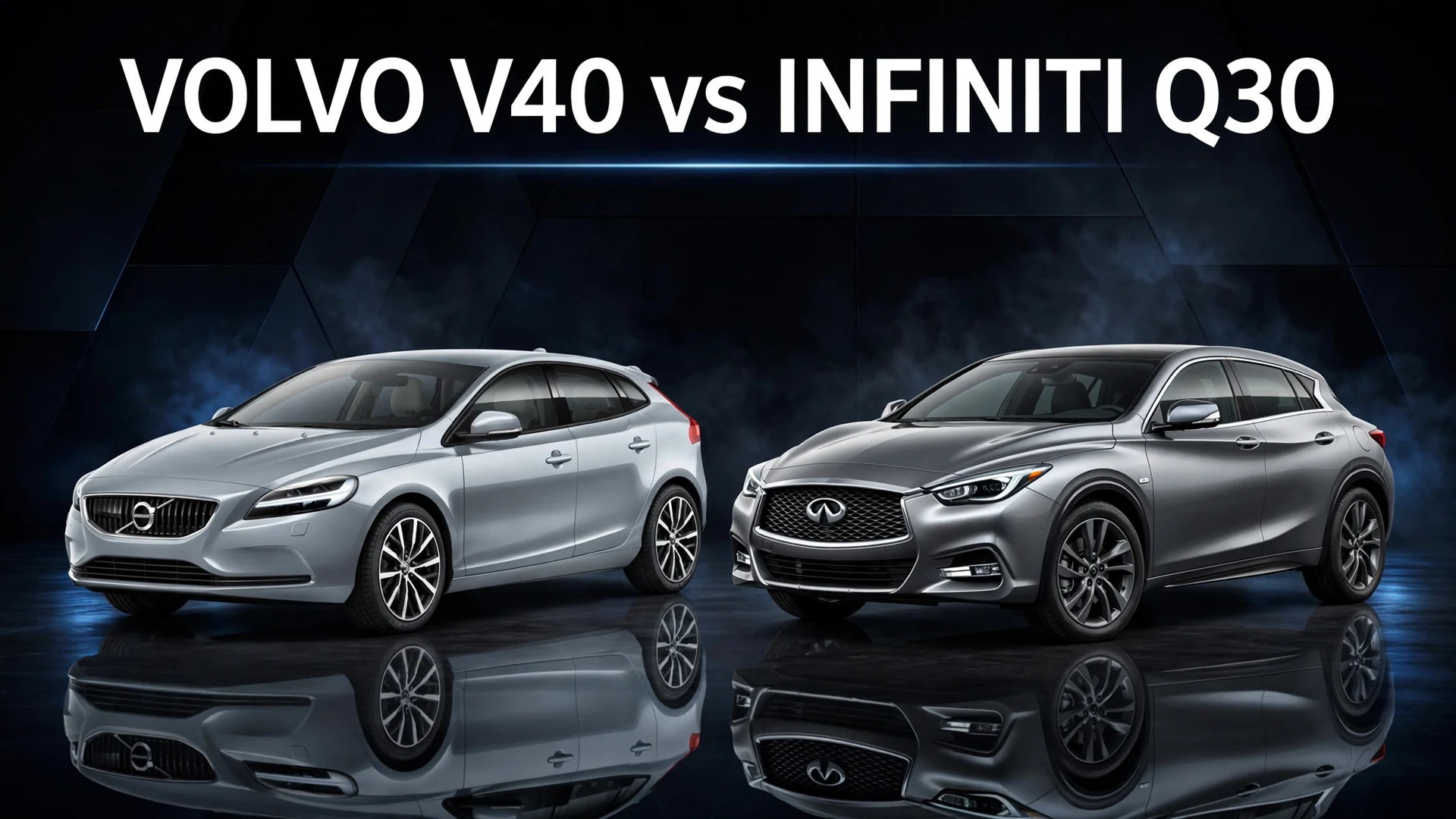
The Volvo V40 and the Infiniti Q30 are two of the most interesting used premium hatchbacks you can buy: both were sold from the mid-2010s, both ended production in 2019, and both now trade at a fraction of their original prices. The V40 is the driver’s choice — a 245-hp Swedish hatch with sharp handling and a 6.3-second 0-100 km/h sprint. The Q30 is the style choice — a Mercedes-based Infiniti with distinctive looks, a 211-hp turbo engine, and a more practical 368-liter boot.
Neither car is sold new anymore, so this is a used-buyer’s comparison. The Volvo is generally the better car to drive and the easier one to live with thanks to stronger parts support, while the Infiniti offers rarity, all-wheel-drive availability, and arguably the more eye-catching design. Here is how they compare on specs, practicality, running costs, and what to check before buying.
- Both are discontinued 2019-era premium hatches now bought used: the V40 (2013–2019) and the Q30 (2015–2019).
- The V40 T5 is the performance pick: 245 hp, 350 Nm, 0–100 km/h in 6.3 seconds versus 211 hp and 7.2–7.3 seconds for the Q30 2.0t.
- The Q30 2.0t uses a Mercedes-sourced 2.0L turbo with a 7-speed DCT and was available with all-wheel drive; the V40 T5 is front-wheel drive with an 8-speed automatic.
- The Q30 has the bigger boot (368 L vs 323 L) and a longer wheelbase (2,700 mm vs 2,647 mm).
- Volvo parts and specialist support are easier to find than Infiniti Q30 parts, since Infiniti withdrew from several markets.
- Verdict: buy the V40 T5 for driving enjoyment and easier ownership; buy the Q30 2.0t if you want standout styling, AWD, and something rare.
Background: Two Short-Lived Premium Experiments
The second-generation Volvo V40 launched in 2012 as Volvo’s answer to the Audi A3 and BMW 1 Series, and it sold in healthy numbers across Europe and Asia through its 2019 discontinuation. The T5 version tested here uses Volvo’s Drive-E 2.0-liter turbocharged four-cylinder — the same engine family that powered much of Volvo’s lineup — making 245 hp and 350 Nm through an 8-speed Geartronic automatic driving the front wheels.
The Infiniti Q30 arrived in 2015 as Nissan’s premium brand’s first real compact car, built at Nissan’s Sunderland plant in the UK on Mercedes-Benz MFA architecture — the same platform as the contemporary A-Class and GLA. Its 2.0t engine is the Mercedes M270 2.0-liter turbo (211 hp, 350 Nm) paired with Mercedes’ 7-speed dual-clutch transmission, in front- or all-wheel-drive form. Infiniti ended Q30 production in 2019 and later withdrew from the European market entirely, which shapes the ownership story below.
Performance: The Volvo Is Clearly Quicker
On paper this is not close. The V40 T5’s 245 hp and 350 Nm deliver a 6.3-second 0–100 km/h sprint and a 240 km/h top speed. The Q30 2.0t’s 211 hp manages 7.2–7.3 seconds to 100 km/h with a 230 km/h top speed. Both make identical 350 Nm of torque, but the Volvo’s extra 34 horsepower and lighter body (around 1,450–1,580 kg depending on spec) give it a decisive edge.
Character matters too. The V40’s Drive-E engine is a willing, smooth unit and the 8-speed automatic is well calibrated; reviewers consistently rated the V40 among the best-handling cars in its class. The Q30’s dual-clutch gearbox can feel hesitant at low speeds — a common DCT trait — though the Mercedes engine itself is strong and refined. For outright driving enjoyment, the Volvo wins.
Practicality: The Infiniti Has the Bigger Boot
The Q30 takes the practicality round. Its boot holds 368 liters (up to 430 liters by some measurements depending on configuration) against the V40’s 323 liters — a useful advantage for a family hatchback. The Q30 is also the slightly larger car: 4,425 mm long on a 2,700 mm wheelbase versus 4,369 mm and 2,647 mm for the Volvo, which translates into a little more rear-seat room.
Neither car is a space champion — both trail a contemporary VW Golf for rear headroom — but the Q30’s extra cargo capacity and available all-wheel drive make it the more versatile all-weather family car. The V40 counters with a lower loading lip and a more thoughtfully designed cabin, though its rear visibility is compromised by thick pillars.
Running Costs and Ownership Reality
Both cars are economical for their performance. The V40 T5 is rated around 6.1 L/100km combined; the Q30 2.0t around 6.2–6.7 L/100km depending on drivetrain — effectively a wash in real driving. Insurance and tax costs are similar in most markets.
The bigger ownership question is parts and support. Volvo’s dealer and independent-specialist network remains strong worldwide, and V40 mechanical parts are shared with high-volume Volvos, keeping costs reasonable. The Q30 is the riskier bet: Infiniti’s withdrawal from Europe means fewer dealers, longer waits for some body and trim parts, and thinner independent-mechanic familiarity. The Mercedes-sourced engine and gearbox help — any Mercedes specialist can service the powertrain — but Q30-specific panels, lights, and interior trim can be slow to source. Get a pre-purchase inspection from someone who knows the MFA platform.
Used Prices: What to Pay
Both cars have depreciated hard, which is exactly why they are interesting. As a rough guide from recent listings: a 2016 Infiniti Q30 2.0t Sport with average mileage trades around £11,000–£12,000 in the UK (AutoUncle recorded a 2016 Sport Tech at £12,008 in early 2026), while Volvo V40 T5s of similar age typically ask slightly less in most European markets, reflecting higher supply. Prices vary enormously by country, mileage, and condition — these are bands, not valuations. In both cases, buy on condition and service history, not on the odometer alone: a full dealer history is worth more than 20,000 fewer kilometers.
Safety
The V40 earned a 5-star Euro NCAP rating and was a class benchmark for pedestrian protection in its day — it even offered an optional pedestrian airbag, a world first. The Q30 also earned 5 stars from Euro NCAP, with strong 91% pedestrian-protection and 81% safety-assist scores. Both come with the expected suite of airbags, stability control, and (on higher trims) autonomous emergency braking. Neither car feels unsafe; the Volvo’s safety engineering was simply more celebrated at launch.
Full Spec Comparison
| Specification | Volvo V40 T5 | Infiniti Q30 2.0t |
|---|---|---|
| Production years | 2013–2019 | 2015–2019 |
| Engine | 2.0L turbo I4 (Drive-E) | 2.0L turbo I4 (Mercedes M270) |
| Power | 245 hp | 211 hp |
| Torque | 350 Nm | 350 Nm |
| Gearbox | 8-speed automatic | 7-speed dual-clutch |
| Drivetrain | FWD | FWD or AWD |
| 0–100 km/h | 6.3 s | 7.2–7.3 s |
| Top speed | 240 km/h | 230 km/h |
| Combined consumption | ~6.1 L/100km | ~6.2–6.7 L/100km |
| Boot volume | 323 L | 368 L |
| Length / wheelbase | 4,369 mm / 2,647 mm | 4,425 mm / 2,700 mm |
| Euro NCAP | 5 stars (class-leading pedestrian score) | 5 stars |
Verdict: Which Used Hatch Should You Buy?
Buy the Volvo V40 T5 if you want the better car in the objective sense: it is faster, sharper to drive, cheaper to keep on the road, and easier to get serviced. For most used buyers, it is the smarter money.
Buy the Infiniti Q30 2.0t if you value individuality and all-weather ability over outright pace. It looks like nothing else on the road, the AWD version is genuinely useful in winter climates, and its rarity means it may hold enthusiast interest longer. Just go in with eyes open about parts availability, and insist on a specialist inspection before you commit.
Sources
- Volvo V40 T5 specs (245 hp, 350 Nm, 6.3 s, 240 km/h, 6.1 L/100km, 323 L boot, dimensions) — CarBase.my; Car.info; Gari.pk.
- Infiniti Q30 2.0t specs (211 hp, 350 Nm, 7-speed DCT, AWD option, 0–62 mph 7.2–7.3 s, 368–430 L boot, dimensions) — Autozine; WintonsWorld; ArabWheels; GoAuto.
- Q30 pricing when new (£31,935–£32,430) and used-market example (£12,008, 2016) — Eurekar; WintonsWorld; AutoUncle UK.
- Q30 Euro NCAP scores (91% pedestrian, 81% safety assist) — ActualidadMotor.
- Q30 platform/production background (Mercedes MFA, Sunderland, 2015–2019) — ActualidadMotor; WintonsWorld.
Frequently Asked Questions
Is the Volvo V40 T5 faster than the Infiniti Q30 2.0t?
Yes, noticeably. The V40 T5 does 0–100 km/h in 6.3 seconds versus 7.2–7.3 seconds for the Q30 2.0t, thanks to 245 hp against 211 hp. Both produce 350 Nm of torque.
Does the Infiniti Q30 have all-wheel drive?
Yes, the Q30 2.0t was offered with all-wheel drive (badged AWD/Sport AWD) alongside front-wheel-drive versions. The Volvo V40 T5 was front-wheel drive only.
Is the Infiniti Q30 based on a Mercedes?
Yes. The Q30 rides on Mercedes-Benz MFA architecture and uses the Mercedes M270 2.0-liter turbo engine and 7-speed dual-clutch transmission — the same hardware as the contemporary A-Class and GLA.
Which has the bigger boot, V40 or Q30?
The Infiniti Q30, at 368 liters (up to 430 L in some configurations) versus 323 liters for the Volvo V40.
Are Volvo V40 parts easy to find?
Generally yes. The V40 shares mechanical parts with high-volume Volvos and the dealer/independent network remains strong. Q30-specific trim and body parts can be harder to source since Infiniti left several markets.
Which is the better used buy, V40 T5 or Q30 2.0t?
The V40 T5 is the safer used buy: faster, easier to service, and usually slightly cheaper. The Q30 2.0t suits buyers who prioritize distinctive styling, AWD availability, and rarity — with the caveat of thinner parts support.