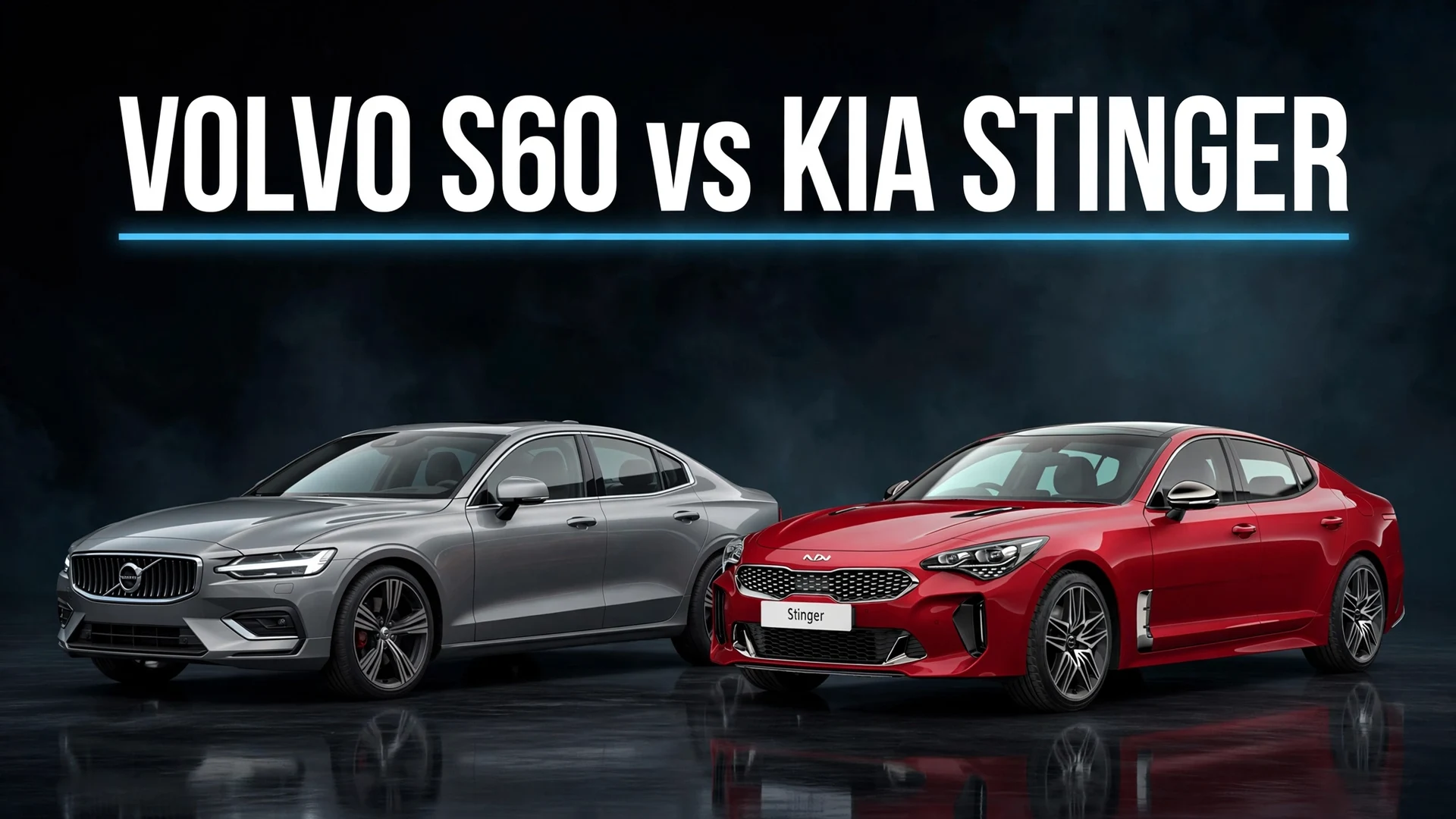
Volvo S60 vs Kia Stinger: The Sedan That Quit vs. the Sedan That Stayed

The sedan that quit vs. the sedan that stayed
One of these sport sedans became a used-market legend the day its factory shut down the line. The other never got a send-off — it just kept selling, quietly, year after year. If you are cross-shopping a Volvo S60 and a Kia Stinger, you are really shopping two different eras of the same idea: a rear-biased, turbocharged, genuinely fun four-door that does not cost German money.
The honest frame for 2026 is this: the Kia Stinger is gone. Production ended with the 2023 model year. The Volvo S60, built on Volvo’s SPA platform since the 2019 model year and produced in Ridgeville, South Carolina, is still in active production and still sold new. This is not a like-for-like new-car comparison. It is a question about what matters more to you: the cult driver’s car that already became a classic, or the calm, safety-first sedan you can still buy with a factory warranty.
The quick verdict: Buy the Kia Stinger if driving dynamics are the point — the twin-turbo V6 GT2 is one of the great used performance bargains of the decade, and even the 300-hp 2.5T base car out-muscles the S60’s standard engine. Buy the Volvo S60 if you want a new car with a warranty, the best fuel economy of the pair, and Volvo’s safety credentials — especially the 455-hp T8 Recharge plug-in hybrid, which matches the Stinger GT2’s pace while drinking far less fuel.
Key Takeaways
- The Kia Stinger was discontinued after the 2023 model year — it is used-only in 2026. The Volvo S60 remains in production and can be bought new.
- Base engines: Stinger 2.5T — 300 hp / 311 lb-ft vs. S60 B5 — 247 hp / 258 lb-ft. The Kia’s base powertrain is meaningfully stronger.
- Top trims: Stinger GT2 3.3T — 368 hp, 0–60 in 4.7 s vs. S60 T8 Recharge — 455 hp, 0–60 in the low 4s. The plug-in Volvo is the fastest car here.
- Fuel economy favors the Volvo: the S60 FWD is EPA-rated 26 city / 35 highway mpg vs. 21/29 mpg for the Stinger 2.5T and 17/24 mpg for the GT2.
- The Stinger’s hatchback body gives 23.3 cu ft of cargo space — more than double the S60’s ~11.6 cu ft trunk.
- Reliability trackers generally rank the S60 above the Stinger, and the Stinger’s 10-year/100,000-mile powertrain warranty only applies to the original buyer — a used buyer gets the remainder, and 2018–2019 models are past it.
Two cars, two philosophies
The Stinger arrived for 2018 as Kia’s moonshot: a rear-drive sport sedan engineered in Germany, aimed squarely at the BMW 4 Series Gran Coupe. Reviewers were stunned — and stayed stunned. The car earned a loyal following precisely because it was an enthusiast’s car that happened to wear a Kia badge. Kia facelifted it for 2022 (bringing the 2.5T four-cylinder and bumping the V6 to 368 hp), then pulled the plug. Production ended in 2023 with a “Tribute Edition” farewell, and the Gwangmyeong plant line was converted for electric vehicles.
The S60 took the opposite path. The current SPA-generation car launched for 2019 as Volvo’s first US-built car, and Volvo kept evolving it: a facelift for 2023, a mild-hybrid B5 powertrain, and the long-running T8 Recharge plug-in hybrid topping the range. It never chased the Stinger’s enthusiast cred — instead it offered Scandinavian calm, a first-rate interior, and fuel economy that embarrasses most of its rivals.
Side-by-side: the numbers
The fairest comparison pairs the base engines and the performance flagships. The Stinger’s base 2.5T makes more power than the S60’s standard B5 — and costs less on the used market.
| Spec | Volvo S60 B5 (2025) | Kia Stinger 2.5T (2023) | Volvo S60 T8 Recharge (2025) | Kia Stinger GT2 3.3T (2023) |
|---|---|---|---|---|
| New MSRP | $43,795 | $37,695 (2023) | $54,490 | $52,895 (2023) |
| Engine | 2.0L turbo I4, 48V mild hybrid | 2.5L turbo I4 | 2.0L turbo+supercharged I4 PHEV | 3.3L twin-turbo V6 |
| Power | 247 hp | 300 hp | 455 hp | 368 hp |
| Torque | 258 lb-ft | 311 lb-ft | 523 lb-ft | 376 lb-ft |
| 0–60 mph | ~6.3 s | ~5.2 s | ~4.3 s | 4.7 s |
| Fuel economy (EPA) | 26/35 mpg | 21/29 mpg | 31 mpg comb. (hybrid) + 40 mi EV | 17/24 mpg |
| Drivetrain | FWD std, AWD opt. | RWD std, AWD opt. | AWD std | RWD std, AWD opt. |
| Cargo space | ~11.6 cu ft (trunk) | 23.3 cu ft (hatch) | ~11.6 cu ft (trunk) | 23.3 cu ft (hatch) |
| Body style | 4-door sedan | 4-door sportback (hatch) | 4-door sedan | 4-door sportback (hatch) |
| Powertrain warranty | 4 yr / 50,000 mi | 10 yr / 100,000 mi* | 4 yr / 50,000 mi (8 yr / 100k battery) | 10 yr / 100,000 mi* |
| Status in 2026 | On sale new | Used only | On sale new | Used only |
*Kia’s 10-year/100,000-mile powertrain warranty applies in full only to the original owner; used buyers receive the remainder of the 5-year/60,000-mile basic coverage plus any balance the original term still has. On a 2018–2019 Stinger, that factory cover is largely gone.
The performance story, in bars
Speed is the Stinger’s home turf — except at the very top, where Volvo’s plug-in hybrid rewrites the script. Zero to sixty tells the story: the T8 Recharge’s electric torque fill makes it the quickest car here at roughly 4.3 seconds, the Stinger GT2 follows at 4.7, the 2.5T Stinger runs about 5.2, and the B5 S60 trails at around 6.3.
How they drive: scalpel vs. cardigan
Drive a Stinger GT2 back to back with an S60 B5 and the difference is immediate. The Kia feels keyed up: the steering weights up, the V6 surges from 1,300 rpm, and the rear-drive platform rotates willingly. It is the car that made reviewers write “the bargain BMW” — a rear-drive sport sedan with real chassis sophistication, from the company nobody expected it from.
The S60 feels like it was engineered by people who drive home in the rain. The steering is light and accurate, the ride is supple, the cabin is library-quiet, and the B5’s mild-hybrid system smooths out stop-start traffic beautifully. It is genuinely quick enough for real roads — but it never eggs you on. Where the Stinger flatters the driver, the S60 pampers the passengers.
Practicality and ownership
This is where the Stinger quietly wins on utility. Its sportback hatch opens to 23.3 cubic feet — more than double the S60’s conventional trunk at roughly 11.6 cubic feet, and enough to swallow a bicycle with the seats down. Rear legroom is generous in both, but the hatch makes the Kia the better single-car solution for an active household.
On fuel, the Volvo dominates. The S60 B5’s 26/35 mpg EPA rating means roughly 500 miles of range from its tank; the Stinger 2.5T’s 21/29 and the GT2’s 17/24 mean noticeably more frequent and more expensive fill-ups — and the Kia requires 91-octane premium. The T8 Recharge, driven with a charged battery, can cover a typical commute on electricity alone (about 40 miles of EV range).
Reliability data favors the Volvo. Independent trackers have consistently scored the S60 above the Stinger for predicted reliability, and the SPA platform’s 2.0L Drive-E powertrains have a long service history by now. The Stinger’s engines are generally stout — the 3.3T V6 has a good owner reputation — but as a discontinued car, parts and dealer expertise will only get harder to find over time.
Safety: Volvo’s home game
No contest here. The S60 has been an IIHS Top Safety Pick+ winner across multiple model years, with Volvo’s full suite of standard driver assists — Pilot Assist, blind-spot monitoring, rear cross-traffic alert — on every trim. The Stinger earned strong crash-test scores too, but Volvo’s safety reputation and equipment depth give the S60 a clear edge.
The 2026 used-market verdict
Here is the thing about discontinued cars: the Stinger is not getting any cheaper to own, but it is not getting any less special either. Values for clean GT2s have held remarkably well — the market knows what it lost. A 2022–2023 Stinger GT-Line with the 2.5T engine typically trades in the mid-to-high $20,000s, while GT2s with the twin-turbo V6 sit in the mid-$30,000s depending on mileage. That is a lot of car for the money, but you are buying into a platform with no future: no more factory updates and parts that will get progressively harder to source.
The S60, meanwhile, can still be bought new from about $43,795, with the T8 Recharge at $54,490 — and as a late-lifecycle model, dealers are often willing to deal. A certified pre-owned S60 splits the difference: modern safety tech, remaining warranty, and depreciation already absorbed.
Frequently asked questions
Is the Kia Stinger discontinued?
Yes. Kia ended Stinger production after the 2023 model year, with a limited Tribute Edition marking the farewell. The assembly line was converted for electric-vehicle production. Every Stinger available in 2026 is a used car — no new examples remain at dealers.
Which is faster: the Volvo S60 or the Kia Stinger?
It depends on the trim. The S60 T8 Recharge plug-in hybrid (455 hp) is the quickest of the bunch at roughly 4.3 seconds to 60 mph. The Stinger GT2’s twin-turbo V6 (368 hp) does it in about 4.7 seconds. The base Stinger 2.5T (300 hp, ~5.2 s) is quicker than the base S60 B5 (247 hp, ~6.3 s).
Is the Kia Stinger reliable as a used buy?
Generally, yes — the 2.5T four-cylinder and 3.3T V6 both have solid owner reputations, and Kia’s powertrain warranty was excellent. The catches: the 10-year/100,000-mile powertrain warranty applies in full only to the original owner (used buyers get the remainder), 2018–2019 cars are now past most factory coverage, and as a discontinued model, parts availability will slowly decline. Always get a pre-purchase inspection.
Does the Volvo S60 come as a plug-in hybrid?
Yes — the S60 T8 Recharge pairs a turbocharged and supercharged 2.0L engine with an electric motor for 455 hp and 523 lb-ft, with about 40 miles of electric-only range. It is all-wheel drive, starts around $54,490 for 2025, and is the fastest S60 ever built.
Which one should I buy in 2026?
Buy the Stinger GT2 if driving enjoyment is the priority and you are comfortable with used-only ownership of a discontinued car. Buy the S60 — new or certified pre-owned — if you want a warranty, better fuel economy, stronger safety credentials, and a car with ongoing manufacturer support. The Stinger is the heart pick; the S60 is the head pick.