Volvo Pine Grey vs Osmium Grey: The Ultimate Metallic Paint Guide

When configuring a modern Volvo—whether an XC60, XC90, V90 Cross Country, or S60—selecting the perfect exterior paint color is an intensely personal decision. Volvo’s color palette is legendary for its understated Scandinavian sophistication, avoiding garish primaries in favor of organic, nature-inspired metallic hues. Among the most popular and debated choices in recent years are two stunning metallic greys: Pine Grey Metallic (Paint Code 724) and Osmium Grey Metallic (Paint Code 714). How do these two colors differ under changing sunlight, which interior upholstery matches them best, and which is easier to keep clean?
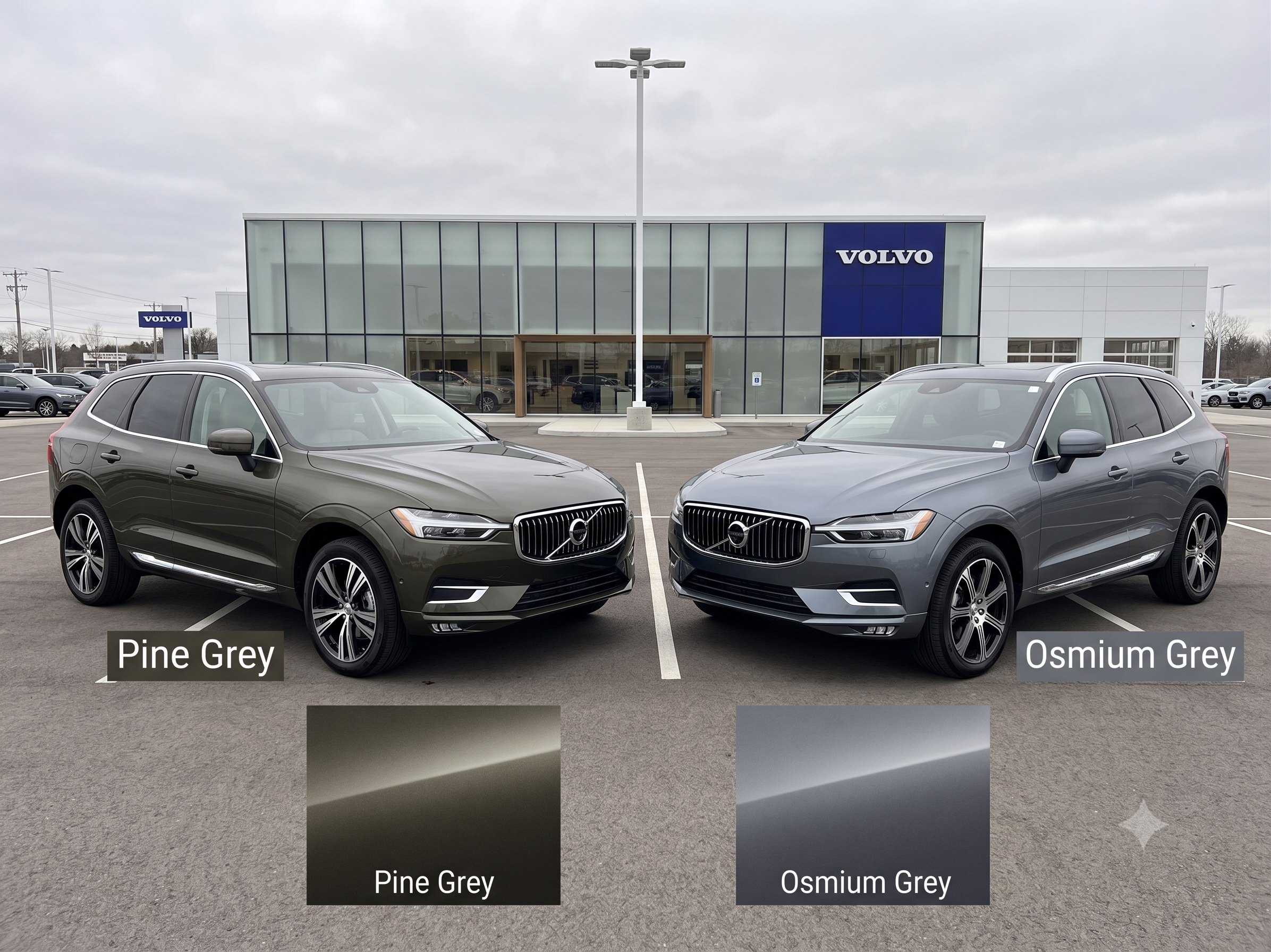
Choosing between Volvo Pine Grey Metallic (Paint Code 724) and Osmium Grey Metallic (Paint Code 714) comes down to lighting undertones and styling themes. Pine Grey is a dynamic, chameleon-like multi-coat finish: in bright sunlight, it reveals rich forest green, sage, and golden-olive undertones, while deepening into dark slate charcoal at dusk. Osmium Grey is a pure, technical industrial metallic with cool steel-blue undertones and sparkling aluminum flake pop. Pine Grey pairs magnificently with Bright Theme chrome and Amber leather, while Osmium Grey excels with Dark Theme gloss black and Charcoal interiors.
Code 724 (Green, sage & olive undertones)
Code 714 (Pure cool gunmetal steel-blue undertones)
Pine Grey + Bright Theme / Osmium Grey + Dark Theme
Both colors conceal road salt and swirl marks exceptionally well
The core distinction lies in their undertones and chromatic complexity. Osmium Grey is an architectural, pure industrial metallic featuring cool steel-blue undertones and brilliant aluminum flake reflection. Pine Grey is a dynamic, chameleon-like multi-coat finish that shifts personalities depending on ambient light: appearing as a moody charcoal grey in overcast weather, but erupting with deep forest green, sage, and golden-olive highlights the moment sunlight strikes the contours of the bodywork. Below is our definitive aesthetic and maintenance guide.
Side-by-Side Paintwork Matrix: Pine Grey vs. Osmium Grey
Compare the optical properties, paint codes, and recommended interior pairings:
| Attribute | Pine Grey Metallic (Code 724) | Osmium Grey Metallic (Code 714) | Aesthetic & Practical Impact |
|---|---|---|---|
| Color Undertones | Deep Forest Green, Sage & Golden-Olive | Cool Gunmetal, Steel Blue & Platinum | Pine Grey: Organic, warm Scandinavian woodland feel. Osmium: High-tech industrial athletic stance. |
| Lighting Shift (The Chameleon Effect) | High Shift: Looks dark charcoal in shade; rich forest olive in bright sunshine. | Consistent: Retains its crisp, silvery gunmetal metallic character across all light conditions. | Personality: Pine Grey feels like driving two distinct cars depending on the weather. |
| Best Exterior Theme Pairing | Bright Theme (Satin Chrome) | Dark Theme (Gloss Black / R-Design) | Styling: Satin chrome illuminates Pine Grey’s olive tones; gloss black enhances Osmium Grey’s sinister stealth look. |
| Ideal Interior Leather Colors | Amber Nappa Leather or Blonde Leather | Charcoal Nappa Leather or Maroon Brown | Contrast: Amber leather creates an organic Swedish cabin; Charcoal creates an executive monochrome cockpit. |
| Dirt & Road Salt Concealment | Excellent (Hides road grime and salt brine) | Excellent (Hides dust, light scratches, and water spots) | Maintenance: Both colors are vastly easier to maintain than Onyx Black or Crystal White. |
Pine Grey 724
Forest green, sage, olive
Chameleon shifts in sunlight
Amber or Blonde leather
Osmium Grey 714
Steel blue, gunmetal, platinum
Crisp, athletic, high-tech
Charcoal with Dark Theme
Interactive Tool: Volvo Paint & Interior Aesthetic Matcher
Select your favorite ambient lighting condition and interior upholstery choice below to generate a tailored exterior paint recommendation:
Harmonize exterior paint codes with interior Scandinavian leathers:
Clear Coat Thickness & Paint Hardness: Ceramic Coating vs. PPF
Modern Volvo vehicles produced at the Torslanda (Sweden), Ghent (Belgium), and Ridgeville (USA) manufacturing plants utilize advanced water-borne robotic paint systems. Understanding your paint’s physical properties is critical for long-term preservation:
- Total Paint Depth: Volvo factory paint thickness averages between 110 and 135 microns (including primer, base color coat, and clear coat). The clear coat layer itself accounts for approximately 35 to 45 microns.
- Paint Hardness (Scratch Resistance): Volvo utilizes medium-hard European clear coats. It is harder and more scratch-resistant than soft Japanese automotive clears (such as Subaru or Mazda), but slightly more forgiving to polish than rock-hard German ceramic clears (such as Audi or Mercedes-Benz).
- Ceramic Coating vs. Paint Protection Film (PPF): Both Pine Grey and Osmium Grey look breathtaking with a professional 9H ceramic coating, which amplifies the metallic flake pop and creates hydrophobic water beading. However, if you drive frequently on gravel roads or winter highways where sand and salt trucks operate, installing self-healing Paint Protection Film (PPF) on the front bumper, hood, and mirror caps is the only guaranteed way to stop stone chips.
How Pine & Osmium Grey Compare to Other Volvo Greys
Volvo has offered several iconic grey shades over the years. Here is how Pine and Osmium compare against their stablemates:
- Savile Grey Metallic (Paint Code 492): A much darker, almost charcoal-black metallic with warm bronze undertones. Considerably darker than Osmium Grey.
- Thunder Grey Metallic (Paint Code 728): A trendy non-metallic/flat solid grey (similar to Audi Nardo Grey) with subtle blue undertones. Lacks the metallic flake reflection of Osmium.
- Platinum Grey Metallic (Paint Code 731): Introduced as a successor to Osmium Grey on late SPA models. Platinum Grey introduces a warmer, silkier taupe/champagne metallic undertone compared to Osmium’s pure cool steel blue.
DIY Swirl Mark Repair & Touch-Up Paint Guide
If your vehicle develops minor rock chips or light car-wash swirl marks, follow this professional detailing procedure:
- Swirl Mark Correction: Use a Dual-Action (DA) orbital polisher with a medium yellow foam polishing pad and a micro-fine finishing compound (such as Sonax Perfect Finish or Menzerna 3800). The medium-hard Volvo clear coat responds beautifully, restoring deep optical gloss in a single pass.
- Stone Chip Repair: Order the genuine Volvo OEM touch-up paint kit (comes with base color bottle and clear coat bottle). Clean the chip cavity with 70% isopropyl alcohol. Apply base paint using the tip of a wooden toothpick—never the thick brush included in the cap! Allow 30 minutes to flash off, then dab a tiny drop of clear coat to build a slight dome over the chip. After 48 hours of curing, wet-sand flat with 3,000-grit sandpaper and polish to an invisible repair.
Frequently Asked Questions About Volvo Paint Colors
Paint Chemistry & Optical Science: Mica Flakes and Multi-Coat Clearcoat
Among the exterior color palettes offered on modern Scalable Product Architecture (SPA) Volvos (including the XC60, XC90, and V90 Cross Country), two metallic shades have sparked intense enthusiast debate: Pine Grey Metallic (Volvo Color Code 724) and Osmium Grey Metallic (Volvo Color Code 714).
To understand why these colors look vastly different in changing daylight, one must examine Volvo’s advanced factory paint application process at the Torslanda Paint Shop:
- Multi-Layer Coating Process: Both colors utilize an electro-deposition cathodic dip primer (e-coat), followed by a high-solid polyester surfacer/primer, a basecoat color layer, and an ultra-hard scratch-resistant 2K polyurethane clearcoat measuring approximately 120 to 140 microns in total dry film thickness.
- Pine Grey Metallic (Code 724): Formulated with a unique blend of dark charcoal carbon black pigments infused with microscopic synthetic green-tinted pearlescent mica platelets and aluminum metallic flakes.
- Osmium Grey Metallic (Code 714): Formulated with high-purity aluminum metallic flakes suspended in a neutral, cool graphite grey base with subtle blue undertones, named after the dense chemical element Osmium (atomic number 76).
Chameleon Lighting Dynamics: Direct Sunlight vs Overcast Skies
The defining characteristic that separates these two colors is their optical reflectivity under different lighting environments:
| Lighting Condition | Pine Grey Metallic (Color Code 724) | Osmium Grey Metallic (Color Code 714) |
|---|---|---|
| Direct Midday Sunlight | Transforms into a rich, deep Scandinavian forest pine green with golden-green mica reflections. | Displays a bright, sparkling liquid-metal graphite with strong specular highlights. |
| Overcast / Rainy Scandinavian Weather | Appears as a sophisticated, dark anthracite charcoal grey; green undertones vanish. | Appears as a smooth, cool gunmetal grey with subtle icy blue-slate undertones. |
| Nighttime / Artificial Streetlights | Deep gloss black/charcoal with subtle warmth under sodium vapor lights. | Clean high-contrast monochrome graphite under LED lighting. |
Daily Maintenance, Scratch Concealment & Resale Value
For daily drivers, practical maintenance considerations often outweigh pure aesthetics:
- Concealing Road Dirt & Salt: Both Osmium Grey and Pine Grey are outstanding at hiding road dust, dried rainwater spots, and winter road salt grime compared to solid Onyx Black or Crystal White. Osmium Grey holds a slight edge due to its brighter metallic reflective base.
- Swirl Mark Resistance: Microscopic wash swirls from automated car wash brushes are far less visible on both metallic greys than on solid non-metallic black or dark navy.
- Resale Market Appeal: Used luxury vehicle market transaction data shows that Osmium Grey is universally favored by corporate buyers and conservative shoppers seeking timeless elegance. Pine Grey commands a dedicated enthusiast premium among outdoor and luxury connoisseurs who appreciate its rare, bespoke green-charcoal color shift.
Ceramic Coating & Paint Protection Film (PPF) Recommendations
To preserve the optical depth of both Pine Grey and Osmium Grey metallic finishes, professional detailers recommend applying an 8-mil Paint Protection Film (PPF) over the front bumper and hood, topped by a 9H ceramic coating. Ceramic quartz layers enhance the hydrophobic surface tension, causing water and road salt to bead off effortlessly while intensifying the green-charcoal mica sparkle.
Frequently Asked Questions