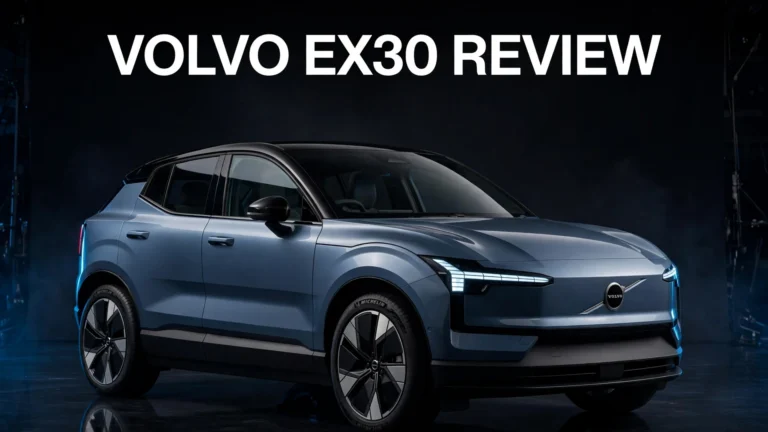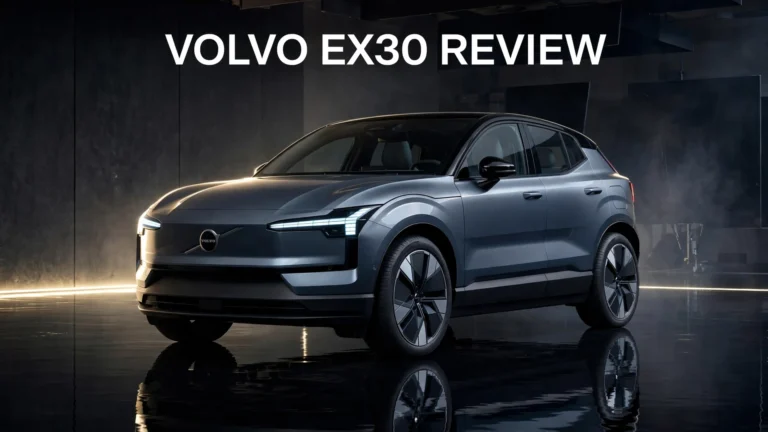
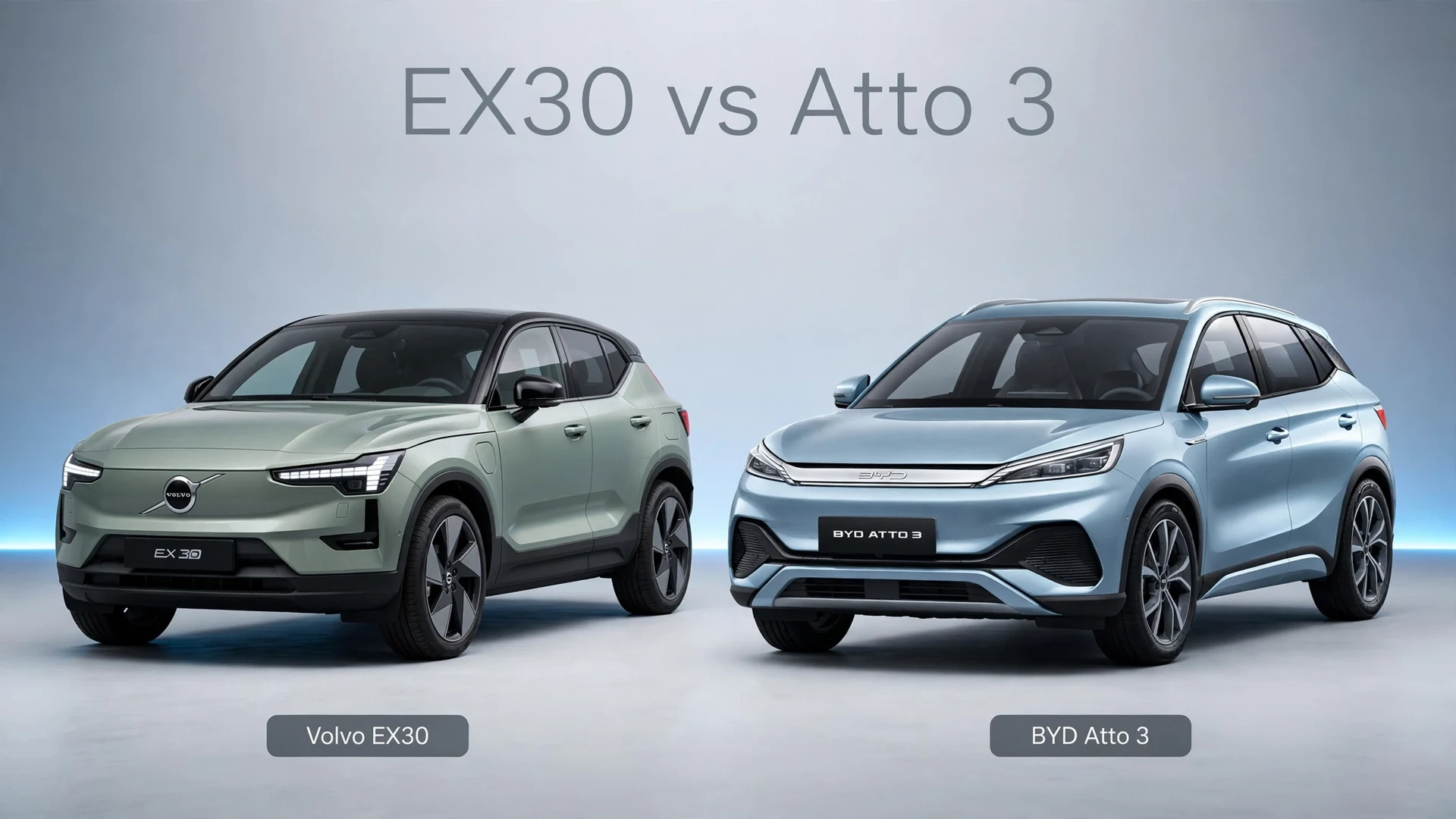
Volvo EX30 vs BYD Atto 3?

Volvo EX30 vs BYD Atto 3?
This is the defining small-EV showdown of the mid-2020s: the Volvo EX30, the Swedish brand’s smallest and most affordable electric SUV, against the BYD Atto 3, the car that put China’s biggest EV maker on the map in Europe. Both are five-star Euro NCAP cars, both are built in China, and both chase the same buyer. The verdict in short: the EX30 Extended Range wins on range (up to 295 miles), charging speed (153 kW vs 88 kW) and driving pace, while the Atto 3 wins on space, standard equipment and value — a bigger boot, a heat pump as standard, and a price that undercuts the comparable Volvo. Which matters more depends entirely on how you drive.
- Range: EX30 Extended Range does 295 miles (WLTP) from a 69 kWh battery; the Atto 3 does 260 miles from a 60.5 kWh LFP Blade battery.
- Charging: the EX30 peaks at 153 kW DC (10–80% in ~26 minutes); the Atto 3 manages 88 kW (10–80% in ~37 minutes).
- Performance: EX30 Single Motor: 272 hp, 0–62 mph in 5.3 s; Atto 3: 204 hp, 0–62 mph in 7.3 s.
- Practicality: Atto 3 has the bigger boot (440 L vs 318 L) and more rear legroom.
- Prices: EX30 launched from £33,795 (later £32,850 Core); the Atto 3 listed around £37,195 in the UK — shop the Extended Range Volvo against it.
Range Is the Whole Argument
For most buyers this comparison starts and ends with range, and the EX30 Extended Range takes it: 295 miles WLTP from its 69 kWh NMC pack (64 kWh usable) versus the Atto 3’s 260 miles from 60.5 kWh of LFP Blade battery. In the real world the gap is similar: Autocar’s long-term Atto 3 averaged 3.0 miles/kWh for a real 181 miles, while the EX30’s lower drag and 17.0–17.5 kWh/100 km WLTP consumption give it a meaningful edge on longer runs.
But the Atto 3’s LFP chemistry is a genuine counter-argument. Lithium-iron-phosphate batteries tolerate being charged to 100% routinely without the degradation anxiety of NMC — for a buyer who charges at home and wants the full displayed range every morning, that’s a practical advantage the spec sheet doesn’t show. And the entry EX30’s 51 kWh LFP pack (209 miles WLTP, 5.7 s 0–62) is actually closer to the Atto 3 on range than on price — worth knowing before you pay for the Extended Range.
| Specification | Volvo EX30 | BYD Atto 3 |
|---|---|---|
| Battery (usable) | 51 kWh LFP / 69 kWh NMC (64 usable) | 60.5 kWh LFP Blade |
| WLTP range | 214 / 295 miles | 260 miles |
| Power / torque | 272 hp / 343 Nm (RWD) | 204 hp / 310 Nm (FWD) |
| 0–62 mph | 5.3 s (Ext. Range) / 5.7 s | 7.3 s |
| Twin-motor option | 428 hp, 3.6 s | — |
| DC fast charging | 153 kW, 10–80% ~26 min | 88 kW, 10–80% ~37 min |
| AC charging | 11 kW | 11 kW |
| Length | 4,233 mm | 4,455 mm |
| Boot | 318 L | 440 L |
| Kerb weight | 1,840 kg | 1,825 kg |
| Euro NCAP | 5 stars (88/85/79/80%) | 5 stars (91/89/74%) |
Charging Speed: Where the Volvo Pulls Away
This is the EX30’s least debatable advantage. A 153 kW peak on the DC curve takes the big-battery car from 10–80% in about 26 minutes; the Atto 3’s 88 kW peak needs around 37 minutes for the same window, and its real-world charge rate averages closer to 73 kW. On a 300-mile journey that means one meaningfully shorter stop in the Volvo — or, more honestly, one stop instead of a stop-plus-top-up.
The Atto 3 fights back with a standard heat pump (the EX30 Plus didn’t include one at launch, per What Car?), which keeps winter range closer to the brochure figure, and with V2L — vehicle-to-load — at 3.3 kW via an adapter, so you can run a kettle, a laptop or camping gear off the traction battery. The EX30 has no V2L. For the buyer who charges mostly at home and drives locally, the Atto 3’s slower DC speed may never matter; for the frequent long-distance driver, the Volvo’s charging advantage compounds on every trip.
Safety: Both Five-Star, Different Strengths
Volvo’s reputation is on the line with every new model, and the EX30 delivered: five Euro NCAP stars in December 2024 testing, with 88% adult occupant, 85% child, 79% pedestrian and 80% safety assist scores. Standard kit runs deep — adaptive cruise, blind-spot monitoring, rear cross-traffic alert, safe-exit alert for cyclists, and a driver-monitoring system.
The Atto 3 is no slouch either: five stars with 91% adult and 89% child scores — actually ahead of the Volvo on occupant protection — though a weaker 74% on safety assist. Where the BYD notably falls down against Volvo expectations is tuning: testers found the EX30’s adaptive cruise could brake for no reason on the motorway, and the Atto 3’s lane-keeping and over-sensitive driver alerts drew similar criticism in long-term tests. Both cars are safe in a crash; both will occasionally annoy you trying to prevent one.
Space, Cabin and Everyday Usability
The Atto 3 is the bigger, more practical car and it shows inside. At 4,455 mm it’s over 200 mm longer than the EX30, and the boot is 440 litres against the Volvo’s 318 — a genuinely useful difference when the kids’ gear comes along. Rear legroom and headroom are better in the BYD, and it carries five adults without the Volvo’s pinch. The EX30’s cabin is the prettier, more minimalist one — a single central screen, a soundbar instead of door speakers, recycled materials — but minimalism has costs: there’s no driver’s instrument cluster at all, everything runs through the touchscreen, and reviewers found simple tasks buried in menus.
Infotainment is a philosophical split. The EX30 runs Google Automotive with built-in Google Maps and app support — slick when it works, frustrating when it doesn’t. The Atto 3’s party trick is a rotating 15.6-inch touchscreen (portrait for maps, landscape for video), plus physical buttons for key functions that Volvo deleted. Neither car is perfect here; the BYD is arguably easier to live with day to day, the Volvo more impressive to show a passenger.
Prices, Warranty and Running Costs
| Volvo EX30 | BYD Atto 3 | |
|---|---|---|
| UK launch price | £33,795 (Single Motor) / £38,545 (Ext. Range) | ~£37,195 (Design) |
| Later entry price | £32,850 (Core, Aug 2024) | — |
| Basic warranty | 3 years / 60,000 miles | 6 years / 93,750 miles |
| Battery warranty | 8 years / 100,000 miles | 8 years / 125,000 miles |
| Heat pump | Not standard on Plus (at launch) | Standard |
| V2L | — | 3.3 kW |
| Towing | Not type-approved (UK) | Not supported |
| Insurance (typical groups) | Higher (fast twin-motor) | Lower |
On warranty, BYD embarrasses the Volvo: six years/93,750 miles on the car and eight years/125,000 miles on the battery versus Volvo’s three years/60,000 miles and eight years/100,000 miles. For a buyer planning to keep the car long-term — exactly the kind of buyer small EVs attract — that matters. Servicing costs are modest on both (no oil, no belts), and both qualify for the same cheap overnight electricity. Tyres are the hidden cost: both cars are heavy and torquey, and the twin-motor EX30 will eat rears if you use all 428 hp.
Residuals are the open question. The EX30’s Volvo badge and huge early demand should support values; the Atto 3 faces the same Chinese-brand depreciation curve as MG — great for used buyers, painful for new ones. If you’re buying used in 2026, a two-year-old Atto 3 is likely the bargain of the pair.
Which One Should You Buy?
Verdict: The Volvo Wins the Spec Sheet, the BYD Wins the Spreadsheet
On capability alone, the EX30 Extended Range is the better electric car: more range, far faster charging, much quicker, and a nicer cabin. If you drive long distances or simply want the best small EV of this generation, buy it.
But the Atto 3 is the better buy for most people: it’s bigger, better equipped, better warranted, and cheaper — and its LFP battery is the right chemistry for real-world ownership. The honest summary is that Volvo built the keener driver’s car and BYD built the keener family car. Pick the one that matches your life, and you won’t regret either.
Sources
- InsideEVs — 2024 Volvo EX30 UK drive review: 69 kWh (64 usable), 295-mile range, 272 hp, 153 kW DC, 0–62 in 5.3 s.
- GreenFleet / Cars UK — EX30 UK launch pricing and powertrain lineup: £33,795 / £38,545 / £40,995.
- PistonHeads — EX30 Core at £32,850 (Aug 2024), Extended Range at £37,050.
- ezoomed.com — EX30 full spec table: 51/69 kWh, 214-mile base range, 318 L boot, 4,233 mm length, 8-yr/100k battery warranty.
- RAC / What Car? / Recharged — EX30 Euro NCAP 5 stars (88/85/79/80%), standard safety kit, missing heat pump on Plus at launch.
- Autoblog — 2026 EX30 US specs: EPA range, twin-motor 422 hp, 4-yr/50k basic warranty, 8-yr/100k battery.
- nyongesasande.com — BYD Atto 3 MY23–24 full specs: 60.5 kWh LFP Blade, 260-mile WLTP, 204 hp/310 Nm, 7.3 s, 440 L boot, 88 kW DC, Euro NCAP 5 stars (91/89/74%), heat pump, V2L.
- Autocar — Atto 3 long-term test: 3.0 mi/kWh average, 181-mile real range, £39,695 list, infotainment faults.
Frequently Asked Questions
Which has more range, the Volvo EX30 or the BYD Atto 3?
The EX30 Extended Range: 295 miles WLTP from its 69 kWh battery versus 260 miles for the Atto 3’s 60.5 kWh LFP pack. The base EX30 (51 kWh) does 214 miles — closer to the Atto 3, at a lower price.
Which charges faster, EX30 or Atto 3?
The EX30, comfortably: up to 153 kW DC for a 10–80% charge in about 26 minutes. The Atto 3 peaks at 88 kW, needing around 37 minutes for the same window.
Is the BYD Atto 3 bigger than the Volvo EX30?
Yes. The Atto 3 is 4,455 mm long with a 440-litre boot; the EX30 is 4,233 mm with a 318-litre boot. Rear-seat space is also more generous in the BYD.
Which is safer, EX30 or Atto 3?
Both are five-star Euro NCAP cars. The Atto 3 scores higher for adult (91%) and child (89%) occupant protection; the EX30 scores 88% adult and 85% child, with a stronger safety-assist suite. Neither is meaningfully safer than the other.
Does the BYD Atto 3 have a heat pump?
Yes — a heat pump is standard on the Atto 3, which helps preserve range in cold weather. On the EX30 it was not standard on the Plus trim at launch, so check the spec of the car you’re buying.
Which is the better buy used: EX30 or Atto 3?
The Atto 3, for most buyers: bigger, better equipped, a six-year warranty, and LFP battery chemistry that tolerates 100% charging — plus Chinese-brand depreciation makes used examples cheap. Buy the EX30 if long range and fast charging are your priorities.