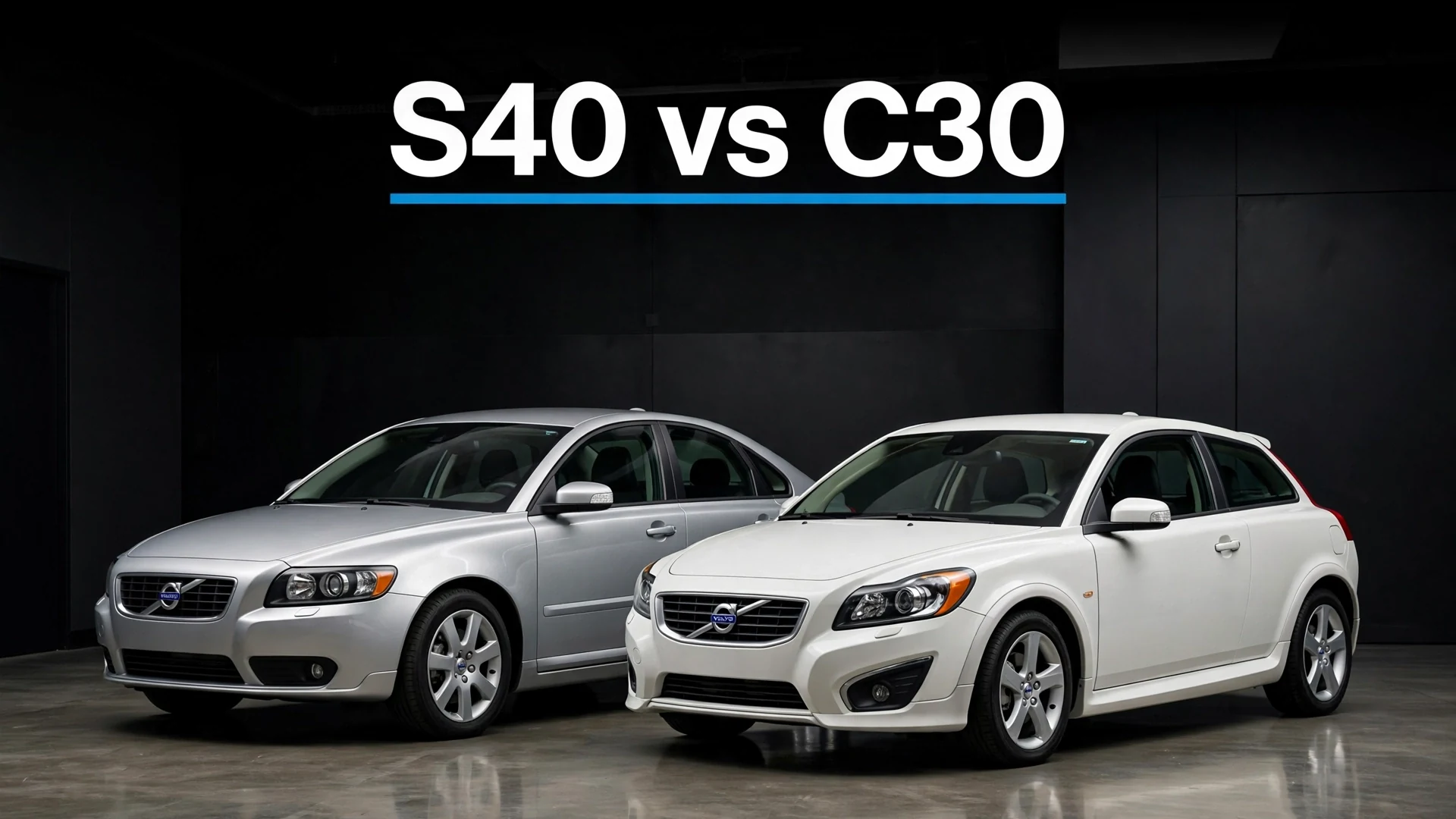
Volvo S40 vs C30: Sedan vs Hatch — Which P1 Volvo Is the Better Used Buy?

Same platform, same engines, same Swedish safety DNA — yet the Volvo S40 and C30 feel like cars from different companies. If you’re shopping the used market and torn between these two P1-platform Volvos, this guide is for you: the commuter who needs four doors and a real back seat, the enthusiast hunting a cheap turbo five-cylinder, or the young family deciding whether a three-door hatch can do school-run duty. They share far more than most rivals, so the choice comes down to body style, space, and character — not mechanicals.
- The S40 is the practical pick: a four-door sedan with a 14.3 cu ft trunk, five seats, and optional AWD on the T5 — the only one of the pair that works as a family car.
- The C30 is the character pick: 8.5 inches shorter, 70+ lbs lighter, a frameless glass tailgate, and just four seats — the sportier, more distinctive drive.
- Same bones, same bills: both ride on Volvo’s P1 platform with the same 103.9-inch wheelbase and the same 2.4i/T5 five-cylinder engines, so reliability patterns and parts costs overlap heavily.
- T5s are the ones to buy: 227 hp, 236 lb-ft, 0–60 in about 6.6–6.7 seconds, and barely worse fuel economy than the 2.4i. The turbo five is the sweet spot in either body.
- Watch-list is shared: front-suspension clunks, ignition-key slot wear, central-locking actuators, PCV breather box, and CV boots/wheel bearings — inspect these on either car before you buy.
The two cars in 60 seconds
The Volvo S40 (second generation, 2004–2012; sold in the US through the 2011 model year) is the sensible one: a compact four-door sedan with a conventional trunk, seating for five, and the quiet confidence of a car designed to commute, carpool, and road-trip without drama. In the US it came with two engines — the 168-hp 2.4i and the 227-hp turbocharged T5 — and the T5 could be had with all-wheel drive, a rarity in this segment.
The Volvo C30 (2006–2013; US model years 2008–2013) is the same car wearing a leather jacket. It keeps the identical 103.9-inch wheelbase but chops 8.5 inches off the overall length, drops a door on each side, and adds the famous frameless glass tailgate that echoes Volvo’s P1800ES. It seats four in individual chairs — two sculpted buckets up front, two individual seats in back — and was aimed squarely at younger buyers cross-shopping the GTI and MINI Cooper S. Same engines, same Ghent, Belgium assembly line, totally different attitude.
Head-to-head specs
Figures below are for the later US-market cars (2010–2012), when the T5 made its full 227 hp. Note the early 2008 C30 T5 was rated at 218 hp before the bump.
| Spec | S40 | C30 |
|---|---|---|
| Body style | 4-door sedan | 3-door hatchback |
| Production years | 2004–2012 | 2006–2013 |
| US model years | 2004.5–2011 | 2008–2013 |
| US engines | 2.4i inline-5 / T5 turbo inline-5 | 2.4i inline-5 / T5 turbo inline-5 |
| Power (T5) | 227 hp | 227 hp |
| Torque (T5) | 236 lb-ft | 236 lb-ft |
| 0–60 mph (T5) | 6.7 s | 6.6 s |
| EPA combined, T5 | 22 mpg | 24 mpg |
| EPA combined, 2.4i | 24 mpg | 24 mpg |
| Cargo space | 14.3 cu ft trunk | 12.9 cu ft seats up / 20.2 cu ft seats folded |
| Seating | 5 | 4 (individual rear seats) |
| Drivetrain | FWD; AWD available on T5 | FWD only |
| Curb weight | 3,273 lb | 3,200 lb |
| Length | 176.2 in | 167.4 in |
| Wheelbase | 103.9 in | 103.9 in |
| Assembly | Ghent, Belgium | Ghent, Belgium |
Spec sources: Volvo 2010 US press materials, MotorTrend, CarBuzz, Edmunds, and carspecs.us. European cars also got 1.6/1.8/2.0 four-cylinder and 1.6D/2.0D diesel engines not sold in the US.
Which is quicker? The 0–60 story
On paper the T5s are near-identical, but the C30’s lighter curb weight gives it a hair’s-breadth edge. The 2.4i cars are a full two seconds slower — noticeable every time you merge onto a highway.
0–60 mph, manufacturer/US press figures. Shorter bar = quicker.
Model-year timeline
Both cars are single-generation designs, which makes used shopping simple: there are no mid-life platform changes to decode, just a 2010 facelift for the C30 and rolling trim updates.
Driving character: same chassis, different mood
Because both cars share the P1 platform’s MacPherson-strut front and multi-link rear suspension — and even the sheet metal ahead of the windshield — the differences are tuning and packaging, not engineering. The S40 is the softer setup: calmer ride, lighter steering, less road noise, and (on T5 AWD cars) genuine all-weather traction. MotorTrend’s contemporary review praised its solid handling but noted mild torque-steer in front-drive T5s — the AWD version solves that and is the connoisseur’s pick.
The C30 gets firmer damping, quicker-feeling steering, and that short-overhang stance (same wheelbase, 8.5 inches less car hanging off the ends) that makes it rotate more eagerly. Owners consistently describe it as the more engaging drive — not a GTI-beater, but the best blend of comfort and sportiness in its class according to long-term owner reviews. The trade-offs: a firmer ride on broken pavement, more road noise, and rear visibility compromised by the sloping glass hatch. The R-Design trim sharpens things further with stiffer suspension and 18-inch wheels on both cars.
Practically speaking, the S40’s fifth seat and proper rear doors change daily life more than any chassis tuning. The C30’s two individual rear seats are genuinely comfortable for the two people they fit — better, some owners say, than a squeezed middle seat — but the two-door layout makes child seats and regular rear passengers a chore.
Running costs and the shared watch-list
Here’s the good news for your wallet: parts bins overlap massively, independent Volvo specialists know these cars inside out, and nothing here is exotic. Budget for premium fuel on the T5 (recommended, per the EPA), and remember the five-cylinder engines use a timing belt — roughly a 10-year/120,000-mile service — so a car with no belt-service history needs that priced into the deal immediately.
TrueDelta’s owner-reported repair data and UK/EU buyer’s guides converge on the same weak points. Inspect all of these on either car:
| Watch item | Applies to | What to check |
|---|---|---|
| Front suspension clunks | Both | Strut bearings, spring seats, control-arm bushings — drive over speed bumps and listen |
| Ignition key & slot wear | Both | The chunky plastic key should feel snug in the dash slot; loose keys and slots are expensive |
| Central locking actuators | Both | Test every door and the fob; listen for actuators that buzz without locking |
| PCV breather box / oil trap | Both | Oil leaks around the engine, whistling at idle — a known five-cylinder weak spot |
| CV boots & wheel bearings | Both | Clicking on full-lock turns; humming that changes with speed |
| Sunroof drains / water leaks | Both with sunroof | Damp carpets or headliner stains — clear the drains before they clog |
| Washer-pump wiring recall | Early cars | Verify the recall was performed; a dealer can check by VIN |
RepairPal rates the C30 3 out of 5 for reliability (19th of 26 luxury compact cars) — respectable for a European car of this age, and the S40’s shared mechanicals put it in the same ballpark. Neither car is a Toyota, but neither is a money pit either, provided the suspension and PCV items above have been addressed.
Pick your winner
Tap your buyer profile — each one names a winner and the one thing to watch.
Verdict
Buy the S40 if you need a car that does everything: commuting, carpools, road trips, and the occasional snowy morning (in T5 AWD form). It’s the rational used buy — cheaper to find, easier to live with, and every bit as safe.
Buy the C30 if you’re buying with your heart at least a little. It’s rarer, better looking, more fun, and likely to hold enthusiast interest longer — but only if you can genuinely live with two doors and four seats. As a second car or a stylish solo commuter, it’s the more special machine.
Either way, buy on condition and history, not mileage alone: a T5 with a fresh timing belt, quiet suspension, and full service records beats a low-mileage example with deferred maintenance every time. Test drive both back to back — the space and character differences are obvious within five minutes, and five minutes is all it takes to know which one is yours.
Frequently asked questions
Are the Volvo S40 and C30 the same car underneath?
Essentially, yes. Both use Volvo’s P1 platform (shared with the V50 and C70), the same 103.9-inch wheelbase, the same 2.4i and T5 five-cylinder engines, and even the same sheet metal ahead of the windshield. They differ in body style, length, seating, and suspension tuning — not in core engineering.
Which is more reliable, the S40 or the C30?
They’re closely matched because they share engines, gearboxes, and electronics. Expect the same age-related issues on both: front suspension wear, ignition-key slot problems, central-locking actuators, and PCV breather-box oil leaks. RepairPal gives the C30 a 3-out-of-5 reliability rating, and the S40 lands in the same territory. Condition and service history matter far more than which badge is on the tailgate.
Is the Volvo C30 fast enough for an enthusiast?
In T5 form, yes. The 227-hp turbo five hits 60 mph in about 6.6 seconds — properly quick for a used car at this price — and the lighter, shorter body feels eager. The 168-hp 2.4i is a different story at roughly 8.4 seconds; it’s adequate, not exciting. Enthusiasts should hold out for a T5, ideally with the six-speed manual.
How does C30 cargo space compare to the S40 trunk?
The S40’s 14.3 cu ft trunk beats the C30’s 12.9 cu ft with the rear seats up, and the sedan’s enclosed trunk is more secure. But fold the C30’s individual rear seats and it opens to 20.2 cu ft — more flexible for bulky items like bikes or flat-pack furniture. For everyday luggage, the S40 wins; for odd-shaped loads, the hatch wins.
Which is cheaper to run, the S40 or the C30?
Very close. The 2.4i cars return about 24 mpg combined in either body, while the T5 manages 22 mpg in the S40 and 24 mpg in the lighter C30. Insurance, parts, and servicing overlap heavily thanks to the shared platform. The real cost differentiator is condition: suspension and timing-belt work dwarfs any fuel-economy difference, so buy the best-maintained example of whichever you choose.