Volvo Pilot Assist vs Adaptive Cruise Control?

Volvo Pilot Assist vs Adaptive Cruise Control?
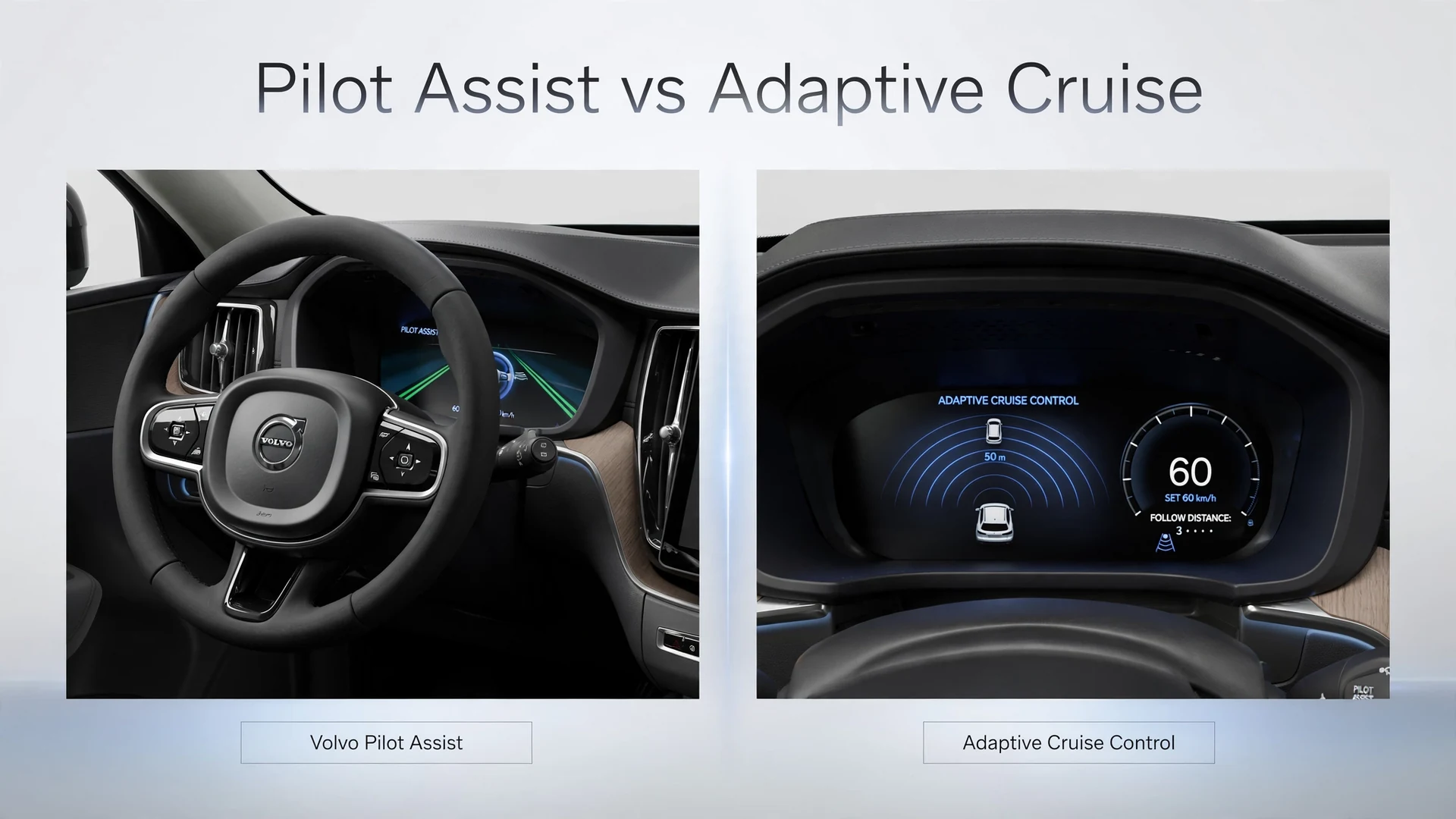
Adaptive cruise control (ACC) handles speed and following distance: it keeps your set speed, slows for slower traffic, and — on modern Volvos — brings the car to a complete stop and resumes in traffic jams. Pilot Assist is ACC plus steering: it adds lane centering, so the car follows the lane’s curves while also managing speed and distance. That’s the entire difference in one sentence — Pilot Assist = adaptive cruise control + steering assistance, making it a Level 2 semi-autonomous system while plain ACC is not. But there are three generations of Pilot Assist with very different abilities, important limitations, and model-year gotchas. Here’s everything, explained.
- The difference: ACC controls speed and distance only; Pilot Assist adds continuous steering assistance to keep the car centered in its lane.
- Three generations: Gen I (2016 XC90) — up to 30 mph, needs a lead car. Gen II (2017+) — up to 80 mph, no lead car needed. Gen III (2019+) — adds predictive, navigation-linked behavior.
- Hands stay on the wheel: all versions require an attentive driver with hands on the wheel; the system warns and disengages if you let go.
- Limitations: needs visible lane markings; struggles with sharp curves, poor weather, construction zones, and faded paint.
- Availability: standard or optional across the SPA/CMA range from 2016 on; Gen III arrived as a dealer software upgrade for 2019+ cars.
- Worth it? Yes for highway commuters and road-trippers — it’s the single most fatigue-reducing option Volvo sells.
Adaptive Cruise Control: The Foundation
Plain adaptive cruise control is a longitudinal system — it only manages the car’s forward motion. You set a speed; radar and camera watch the vehicle ahead; the car accelerates to your set speed when the road is clear, matches the speed of slower traffic, and keeps your chosen following gap. On Volvo’s modern implementation, ACC works down to a standstill: in a traffic jam it brakes to a complete stop behind the car ahead and pulls away again when traffic moves (on longer stops you may need to tap the accelerator or the resume button).
What ACC never does is steer. Drift toward the lane line and the car will happily follow you off the road — lane departure warning or Lane Keeping Aid may beep or nudge, but that’s a separate, reactive safety system, not continuous steering. ACC is standard or widely available across the Volvo range and most competitors; it’s the commodity part of the equation.
What Pilot Assist Adds: The Side-by-Side
| Capability | Adaptive Cruise Control | Pilot Assist |
|---|---|---|
| Maintains set speed | Yes | Yes |
| Adjusts speed to traffic ahead | Yes | Yes |
| Stop-and-go in traffic jams | Yes | Yes |
| Continuous lane centering (steering) | No | Yes |
| Follows lane curves | No | Yes |
| Works without a lead vehicle | Yes | Yes (Gen II+) |
| SAE automation level | Level 1 | Level 2 |
| Driver must stay engaged | Yes | Yes |
In practice, the difference is transformational on a highway. With ACC alone, you’re still steering every mile. With Pilot Assist active, the car holds its lane position through gentle curves while you supervise — your job becomes monitoring rather than constant micro-corrections. Volvo dealers describe it as the difference between driving the car and managing it, and long-distance owners consistently call it the option they’d never give up.
The Three Generations, Explained
Pilot Assist debuted on the 2016 XC90, and Volvo iterated it aggressively. Knowing which generation a used Volvo has matters more than most buyers realize, because Gen I is a fundamentally limited system.
| Pilot Assist I | Pilot Assist II | Pilot Assist III | |
|---|---|---|---|
| Debut | 2016 XC90 | 2017 S90 (rolled across range) | 2019 (dealer upgrade / factory) |
| Max steering-assist speed | 30 mph | 80 mph | 80 mph |
| Needs a lead car to steer | Yes | No | No |
| Steers using | Lead car + lane markings | Lane markings (camera/radar) | Lane markings + navigation data |
| Predictive curve behavior | No | No | Yes (slows pre-emptively for bends) |
| Best use case | Traffic jams only | Highway cruising | Highway cruising |
Generation I (2016 XC90, optional via a roughly $1,800 convenience package) was essentially a traffic-jam assistant: it would accelerate, brake, stop, resume, and steer — but only up to 30 mph, and only when it could see both clear lane markings and a vehicle ahead to follow. Useful in congestion, useless everywhere else.
Generation II (standard on the 2017 S90 in the US, then rolled out across the SPA range) was the breakthrough: steering assistance to 80 mph with no lead car required. This is the system most used Volvos (2017–2019) carry, and it’s the first version that’s genuinely useful on the open highway.
Generation III arrived around 2019 — sold by Volvo as a dealer-installed software upgrade (an official accessory for cars already equipped with Pilot Assist II / IntelliSafe Assist and Sensus navigation) and fitted at the factory on newer cars. Owner reports from Volvo forums describe the upgrade as linking Pilot Assist to navigation data: the car pre-emptively eases off for sharp corners rather than braking mid-bend, and in Eco mode it modulates speed for terrain (easing off uphill, recovering downhill). It’s a refinement, not a revolution — but owners who’ve had the upgrade describe noticeably smoother, more confident behavior.
How It Actually Feels to Use
Engaging Pilot Assist is a steering-wheel button press (on newer cars it’s integrated into the cruise control cluster). A green steering-wheel icon in the driver display tells you lane centering is active; grey means ACC is running without steering. On a well-marked highway, the sensation is uncanny at first: the wheel makes small, smooth corrections on its own, tracking the lane center rather than ping-ponging between the lines the way older lane-keeping systems do.
The system is tuned for calm, not sport. It centers the car rather than taking a racing line, it disengages steering gracefully (with a clear warning) when markings vanish, and it hands back control the instant you apply meaningful steering input — there’s no fight for the wheel. In stop-and-go traffic, the combination of ACC’s auto-resume and lane centering makes congestion dramatically less draining. Owners consistently report arriving fresher after long drives; it’s the rare driver-assist feature that delivers on its marketing.
Limitations: What It Can’t Do
This is the section that matters most, because misunderstanding it is dangerous. Pilot Assist is SAE Level 2: the driver must remain engaged, attentive, and ready to take over at all times. Take your hands off the wheel and the car warns you — escalating chimes, then steering-assist disengagement. It is not self-driving, and Volvo has never claimed otherwise.
Specific limitations, straight from the owner’s manual logic and owner experience:
It needs lane markings. Faded paint, snow cover, heavy rain, or roads with no center line and the steering assistance simply won’t engage or will drop out. Rural two-lanes are its weakness; divided highways are its home.
It doesn’t like sharp curves. Even Gen II/III will ask for help on tight bends — the 80-mph ceiling is a maximum, not a promise. Gen III’s predictive corner braking helps, but physics still applies.
Construction zones confuse it. Temporary lane shifts, cones, and conflicting old/new markings can cause erratic behavior. Experienced owners disengage pre-emptively in work zones.
It can’t see everything. Stationary obstacles at speed, crossing traffic, and cut-in vehicles at the edge of the sensor envelope are known weak points of camera/radar ACC systems generally. Your eyes remain the primary sensor.
Weather degrades it. Heavy rain, fog, and low sun can blind the camera; radar handles precipitation better but isn’t immune. When sensors are compromised, the car tells you — believe it.
Which Volvos Have Which System?
Should You Pay Extra for It?
If you’re buying new, the question is moot — it’s standard. On the used market, treat Pilot Assist as a must-have filter for any 2017+ Volvo, and a deal-breaker check on a 2016 XC90 (Gen I cars without the package can’t be meaningfully upgraded to Gen II behavior; the hardware and software generation is baked in). For 2019+ cars with Pilot Assist II, ask the dealer about the Gen III software upgrade — it’s an official accessory, typically a few hundred dollars installed, and owners report it’s the best-value software money in the Volvo world.
One honest caveat: if you never drive highways — pure city car, short commute — Pilot Assist earns its keep only in traffic jams, and ACC alone covers most of that. The system’s value scales directly with your highway miles. Road-trippers and long commuters: non-negotiable. City-only drivers: nice to have.
Verdict: ACC Is the Tool, Pilot Assist Is the Upgrade
Adaptive cruise control manages speed and distance; Pilot Assist adds the steering that turns a cruise control into a co-pilot. Gen I was a promising prototype, Gen II was the real product, and Gen III polished it with predictive smarts. None of them drive the car for you — hands on the wheel, eyes on the road, always — but for anyone who spends serious time on highways, Pilot Assist is the single most worthwhile technology in a modern Volvo. If you’re choosing between two used Volvos and one has it, take that one.
Sources
- Volvo Cars USA press release via Cision (Jan 2016) — Pilot Assist I (30 mph, lead car) on 2016 XC90; Gen II (80 mph, no lead car) standard on 2017 S90.
- MotorTrend / Automotive Fleet (2016) — Gen II details: 80-mph steering, convenience package context.
- XC40 Forums / Volvo Forums UK (2019) — Pilot Assist III as official dealer software/accessory upgrade for IntelliSafe Assist + Sensus nav cars; owner-reported predictive corner behavior.
- Volvo Cars Lakeridge dealer guide (2024) — Pilot Assist system components: ACC, lane keeping, steering assistance, stop-and-go.
- AutoEvolution / TheStreet (2016) — Gen I vs Gen II comparison and hands-on-wheel requirement.
Frequently Asked Questions
What is the difference between Pilot Assist and adaptive cruise control?
Adaptive cruise control manages speed and following distance only. Pilot Assist adds continuous steering assistance (lane centering) on top of ACC — so the car also steers to stay centered in its lane. Pilot Assist is Level 2 automation; ACC alone is Level 1.
Is Volvo Pilot Assist self-driving?
No. Pilot Assist is SAE Level 2: the driver must keep hands on the wheel and stay attentive at all times. If you take your hands off, the car warns you and then disengages steering assistance. It is a driver-assist system, not autonomous driving.
What are the three generations of Pilot Assist?
Gen I (2016 XC90): steering assist to 30 mph, needs a lead car. Gen II (2017+): to 80 mph, no lead car needed. Gen III (2019+): same 80-mph ceiling with predictive, navigation-linked behavior such as pre-emptive braking for corners.
Can I upgrade my Volvo to Pilot Assist III?
If your 2019+ Volvo already has Pilot Assist II (IntelliSafe Assist) with Sensus navigation, Volvo sells an official dealer-installed software upgrade to Gen III behavior. Cars without factory Pilot Assist hardware generally cannot be retrofitted.
Does Pilot Assist work without lane markings?
No — the steering assistance needs visible lane markings to function. Gen I additionally needs a vehicle ahead to follow. On unmarked roads, in heavy rain or snow, or in construction zones, steering assistance may not engage or may disengage.
Which Volvos have Pilot Assist as standard?
Pilot Assist became standard across most of the US Volvo lineup from the early 2020s. On 2016–2019 cars it was optional or trim-dependent — always verify with the window sticker or build sheet when buying used.