Volvo V60 vs Ford Mondeo?

Volvo V60 vs Ford Mondeo?
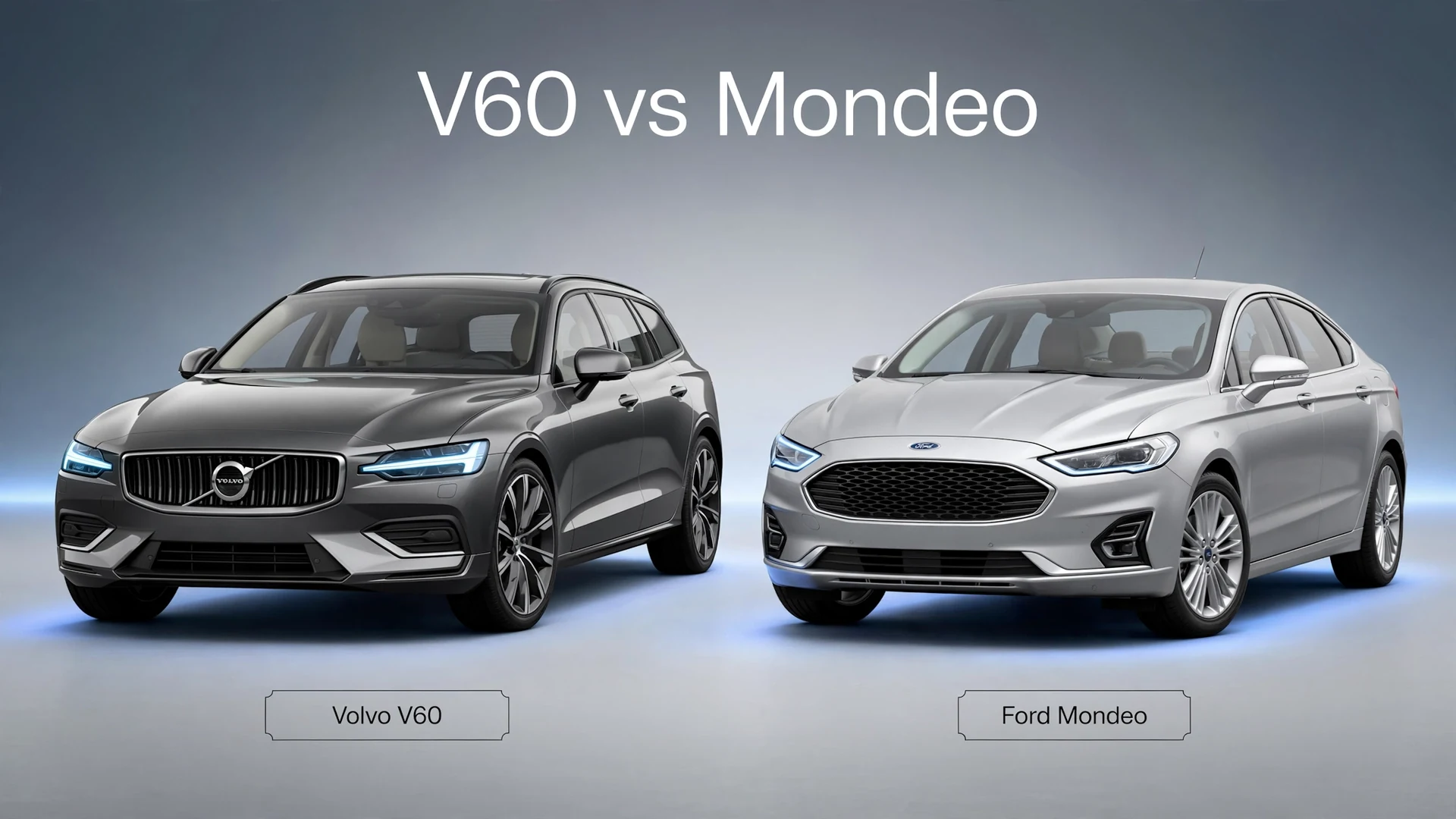
The used estate market keeps throwing these two together, and on paper it’s a mismatch: the Volvo V60 (2010–2018) is a premium lifestyle wagon with a coupe-ish roofline, while the Ford Mondeo estate (Mk4 2007–2014, Mk5 2015–2021) is a big mainstream load-lugger. The honest answer is that neither is the “better” car — they solve different problems. Buy the V60 for the nicer cabin, stronger diesel engines and the badge, at the cost of a genuinely small boot and higher repair bills. Buy the Mondeo estate for maximum space, tow-car talent and rock-bottom running costs, at the cost of less special interior quality and weaker residuals. Here’s the full breakdown with real numbers.
- Space is the Mondeo’s trump card: the Mk4 estate holds 542 litres seats-up vs just 430 for the V60; folded, it’s 1,733 vs 1,241 litres.
- Power favours the Volvo: the D4 Drive-E makes 181 hp and 400 Nm, hits 62 mph in 7.6 seconds, and returns a claimed 67.3 mpg — the Mondeo’s 2.0 TDCi 150 manages 9.1 seconds to 60.
- Towing is a draw on paper: both are rated to 1,800 kg braked, and both have won praise from tow-car testers.
- Watch the same things on both diesels: EGR/DPF trouble on the V60 D4 VEA (2014–2016 cars) and the Mondeo’s wet-clutch Powershift, which needs a fluid change every five years/60,000 km.
- Verdict: choose the V60 if you value the premium cabin and stronger engines; choose the Mondeo if load space, towing stability and cheap parts matter more.
Two Very Different Answers to the Estate Question
Volvo launched the V60 in 2010 as the estate version of the S60 — and made no secret that it was aimed at design-conscious buyers, not removal men. The sloping tailgate and tapering roofline look great in a driveway, but they cost the car dearly in load space: 430 litres with the seats up is barely more than a Focus hatch of the era, and multiple contemporary reviewers called the V60 out for being “compromised as an estate.”
The Mondeo estate comes from the opposite school. The Mk4 (2007–2014) was designed around the idea that a family wagon should swallow a family’s life: 542 litres seats-up, 1,733 litres folded, and a boxy tailgate you can actually use. The Mk5 (2015–2021) gave up a little boot space to styling but remained firmly in the “proper wagon” class. On the used market, that difference in intent is reflected in prices: a big Ford estate buys you more car-per-pound than almost anything else with a roof that long.
Size and Space: the Numbers
| Specification | Volvo V60 (2010–2018) | Ford Mondeo Mk4 estate (2007–2014) | Ford Mondeo Mk5 estate (2015–2021) |
|---|---|---|---|
| Length | 4,628 mm | 4,804 mm | 4,867 mm |
| Boot, seats up | 430 L | 542 L | 500–525 L* |
| Boot, seats folded | 1,241 L | 1,733 L | 1,630 L |
| Braked towing limit | 1,800 kg | 1,800 kg | 1,800 kg |
| Kerb weight (2.0 diesel) | ~1,700 kg | ~1,585 kg | ~1,597 kg |
| Euro NCAP | 5 stars (2010) | 5 stars (2010) | 5 stars (2014): 86/82/66% |
*Mk5 estate boot is 525 litres with the tyre-repair kit or 500 litres with a space-saver spare (Parkers).
The V60 is the only estate here that a rear-seat passenger might find cramped: the tapering roofline pinches headroom, and rear legroom is merely adequate. The Mondeo, especially the Mk4, is properly limousine-like in the back — one six-footer behind another is no drama.
Engines and Performance
This is where the Volvo turns the tables. The star of the V60 range is the D4 Drive-E: a 2.0-litre four-cylinder turbo diesel with 181 hp and 400 Nm, good for 0–62 mph in 7.6 seconds and a claimed 67.3 mpg combined (109 g/km CO₂). Earlier cars used Volvo’s five-cylinder diesels — the D3 (163 hp) and D5 (215 hp) — which sound better and are mechanically simpler, though thirstier. Petrol fans got the T5 (245 hp 2.0) and, briefly, a 304 hp 3.0-litre T6.
The Mondeo’s engine room is more workmanlike. The Mk4’s best bet is the 2.0 TDCi in 140 hp or 163 hp form (the 163 hp unit gets a 2.0 TDCi with 340 Nm and roughly 9-second 0–62 pace). The Mk5 moved to the 2.0 EcoBlue in 150 hp or 180 hp outputs — the 150 hp version does 0–60 in 9.1 seconds per Parkers — plus a 240 hp 2.0 EcoBoost petrol and a hybrid saloon. None of them match the D4’s blend of pace and economy, but the 2.0 TDCi is a famously tough, long-lived unit that will happily take 200,000 miles with basic servicing.
| Engine | Power / torque | 0–62/60 mph | Claimed economy |
|---|---|---|---|
| V60 D4 Drive-E (2014–2018) | 181 hp / 400 Nm | 7.6 s | 67.3 mpg |
| V60 D5 2.4 (2010–2018) | 215 hp / 440 Nm | 7.6 s | ~52 mpg |
| V60 T5 2.0 (2014–2018) | 245 hp / 350 Nm | 6.7 s | ~40 mpg |
| Mondeo Mk4 2.0 TDCi 163 | 163 hp / 340 Nm | ~9.0 s | ~53 mpg |
| Mondeo Mk5 2.0 EcoBlue 150 | 150 hp / 350 Nm | 9.1 s | 44–45 mpg |
| Mondeo Mk5 2.0 EcoBoost 240 | 240 hp / 340 Nm | ~7.9 s | ~36 mpg |
On the road the characters diverge: the Mondeo steers sweeter and feels lighter on its feet — Ford’s chassis tuning was the class benchmark. The V60 rides more comfortably and feels more planted at a cruise, but its steering is linear and lifeless by comparison.
Real-World Running Costs
Fleet News’s long-term V60 D3 (150 hp) test recorded 40–45 mpg in everyday use against a 61.4 mpg claim; D4 owners report low-50s on a run and low-40s around town. That’s still excellent for a car with this pace, but don’t buy a D4 expecting 67 mpg on your commute.
The Mondeo’s 2.0 TDCi 163 is a simpler, lower-stressed engine and its real-world figures land in a similar band — high-40s on a run, low-40s in town — while asking less of your wallet when things go wrong. Insurance groups favour the Ford (group 22 for the 2.0 TDCi estate vs group 27 for the V60 D4), and consumables are cheaper: Ford brake discs, suspension arms and clutches are all significantly less expensive than Volvo-branded equivalents. Both cars use timing belts on the diesels — budget for a change around 100,000–120,000 miles if there’s no receipt.
One cost to note on the Mondeo: the wet-clutch Powershift dual-clutch gearbox needs its fluid changed every five years or 60,000 km, and that service is expensive but absolutely non-negotiable — skip it and the gearbox will punish you. The V60’s conventional Aisin automatics are more forgiving, though the early PowerShift-fitted V60s (the Getrag dual-clutch on some 2010–2013 cars) share the same fluid-change discipline.
Reliability: What Breaks on Each
V60. The five-cylinder diesels (2010–2013) are the safe bets: mechanically simple, well understood, and generally durable. The Drive-E D4 is the one to research carefully. Owner forums document EGR cooler and EGR valve problems on 2014–2016 cars — clogged coolers and sticking valves triggering check-engine lights and occasional limp-home mode — plus higher-than-expected oil consumption on some 2014–2016 builds. Volvo also recalled around 70,000 UK cars with the 2.0 diesel over a potential engine-fire risk; verify any D4 you’re viewing has had the recall work done.
Mondeo. The 2.0 TDCi is fundamentally strong, but listen for turbo whine (a worn turbo is a four-figure job). The big-ticket item is the Powershift gearbox on automatics: fluid leaks, clutch wear and mechatronic faults are all documented, and a full replacement is ruinously expensive — demand full fluid-change history or buy the manual (the 6-speed manual is essentially bulletproof). Electrical gremlins (central locking, climate control glitches) and worn suspension bushes are the common niggles. What Car? scored the Mk4 estate 67% for reliability and the Mk5 a strong 86%, fifth in the executive class.
Used Buying Guide: Which Spec to Hunt
A final inspection tip that applies to both: these are lifestyle and family cars that live hard lives. Check the V60’s rear seat bases for child-seat damage and the boot floor for moisture (tailgate seal failures), and on the Mondeo check the huge boot for damp under the spare — the tailgate drains can clog. Service history matters more than mileage on both.
Verdict: Buy the Space You Actually Need
If your estate will carry adults, dogs, bikes and flat-pack furniture, the Mondeo is the rational choice and it isn’t close: roughly 110 more litres of boot, a better back seat, tow-car awards, cheaper parts and the sweetest steering in the class. The Mk5 is the one to have for safety and refinement; the Mk4 for maximum value.
But if the car is mostly for you — long motorway runs, a cabin you enjoy sitting in, and an engine with real pace — the V60 justifies its premium. The D4 Drive-E is one of the great diesel engines of its era when healthy, and the Volvo’s residuals hold up better. Just go in with your eyes open about the boot: 430 litres is what a hatchback offers, and no amount of Scandinavian design changes that.
Sources
- Practical Caravan — Used Volvo V60 (2010–2018) tow car buyer: 430 L boot, D4 as best tow engine.
- am-online.com — Volvo V60 long-term review: 430 L seats-up, 557 L to roof, 1,241 L folded.
- engineindetail.com — Volvo V60 T6 2010 spec sheet: 4,628 mm length, 430 L boot, 1,800 kg braked towing.
- Parkers — Ford Mondeo Estate Mk5 2.0 TDCi/EcoBlue spec pages: 500–525 L boot, 1,800 kg towing, 9.1 s 0–60, Euro NCAP 5 stars (86/82/66%).
- Practical Caravan — Ford Mondeo Estate Mk4 reviews: 542 L / 1,733 L boot, tow-car verdicts.
- What Car? — Used Volvo V60 (2010–2018) reliability: D4 EGR issues, ~70,000-car fire-risk recall; Used Ford Mondeo reliability pages (67% Mk4, 86% Mk5).
- Car Enthusiast / BusinessCar — V60 D4 Drive-E first drive: 181 hp, 400 Nm, 7.6 s 0–62, 67.3 mpg, 109 g/km.
- Volvo Owners Club Forum — D4 VEA EGR cooler/valve and oil-consumption owner reports (2014–2016 cars).
- Australian Ford Forums — Powershift wet-clutch explainer: 5-year/60,000 km fluid change imperative.
- Carchecker.pro — V60 T5 Mk1 buying checklist: Drive-E oil consumption, Powershift and PCV weak points.
Frequently Asked Questions
Which has the bigger boot, the Volvo V60 or the Ford Mondeo estate?
The Mondeo, by a wide margin. The Mk4 estate offers 542 litres seats-up and 1,733 litres folded; the Mk5 offers 500–525 litres seats-up and 1,630 litres folded. The V60 (2010–2018) manages just 430 litres seats-up and 1,241 litres folded.
Is the Volvo V60 D4 diesel reliable?
Mostly, but do your homework. The 2.0 Drive-E D4 is strong and economical, but 2014–2016 cars have documented EGR cooler/valve problems and oil-consumption issues on some builds. Volvo also recalled around 70,000 UK 2.0 diesels over an engine-fire risk — verify recall completion before buying.
Can a Volvo V60 or Ford Mondeo estate tow a caravan?
Yes — both are rated to tow 1,800 kg braked. The Mondeo has won tow-car awards for stability and steering precision, while the V60 D5’s 440 Nm of torque makes it the stronger puller. Both are proven, capable tow cars.
What is the Ford Mondeo Powershift gearbox problem?
The Getrag dual-clutch Powershift (fitted to 2.0 TDCi and EcoBoost automatics) can suffer fluid leaks, clutch wear and mechatronic faults if neglected. It needs a fluid change every five years or 60,000 km — demand proof, or buy the reliable 6-speed manual instead.
Which is cheaper to run, a V60 or a Mondeo?
The Mondeo: lower insurance groups (group 22 vs 27 for the V60 D4), cheaper parts and servicing, and strong real-world economy from the 2.0 TDCi. The V60’s claimed 67.3 mpg for the D4 is optimistic — expect low-50s on a run.
Which used estate should I buy: V60 or Mondeo?
Buy the Mondeo Mk5 2.0 EcoBlue estate if space, safety and low costs matter most. Buy the V60 — ideally a D4 manual from 2015 with recall work done — if you want the premium cabin, stronger engines and better residuals, and can live with a 430-litre boot.