Volvo EX40 vs Ford Mustang Mach-E: Electric Crossover Showdown (2026)

Search “Volvo XC40 vs Ford Mustang Mach-E” and you’ll land here expecting a simple answer. But there’s a plot twist hiding in the URL: the electric Volvo you’re thinking of isn’t called the XC40 anymore. For 2025, Volvo renamed its electric compact SUV the EX40 (the old XC40 Recharge name is gone), which makes this the most natural apples-to-apples EV matchup in the compact luxury segment: Swedish restraint against American muscle-car swagger, both fully electric, both starting in the high-$30Ks to mid-$50Ks.
This is a rewrite of the original comparison, rebuilt around the electric-versus-electric reality. If you’re actually cross-shopping a gas XC40 against the Mach-E, there’s a short note on that near the end. But the main event is EX40 versus Mach-E — two five-seat electric crossovers aimed at the same driveway.
Key Takeaways
- The Ford Mustang Mach-E starts about $16,000 cheaper than the Volvo EX40 ($37,995 vs $53,795) and offers a wider spread of trims, power levels, and range options.
- The EX40 counters with a calmer, better-built-feeling cabin, standard all-wheel-drive on the Twin Motor, and 296 miles of EPA range in single-motor form.
- For maximum range, the Mach-E Premium Extended Range RWD leads at 320 EPA miles; for maximum thrust, the Mach-E GT and Rally hit 480 hp and 3.4–3.8-second 0–60 runs.
- Both charge at home overnight and both can now tap the Tesla Supercharger network via NACS adapters.
- The federal EV tax credit ended for vehicles acquired after September 30, 2025, so neither car carries a federal credit anymore — price comparisons are now sticker-to-sticker.
Meet the Contenders
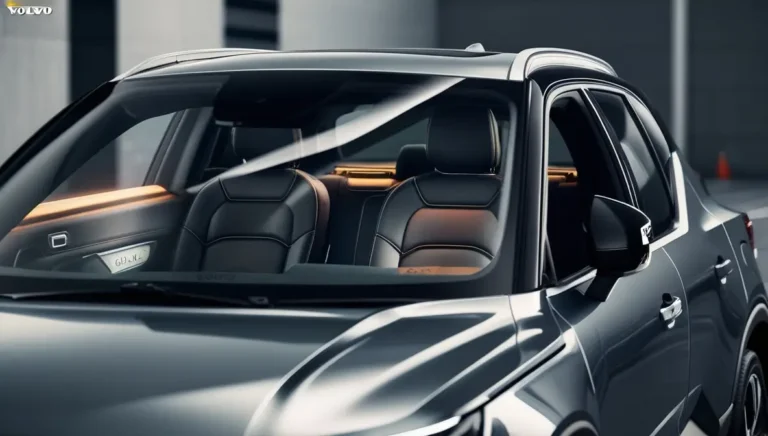
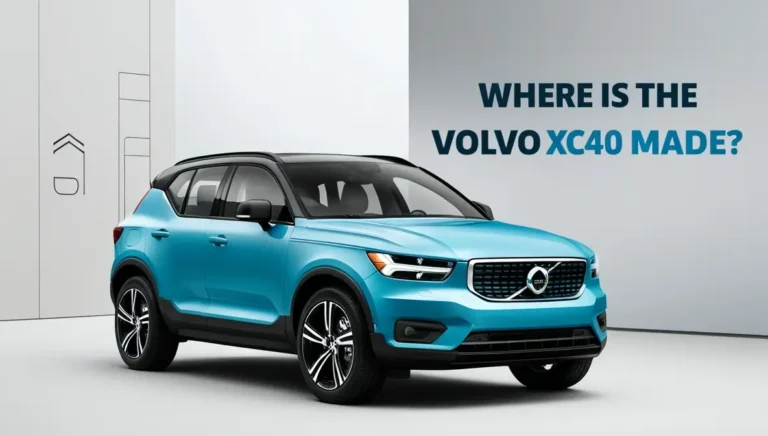
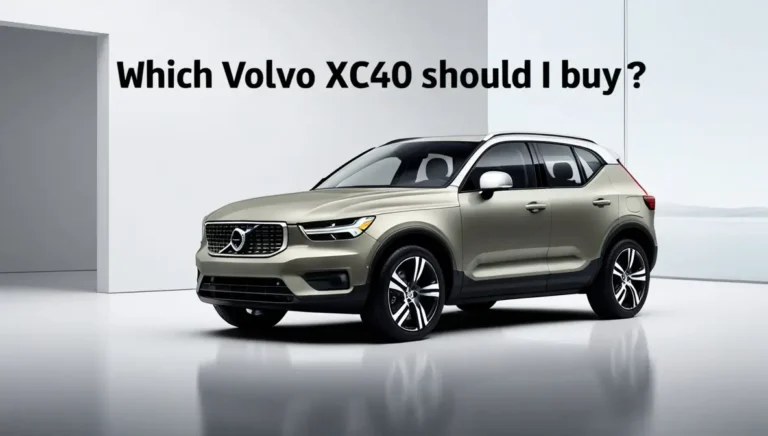
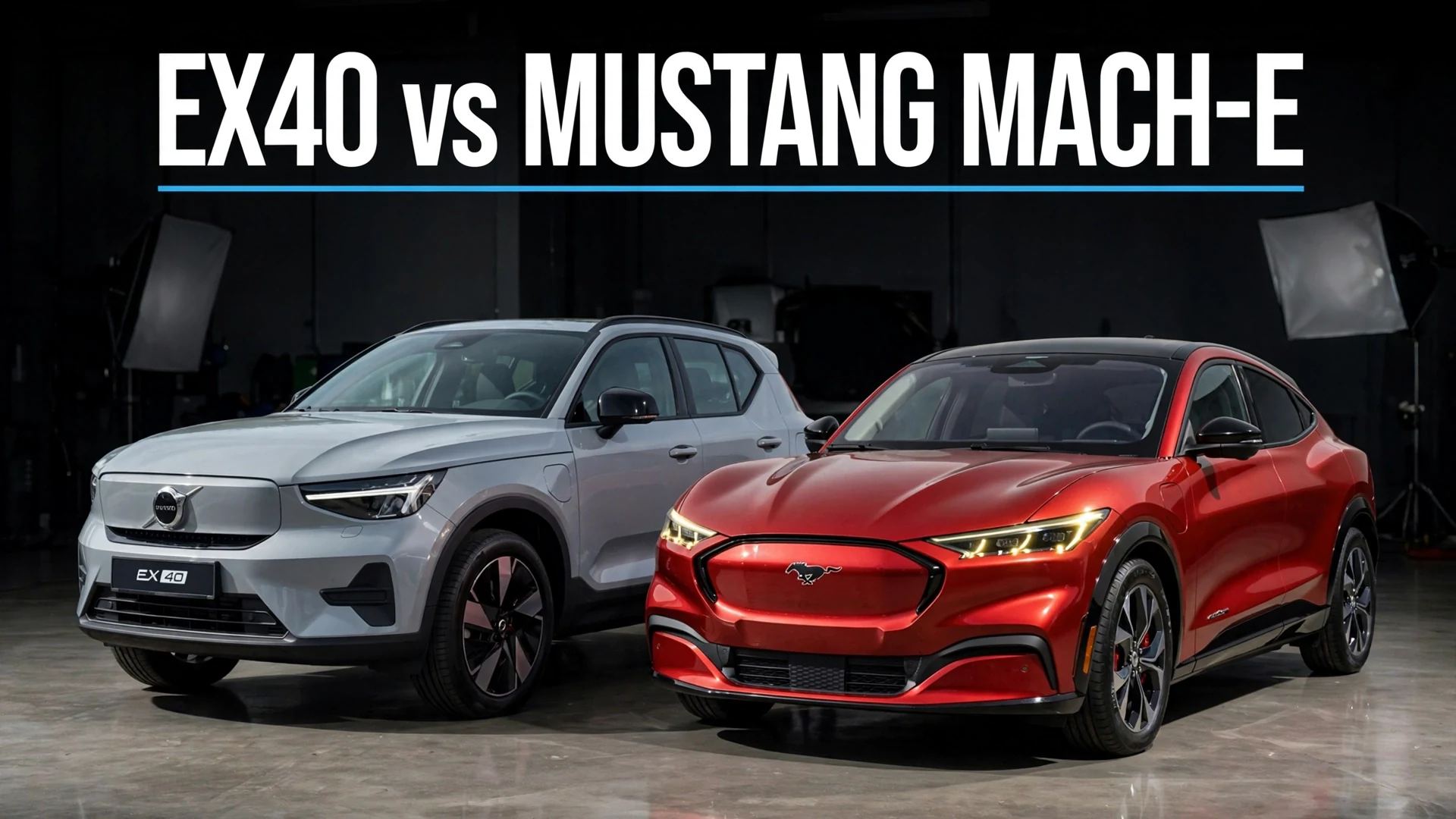
The 2025 Volvo EX40 is the renamed XC40 Recharge, built on the CMA platform it shares with the gas XC40 and Polestar 2. Two powertrains: a 248-hp single-motor extended-range model (rear-wheel drive, 82-kWh battery, 296 miles of EPA range) and a 402-hp twin-motor all-wheel-drive model (78-kWh battery, 260 miles). Google Built-in infotainment and Volvo’s safety-first reputation come standard. Pricing runs from $53,795 to $62,045.
The 2025 Ford Mustang Mach-E is Ford’s ground-up electric crossover, now in its fifth model year and continuously improved with over-the-air updates. Four trims — Select, Premium, GT, and Rally — with standard-range (73-kWh) and extended-range (88-kWh, 91-kWh on GT/Rally) batteries. Power spans 264 to 480 horsepower, range spans 240 to 320 EPA miles, and prices run from $37,995 to $58,490. The 2025 model adds a heat pump and a newer BlueCruise hands-free system.
Spec-by-Spec: The Headline Numbers
| Spec | EX40 Single Motor ER | EX40 Twin Motor | Mach-E Select / Premium | Mach-E GT / Rally |
|---|---|---|---|---|
| Powertrain | Single motor, RWD | Dual motor, AWD | Single or dual motor, RWD or AWD | Dual motor, AWD |
| Horsepower | 248 hp | 402 hp | 264–370 hp | 480 hp |
| Torque | 310 lb-ft | 494 lb-ft | 387–500 lb-ft | 600–700 lb-ft |
| Battery (usable) | 82 kWh | 78 kWh | 73–88 kWh | 91 kWh |
| EPA range | 296 miles | 260 miles | 240–320 miles | 265–280 miles |
| 0–60 mph | 6.9 sec | 4.6 sec | 4.6–5.6 sec | 3.4–3.8 sec |
| DC fast charging | Up to 205 kW | Up to 205 kW | Up to 115 kW | Up to 115 kW |
| 10–80% charge | ~28 minutes | ~28 minutes | ~38 minutes (std. range) | ~38 minutes |
| Cargo (seats folded) | 57.5 cu ft | 57.5 cu ft | 59.7 cu ft | 59.7 cu ft |
| Max towing | 2,000 lbs | 2,000 lbs | Not rated for towing in US | Not rated for towing in US |
| Starting price | $53,795 | ~$55,545 | $37,995 | $54,495 (GT) |
EPA Range Compared
EPA-rated range by variant (2025 model year; Rally is EPA-targeted). The Mach-E’s lineup stretches in both directions — cheapest entry and longest range — while the EX40’s two variants sit in the upper-middle band.
Price: Where the Money Goes
Price is the Mach-E’s sharpest weapon. The entry-level Mach-E Select starts at $37,995 — roughly $16,000 less than the cheapest EX40. Even a loaded Mach-E Rally at $58,490 undercuts the EX40 Twin Motor Ultra’s $62,045. Trim-for-trim, a Mach-E Premium with the extended-range battery lands in the mid-$40Ks, where Volvo simply has no offering.
What does the Volvo’s premium buy? Shorter list of decisions (two powertrains, three trim levels), standard Pilot Assist driver assistance, and the kind of cabin materials and build solidity that luxury buyers notice on the test drive. Ford counters with BlueCruise hands-free highway driving standard across the Mach-E range and a broader menu of performance choices. Neither car qualifies for a federal tax credit anymore — the credit ended for vehicles acquired after September 30, 2025 — so compare window stickers, not post-credit fantasies.
Charging: The EX40’s Quiet Advantage
This is where the spec sheet flips. The EX40 charges at up to 205 kW on a DC fast charger, taking about 28 minutes to go from 10 to 80 percent. The Mach-E tops out around 115 kW, needing roughly 38 minutes for the same 10–80% window on the standard-range battery. On a long road trip with two charging stops, that’s 20 minutes of your life the Volvo hands back.
For daily life, both are easy. Both refill overnight on a 240-volt home circuit, and both gained access to the Tesla Supercharger network: the Mach-E was among the first non-Tesla EVs to get access, and Volvo rolled out NACS adapters for its CCS-equipped cars including the EX40. Check whether the adapter is included or sold separately before you sign — policies change by model year.
Home-charging math favors neither car: a full charge costs roughly a third of an equivalent gas fill-up either way. The difference is time on the road, where the EX40’s faster peak rate wins.
Interior and Tech: Two Philosophies
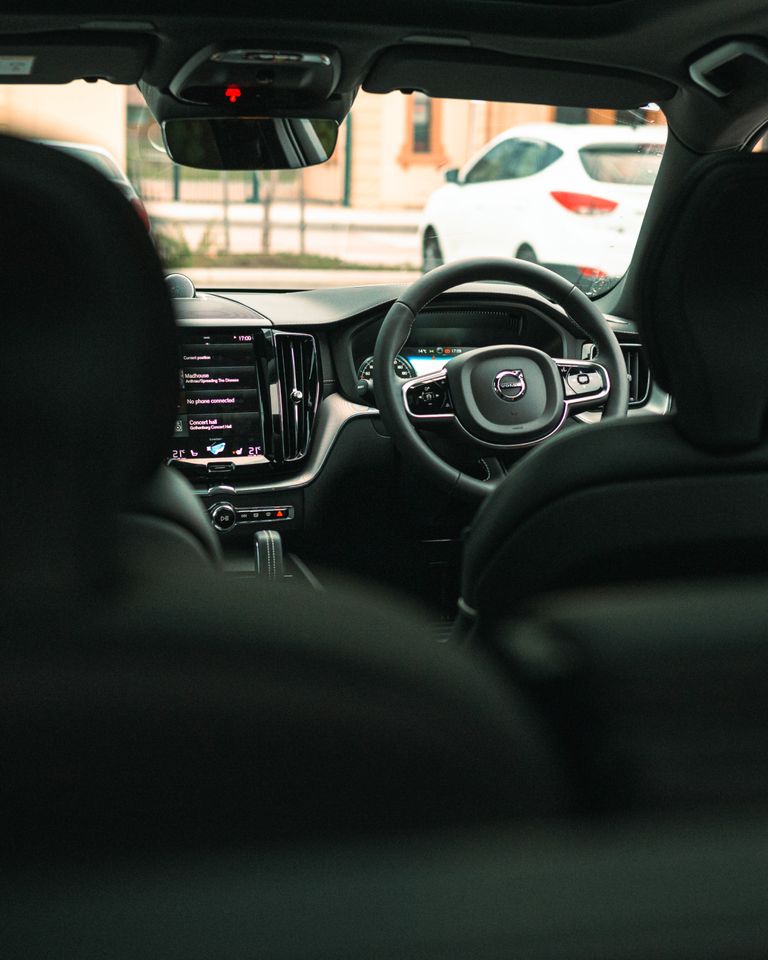
The EX40’s cabin is Scandinavian calm: a 9-inch portrait touchscreen running Google Built-in (Google Maps and voice assistant native), a 12.3-inch driver display, and materials that feel a class up. Reviewers praise the serene ride and low noise, though some find the small screen and buried climate controls fussy.
The Mach-E is tech-forward theater: a 15.5-inch portrait touchscreen running Ford’s SYNC 4A with wireless Apple CarPlay and Android Auto, a 10.2-inch digital cluster, and Mustang cues like the tri-bar taillights. BlueCruise hands-free highway driving comes standard and is one of the best systems in the class. The Mach-E feels younger and sportier; the EX40 feels calmer and more expensive.
Ownership Costs and Reliability Notes
Both brands back their battery packs for 8 years / 100,000 miles, the industry standard. Basic bumper-to-bumper coverage differs: Volvo offers 4 years / 50,000 miles; Ford offers 3 years / 36,000 miles. Volvo also includes 4 years of complimentary scheduled maintenance on new cars — a small but real running-cost edge in the early years.
Maintenance is minimal on both — no oil changes, no transmission services; budget for tires, cabin filters, brake fluid, and wiper blades. The Mach-E’s broader Ford dealer network can mean easier parts and body-shop access than Volvo’s smaller footprint, though Volvo’s complimentary towing and roadside assistance during the warranty period softens that.
Depreciation is the honest unknown. The Mach-E’s history of aggressive price cuts (including a large one for 2025) has softened used values — good news for used buyers, bad news for new-car sellers. The EX40’s smaller volumes and luxury badge have held up somewhat better, but the EV market’s rapid evolution punishes everything eventually.
How They Got Here: A Short Timeline
Which EV Is for You? Pick Your Profile
Verdict
The Ford Mustang Mach-E wins on breadth and value: more trims, more range options, more performance, lower prices, and a hands-free driving system that leads the class. For most shoppers in 2026, it’s the easier recommendation — especially the Premium Extended Range RWD, which pairs 320 miles of range with a price the Volvo can’t touch.
The Volvo EX40 wins on refinement: the faster-charging, calmer, better-finished alternative for buyers who’ll pay a premium for serenity. The Twin Motor’s 4.6-second 0–60 is genuinely quick, and 296 miles from the single-motor car is plenty for real life.
Frequently Asked Questions
Is the Volvo XC40 Recharge now called the EX40?
Yes. For the 2025 model year, Volvo renamed the XC40 Recharge to the EX40 and retired the Recharge badge. The gas XC40 continues with mild-hybrid powertrains. Single-motor models switched from front- to rear-wheel drive for 2024.
Which has more range, the EX40 or the Mustang Mach-E?
The Mustang Mach-E, at the top end. The Mach-E Premium Extended Range RWD is EPA-rated at 320 miles, versus 296 miles for the EX40 Single Motor Extended Range. At the performance end the gap narrows: the Mach-E GT is rated at 280 miles and the Rally at 265, close to the EX40 Twin Motor’s 260.
Which is faster, the EX40 or the Mustang Mach-E?
The Mach-E. Its GT and Rally trims make 480 horsepower and hit 60 mph in 3.4 to 3.8 seconds, versus 4.6 for the 402-hp EX40 Twin Motor. Base models are closer: 6.9 seconds for the EX40 single motor versus 5.6 for the Mach-E Select RWD.
Can the EX40 and Mach-E use Tesla Superchargers?
Yes, both can. The Mach-E was one of the first non-Tesla EVs granted Supercharger access, and Volvo rolled out NACS adapters for its CCS-equipped cars including the EX40. You may need to buy the adapter separately depending on model year, and charging speeds will be limited by each car’s onboard maximum.
Do the EX40 or Mach-E qualify for a federal tax credit in 2026?
No. The federal clean-vehicle credits ended for vehicles acquired after September 30, 2025, so neither car carries a federal credit. Some state and utility incentives still exist — check your state’s current programs. This is not tax advice; consult a tax professional for your situation.
If the EX40’s calm confidence speaks to you, our Volvo EX30 review covers the smaller electric sibling — and if the Mach-E’s value story wins, at least now you know exactly which trim to ask for.