Volvo XC60 vs Toyota RAV4?

Nearly an $18,000 gap separates these two SUVs at the entry level. The question isn’t really which one is “better”—it’s whether that gap buys you something you’ll actually notice every day.
TL;DR
- The RAV4 starts significantly cheaper, around $33,350 with destination versus roughly $51,095 for the XC60 Core
- The RAV4 offers dramatically better fuel economy, especially on hybrid trims
- For 2026, the RAV4 goes electrified-only—no more pure gas-only trims
- The XC60 has more base horsepower and a slight reliability edge in independent ratings
- The RAV4 retains value significantly better over a 5-year period
The core answer: the Toyota RAV4 is the dramatically more affordable, more fuel-efficient, and better resale-value option, while the Volvo XC60 offers more base horsepower, a slight reliability edge, and a genuinely premium cabin experience—making the RAV4 the practical value pick and the XC60 the choice for buyers specifically willing to pay for luxury feel.
How Big Is the Price Gap, Really?
The price difference here isn’t subtle, and it’s worth understanding exactly what it buys.
Toyota lists the 2026 RAV4 at $31,900 base MSRP before destination, landing around $33,350 with destination included, compared to $51,095 for the Volvo XC60 Core—a gap of roughly $17,745. That’s a meaningful chunk of money for most shoppers to justify.
Quick Tip: Luxury models often see bigger gaps between MSRP and actual transaction price—recent XC60 base-trim buyers have reportedly paid somewhat below MSRP, which can narrow the real-world price gap versus the RAV4.
How Do Efficiency and Power Compare?
This is where the RAV4’s electrified 2026 lineup really separates itself.
For 2026, Toyota has shifted the RAV4 to an electrified-only lineup, with the most efficient versions targeting up to 47 city and 40 highway MPG. On power, the comparison flips: the Volvo XC60’s base engine produces 247 horsepower compared to 203 horsepower for the Toyota RAV4’s base engine, giving Volvo a clear edge in outright power.
Expert Insight: According to iSeeCars, the Toyota RAV4 holds advantages in new vehicle pricing, fuel efficiency, resale value, interior volume, and overall quality score, while the Volvo XC60 holds the edge in reliability and base engine power—a fairly clean split between value-focused and performance-focused strengths.
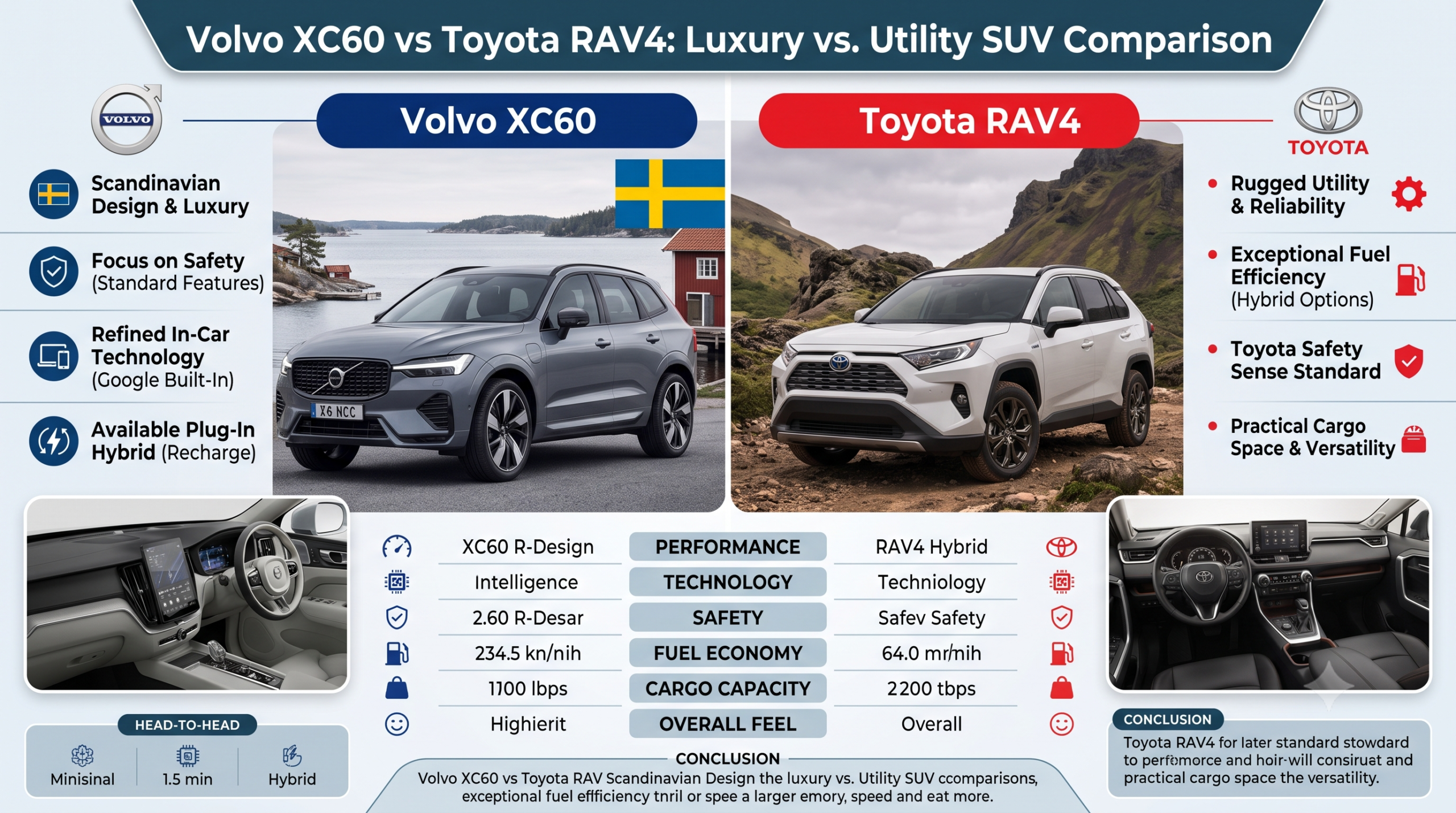
XC60 vs. RAV4: Side-by-Side
| Feature | Volvo XC60 | Toyota RAV4 |
|---|---|---|
| Starting price (with destination) | ~$51,095 | ~$33,350 |
| Base horsepower | 247 HP | 203 HP |
| Fuel economy (efficient trims) | Lower | Up to 47 city / 40 highway MPG |
| Reliability rating (iSeeCars) | 8.3/10 | 8.2/10 |
| 5-year depreciation | Loses ~53.7% | Loses ~30.3% (much better retained value) |
| Cargo space (behind rear seats) | ~22.4 cu ft | Up to 37.8 cu ft |
| Fuel type | Premium unleaded | Regular unleaded |
Pros and Cons by Buyer Type
Value and Practicality-Focused Buyers
- ✅ The RAV4 costs roughly $17,000+ less at the entry level and retains value dramatically better
- ✅ Significantly more cargo space and better fuel economy on efficient trims
- ❌ Less powerful base engine and a less premium cabin experience
Buyers Willing to Pay for Luxury Feel
- ✅ The XC60 offers more base horsepower and a quieter, more premium cabin
- ✅ Slight reliability edge in independent ratings despite the higher price
- ❌ Requires premium fuel and comes with meaningfully less cargo space behind the rear seats
Plug-In Hybrid Shoppers
- ✅ Both offer PHEV variants worth comparing directly against each other rather than base trims
- ✅ This comparison changes meaningfully once you’re looking at RAV4 Plug-In Hybrid versus XC60 Plug-In Hybrid specifically
- ❌ PHEV pricing narrows the gap between the two, so budget-focused buyers should compare those trims directly if considering a plug-in
Quick Tip: If your budget is under $45,000, the RAV4’s highest non-plug-in trim still lands under that mark with destination—worth checking before assuming you need to stretch into XC60 territory.
Real-World Scenario
Picture a buyer with about $51,000 to spend. One path: buy a RAV4 Limited, pocket the difference, and end up with more cargo space and dramatically better fuel economy. The other path: buy the XC60 Ultra, and get Volvo’s Pilot Assist, a 360 camera, a head-up display, and a more premium overall feel—spending the full budget to get there.
Neither choice is wrong; it’s a question of whether the premium features and cabin experience are worth the full price gap for that specific buyer.
Which Should You Choose?
Choose the RAV4 if: you want dramatically better value, fuel economy, cargo space, and resale value, and don’t need a luxury badge or premium cabin.
Choose the XC60 if: you want more base horsepower, a quieter and more premium driving experience, and are comfortable with the significant price premium.
Pull quote: The RAV4-to-XC60 gap isn’t about which SUV is better—it’s about what luxury is actually worth to you.
FAQ
How much more expensive is the XC60 than the RAV4? Roughly $17,745 more at entry-level trims with destination included, based on current published pricing.
Does the RAV4 still come in a pure gas-only version? No, for 2026 Toyota has shifted the RAV4 to an electrified-only lineup, meaning every trim includes some form of hybrid or plug-in hybrid powertrain.
Which has better fuel economy? The RAV4 has a significant advantage, with the most efficient trims targeting up to 47 city and 40 highway MPG compared to lower figures for the XC60.
Which holds its value better? The Toyota RAV4 retains value dramatically better over a 5-year period, losing about 30.3% of its value compared to roughly 53.7% for the XC60.
Is the XC60 more powerful than the RAV4? Yes, the XC60’s base engine produces 247 horsepower compared to 203 horsepower for the RAV4’s base engine.
Key Takeaways
- The RAV4 costs roughly $17,000+ less than the XC60 at entry-level trims
- For 2026, the RAV4 is electrified-only—no pure gas trims remain
- The XC60 has more base horsepower and a slight reliability edge
- The RAV4 offers significantly better fuel economy, cargo space, and resale value
- If comparing plug-in hybrids specifically, compare those trims directly—the picture shifts from the base-trim comparison
What To Do Next
Decide whether your priority is value and efficiency or premium feel and power, then compare matching powertrains—base-to-base or PHEV-to-PHEV—rather than mixing trim levels, since that’s where these comparisons get misleading.