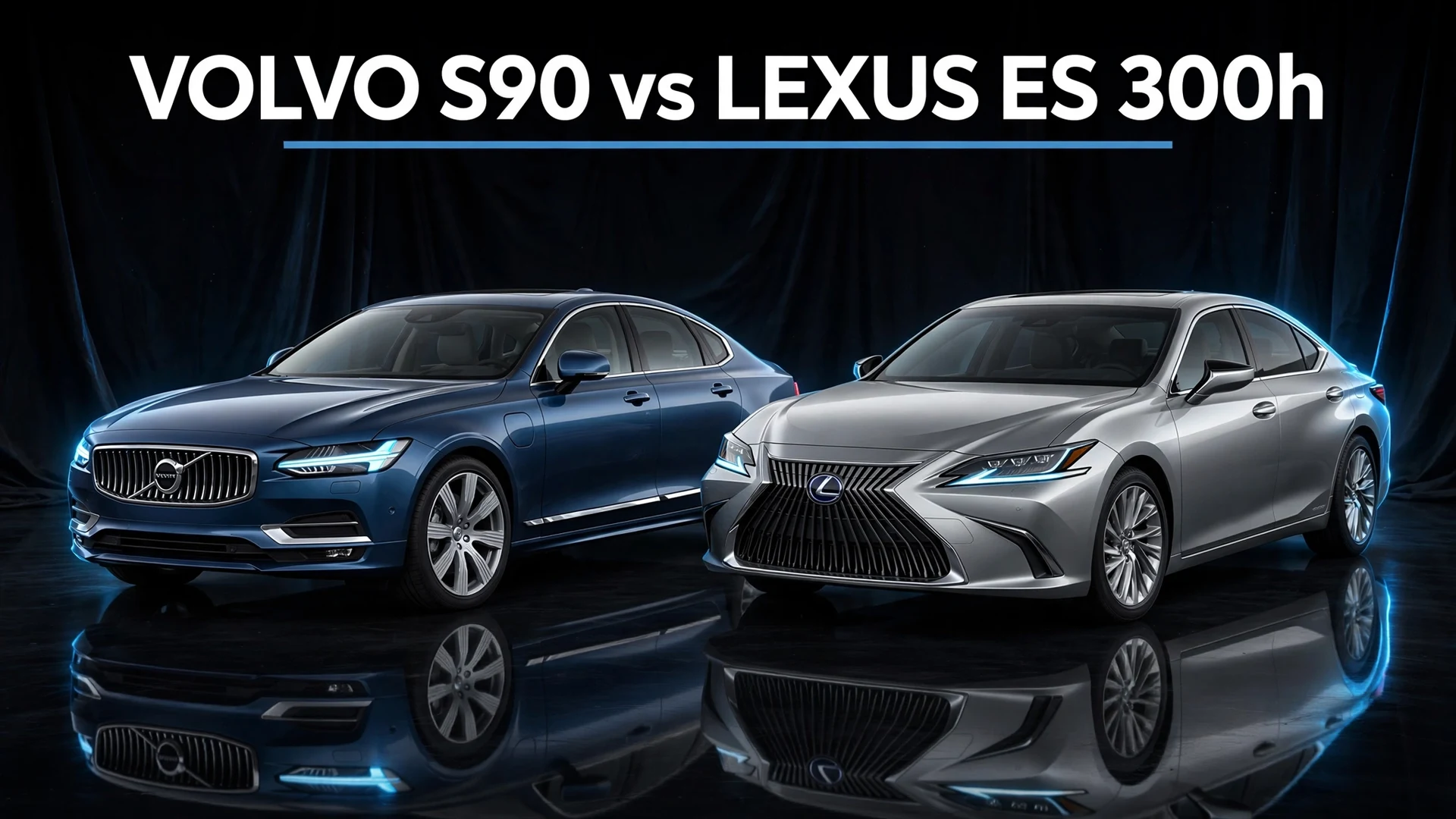
Volvo S90 vs Lexus ES 300h?

Volvo S90 vs Lexus ES 300h?
The Volvo S90 and the Lexus ES 300h are both comfortable, quiet luxury sedans, but they are built for different buyers. The Volvo S90 is the larger, more powerful car: a 200.4-inch flagship sedan with standard all-wheel drive, a 295-hp twincharged B6 mild-hybrid engine, and a starting price of $58,300. The Lexus ES 300h is the efficiency and value play: a 215-hp hybrid that returns an EPA-estimated 44 mpg combined and starts around $44,590, roughly $13,700 less than the Volvo.
If you want maximum fuel economy and the lowest cost of entry, the ES 300h wins easily. If you want a bigger, quicker, all-weather sedan with genuine flagship presence, the S90 is the better car. The rest of this comparison breaks down price, powertrains, economy, space, and safety so you can match the car to your priorities.
- The S90 costs about $13,700 more to start ($58,300 vs $44,590) but brings standard AWD and 80 more horsepower.
- The ES 300h delivers 44 mpg combined versus 26 mpg for the S90 B6 — a 69% efficiency advantage that dominates running costs.
- The S90 T8 plug-in hybrid (455 hp, 38 miles of electric range) has no direct Lexus equivalent at this price.
- The S90 is 4.5 inches longer with a 7.5-inch longer wheelbase, but the ES 300h counters with a larger trunk (16.7 vs 13.5 cu ft).
- Both have excellent safety reputations; Volvo adds standard Pilot Assist semi-autonomous driving on every S90.
- Verdict: buy the Lexus for low running costs and reliability reputation; buy the Volvo for space, performance, and all-weather capability.
Price and Trims: The Lexus Undercuts the Volvo by a Wide Margin
Pricing is the single biggest difference between these two cars. The 2025 Lexus ES 300h starts at $44,590 including destination, and the range tops out at $53,480 for the Ultra Luxury grade. The 2025 Volvo S90 starts at $58,300 for the Plus B6 and climbs to $63,900 for the Ultra B6, with the T8 plug-in hybrid spanning $65,650 to $71,200. Destination ($1,195 on the Volvo) is extra on both.
That means a base S90 costs more than a loaded ES 300h Ultra Luxury. To be fair, the S90 is a class larger and comes standard with all-wheel drive and a panoramic roof, but the price gap is real and it never fully closes: there is no S90 configuration that matches the Lexus on purchase price.
| Model year 2025 | Volvo S90 | Lexus ES 300h |
|---|---|---|
| Starting MSRP | $58,300 | $44,590 |
| Top trim MSRP | $63,900 (B6 Ultra) / $71,200 (T8 Ultra) | $53,480 (Ultra Luxury) |
| Plug-in hybrid option | Yes — T8, 455 hp, 38-mi EV range | No |
| Standard drivetrain | All-wheel drive | Front-wheel drive |
Powertrains and Performance: Volvo Has the Muscle
The S90 B6 uses a 2.0-liter four-cylinder that is both turbocharged and supercharged (Volvo calls it “twincharged”), assisted by a 48-volt mild-hybrid system. It produces 295 hp and 310 lb-ft of torque, routed through an 8-speed automatic to all four wheels. Volvo and independent testers put the 0-60 mph sprint at about 6.2 seconds. The T8 plug-in hybrid pairs the same engine with a more powerful electric system for a combined 455 hp and 523 lb-ft, cutting the 0-60 run to roughly 4.6 seconds with up to 38 miles of electric-only range.
The ES 300h takes the opposite approach. Its 2.5-liter Atkinson-cycle four-cylinder works with Toyota’s proven hybrid system for a combined 215 hp, driving the front wheels through a CVT-style transmission. It reaches 60 mph in about 8.1 seconds. It will never feel quick next to the Volvo, but the powertrain is famously smooth and the hybrid battery — lithium-ion since the 2021 refresh — sits under the rear seat instead of eating trunk space.
Fuel Economy: The Lexus Runs Away With It
This is where the ES 300h justifies its existence. EPA ratings of 43 mpg city / 44 mpg highway / 44 mpg combined make it one of the most efficient luxury sedans sold in America. The S90 B6 is rated 23/31/26 mpg — respectable for a 4,300-lb AWD sedan, but 18 mpg behind the Lexus in combined driving.
Put it in dollars: over 15,000 miles a year at $3.50 per gallon, the Lexus uses about $1,193 in fuel versus roughly $2,019 for the Volvo — a saving of more than $800 a year, every year. The S90 T8 narrows the gap only if you charge it religiously and drive within its 38-mile electric range; on longer trips it behaves like a heavy, powerful gasoline sedan.
Interior Space, Cargo, and Technology
The S90 is the bigger car in nearly every exterior dimension: 200.4 inches long on a 120.5-inch wheelbase, versus 195.9 inches and 113 inches for the Lexus. Rear-seat legroom favors the Volvo, and its cabin feels a class up with standard Nappa-adjacent materials on higher trims, an optional Lounge package with rear-seat ventilation and massage, and Volvo’s clean Scandinavian design.
The Lexus fights back on practicality. Its trunk holds 16.7 cubic feet against the Volvo’s 13.5, a meaningful advantage for airport runs. Lexus’s infotainment (12.3-inch screen on higher grades, 10.2-inch head-up display available) is straightforward, and the Mark Levinson audio option is superb. Volvo counters with its Google-based infotainment and a 14-speaker Harman Kardon system on the Ultra. Both offer wireless Apple CarPlay and Android Auto.
Safety: Both Are Excellent, Volvo Adds More Standard
Volvo’s reputation is built on safety, and the S90 backs it with standard Pilot Assist (adaptive cruise with lane centering), blind-spot monitoring, and a full suite of airbags including a driver knee airbag. The S90 has historically earned IIHS Top Safety Pick+ ratings. The ES 300h carries Lexus Safety System+ 2.5 with pre-collision, lane tracing assist, and road-sign assist, and the ES line has also earned strong IIHS scores. Neither car gives you a reason to worry; the Volvo simply bundles more driver assistance as standard rather than as options.
Full Spec Comparison
| Specification (2025 MY) | Volvo S90 B6 AWD | Lexus ES 300h |
|---|---|---|
| Engine | 2.0L twincharged I4 + 48V mild hybrid | 2.5L Atkinson I4 hybrid |
| Horsepower | 295 hp | 215 hp |
| Torque | 310 lb-ft | 163 lb-ft (engine) |
| Transmission | 8-speed automatic | CVT-style (eCVT) |
| Drivetrain | AWD standard | FWD only |
| 0–60 mph | ~6.2 sec | ~8.1 sec |
| EPA combined mpg | 26 | 44 |
| Fuel requirement | Premium unleaded | Regular unleaded |
| Length / wheelbase | 200.4 in / 120.5 in | 195.9 in / 113.0 in |
| Trunk volume | 13.5 cu ft | 16.7 cu ft |
| Curb weight | 4,296 lb | 3,730 lb |
| Starting MSRP | $58,300 | $44,590 |
Verdict: Which Sedan Should You Buy?
Buy the Lexus ES 300h if your priorities are low purchase price, minimal fuel bills, and a proven hybrid powertrain with a long reliability track record. It is the rational choice and it is not close on running costs — the fuel savings alone exceed $800 a year, and the purchase-price gap buys a lot of gasoline.
Buy the Volvo S90 if you want a true flagship sedan: more space, far more power, standard all-wheel drive for winter climates, and a more prestigious cabin. The T8 plug-in hybrid is the enthusiast pick — 455 hp with 38 miles of electric range is something Lexus simply does not offer in this segment. One caveat: the ES was fully redesigned for 2026 as an all-hybrid (plus a new BEV variant), so cross-shop the new generation before signing on a 2025.
Sources
- Volvo S90 pricing, trims, B6/T8 specifications — CarBuzz 2025 Volvo S90 overview; Park Place Volvo digital showroom.
- S90 B6 detailed specs (295 hp, 310 lb-ft, 23/31 mpg, dimensions) — CarWeek 2025 S90 specifications.
- S90 T8 output (455 hp, 523 lb-ft, 38-mile range, 4.6-sec 0-60) — AutoEvolution reporting Volvo Car USA figures.
- Lexus ES 300h pricing and trims ($44,590–$53,480) and 44 mpg combined rating — Green Car Reports, 2025 ES hybrid pricing.
- ES 300h specs (215 hp, 2.5L hybrid, FWD, 0-60 ~8.1s, dimensions, 3,730-lb curb weight) — McGrath Lexus of Chicago; CCarPrice USA.
Frequently Asked Questions
Is the Volvo S90 bigger than the Lexus ES 300h?
Yes. The S90 is 200.4 inches long with a 120.5-inch wheelbase, versus 195.9 inches and a 113-inch wheelbase for the ES 300h. The Volvo offers more rear-seat room, though the Lexus has the larger trunk at 16.7 cubic feet versus 13.5.
Which is more fuel efficient, the S90 or the ES 300h?
The Lexus ES 300h by a wide margin: 44 mpg combined against 26 mpg for the S90 B6. At 15,000 miles a year and $3.50/gallon, the Lexus saves over $800 annually in fuel.
Does the Volvo S90 come as a plug-in hybrid?
Yes. The S90 T8 pairs the 2.0-liter engine with a plug-in hybrid system for 455 hp, 523 lb-ft, and up to 38 miles of electric-only range. Lexus does not offer a plug-in ES in the U.S.
Is the Lexus ES 300h all-wheel drive?
No. The ES 300h is front-wheel drive only; Lexus reserves AWD for non-hybrid ES models. The Volvo S90 comes standard with all-wheel drive.
Which is cheaper to buy, the S90 or the ES 300h?
The Lexus. The 2025 ES 300h starts at $44,590 while the S90 starts at $58,300 — a gap of roughly $13,700 before options. A fully loaded ES 300h Ultra Luxury ($53,480) still costs less than a base S90.
Which is more reliable, Volvo or Lexus?
Lexus has the stronger long-term reliability reputation, particularly for its hybrid powertrains, which have been refined over two decades. The S90’s twincharged mild-hybrid system is more complex. Neither brand publishes directly comparable defect rates, so this reflects industry reputation and owner-survey history rather than a single definitive metric.