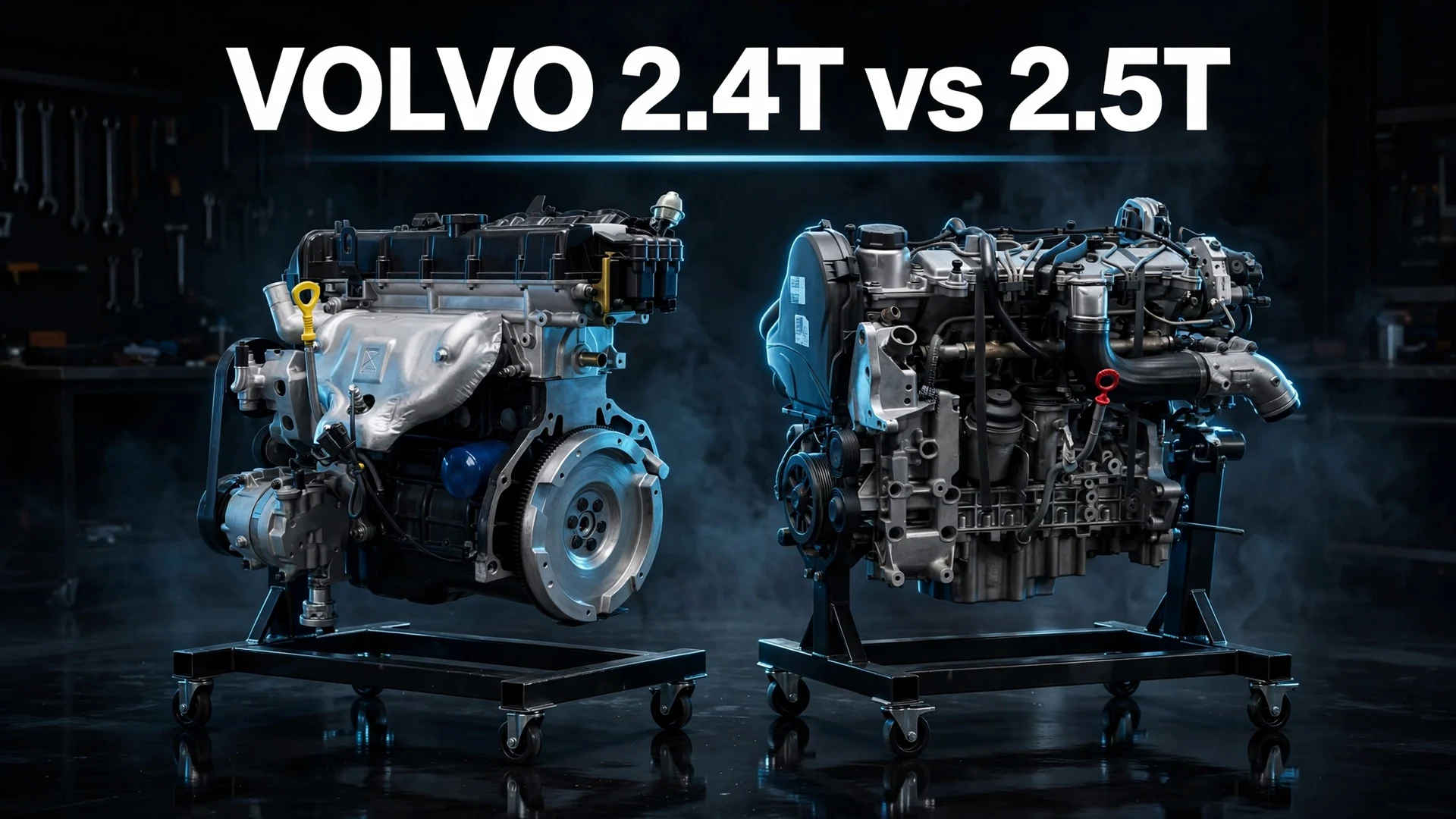
Volvo 2.4T vs 2.5T?

Volvo 2.4T vs 2.5T?
Volvo’s 2.4T and 2.5T badges look like a rounding error, but they denote two distinct five-cylinder turbo engines from the P2 era. The 2.4T (B5244T3) is the earlier unit: 2,435 cc, 197 hp, 285 Nm, single exhaust-cam VVT, offered roughly 2000–2003. The 2.5T (B5254T2) is its stroked successor: 2,522 cc, 207 hp, 320 Nm, dual variable valve timing, offered 2003–2012 across far more models including the XC90. The 2.5T is the better engine — more torque, lower down, with newer technology — but the 2.4T cars are older, cheaper, and carry one well-known electronic weak spot you should know about.
- Real differences: 3.2 mm more stroke, dual CVVT vs single-cam VVT, a larger turbo (TD04L-14T vs TD04HL-13T), and 35 Nm more torque.
- Output: 197 hp / 285 Nm (2.4T) vs 207 hp / 320 Nm (2.5T) — and the 2.5T’s torque arrives 300 rpm earlier and holds longer.
- Years: 2.4T ≈ 2000–2003 (S60, V70, S80, early XC70); 2.5T = 2003–2012 (adds XC70 and the XC90).
- Fuel economy is a wash: EPA rates the 2005 S60 2.5T at 22 combined mpg vs 21 for the 2003 2.4T.
- Verdict: buy the 2.5T for the better engine and wider model choice; buy the 2.4T only at a meaningful discount, and check the electronic throttle module.
Why Two Nearly Identical Engines Exist
The 2.5T is not a different engine family — it’s the 2.4T evolved. Volvo took the B5244T3’s 83 mm bore and stretched the stroke from 90 mm to 93.2 mm, taking displacement from 2,435 cc to 2,522 cc. At the same time, engineers upgraded the variable valve timing from a single exhaust-cam phase regulator to dual CVVT (intake and exhaust), fitted a slightly larger Mitsubishi turbo (TD04L-14T replacing the TD04HL-13T), and retuned everything for stronger low-end response. Compression stayed at 9.0:1 in both.
The timing tells the story: the 2.4T powered the first wave of P2 cars (2000–2003), and the 2.5T arrived for 2003 as the refined replacement, then stayed in production all the way to 2012 — most notably as the long-serving turbo option in the first-generation XC90. When you see a 2.5T badge, you’re looking at the mature version of Volvo’s five-cylinder turbo formula.
One common confusion to clear up: some sources quote 193 hp for a “2.4T.” That figure belongs to the earlier 1997–1999 B5254T engine, not the B5244T3 covered here. The B5244T3 makes 200 PS — 197 hp.
Specs at a Glance
| Specification | 2.4T (B5244T3) | 2.5T (B5254T2) |
|---|---|---|
| Displacement | 2,435 cc | 2,522 cc |
| Bore × stroke | 83 × 90 mm | 83 × 93.2 mm |
| Compression | 9.0:1 | 9.0:1 |
| Power | 197 hp @ 6,000 rpm | 207 hp @ 5,000 rpm |
| Torque | 285 Nm @ 1,800–5,000 rpm | 320 Nm @ 1,500–4,500 rpm |
| Valve timing | Exhaust-cam VVT only | Dual CVVT (intake + exhaust) |
| Turbocharger | Mitsubishi TD04HL-13T | Mitsubishi TD04L-14T |
| Model years | ~2000–2003 | 2003–2012 |
| Fitted to | S60, V70, S80, V70 XC | S60, V70, XC70, S80, XC90 |
| EPA combined (S60) | 21 mpg (2003) | 22 mpg (2005) |
Torque Is the Real Story
The 10-hp power gap understates the difference. What you feel from the driver’s seat is torque: 320 Nm versus 285, arriving at 1,500 rpm instead of 1,800 and holding to 4,500. The 2.5T pulls harder from just off idle and needs fewer downshifts in daily driving — exactly what you want in a heavy wagon or an XC90.
Straight-line pace reflects the modest gap: specialist tuner IPD lists stock 0–60 mph at 7.8 seconds for the S60 2.4T and 7.6 for the S60 2.5T. (These are specialist-supplied stock figures rather than period magazine road tests, which I couldn’t locate — treat them as indicative, not gospel.) The 2.5T’s real advantage isn’t the stopwatch; it’s effortlessness.
Where the 2.5T Pulls Ahead
Technology, breadth, and refinement. Dual CVVT gives the 2.5T better breathing across the rev range, which shows up as that fatter torque curve and slightly better EPA numbers — 22 combined mpg for a 2005 S60 2.5T versus 21 for the 2003 2.4T, with the bigger engine. The 2.5T also unlocks the models the 2.4T never reached: the XC70 and, most importantly, the XC90, where the B5254T2 served from 2003 all the way to 2012 and proved itself as a durable, long-lived powerplant.
Age matters too. The newest 2.4T cars are 2003 models; the newest 2.5Ts are nearly a decade younger. On the used market, that means less wear, more remaining life in rubber components and wiring, and cars that have lived through fewer winters.
Where the 2.4T Still Holds Up
Price. The 2.4T only exists in 2000–2003 cars, which are now firmly in budget territory — often thousands less than a comparable 2.5T car. The engine itself is fundamentally sound: same iron-block modular five architecture, same 9.0:1 compression, and the same basic turbo layout. If you find a well-maintained 2002 S60 2.4T at the right price, the engine is not the reason to walk away.
The reason to be careful is electronic, not mechanical. Early-2000s Volvos used a Magneti Marelli electronic throttle module (ETM) that is a well-documented weak spot on 1999–2002-era cars, and the 2.4T’s production run sits squarely in that window. Symptoms are erratic idle, surging, and limp-home mode. Ask whether the ETM has been replaced or rebuilt (rebuilt units with contactless sensors are the permanent fix), and budget accordingly if it hasn’t. This is community-documented rather than factory-acknowledged, but the pattern is consistent across owner forums and specialists.
Reliability: What to Watch on Each
Both engines share the modular five-cylinder’s signature maintenance item: the PCV breather-box system. When it clogs — and it will, typically past 100,000 miles — crankcase pressure rises, causing oil consumption and pushing out cam and rear-main seals. It’s a well-documented job (FCP Euro’s PCV guide, widely referenced on Matthews Volvo Site, covers the 2.5T applications), and a car with a fresh PCV service is worth a premium over one without.
On the 2.4T specifically, add the ETM check above and watch for oil weeping from camshaft seals onto the timing belt — another commonly reported issue on these early cars. Neither engine is fragile, but neither tolerates deferred maintenance. A stack of service records matters more than which badge is on the trunk.
Which Should You Buy?
Verdict: The 2.5T Is the Engine to Have
The 2.5T wins on technology (dual CVVT, bigger turbo), output (207 hp / 320 Nm), refinement, model availability, and age — it’s the mature version of the formula and the only choice for XC90 and XC70 buyers. But the 2.4T is not a bad engine; it’s simply the earlier draft, and its cars trade at a discount that can make them the smarter buy for a budget shopper who does their homework. Buy the 2.5T if the prices are close. Buy the 2.4T only if the discount is real and the ETM and PCV check out.
Sources
- Wikipedia “Volvo Modular engine” — B5244T3/B5254T2 displacement, bore/stroke, compression, output, VVT and turbo specifications, application years.
- mymotorlist.com — B5244T3/B5254T2 technical pages (production spans, turbo models, reported issues).
- fueleconomy.gov (US EPA) — 2003 S60 2.4T (21/18/26 mpg) and 2005 S60 2.5T (22/19/27 mpg).
- IPD USA — specialist-supplied stock 0–60 figures for S60 2.4T/2.5T (flagged as specialist data, not magazine tests).
- FCP Euro PCV guide via Matthews Volvo Site; Turbobricks forums — PCV breather-box issue documentation.
Frequently Asked Questions
What is the difference between Volvo 2.4T and 2.5T engines?
The 2.5T (B5254T2) is a stroked evolution of the 2.4T (B5244T3): 2,522 cc vs 2,435 cc, dual CVVT vs exhaust-only VVT, a larger TD04L-14T turbo, 207 hp / 320 Nm vs 197 hp / 285 Nm.
Which years had the Volvo 2.4T engine?
Roughly 2000–2003: S60 2.4T (2001–2003), V70 2.4T (2000–2003), S80 2.4T (2001–2003), and V70 XC 2.4T AWD (2001–2002). The 2.5T replaced it from 2003.
Is the Volvo 2.5T reliable?
Yes, with maintenance. The B5254T2 is a durable long-lived engine (it served in the XC90 through 2012), but the PCV breather-box system clogs with age and must be serviced — neglect causes oil consumption and seal failures.
What is the ETM problem on early 2000s Volvos?
The Magneti Marelli electronic throttle module on 1999–2002-era cars (including 2.4T models) is a known weak spot, causing erratic idle, surging, or limp-home mode. Rebuilt units with contactless sensors are the permanent fix.
Which is better for towing, 2.4T or 2.5T?
The 2.5T: 320 Nm from 1,500 rpm versus 285 Nm from 1,800 rpm makes it notably stronger for towing. It’s also the only option in the XC90 and XC70, Volvo’s tow-rated wagons and SUVs of the era.
Does the 2.5T use more fuel than the 2.4T?
No — slightly less. EPA figures for the S60 give the 2005 2.5T 22 mpg combined versus 21 mpg for the 2003 2.4T, thanks to dual CVVT and better low-end efficiency.