Where Is the Power Steering Reservoir on a 2007 XC90?

Popped the hood on your 2007 XC90 looking for the power steering reservoir and come up empty? You’re not alone — this is one of the most commonly searched Volvo maintenance questions, and the owner’s manual diagrams don’t always match what you actually see under the hood.
TL;DR
- The reservoir sits inside the engine bay on the passenger side, near the front of the engine — no need to remove headlights or wheel liners on this model.
- It has a cap marked with a steering wheel symbol, usually black or grey, that turns counterclockwise to remove.
- Check the fluid level when the engine is cold and the car is parked on level ground.
- 2007 XC90s came with either a 3.2-liter inline-6 or a 4.4-liter V8, and reservoir shape differs slightly between them — the V8 unit uses a dipstick-style cap.
- If you can’t find it visually, follow the two rubber hoses running from the steering rack toward the front-right of the engine — they lead straight to it.
The Short Answer: Passenger-Side Engine Bay
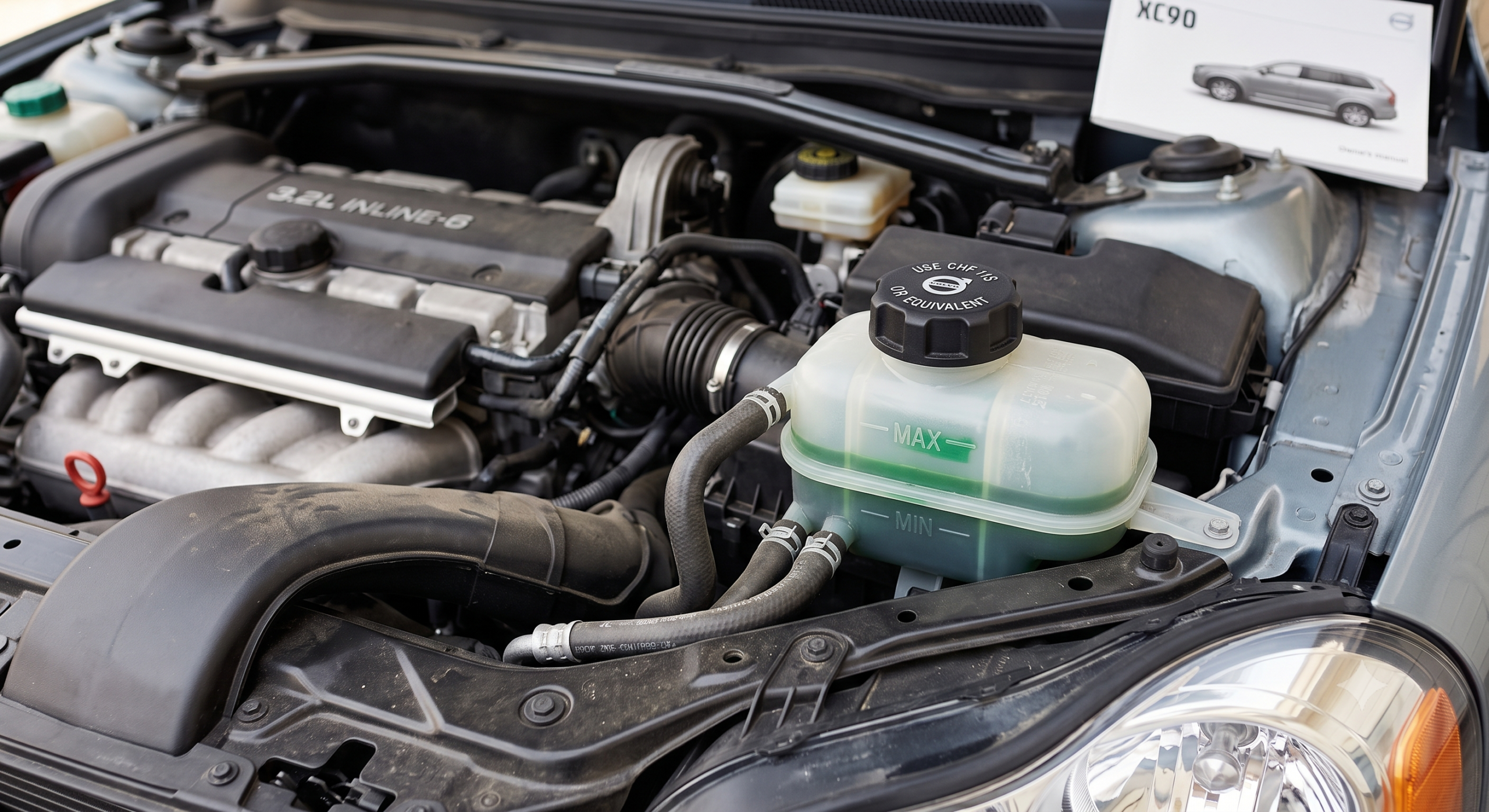
On a 2007 Volvo XC90, the power steering fluid reservoir is located under the hood on the passenger side of the engine, roughly level with the top of the engine block. It’s a plastic tank, usually with MAX and MIN markings printed on the side, connected to two rubber hoses that carry fluid to and from the steering pump.
Unlike some later Volvo models built on the compact P1 platform (S40, V50, C30), where technicians sometimes have to pull a headlight to reach the reservoir, the XC90 doesn’t require that. Everything you need is visible once the hood is up — you’re just looking for a smaller, easy-to-miss cap among the coolant tank, brake fluid reservoir, and washer fluid tank.
Quick Tip: If your engine bay looks crowded, start by finding the brake fluid reservoir near the firewall — it’s usually the largest, most obvious cap. The power steering reservoir sits forward and to the right of it, closer to the front of the car.
Step-by-Step: How to Find and Check It
Every step here leads with the action first, so you can move fast if you’re standing at the car right now.
1. Park on level ground and pop the hood. Pull the interior hood release, then walk to the front and lift the hood using the exterior latch. Make sure the prop rod is secure before reaching inside.
2. Let the engine cool if it’s been running. Volvo recommends checking power steering fluid when the engine is cold, since fluid expands with heat and can give a false high reading.
3. Locate the cap with the steering wheel icon. It’s a smaller, round cap on the passenger side of the engine bay — it should be distinctly labeled, unlike the coolant or washer fluid caps nearby.
4. Check the level against the MAX/MIN lines. Many reservoirs on this generation are translucent enough to see fluid level without opening the cap. If yours isn’t, remove the cap and check the built-in dipstick.
5. Top off if needed, but don’t overfill. Add fluid until it reaches just below the MAX line — overfilling can cause foaming and leaks once the engine warms up and the fluid expands.
Expert Insight: A groaning or whining noise on startup, especially when turning the wheel at low speed, is the classic symptom of low power steering fluid. If the level looks fine but the noise persists, the issue may be a failing power steering pump rather than fluid alone.
Comparison: 3.2L I6 vs. 4.4L V8 Reservoir Differences
The 2007 XC90 sold in the US with two engine choices, and Volvo used slightly different reservoir hardware for each.
| Feature | 3.2L I6 | 4.4L V8 |
|---|---|---|
| Reservoir cap style | Screw-off cap, MAX/MIN lines | Dipstick-integrated cap |
| Reservoir compatibility | 3.2L-specific part | Shared with 2.5T/T6/V8 reservoir family |
| Fluid type | CHF 11S or CHF 202 (Pentosin) | CHF 11S or CHF 202 (Pentosin) |
| Common owner complaint | Reservoir filter can clog over time | Same filter design, same cleaning method |
| Access difficulty | Straightforward, top-down access | Straightforward, top-down access |
A 2024 repair-industry guide on European SUV maintenance noted that Volvo’s hydraulic power steering systems from this era are among the easier ones to service at home, since the reservoir sits fully exposed rather than buried under intake or accessory components.
Pros and Cons of DIY Fluid Checks by Owner Type
The First-Time Volvo Owner
- Pros: No special tools needed, cap is accessible without jacking up the car
- Cons: Easy to confuse with the coolant reservoir if you’re not familiar with the layout yet
The High-Mileage Daily Driver
- Pros: Catching low fluid early can prevent pump damage, which is a costlier repair
- Cons: Reservoir filters can clog with age, sometimes requiring a full flush rather than a simple top-off
The DIY Fluid-Flusher
- Pros: The whole system — reservoir, return line, and pump — is reachable without major disassembly
- Cons: Getting the exact correct fluid matters; some 2007 XC90 owners report earlier documentation errors that listed the wrong fluid type
Quick Tip: Volvo’s official spec for this generation is CHF 11S or the newer CHF 202 hydraulic fluid — not automatic transmission fluid (ATF), despite some older documentation confusion. Using the wrong fluid type can damage seals over time.
Alternative worth knowing: If you own a later XC90 (2016 or newer), skip this whole process — that generation switched to electric power steering, which has no fluid reservoir at all. Choose to check your model year first if you’re not sure which system you have.
Frequently Asked Questions
Why can’t I find the power steering reservoir in my 2007 XC90? It’s easy to mistake it for the coolant or washer fluid tank since all three sit close together on the passenger side — look specifically for the cap marked with a steering wheel icon.
What kind of power steering fluid does a 2007 XC90 use? Volvo specifies CHF 11S or the backward-compatible CHF 202 hydraulic fluid for this generation, not ATF or generic power steering fluid.
How often should I check the power steering fluid? Checking monthly, or any time you notice stiff or noisy steering, is a reasonable habit for a vehicle of this age.
Does the 2007 XC90 have electric or hydraulic power steering? It uses traditional hydraulic power steering with a belt-driven pump and fluid reservoir; electric power steering didn’t arrive on the XC90 until the redesigned 2016 model.
Can low power steering fluid damage my XC90? Yes — running the pump dry or low for extended periods can wear out the pump prematurely, turning a simple fluid top-off into a more expensive pump replacement.
Key Takeaways
- The reservoir is under the hood, passenger side, near the front of the engine — accessible without removing any body panels.
- Look for the cap with the steering wheel symbol among the coolant, brake, and washer fluid caps.
- Check fluid level cold, on level ground, against the MAX/MIN markings.
- Use only CHF 11S or CHF 202 hydraulic fluid, never ATF.
- If fluid keeps dropping after a top-off, inspect the return hose and reservoir filter for leaks or clogs before assuming pump failure.
Your Next Step
If you’ve located the reservoir and the fluid is consistently low a week after topping it off, check the two rubber hose connections at the reservoir base first — that’s the most common leak point on this generation, and it’s a far cheaper fix than a new pump.