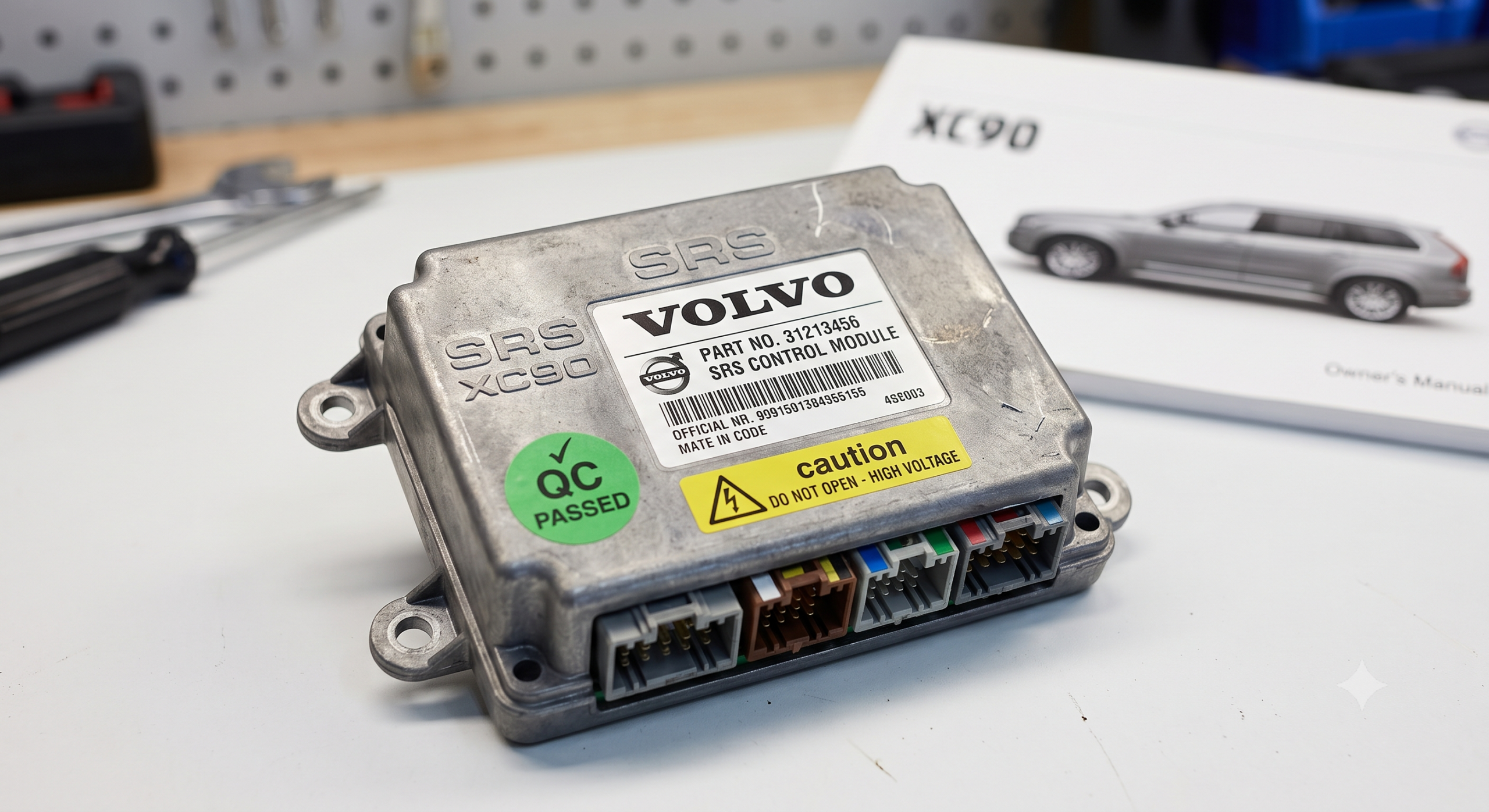
Where Is The Seat Belt Module In a 2008 Volvo XC90?

Your SRS light won’t turn off, a scan tool is throwing a seat belt code, and you’re crawling around under the dash looking for something that isn’t even there. Here’s the part nobody tells you upfront: on a 2008 XC90, “the seat belt module” usually means two different things in two different places.
TL;DR
- There’s no single “seat belt module” — you’re likely looking for either the SRS control module (which monitors the seat belt pretensioners) or the seat belt buckle switch (which sends a “buckled” signal).
- The SRS control module sits on the transmission tunnel, under the center console, just in front of the parking brake.
- The seat belt buckle switch is built into the buckle itself, mounted at the base of each seat, not a separate box.
- Getting to the SRS module means pulling the entire center console — a 30–60 minute job with basic sockets.
- Disconnect the battery and wait at least 3 minutes before touching any SRS wiring — this is a genuine safety step, not overcaution.
Bottom line: on a 2008 XC90, the SRS control module that manages your seat belt pretensioners is mounted under the center console on the transmission tunnel, right in front of the parking brake lever.
“Seat Belt Module” Actually Means Two Different Parts
This is the single biggest source of confusion for XC90 owners searching for this part. People say “seat belt module” to mean either the buckle switch or the whole SRS brain, and they live in completely different spots.
A 2025 automotive diagnostics industry report noted that seat belt-related SRS faults are among the top five most common airbag system codes across mid-2000s vehicles, which is exactly why this search comes up so often. Knowing which one you actually need saves you from tearing apart the wrong part of the car.
Quick Tip: If your scan tool code mentions a specific seat position (like “driver buckle switch fault”), you need the buckle at that seat — not the center SRS module.
Where the SRS Control Module Sits
The SRS control module — the computer that monitors seat belt pretensioners, airbags, and crash sensors — is mounted on the transmission tunnel, under the center console, directly in front of the parking brake lever.
Volvo’s own wiring documentation places the collision sensor control module on the transmission tunnel in the center console, just ahead of the parking brake, and forum teardown guides confirm you’ll find it secured by three 10mm bolts once the console is out of the way. You cannot see it without removing the console — there’s no access panel or cutout.
How to Access It
- Disconnect the battery negative terminal and wait at least 3 minutes before touching anything (Volvo’s own service warning — the system can still fire seat belt pretensioners briefly after power is cut).
- Open the center console lid and remove the rubber liner underneath.
- Pop the small plastic trim cover near the gear shifter with a trim tool or flat screwdriver.
- Remove the screws securing the console front and rear.
- Lift and wiggle the console free, adjusting the parking brake lever position if it’s tight.
- The SRS module is now visible, held by three 10mm bolts, with a pink wiring connector that unlocks via a sliding orange bracket — never yank the connector itself.
Expert Insight: Forum teardown guides are consistent that this connector unlocks by sliding a small orange bracket, not by pulling — forcing it risks snapping the pink locking tab.
Where the Seat Belt Buckle Switch Sits
Unlike the SRS module, the buckle switch isn’t a separate box — it’s built directly into the seat belt buckle at the base of each seat.
Owners replacing front seat belts describe removing rear seat rail covers and bolts, sliding the seat back, then tilting it up to access the buckle’s mounting bolt and its connector underneath. The switch and the buckle are one unit — if the switch fails, you typically replace the whole buckle assembly.
Quick Tip: Always remove the ignition key before disconnecting a seat belt buckle connector — leaving it in can set an SRS fault code even if nothing is actually broken.
Comparison Table: SRS Module vs. Seat Belt Buckle Switch
| Feature | SRS Control Module | Seat Belt Buckle Switch |
|---|---|---|
| Location | Under center console, on transmission tunnel | Base of each individual seat |
| What it does | Monitors all pretensioners, airbags, crash sensors | Signals whether that specific belt is buckled |
| Access difficulty | Moderate — full console removal | Moderate — seat rail covers and tilt |
| Common failure sign | Generic SRS light, internal fault codes | Seat-specific “buckle fault” code |
| Typical fix | Replace/reset module (often needs no reprogramming) | Replace whole buckle assembly |
Pros and Cons by Reader Type
The Fault-Code Chaser
- Pros: A scan tool code that names a specific seat (“driver buckle”) tells you exactly where to look — no guessing needed.
- Cons: A vague “internal fault” code usually points to the SRS module itself, which means the bigger console teardown.
The Budget DIYer
- Pros: Used SRS modules are inexpensive and rarely fail from wear, so junkyard or forum-sourced units are common and reliable.
- Cons: Some replacement modules need dealer VIN programming while others are plug-and-play — confirm before you buy, or you’ll pay for a part you can’t use.
The Safety-First Owner
- Pros: Following the battery-disconnect and wait-time steps makes this a genuinely low-risk DIY job.
- Cons: Skipping those steps risks accidental pretensioner deployment — this isn’t a job to rush.
A Real-World Scenario
Picture a 2008 XC90 owner whose SRS light won’t clear after a fender-bender. A scan tool throws two vague codes and the shop quotes a full module replacement at a steep price. Instead, they pull the center console themselves, find the SRS module held by three 10mm bolts, and discover the pink connector was simply seated at an angle from a previous repair.
Reseating that one connector — no new parts needed — cleared the fault and the light stayed off. Not every SRS light means a dead module; sometimes it means a loose connection from work done years earlier.
Choose This If: Alternatives to DIY
Choose a Volvo specialist or SRS repair shop if: your seat belts or airbags actually deployed in a collision — deployed pretensioners must be replaced (never reused), and post-collision SRS diagnosis benefits from proper tools like VIDA.
Choose the DIY route if: you’re chasing a nuisance SRS light with no collision history, have basic hand tools, and are comfortable following the battery-disconnect safety steps precisely.
Quick Tip: Note your SRS module’s part number before shopping for a replacement — used modules must match your part number, and some require dealer programming while others don’t.
Frequently Asked Questions
Is the SRS module the same as the seat belt module on a 2008 XC90? Not exactly — the SRS module is the central computer that monitors seat belt pretensioners along with airbags, while each seat belt buckle has its own separate switch built in.
Do I need to disconnect the battery before working near the seat belt module? Yes. Volvo’s own service guidance calls for disconnecting the battery and waiting at least 3 minutes, since the system can retain enough charge to fire a pretensioner briefly after power is cut.
Can I replace the SRS module myself without a dealer? Often yes — many owners report a straight plug-and-play swap using a matching part number, though some replacement modules require dealer or VIDA-tool programming, so check before buying.
Why does my SRS light stay on after replacing a seat belt buckle? A stored fault code needs to be cleared with a compatible scan tool after the repair; simply installing a new part doesn’t automatically reset the light.
What does it mean if my scan tool shows a seat belt pretensioner fault after an accident? If pretensioners fired during a collision, they’re a one-time-use device and must be replaced — a fired pretensioner cannot be reset or reused.
Key Takeaways
- “Seat belt module” usually means either the SRS control module (center console, transmission tunnel) or the buckle switch (base of each seat) — confirm which one your fault code points to.
- The SRS module sits under the center console in front of the parking brake, secured by three 10mm bolts.
- Always disconnect the battery and wait at least 3 minutes before working near SRS wiring.
- The seat belt buckle switch is built into the buckle itself, accessed by tilting the seat back after removing rail covers.
- Deployed pretensioners from an actual collision must be replaced, never reused — this isn’t a resettable part in that case.
Next Step
Pull your scan tool code first — it’ll tell you whether you’re chasing the center SRS module or a specific seat’s buckle switch, which saves a lot of unnecessary console teardown.