What Haldex Version Does the Volvo XC90 Have?

Ask five XC90 owners which Haldex generation their AWD system uses, and you might get five slightly different answers — because even the enthusiast community doesn’t fully agree on the exact model-year cutoffs.
This guide is compiled from Volvo enthusiast forum research and cross-referenced technical discussions on Haldex AWD generations, so it’s transparent about where the community has consensus and where it doesn’t.
TL;DR
- Early first-gen XC90s (2003–2005ish) used Haldex Generation 2.
- Mid-cycle first-gen models picked up Generation 3, with faster engagement and a dual-pump design.
- Later first-gen XC90s (roughly 2007 onward) moved to Generation 4, which dropped the mechanical pump.
- The final first-gen years (around 2013–2014) are often cited as Generation 5.
- Second-generation XC90s (2016+) use a modern, faster-reacting Haldex-based Instant Traction AWD system.
- Exact year cutoffs vary by source — verifying against your specific coupler is the only fully reliable method.
Here’s the short answer: which Haldex generation your XC90 has depends heavily on its model year, generally moving from Generation 2 in the earliest cars, through Generation 3 and 4 across the mid-to-late first-generation years, up to Generation 5 in the final pre-2015 models, with the second-generation XC90 (2016+) using its own modern Haldex-based AWD system.
Why This Question Doesn’t Have One Clean Answer
This is worth addressing honestly upfront. Unlike some spec questions with a clear factory number, Haldex generation cutoffs for the XC90 come almost entirely from owner and enthusiast research rather than a single official Volvo document.
One detailed forum breakdown places Generation 3 from 2003 to 2006, Generation 4 from 2007 to 2012, and Generation 5 from 2013 to 2015. A separate technical discussion citing an outside AWD reference instead describes Generation 2 starting in 2002, with some owners’ own inspection of their specific couplers suggesting Generation 2 was still present as late as 2005, transitioning to Generation 3 around 2006.
Quick Tip: If precision matters — say, you’re sourcing a replacement coupler — don’t rely on the model year alone. Physically inspecting your Haldex unit’s housing and filter design is the most reliable way to confirm generation, since owners report visible design differences between generations.
How to Tell the Generations Apart by Design
Since the model-year cutoffs are debated, it helps to know what owners actually look for on the unit itself. This is where hands-on forum research becomes genuinely useful.
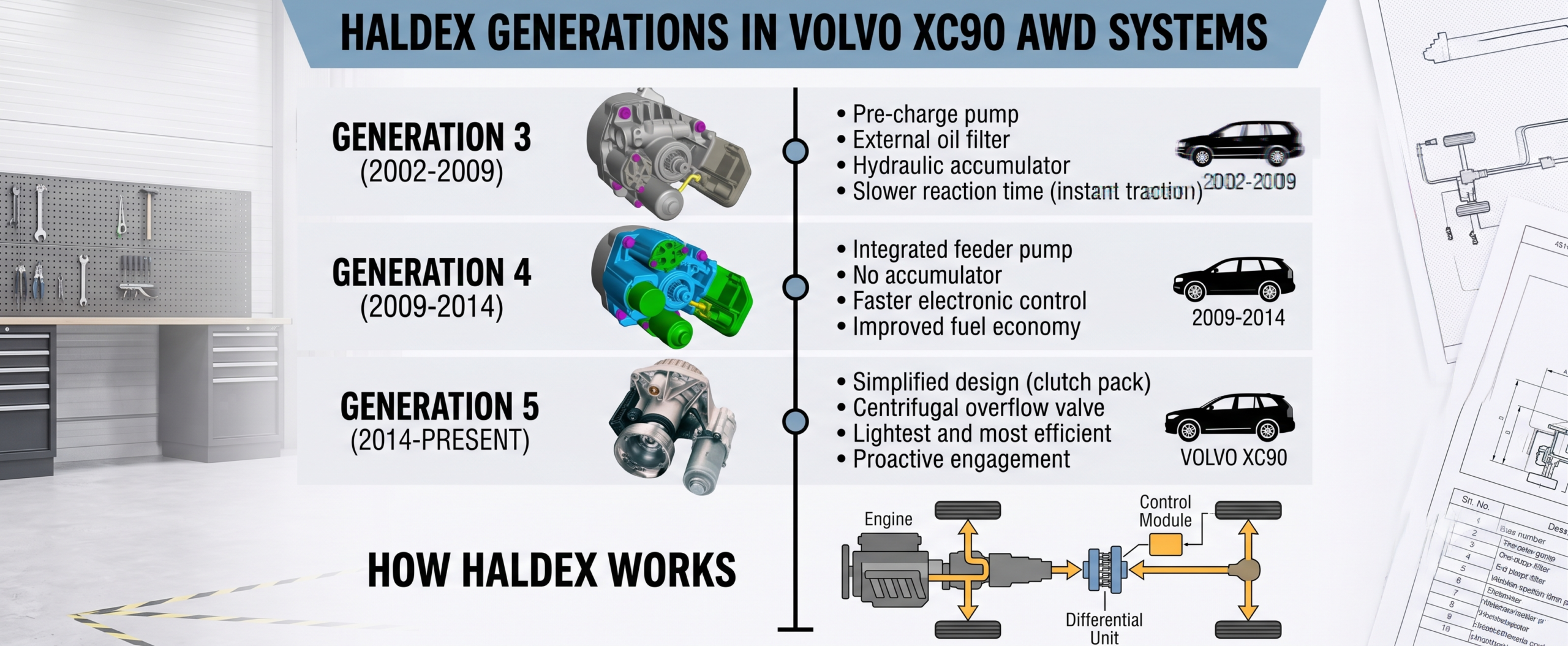
Owners comparing units side by side describe the Generation 2 housing as noticeably smaller than Generation 3, while Generation 3 and Generation 4 can be told apart by filter placement — Generation 3 uses a side-mounted filter, while Generation 4 uses a top-mounted filter.
Bold takeaway: filter placement and housing size are more reliable visual identifiers than model year alone, since production transitions don’t always align perfectly with a new calendar year.
What Actually Changed Between Generations
The differences aren’t just cosmetic — each generation genuinely changed how quickly the system reacts to wheel slip. Understanding this helps explain why some owners across model years notice real differences in how their AWD “feels.”
Broadly, later Haldex generations react faster and more decisively to slip. According to one detailed forum explanation, Generation 3 was the first version to offer near-instant engagement, while Generation 4 added an accumulator tank that pre-builds pressure so it can essentially release the clutch immediately, rather than needing to actively pump pressure the way Generation 3 does.
Expert Insight: Volvo’s own marketing described the second-generation AWD system broadly as capable of reacting in as little as one-seventh of a wheel revolution — a spec that’s often mixed into “which generation is fastest” debates, so it’s worth checking whether a given claim refers to Volvo’s official language or a specific coupler generation.
Comparison Table: Haldex Generations in the First-Gen XC90
| Generation | Approx. Years (per most-cited source) | Key Trait |
|---|---|---|
| Gen 2 | 2002–2005 (disputed range) | Electronically controlled, mechanical pump only |
| Gen 3 | 2003–2006 (or 2006 onward, depending on source) | Dual pump (mechanical + electric), faster engagement |
| Gen 4 | 2007–2012 | Electric pump only, accumulator tank, fastest engagement |
| Gen 5 | 2013–2015 | Final first-gen refinement, cited less consistently across sources |
The takeaway: the two most consistent, widely-repeated claims across sources are that Generation 3 introduced meaningfully faster engagement than Generation 2, and that Generation 4 further sped things up by removing the mechanical pump — the exact year boundaries around those changes are the part with genuine disagreement.
Second-Generation XC90 (2016+): A Different System Entirely
If your XC90 is a 2016 or newer model, this whole generational debate doesn’t really apply to you in the same way. The second-generation XC90, built on Volvo’s SPA platform, uses its own Haldex-based AWD system, marketed by Volvo as Instant Traction.
This system builds on the same electronically controlled clutch-coupling principle as the earlier generations but is integrated with the newer platform’s electronics and Aisin eight-speed automatic transmission, rather than being a direct continuation of the first-generation’s numbered Haldex lineage.
Real-World Scenario: Sourcing a Used Coupler
Say your first-gen XC90’s AWD coupler needs replacing, and you find a used one from a donor car of a different model year. Before assuming it’s a drop-in match, check the filter mounting position and overall housing size against your own unit — owners have found that part numbers and internal designs can differ even between years that some sources lump into the same generation.
It’s a small extra step, but it can save you from installing a part that technically bolts on but behaves differently than your original system.
Pros & Cons by Owner Type
The DIY Repairer
- Pros: Visual identification (filter placement, housing size) gives you a reliable fallback when model-year sources disagree
- Cons: Requires physically inspecting the unit, which isn’t always convenient before a purchase
The Used-Parts Shopper
- Pros: Later generations (3 and 4) are widely reported to offer noticeably better engagement speed if you’re upgrading from an early Gen 2 unit
- Cons: Cross-year part compatibility isn’t guaranteed just because two cars are labeled the “same generation” by a given source
The Performance-Focused Owner
- Pros: Generation 4’s accumulator-based design is consistently described as the quickest-reacting of the first-gen systems
- Cons: Confirming you actually have Gen 4 (versus 3) requires visual inspection rather than trusting model year alone
Alternatives Worth Considering
Confirm by VIN through a Volvo dealer or VIDA database — choose this if you want the closest thing to an authoritative answer, since dealer parts systems can look up your exact original component by chassis number.
Physical inspection of your existing unit — choose this if you’re comparing a used replacement part and want a same-day answer without dealer involvement.
FAQ
What Haldex generation does my Volvo XC90 have? It depends on your specific model year and production date, generally ranging from Generation 2 in early cars through Generation 5 in late first-generation models — though exact year cutoffs vary between sources.
How can I tell which Haldex generation my XC90 has? Check the physical unit — Generation 2 housings are noticeably smaller, and Generation 3 versus Generation 4 can often be distinguished by side-mounted versus top-mounted oil filters.
Is a later Haldex generation actually better? Later generations generally engage AWD faster and more smoothly, with Generation 4’s accumulator-based design frequently cited as the quickest-reacting system in the first-generation lineup.
Does the second-generation XC90 (2016+) use the same Haldex numbering? Not in the same way — it uses a modern Haldex-based Instant Traction system integrated with the SPA platform, rather than continuing the first-generation’s numbered lineage.
Can I swap a Haldex unit from a different model year into my XC90? Possibly, but confirm the physical design matches (filter placement, housing size, part number) rather than assuming compatibility based on model year alone.
Key Takeaways
- Haldex generation in the first-gen XC90 (2003–2014) generally progressed from Gen 2 through Gen 5 across the production run.
- Sources disagree on exact model-year cutoffs, so physical inspection is the most reliable identification method.
- Later generations (3 and 4) offer meaningfully faster AWD engagement than early Gen 2 units.
- Generation 4 introduced an accumulator tank and removed the mechanical pump, generally regarded as the quickest-reacting first-gen system.
- The second-generation XC90 (2016+) uses its own modern Haldex-based Instant Traction system, separate from the numbered first-gen lineage.
Next Step
If you need a definitive answer for a repair or parts purchase, physically inspect your Haldex unit’s filter placement and housing size, or confirm your exact component by VIN through a Volvo dealer’s parts database.