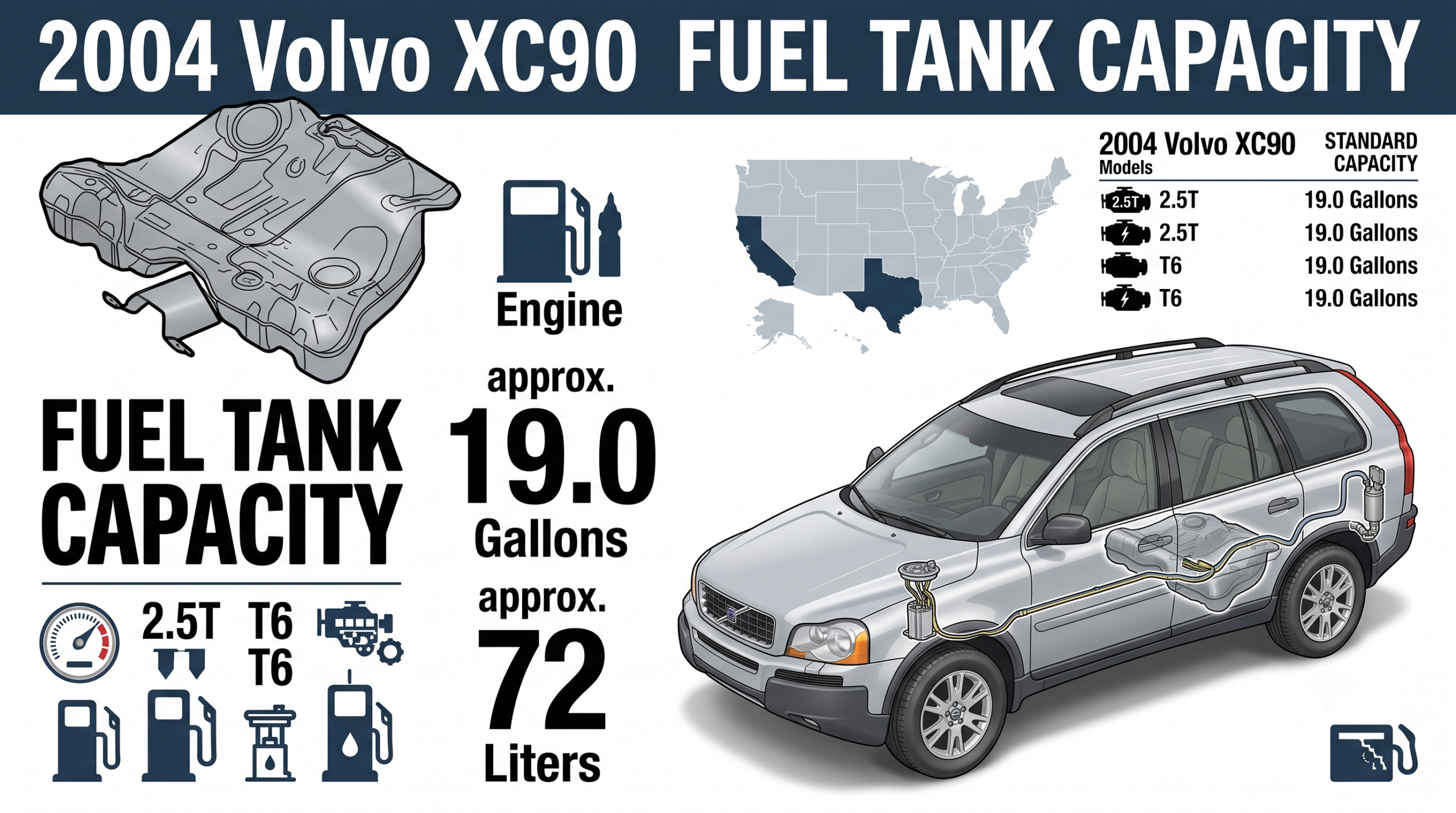
2004 Volvo XC90 Fuel Tank Capacity?

Planning a road trip in your 2004 XC90 and wondering how far you’ll get between fill-ups? The tank size is smaller than a lot of modern three-row SUVs, and it’s worth knowing before you hit the highway.
This guide is compiled from official manufacturer specification data for the 2004 XC90, so the numbers reflect factory figures rather than rough estimates.
TL;DR
- The 2004 Volvo XC90’s fuel tank holds 70 liters, or approximately 18.5 US gallons.
- This figure is consistent across the 2.5T and T6 trims offered that year.
- Both engines require premium unleaded gasoline.
- Combined with typical fuel economy for this generation, expect a real-world range of roughly 300–350 miles per tank.
- A few third-party estimators list slightly different figures (around 68 liters), so treat the 70L factory spec as authoritative.
Here’s the short answer: the 2004 Volvo XC90 has a fuel tank capacity of 70 liters, which converts to approximately 18.5 US gallons, and this applies across both trims available that model year.
The Official Fuel Tank Figure
For a spec like this, going straight to manufacturer data is the most reliable approach. Official specification data lists the fuel tank capacity for the 2004 Volvo XC90 2.5T AWD at 70 liters.
Converting that to US gallons, 70 liters works out to approximately 18.5 gallons — a middle-of-the-road tank size for a midsize luxury SUV of that era, though noticeably smaller than what you’ll find on many modern three-row SUVs.
Quick Tip: If you’re comparing listings or spec sheets that show different numbers, check whether they’re using liters or gallons — a “70” listed without units could easily be mistaken for gallons instead of liters, which would be a huge (and wrong) difference.
Does Tank Size Vary by Trim?
This is worth clarifying since the 2004 XC90 came in two configurations. The lineup that year included the 2.5T (with the turbocharged five-cylinder engine) and the T6 (with the twin-turbo six-cylinder).
Bold takeaway: based on available manufacturer data, the fuel tank capacity doesn’t meaningfully differ between these two trims — both share the same 70-liter (roughly 18.5-gallon) tank, since they’re built on the same platform with the same fuel system architecture.
Why You Might See Slightly Different Numbers Online
If you’ve searched around and found a figure like 68 liters instead of 70, you’re not imagining things — and it’s not necessarily wrong either. Forum discussion among Volvo owners has referenced the P2-platform cars (which includes the entire first-generation XC90) as having roughly 68-liter fuel tanks as a general platform-wide figure.
The small discrepancy between 68 and 70 liters likely comes down to slightly different sources rounding or measuring capacity differently — some list “usable” capacity, while others list the tank’s total filled capacity including the neck. For practical purposes, treat anything in the 68–70 liter (18–18.5 gallon) range as accurate for your 2004 XC90.
What That Means for Real-World Driving Range
A tank size on its own doesn’t tell you much until you pair it with fuel economy. The 2004 XC90’s engines — the 2.5T and T6 — were both turbocharged and required premium fuel, with real-world combined fuel economy in this generation’s range typically landing in the high-teens for mpg.
Bold takeaway: with an 18.5-gallon tank and combined fuel economy commonly reported in the 17–19 mpg range for these engines, expect a realistic driving range of roughly 300 to 350 miles per tank under normal mixed driving — noticeably less on a heavy-footed highway run, more if you’re driving conservatively.
Comparison Table: 2004 XC90 Tank Size in Context
| Spec | Value |
|---|---|
| Fuel tank capacity | 70 liters (~18.5 US gallons) |
| Applies to | Both 2.5T and T6 trims |
| Fuel type required | Premium unleaded |
| Approx. real-world range | 300–350 miles combined |
The takeaway: this is a modestly sized tank by modern three-row SUV standards, so if you’re used to a newer vehicle with a 20+ gallon tank, expect to stop for fuel somewhat more often on long trips.
Real-World Scenario: Planning a Road Trip
Say you’re mapping out a 600-mile road trip in your 2004 XC90. With an 18.5-gallon tank and a realistic range of around 300–350 miles per fill-up, you should plan on at least one, and likely two, fuel stops depending on your route and driving style — especially if you’re running the AC, carrying a full load of passengers, or driving at higher highway speeds, all of which reduce your effective range.
Planning around a 300-mile range rather than assuming you’ll stretch it to 350+ gives you a safer buffer, particularly if you’re driving through areas with fewer gas stations.
Pros & Cons by Owner Type
The Road Tripper
- Pros: A well-known, predictable tank size makes range planning straightforward
- Cons: Smaller capacity than many modern SUVs means more frequent stops on long drives
The Daily Commuter
- Pros: 18.5 gallons is plenty for a week or more of typical commuting without needing frequent fill-ups
- Cons: Premium fuel requirement adds up over time compared to regular-gas vehicles
The Used-Car Buyer
- Pros: Tank capacity is consistent across both 2004 trims, so it’s one less variable to compare when trim-shopping
- Cons: None specific to this spec — it’s a straightforward, well-documented figure
FAQ
How many gallons does a 2004 Volvo XC90 hold? Approximately 18.5 US gallons, based on the official 70-liter fuel tank capacity.
Is the fuel tank size different between the 2.5T and T6 trims? No — both 2004 XC90 trims share the same 70-liter (roughly 18.5-gallon) fuel tank capacity.
What kind of gas does a 2004 XC90 need? Both engines available that year require premium unleaded gasoline.
How far can a 2004 XC90 go on a full tank? Realistically around 300 to 350 miles under normal mixed driving, depending on driving style, load, and conditions.
Why do some websites list a slightly different fuel tank size for this car? Minor discrepancies (such as 68 liters versus 70 liters) typically come from different sources measuring or rounding capacity slightly differently — both figures are close enough to be practically accurate.
Key Takeaways
- The 2004 Volvo XC90’s fuel tank holds 70 liters, or approximately 18.5 US gallons.
- Both the 2.5T and T6 trims share the same tank capacity.
- Both engines require premium unleaded gasoline.
- Expect a real-world range of roughly 300–350 miles per tank under normal driving.
- Minor online discrepancies (68L vs. 70L) are typically just rounding or measurement differences, not conflicting facts.
Next Step
If you’re planning a long trip, budget for a fuel stop around every 300 miles rather than stretching for the full theoretical range — it’ll save you from cutting it close in an area without many gas stations.