Volvo FH16 750 vs Scania R730?

If you’re reading this from the US, here’s the first thing to know: you can’t order either of these trucks from a local dealer. The Volvo FH16 750 and Scania R730 are both flagship heavy-haul tractors built for European, Asia-Pacific, Middle Eastern, African, and Australian markets — not North America. This is a genuine rivalry, just not one that plays out on American highways, so we’ll flag that clearly before getting into the numbers.
TL;DR
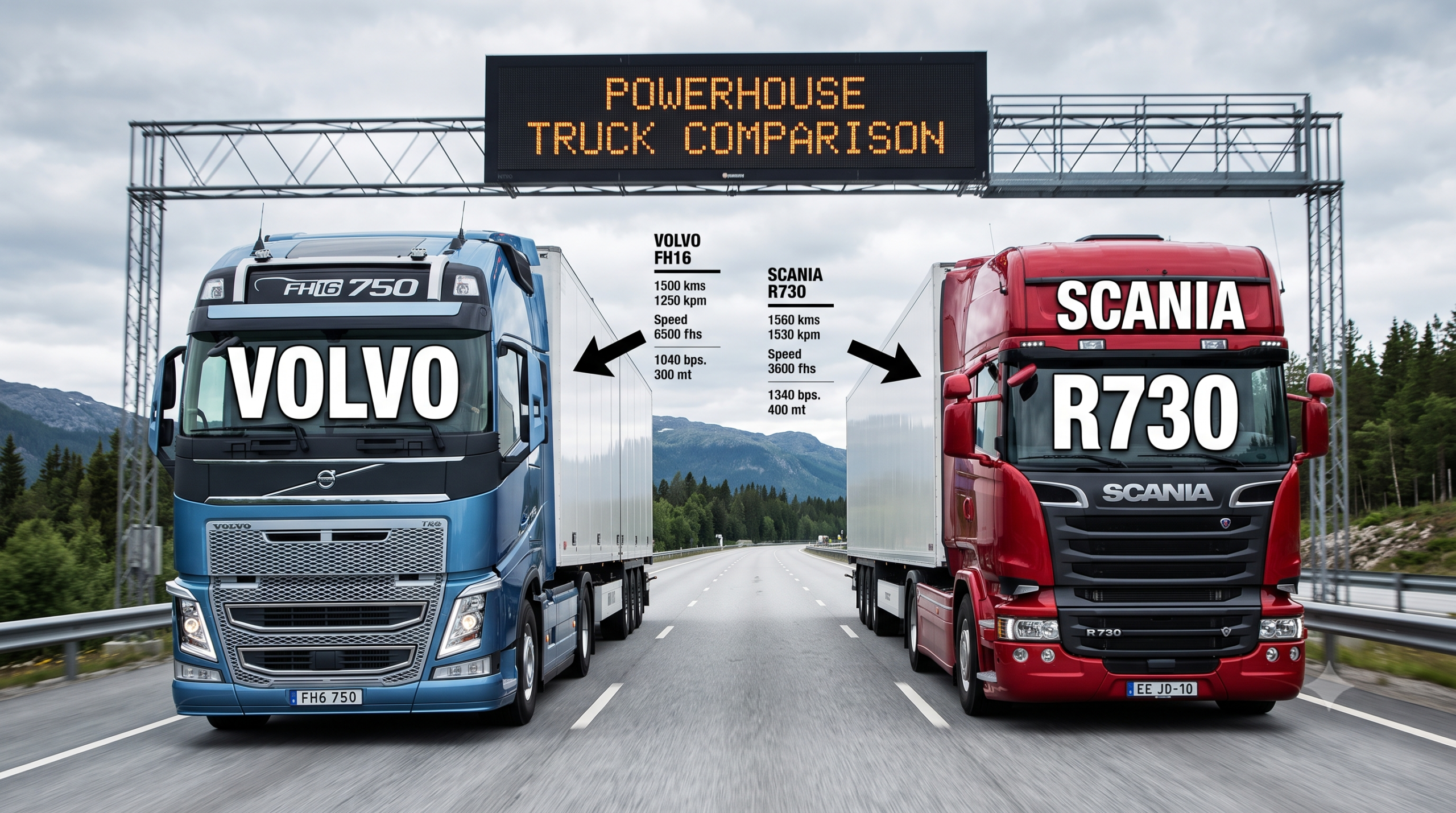
- The Volvo FH16 750 and Scania R730 are Europe’s two heaviest-hitting production tractor units, both historically chasing the “world’s most powerful production truck” title
- <cite index=”104-1″>The FH16 750 uses Volvo’s D16 inline-six, producing 750 hp and 3,550 Nm of torque</cite>
- <cite index=”113-1″>The Scania R730 uses a 16.4-liter 90-degree V8, producing 730 hp and 3,500 Nm of torque</cite>
- Neither truck is sold new in the US or Canada — <cite index=”106-1″>Volvo FH16 availability is limited to Asia/Pacific, Europe, Middle East, and Africa</cite>, and <cite index=”129-1″>Scania does not sell new heavy trucks for general road transport in the US at all</cite>
- The rivalry is real, but it’s a European and Australian mining/road-train story, not a North American one
Why This Comparison Doesn’t Touch US Roads
North American heavy-haul buyers cross-shop Freightliner, Kenworth, Peterbilt, International, and Volvo Trucks North America’s own VNL lineup — which uses a different D16 engine platform than the European FH16. <cite index=”129-1″>Scania’s US presence is essentially limited to industrial and marine engines sold through Scania North America in San Antonio, Texas — not complete trucks</cite>. If you’re comparing these two names because you’ve seen them mentioned in trucking forums or overseas trade press, this article explains what you’re actually looking at.
Pull quote: “This is Europe’s horsepower war — American highways were never part of the battlefield.”
The Horsepower Race, Briefly
These two trucks have leapfrogged each other for over a decade. <cite index=”116-1″>Scania’s V8 hit 730 hp in April 2010, briefly making the R730 the most powerful large-scale production truck in the world</cite> — until <cite index=”116-1″>Volvo’s FH16 750 surpassed it in September 2011</cite>. <cite index=”104-1″>Volvo’s own history shows this race stretching back decades: 470 hp in 1987, 520 hp in 1993, 610 hp in 2003, and 700 hp in 2008</cite> before the 750 arrived.
Quick Tip: If you see “R730” badging on a truck, remember it denotes cab type plus horsepower — Scania’s naming convention bakes the power figure right into the model name, unlike Volvo’s separate FH16 designation with a trailing power suffix.
Engine Philosophy: Inline-Six vs. V8
This is where the two trucks genuinely diverge. <cite index=”107-1″>Volvo’s D16 is a 16.1-liter inline-six with a single overhead camshaft and four valves per cylinder</cite>, an engine architecture Volvo has refined <cite index=”104-1″>since the original 1987 Volvo F16</cite>. <cite index=”120-1″>Scania went a different direction, reworking its V8 into a 16.4-liter unit built from lighter, stronger compacted graphite iron (CGI) to reach the 730 hp mark</cite>.
<cite index=”114-1″>Independent testing found the Volvo FH16 700 (not even the full 750) averaged 7.81 mpg against the R730’s 7.02–8.19 mpg range under the same conditions</cite> — a real but modest edge for Volvo’s inline-six on steady highway cruising. <cite index=”114-1″>The Scania V8, by contrast, is engineered to shine under extreme load, where its torque and pulling power give it an edge</cite>.
Expert Insight: The inline-six-versus-V8 debate here isn’t just an engineering footnote — it reflects genuinely different design philosophies. Volvo optimized for fuel-efficient, steady cruising; Scania optimized for brute pulling power under maximum strain. Neither approach is “wrong,” but they suit different jobs.
Comparison Table
| Spec | Volvo FH16 750 | Scania R730 |
|---|---|---|
| Engine | <cite index=”104-1″>D16G, 16.1L inline-six</cite> | <cite index=”113-1″>DC16 730, 16.4L 90° V8</cite> |
| Power | <cite index=”104-1″>750 hp</cite> | <cite index=”113-1″>730 hp</cite> |
| Torque | <cite index=”104-1″>3,550 Nm</cite> | <cite index=”113-1″>3,500 Nm</cite> |
| Transmission | <cite index=”105-1″>I-Shift, 12-speed automated manual</cite> | <cite index=”120-1″>Opticruise, 14-speed automated manual</cite> |
| Emissions standard (launch) | <cite index=”110-1″>Euro 5 and EEV variants at launch</cite> | <cite index=”115-1″>Euro 5 and EEV at launch; later Euro 6</cite> |
| Max gross combination weight | <cite index=”109-1″>Up to 325 tonnes</cite> | <cite index=”122-1″>Commonly rated to 60 tonnes in Europe; much higher in road-train configurations (Australia)</cite> |
| Markets sold | <cite index=”106-1″>Asia/Pacific, Europe, Middle East, Africa</cite> | <cite index=”129-1″>Europe, South America, Asia, Africa, Oceania — not North America</cite> |
| US/Canada availability | Not available | Not available |
Pros and Cons by Buyer Type
The European long-haul fleet operator
- ✅ FH16 750: Better steady-state highway fuel economy and a driver-comfort-focused cab that reviewers consistently praise
- ✅ R730: Stronger low-end pulling character for mixed terrain and heavy grades
- ❌ Both: Flagship-tier trucks command a real price premium over mid-power siblings — most fleets don’t need 700+ hp for typical loads
The Australian road-train / mining operator
- ✅ R730: <cite index=”120-1″>Purpose-built for extreme combination weights, with gantry-mounted auxiliary fuel tanks available for outback-range operations</cite>
- ✅ FH16 750: <cite index=”109-1″>Rated for combination weights up to 325 tonnes</cite>, competitive in the same heavy-haul segment
- ❌ Both: Neither is a light-duty or budget option — this is genuinely specialized equipment
The US-based trucking enthusiast or import buyer
- ❌ Both: Not federally certified for US road use as new vehicles, and importing either as a used unit means navigating EPA and DOT compliance hurdles
- ✅ Alternative: Volvo Trucks North America’s own VNL lineup uses a related D16 engine platform if the appeal is Volvo’s heavy-duty engineering specifically
Real-World Scenario
Picture an Australian road-train operator hauling a loaded B-triple combination across the outback between Alice Springs and Longreach — <cite index=”122-1″>a route where a Scania R730 pulled 77 tonnes through a demanding series of climbs and descents with the driveline handling the strain almost imperceptibly</cite>. That’s the kind of extreme-duty environment these trucks are actually built for — a world away from a US interstate hauling a standard 40-ton combination.
Alternatives to Consider
Choose a Volvo Trucks North America VNL if: you’re US-based and want Volvo’s heavy-duty engineering pedigree in a truck actually built and certified for American roads.
Choose a Mack Titan if: you want Volvo Group ownership and severe-duty capability in a North American-market truck — Mack is part of the same parent group as Volvo Trucks.
FAQ
Can I buy a Volvo FH16 750 or Scania R730 in the United States? No. <cite index=”106-1″>The Volvo FH16 is sold in Asia/Pacific, Europe, the Middle East, and Africa</cite>, and <cite index=”129-1″>Scania does not sell complete new heavy trucks for general road transport in the US</cite>. Neither is federally certified for the US market.
Is Volvo Trucks the same company as Volvo Cars? No — they’re separate companies. Volvo Cars makes passenger vehicles like the XC90 and EX30. Volvo Trucks, which builds the FH16, is part of the Volvo Group alongside Mack Trucks, Renault Trucks, and UD Trucks.
Which is more fuel efficient, the FH16 or the R730? <cite index=”114-1″>In one comparison test, the Volvo FH16 700 averaged 7.81 mpg versus the R730’s 7.02–8.19 mpg range</cite> — a modest edge for Volvo on steady highway cruising, though the Scania’s V8 is built to excel under extreme load rather than economy runs.
Why did Scania stop selling trucks in North America? <cite index=”127-1″>Scania attempted a US market entry in the 1980s that ultimately failed due to market saturation, the cost of building a dealer network, and competition from established American and Volvo-owned brands</cite>. It hasn’t returned to selling complete trucks here since.
What’s the closest thing to these trucks available in the US? Volvo Trucks North America’s VNL lineup uses a related D16 engine architecture, though tuned and certified specifically for the North American market rather than being a direct FH16 import.
Key Takeaways
- Both the Volvo FH16 750 and Scania R730 are flagship heavy-haul tractors, and neither is sold new in the US or Canada
- <cite index=”104-1″>The FH16 750 makes 750 hp and 3,550 Nm from a 16.1L inline-six</cite>, while <cite index=”113-1″>the R730 makes 730 hp and 3,500 Nm from a 16.4L V8</cite>
- Volvo’s inline-six shows a modest fuel-economy edge on highway cruising; Scania’s V8 is engineered for pulling strength under extreme load
- The real-world rivalry plays out in European long-haul and Australian road-train/mining operations, not on American interstates
- Volvo Cars and Volvo Trucks are distinct companies — don’t confuse this heavy-truck content with Volvo’s passenger-car lineup
Next step: If you’re US-based and drawn to this comparison out of curiosity about Volvo’s heavy-duty engineering, look into Volvo Trucks North America’s VNL series — it’s the version of this story that’s actually available to order here.