Volvo S40 vs Saab 9-3?

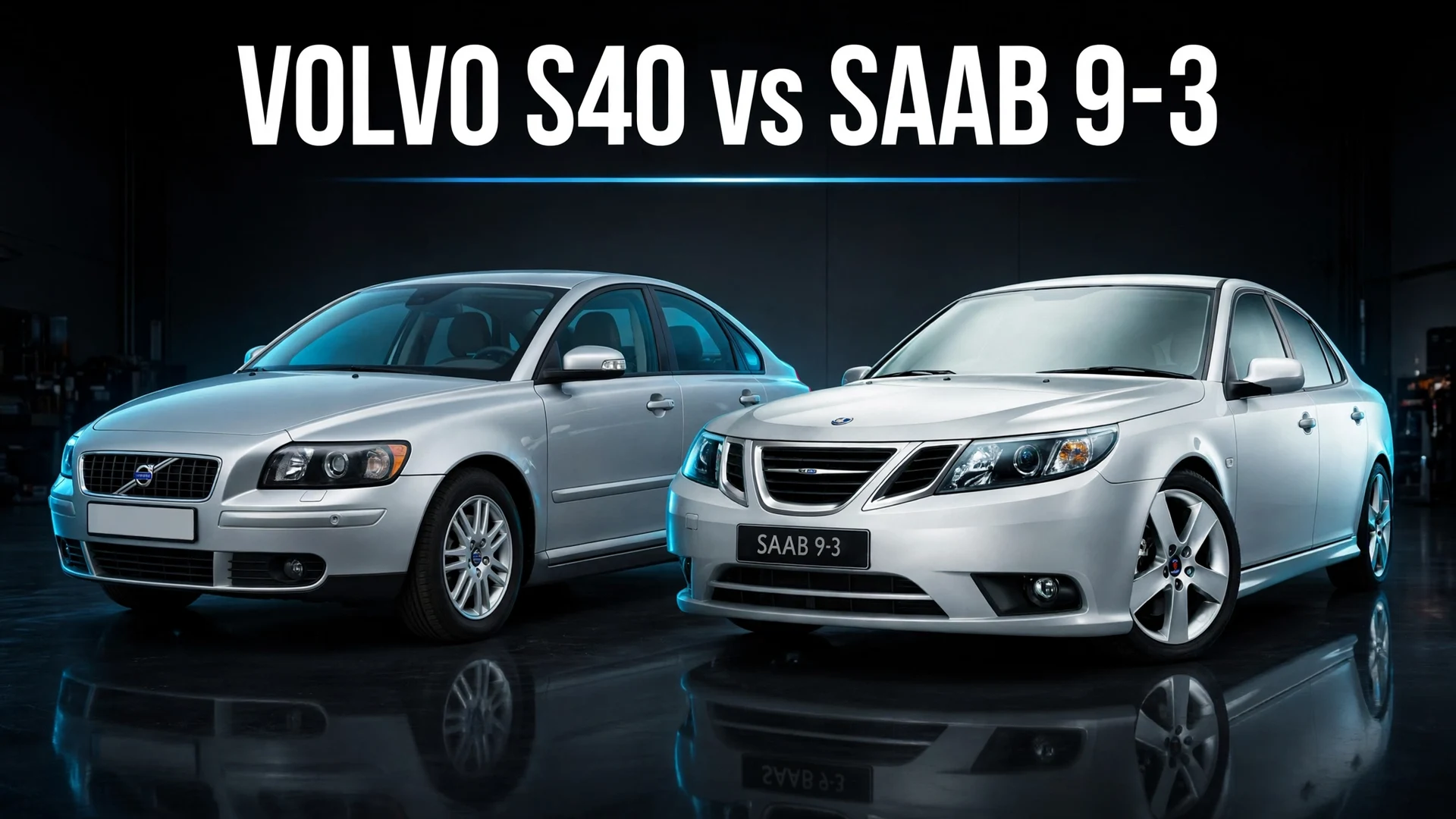
Volvo S40 vs Saab 9-3
Shopping a used Volvo S40 against a used Saab 9-3 in 2026 is really two questions in one: which car drives better, and which one you can actually keep on the road. The short answer: the Volvo S40 is the easier car to own — Volvo still exists, the parts network is alive, and its turbo five is a known quantity. The Saab 9-3 is the more interesting car to drive, with a performance ceiling the Volvo never reached (the 2.8T V6 Aero peaked at 276 hp), but its manufacturer went bankrupt in 2011 and the support trail is thinner. Choose the S40 for low-friction ownership; choose the 9-3 if you want character.
Key Takeaways
- Two different deaths. Volvo retired the S40 nameplate in 2012 (replaced by the V40) — a badge sunset, not a collapse. Saab went bankrupt in December 2011, so the 9-3 has no manufacturer behind it at all.
- Performance favors the Saab. The 9-3 Aero’s 2.8T V6 made up to 276 hp / 295 lb-ft; the S40 T5 peaked at 227 hp / 236 lb-ft. A 9-3 Aero reaches 60 mph in about 5.5 seconds versus roughly 6.5–7.2 for a T5.
- Ownership ease favors the Volvo. Volvo’s active dealer network and P1 parts shared with the Ford Focus and Mazda3 make S40 upkeep straightforward; Saab parts flow through Orio AB and specialists, not a carmaker.
- Safety is a wash. Euro NCAP gave both cars five stars (S40 in 2004, 9-3 under the 2002 protocol); both earned top US honors — IIHS Best Pick for the S40, IIHS Top Safety Pick Gold for the 9-3.
- Both are 15-to-20-year-old used-only cars. Clean examples typically trade in the mid-single-thousands; well-kept T5 AWDs and 9-3 Aeros command more. Budget for specialist maintenance either way.
Two Very Different Endings
The two cars reached the end of the road in completely different ways. The S40 began life in 1995 as a joint venture with Mitsubishi, then was reengineered for 2004 on Volvo’s P1 platform — shared with the Ford Focus and Mazda3 — during Volvo’s Ford ownership era. The second generation ran from 2004 to 2012, when Volvo retired the nameplate and replaced it with the V40 hatchback. The badge died; the company did not.
The Saab 9-3’s second generation ran from 2003 on GM’s Epsilon platform until Saab filed for bankruptcy in December 2011. A company called NEVS briefly restarted limited 9-3 Aero production at Trollhättan for the 2014 model year, but that was a small afterlife, not a continuation of Saab as a functioning automaker. Buy a 9-3 and you own a car whose manufacturer no longer exists. That asymmetry shapes everything else: parts sourcing, specialist support, and resale.
Engines and Driving Character
The Volvo S40: one good five-cylinder, two tunes
The base 2.4i used a naturally aspirated 2.4-liter inline-five making 168 hp and 170 lb-ft — smooth, durable, unexciting. The car worth buying is the T5: a turbocharged 2.5-liter five making 218 hp and 236 lb-ft (2005–2007), then 227 hp from 2008 onward, torque unchanged. A 5-speed Geartronic automatic or 6-speed manual was offered, with T5 all-wheel drive available from 2005 through 2010. Behind the wheel the S40 is a refined, comfort-first car — safe, composed, and unremarkable to drive in the best possible way.
The Saab 9-3: a broader, more aggressive menu
The 9-3’s four-cylinder lineup used GM’s Ecotec 2.0-liter as the 2.0t (175 hp) and 2.0T (210 hp, 221 lb-ft). The headline act was the 2.8T V6 in Aero trim: 247 hp in 2006, 252 hp for 2007–2008 front-drive cars, and 276 hp with 295 lb-ft for the 2008–2010 XWD all-wheel-drive models and the Turbo X. Gearboxes were a 6-speed manual, a 5-speed automatic on fours, and a 6-speed automatic on the V6.
The Saab pulls harder and feels more eager — turbo character is baked into the brand — and XWD, introduced on the Aero for 2008, gave the quickest cars genuine all-weather traction. The trade-off is complexity: more variants, more turbo hardware, and a steeper learning curve for whoever maintains it. (Diesels — the S40 D5, the 9-3 1.9 TiD — existed in Europe but are irrelevant to most US buyers.)
| Engine | Car & trim | Power | Torque | Model years |
|---|---|---|---|---|
| 2.4L inline-5 | Volvo S40 2.4i | 168 hp | 170 lb-ft | 2004–2012 |
| 2.5L turbo inline-5 | Volvo S40 T5 (early) | 218 hp | 236 lb-ft | 2005–2007 |
| 2.5L turbo inline-5 | Volvo S40 T5 (late) | 227 hp | 236 lb-ft | 2008–2011 |
| 2.0L turbo inline-4 | Saab 9-3 2.0t | 175 hp | 195 lb-ft | 2003–2011 |
| 2.0L turbo inline-4 | Saab 9-3 2.0T | 210 hp | 221 lb-ft | 2003–2011 |
| 2.8L turbo V6 | Saab 9-3 Aero 2.8T (FWD) | 247–252 hp | 258–262 lb-ft | 2006–2008 |
| 2.8L turbo V6 | Saab 9-3 Aero 2.8T (XWD) | 276 hp | 295 lb-ft | 2008–2010 |
Power Output Compared
The chart below uses only manufacturer-published power figures for the key trims.
Performance, Economy and Dimensions
On paper the cars are close in size — the Saab is slightly larger at 4,635 mm long against the Volvo’s 4,476 mm, with a small boot advantage. Acceleration figures below are indicative ranges, since gearbox, drivetrain and year all move the number.
| Spec | Volvo S40 (2004–2012) | Saab 9-3 (2003–2011) |
|---|---|---|
| 0–60 mph, top trim | T5: ~6.5–7.2 s | Aero 2.8T V6: ~5.5–6.7 s |
| 0–60 mph, base engine | 2.4i auto: ~8.9 s | 2.0T: ~7.5 s |
| Fuel economy (petrol) | T5: 22 city / 31 hwy mpg | 2.0T: 19 city / 28 hwy, 22 combined mpg |
| Length | 4,476 mm (175.9 in) | 4,635 mm (182.5 in) |
| Wheelbase | 2,640 mm (103.9 in) | 2,675 mm (105.3 in) |
| Boot space | 404 L (12.6 cu ft) | 425 L (15.0 cu ft) |
| Curb weight (typical) | ~3,126 lb (1,418 kg) | ~3,230 lb (1,465 kg) |
| Fuel tank | 58 L (15.9 gal) | 62 L (16.4 gal) |
| All-wheel drive | T5 AWD, 2005–2010 | Aero/2.0T XWD from 2008 |
| Platform | Volvo P1 (Ford-era, Focus/Mazda3 shared) | GM Epsilon (Vectra/Signum shared) |
Safety: A Genuine Draw
Neither car can claim superiority here. Euro NCAP gave the S40 five stars in 2004 (34.15 out of 37, including a full 16/16 in the side impact), and it also earned an IIHS Best Pick in the US. The 9-3 earned five stars from Euro NCAP under the 2002 protocol (13.15/16 frontal offset, 16/16 side impact) and was named the IIHS’s first-ever Top Safety Pick Gold winner in 2005. Both carried active head restraints for whiplash protection — Volvo’s WHIPS system and Saab’s SAHR design. These are twenty-year-old tests — buy on condition and maintenance history, not scores.
Reliability and the Parts Reality in 2026
Mechanically, neither car has a lemon reputation. The S40’s five-cylinders are sturdy; owner communities most often flag PCV breather (oil trap) servicing and oil-consumption checks on higher-mileage T5s, plus the usual age items — bushings, mounts, aging electronics. The base 2.4i is the simplest and cheapest to keep running.
The 9-3’s Ecotec fours are generally robust, though owners report timing-chain wear as a known watch item on the B207, and the 2.8T V6 is well regarded — the XWD hardware on late Aeros just adds another system to maintain. The bigger variable is the ecosystem. Saab Automobile Parts AB was reborn as Orio AB, which still supplies genuine Saab parts, and specialists such as eSaabParts, FCP Euro, Skandix stock deep catalogs including GM Epsilon shared components. But some trim and electronics parts are strictly forum-classified or breaker-yard finds, while the S40 benefits from Volvo’s continued existence and P1 parts shared with the high-volume Ford Focus and Mazda3.
Flag: timing-chain wear on the 9-3’s B207 and PCV/oil-consumption topics on the S40 T5 are owner-community reports, not manufacturer-acknowledged defects. I could not verify precise current average used prices from a published source, so treat price ranges here as observed, not verified.
Which Should You Buy?
Buy the Volvo S40 — a 2.4i or a well-kept T5. For commuting, parts availability decides it: Volvo dealers and independents can still source nearly everything, and shared P1 parts keep prices down. Get a pre-purchase inspection covering the PCV system and suspension bushings.
Buy the Saab 9-3 Aero — ideally a 2.8T V6, XWD if you can find one. Nothing the S40 offered matches the 276 hp Aero’s pace. Budget a parts contingency fund, join the owner forums before buying, and confirm XWD service history on all-wheel-drive cars.
Buy the cheapest clean example of either — then spend the savings on maintenance. At the bottom of the market, condition beats badge. Avoid the very cheapest Aeros and Turbo Xs unless you can verify service records; neglected performance hardware is expensive to fix.
Verdict
There is no single winner — the two cars optimize for different things. The Volvo S40 is the better used buy for most people: a safe, comfortable compact from a manufacturer that still exists, with a healthy parts network and shared-platform running costs. If your goal is a dependable older Swedish sedan with minimal drama — a 2008-or-later T5 or a simple 2.4i — the S40 is the rational choice.
The Saab 9-3 is the better buy for the enthusiast who values character over convenience. Its turbo engines are more charismatic and its Aero trims genuinely quick — but you are buying into a defunct brand, where parts take longer to find and every repair carries a small research project with it. If that sounds like a hobby rather than a burden, the 9-3 rewards you. If it sounds like a burden, it will be one — buy the Volvo.
Sources
- Volvo Cars USA — 2005 S40 specs and safety ratings: https://news.cision.com/volvo-car-usa/r/all-new-volvo-s40-sees-stars-as-it-aces-nhtsa-side-impact-crash-test–sales-up-over-29-percent-month-to-date,c4199757
- CarBuzz — S40 T5 engine details: https://carbuzz.com/volvo-s40-t5-reliable-cheap-quick/
- CarsArt — S40 T5 AWD dimensions and boot space: https://carsart.net/en/cars/volvo/s40/ii/2500cc-20v-t5-220hp-awd/
- TestDriven — S40 Euro NCAP result: https://www.testdriven.co.uk/new-volvo-s40-gets-top-results-in-four-crash-tests/
- ANCAP — Volvo S40 2004 crash scores: https://www.vdrsyd.com/ancap_datasheets/r-z/Volvo/s40_04.pdf
- Wikipedia — Saab 9-3 second generation: https://en.wikipedia.org/wiki/Saab_9-3
- CarBuzz — Saab 9-3 Aero engines and 0–60: https://carbuzz.com/saab-93-surprising-turbocharged-engines/
- CarWeek — 2007 Saab 9-3 2.0T specs: https://www.carweek.com/research/saab/9-3/2007/specs
- ANCAP — Saab 9-3 2004 crash scores: https://www.vdrsyd.com/ancap_datasheets/r-z/Saab/saab93_04.pdf
- Automotive Fleet — IIHS award for Saab 9-3 (2005): https://www.automotive-fleet.com/41486/top-pick-honor-for-saab-9-3-sport-sedan-in-new-safety-report
- Automotive World — NEVS/Orio parts agreement: https://staging.automotiveworld.com/news-releases/nevs-orio-ab-sign-agreement-global-spare-parts-supply-new-saab-cars/
- CarBuzz — Saab bankruptcy and end of production: https://carbuzz.com/saabs-auction-bankruptcy/
Frequently Asked Questions
Is the Saab 9-3 reliable even though the company is defunct?
Mechanically, yes — owners generally report strong reliability from the 2.0T four and 2.8T V6 when maintenance is current. Complaints center on parts availability and repair costs, not the engines. The risk in a 9-3 is the support ecosystem, not the hardware.
Can I still get parts for a Saab 9-3 in 2026?
Yes, with caveats. Orio AB — successor to Saab Automobile Parts AB — still supplies genuine parts, and specialists like eSaabParts, FCP Euro, eEuroparts and Skandix carry deep catalogs including GM Epsilon shared components. But some trim and electronics parts are only findable through owner forums and breaker yards.
Which is faster, the S40 T5 or the Saab 9-3 Aero?
The 9-3 Aero. The S40 T5 peaked at 227 hp (2008+) with 0–60 mph in roughly 6.5–7.2 seconds; the Aero’s 2.8T V6 reached 276 hp and 295 lb-ft in XWD form, good for about 5.5–6.7 seconds. Figures vary by year, gearbox and drivetrain.
What should I budget for a good used example of either car?
Clean examples of either typically trade in the mid-single-thousands, with well-kept S40 T5 AWDs and 9-3 Aeros commanding more. Precise market averages were not verifiable from a published source, so budget from actual listings in your area — and keep a maintenance reserve on top.
Is either car a good first older-Swede purchase?
The S40 is the gentler on-ramp thanks to easier parts access and a simpler lineup. The 9-3 rewards buyers comfortable with independent research and specialist support. Either way, get a pre-purchase inspection from a specialist who knows the platform.
Does Saab’s bankruptcy affect insurance or registration?
No. Insurers and motor-vehicle authorities treat the 9-3 like any other used car of its age — the bankruptcy affects parts and manufacturer support, not legality or insurability. Agreed-value classic policies are worth considering for rare Aeros.