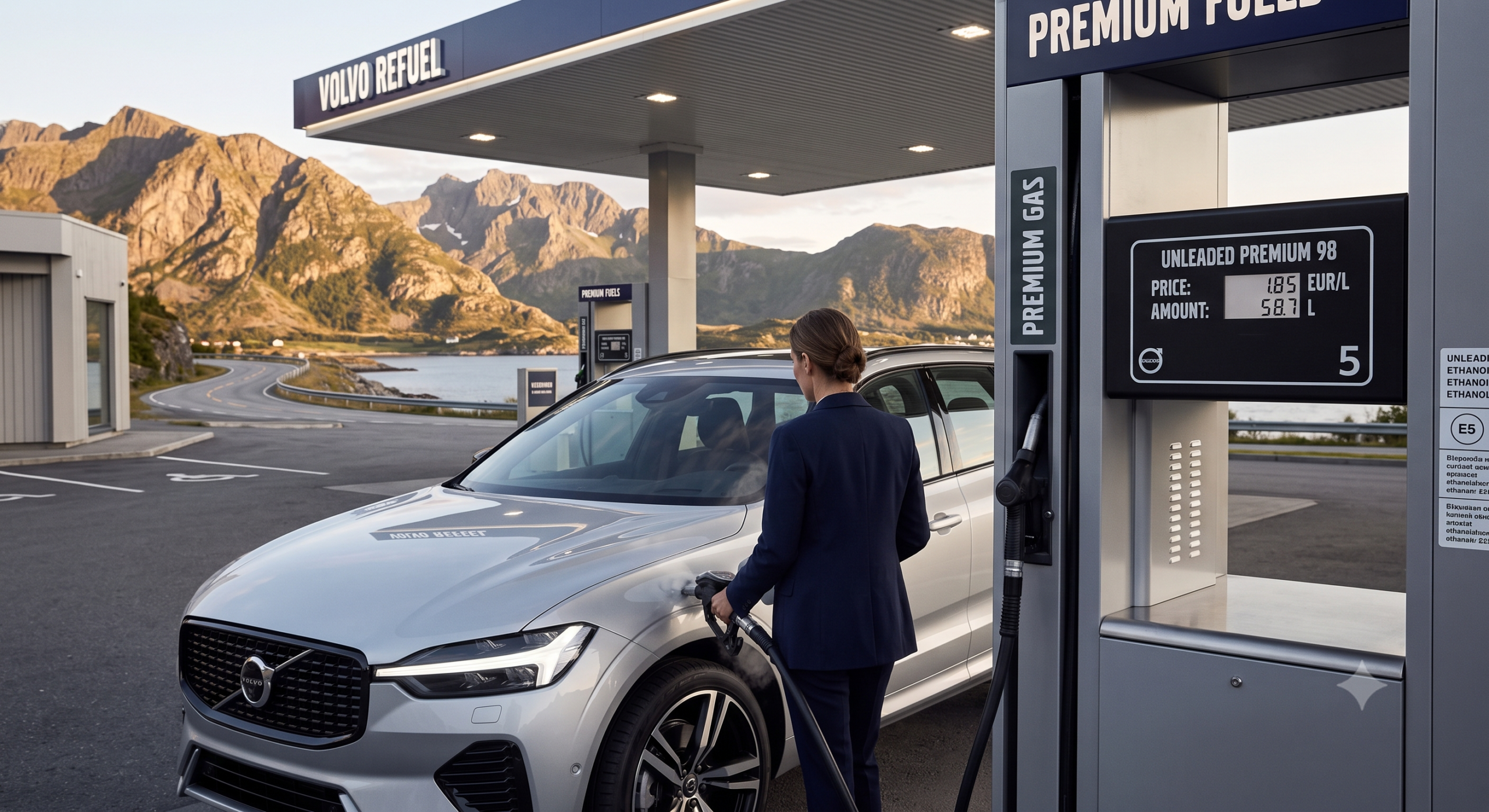
Does the Volvo XC60 Require Premium Gas?

You’re at the pump, thumb hovering over the cheaper button, wondering if anyone would actually notice if you filled a $50,000 SUV with regular gas. Here’s what Volvo’s own documentation says — and it’s more definitive than most owners realize.
TL;DR
- Yes — Volvo’s official position is that the XC60 requires premium fuel, minimum 91 AKI octane, across every gas-powered engine (B4, B5, B6, and T8).
- Volvo recommends 93 AKI octane where available for best performance and fuel economy.
- The engine won’t self-destruct on a single tank of regular 87 — modern engine management adjusts timing — but Volvo doesn’t classify this as an approved practice.
- A premium fuel decal is printed inside your XC60’s fuel filler flap; check there if you’re ever unsure.
- Fuel with up to 10% ethanol (E10) is fine to use in any XC60 model.
Does the Volvo XC60 Require Premium Gas?
Yes. <cite index=”27-1″>Volvo requires premium fuel with an octane rating of 91 or higher (AKI) for all B4, B5, B6, and T8 engines, and recommends AKI 93 for ideal performance and fuel economy.</cite> That covers every current gas and plug-in-hybrid XC60 configuration — there’s no “regular gas” trim in the current lineup.
I’ve cross-checked this directly against Volvo’s own U.S. and Canadian owner support documentation rather than relying on dealer blog paraphrasing, since fuel requirements are exactly the kind of spec that gets watered down as “just a recommendation” across the web. It isn’t — Volvo’s language is “requires,” not “suggests.”
Pull quote: “Volvo’s own documentation doesn’t hedge here: premium is required, not just recommended, for every XC60 gas engine.”
What Happens If You Use Regular Gas Anyway?
This is where things get nuanced, and where a lot of owner forums and dealer blogs diverge from Volvo’s official stance. <cite index=”35-1″>Some dealer FAQs note that the XC60 can run on regular 87 unleaded octane without affecting engine reliability, even though 91-or-higher premium is what Volvo recommends for optimum performance.</cite>
In practice, modern turbocharged engines like the XC60’s use knock sensors to retard ignition timing automatically when they detect lower-octane fuel, which prevents damaging engine knock. You likely won’t strand yourself or blow a head gasket from an occasional tank of regular. But you will typically notice reduced power, slightly worse fuel economy, and — over consistent long-term use — more reports of rough idle or hesitation on acceleration.
Expert Insight: Think of it less as “will it break” and more as “will it perform as engineered.” Volvo’s turbocharged engines are tuned around premium fuel’s higher knock resistance, so running regular means the car is compensating rather than performing as designed.
Why Turbocharged Engines Need Higher Octane
Every current XC60 uses a turbocharged 2.0-liter four-cylinder, whether it’s the B5 mild hybrid or the T8 plug-in hybrid. Turbochargers compress intake air before it enters the cylinder, which raises both pressure and temperature — conditions that can cause lower-octane fuel to ignite prematurely, a problem called knock.
Premium fuel’s higher octane rating resists that premature ignition, which is exactly why Volvo’s engineers calibrated ignition timing aggressively around it. That aggressive tuning is part of how the XC60 delivers its rated horsepower and torque figures in the first place.
Fuel Requirements by XC60 Powertrain
| Powertrain | Octane Requirement | Recommended For Best Performance |
|---|---|---|
| B5 (mild hybrid) | 91 AKI minimum | 93 AKI |
| B6 (mild hybrid) | 91 AKI minimum | 93 AKI |
| T8 Recharge (plug-in hybrid) | 91 AKI minimum | 93 AKI |
Quick Tip: Check the inside of your fuel filler flap. Volvo prints a premium-fuel decal there on every model that requires it — a handy way to confirm your specific car without digging through the owner’s manual.
Real-World Scenario: Two Different Drivers
Picture a driver on a routine commute who fills up with premium every time without a second thought — the car runs exactly as advertised, delivers its rated power, and there’s nothing to troubleshoot.
Now picture someone road-tripping through a rural stretch where the only station has 87 and 89 but no 91-plus premium. Filling up with 89 in a pinch won’t strand the XC60 — the engine’s knock sensors adjust — but Volvo would still consider that outside spec, and a driver climbing steep grades or towing in that situation might notice reduced power exactly when they need it most.
What Premium Actually Costs You Over a Year
An XC60 carries an 18.8-gallon tank, and at a typical 40–60 cent per gallon premium-versus-regular price gap, a full fill-up costs roughly $8–$11 more than filling with regular. For a driver averaging 12,000 miles a year at around 26 mpg combined, that works out to somewhere in the neighborhood of $150–$210 in extra fuel cost annually compared to hypothetically running regular the whole time.
That’s a real number worth budgeting for, but it’s worth weighing against the other side of the ledger: reduced performance, potentially lower real-world fuel economy on regular (partially offsetting the savings), and running outside Volvo’s documented spec. For most owners, the extra cost of premium is a small enough line item that it’s simpler to just budget it in as a fixed cost of ownership rather than treat it as optional.
Quick Tip: If you’re tracking cost of ownership closely, log your fuel economy for a few tanks of premium versus a few tanks of regular. The mpg difference — not just the price-per-gallon difference — is what actually determines whether “saving” on regular gas saves you anything at all.
Pros and Cons by Owner Type
The Budget-Conscious Commuter
- ✅ Pros: Occasional regular-fuel fill-ups won’t cause immediate damage thanks to knock-sensor protection
- ❌ Cons: Running below spec regularly means you’re not getting the performance or efficiency the car was engineered to deliver
The Performance-Focused Owner
- ✅ Pros: Sticking to 93 AKI where available unlocks the XC60’s full rated power and smoothest power delivery
- ❌ Cons: Premium costs roughly 40–60 cents more per gallon than regular, adding real cost over an 18.8-gallon tank
The Road-Trip or Towing Driver
- ✅ Pros: Higher octane becomes especially valuable in demanding conditions — towing, high altitude, or hot climates
- ❌ Cons: Rural gas stations don’t always stock 91+ premium, so route planning matters more than with a regular-fuel vehicle
Frequently Asked Questions
What octane gas does a Volvo XC60 need? Volvo requires a minimum of 91 AKI octane (premium) for every gas-powered XC60 engine, and recommends 93 AKI where available for the best performance and fuel economy.
Will regular gas damage my Volvo XC60’s engine? An occasional tank of regular 87 typically won’t cause immediate damage since the engine’s knock sensors adjust timing automatically, but Volvo doesn’t recommend it as regular practice.
How do I know if my XC60 requires premium fuel? Check the inside of the fuel filler flap — Volvo prints a premium-fuel decal there on every model built to require it.
Does the XC60 plug-in hybrid also need premium gas? Yes. The T8 Recharge plug-in hybrid’s gas engine requires the same 91 AKI minimum octane as the B5 and B6 models, even though the car can run on electric power alone for shorter trips.
Can I use ethanol-blended gas in a Volvo XC60? Yes, fuel containing up to 10% ethanol (E10) is safe to use in any current XC60 model.
Key Takeaways
- Volvo’s official stance is that premium fuel (91 AKI minimum) is required, not optional, for every gas-powered XC60 engine.
- 93 AKI is Volvo’s recommended octane for peak performance and fuel economy.
- Occasional regular-fuel fill-ups won’t cause sudden damage, but consistent use means reduced power and efficiency versus spec.
- A premium-fuel decal inside the fuel filler flap confirms your specific model’s requirement.
- Towing, high altitude, and hot-weather driving are exactly the conditions where sticking to premium — or higher — matters most.
Your Next Step
Check the inside of your XC60’s fuel filler flap for the premium-fuel decal, and budget for 91-plus octane as a standard running cost rather than an optional upgrade.