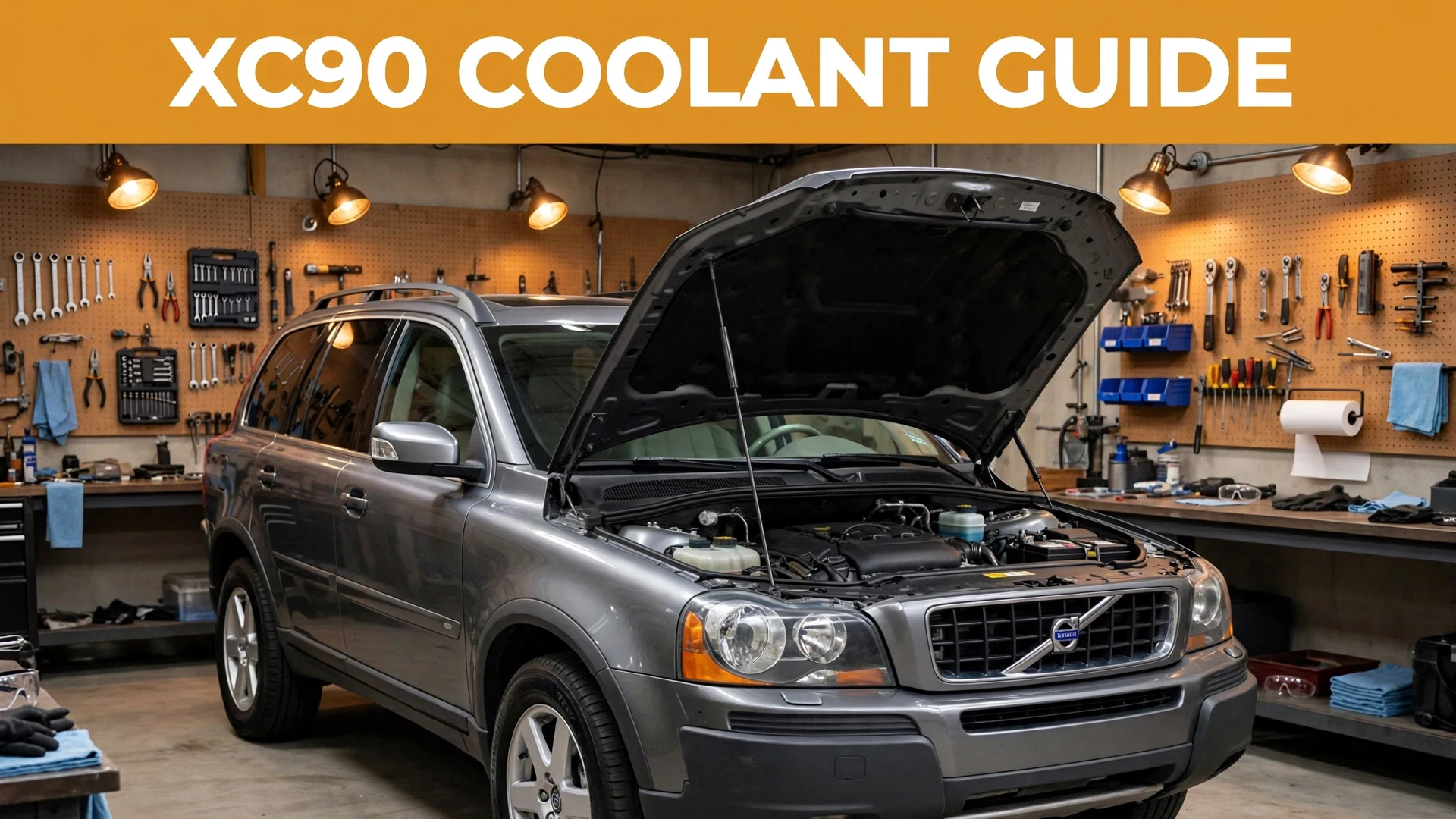
How to Add Coolant to a 2006 Volvo XC90: Safe DIY Steps

Adding coolant to a 2006 Volvo XC90 is a five-minute driveway job — once you know which coolant to buy, where the expansion tank hides, and the one rule above all others: cold engine only. Below: the correct spec for the 2.5T, T6, and V8, how much the system holds, how to bleed trapped air, and how to tell a simple top-off from a leak that needs a shop.
Key Takeaways
- Only add coolant to a stone-cold engine — never open the cap on a hot, pressurized system.
- The 2006 XC90 used blue G48-spec coolant; top off with the same chemistry (Genuine Volvo, Zerex G48, or Pentofrost NF), mixed 50/50 with distilled water.
- Capacities per the owner’s manual: 9.0 liters (9.5 US qt) for the 5-cylinder turbo, 10.2 liters (10.7 US qt) for the V8. A top-off typically needs well under a liter.
- Fill to the MAX line on the translucent tank — never above it; coolant needs room to expand.
- Topping off more than once between services means a leak, not normal consumption — find it or have it pressure-tested.
Which Coolant Does a 2006 XC90 Actually Take?
Every 2006 XC90 — 2.5T five-cylinder, T6, and the 4.4-liter V8 — left the factory with blue, silicate-based hybrid coolant built to the Glysantin G48 specification. (The 3.2-liter six arrived with the 2007 model year and uses the same coolant family.) Volvo’s branded coolant has changed colors over the years, and today’s dark-green G64 formula is stated to be backwards compatible with G48 blue. For a top-off, the rule is simple: match what is already in the tank. Blue in, blue back.
The one incompatibility to avoid is mixing chemistries: blue G48/HOAT must not be mixed with orange OAT coolants like DEX-COOL — the additive packages can react and clog the radiator and heater core. When in doubt, a full drain and refill with one known coolant beats topping off a mystery mix.
| Coolant option | Color | Chemistry | Verdict for a 2006 XC90 |
|---|---|---|---|
| Genuine Volvo coolant (current G64 spec) | Dark green | PSi-OAT | Volvo states it is backwards compatible with the G48 factory fill |
| Zerex G48 / Pentofrost NF | Blue | HOAT (silicate hybrid) | Matches the factory fill — ideal for topping off blue coolant |
| Older Genuine Volvo stock (pre-G64) | Blue-green | G48-type | Fine if fresh and sealed; same coolant family |
| “Universal” OAT / DEX-COOL-type (orange) | Orange | OAT | Do not mix with blue coolant; usable only after a full flush |
| Plain water | — | — | Emergency use only; no corrosion or freeze protection |
Buy concentrate and mix it yourself, or buy pre-mixed 50/50 — just never pour concentrate in straight. A 50/50 mix of ethylene-glycol coolant and water protects to about −37 °C (−35 °F) and carries the corrosion inhibitors the aluminum engine needs. Always mix with distilled water, not tap: minerals in hard water form scale inside the radiator and heater core over time.
How the XC90 Cooling Loop Works (60-Second Primer)
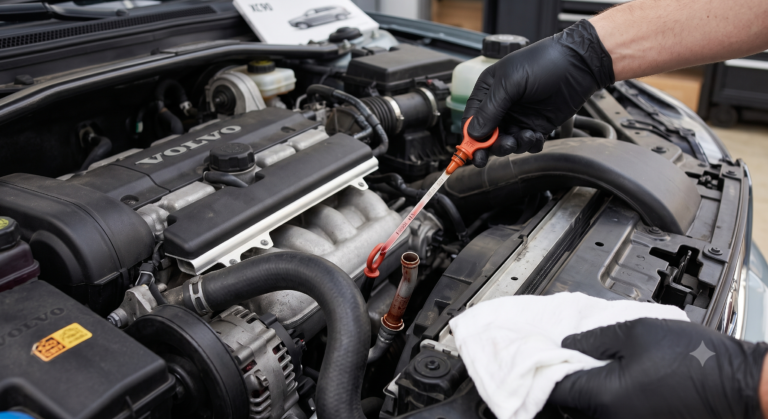
Knowing the loop makes the job make sense. The water pump pushes coolant through the engine block, where it absorbs heat; the thermostat (which begins to open at 194 °F / 90 °C per the owner’s manual) routes it to the radiator to dump the heat. A smaller loop feeds the heater core — which is why cabin heat is a useful diagnostic later. The translucent expansion tank is the system’s breathing room: it and its pressure cap keep the sealed system pressurized so the coolant can run hotter than water’s boiling point without boiling.
What You Will Need
- Correct coolant (blue G48-type or Genuine Volvo) — one jug is plenty
- Distilled water (one gallon) if you bought concentrate
- A clean funnel and measuring jug
- Clean rags and a drip tray or cardboard
- Gloves and eye protection
- A flashlight (aged tanks can be hard to read through)
The 7 Steps: Adding Coolant to Your 2006 XC90
Tap through each step in order — and do not skip the cool-down.
How Much Coolant and the Bleeding Details
A routine top-off rarely needs more than half a liter — the MIN-to-MAX gap is small. Full capacities from the 2006 owner’s manual: 9.0 liters (9.5 US quarts) for the 5-cylinder turbo and 10.2 liters (10.7 US quarts) for the V8. (The T6 is not listed separately there; on a full T6 drain-and-refill, add concentrate for roughly half the expected capacity first, then top off with distilled water — old coolant always stays trapped in the block and heater core.)
The thermostat begins opening at 194 °F (90 °C), which is why Step 6 works: until it opens, coolant is not circulating through the radiator and the tank level will not settle. If the level keeps dropping after two or three warm top-offs, stop and hunt for a leak.
Leak, Thermostat, or Head Gasket? Reading the Symptoms
Low coolant is a symptom, not a diagnosis. Match your pattern below before deciding between another top-off and a shop visit.
| What you notice | Most likely cause | What to check | Urgency |
|---|---|---|---|
| Puddle under the car, sweet smell, white crusty residue on hoses | External leak | Radiator end tanks, hose clamps, water-pump weep hole, tank seams | Fix soon — it will only get worse |
| Level drops slowly with no puddle; must top off every few weeks | Seep or pinhole leak | Pressure-test; check heater hoses at the firewall and under the oil cap | Schedule a diagnosis |
| Temperature gauge swings, slow warm-up, or overheating at idle but fine on the highway | Thermostat sticking | Check thermostat operation (begins opening at 194 °F / 90 °C) | Fix soon — overheating damages engines fast |
| Milky residue under the oil cap, white sweet-smelling exhaust smoke, bubbles in the tank | Head gasket failure | Stop driving; have it tested (combustion-gas or compression test) | Stop driving — tow it |
| No cabin heat plus rising temperature gauge | Low coolant or air lock | Re-bleed (Step 6); if it recurs, suspect a leak | Do not drive it hot |
When to Stop and Call a Mechanic
A top-off is the right fix exactly once. Get professional help if: you add coolant more than once between oil changes; the gauge ever hits red; you see milky oil or white exhaust smoke; there is coolant on the passenger footwell (heater core); or the warning returns within days of a careful fill-and-bleed. A shop pressure test takes minutes and costs far less than engine damage from driving while low.
Frequently Asked Questions
Can I just use water instead of coolant in my 2006 XC90?
Only to limp home. Plain water has no corrosion inhibitors, no water-pump-seal lubrication, and no freeze protection — and the XC90’s aluminum engine, radiator, and heater core need that inhibitor package. If you add water roadside, swap in a proper 50/50 mix as soon as possible.
What color coolant does a 2006 Volvo XC90 use?
Blue — the factory fill was a blue G48-spec hybrid coolant. Top off with blue G48-type (Zerex G48, Pentofrost NF, or equivalent) or Genuine Volvo coolant. Never mix blue with orange OAT-type coolant; the chemistries are incompatible and can form sludge.
How much coolant does a 2006 XC90 hold?
According to the 2006 owner’s manual, the cooling system holds 9.0 liters (9.5 US quarts) on the 5-cylinder turbo and 10.2 liters (10.7 US quarts) on the V8. A routine top-off between MIN and MAX needs far less — typically well under a liter.
Why does my XC90 keep losing coolant with no visible leak?
Usually a seep that only leaks under pressure or evaporates on a hot surface before it can drip — check radiator end-tank seams, hose clamps, the water-pump weep hole, and heater hoses. A shop pressure test will find it. Milky residue under the oil cap or white exhaust smoke means possible head-gasket failure: stop driving.
Is it safe to drive with the coolant warning light on?
Only as far as somewhere safe, and only with the gauge in the normal range. If it is climbing or red, pull over and shut off — an overheating engine can warp the head within minutes. Let it cool fully before opening the tank, then top off or call a tow.
Done right, this is one of the easiest XC90 jobs: cold engine, blue G48-type coolant at 50/50 with distilled water, fill to MAX, bleed the air, recheck the next morning. After that the tank should stay put until the next service — if the level drops again, the coolant is telling you something. Listen to it.