How to Use AWD on a 2005 Volvo XC90: Haldex Guide & Troubleshooting

- There is nothing to operate. The 2005 XC90’s Haldex AWD is fully automatic — no buttons, no modes, no driver input needed. It engages the rear wheels on its own when the fronts slip.
- Not every 2005 XC90 has AWD: it’s standard on the T6 and V8, but optional on the base 2.5T (which came standard as front-wheel drive).
- “Anti-skid service required” on the dashboard is the classic sign the AWD has failed — usually a dead Haldex pump or DEM module, a $1,500+ repair.
- Buyer’s note: the 2.5T is the reliable pick; the T6’s GM 4-speed automatic is a documented weak point.
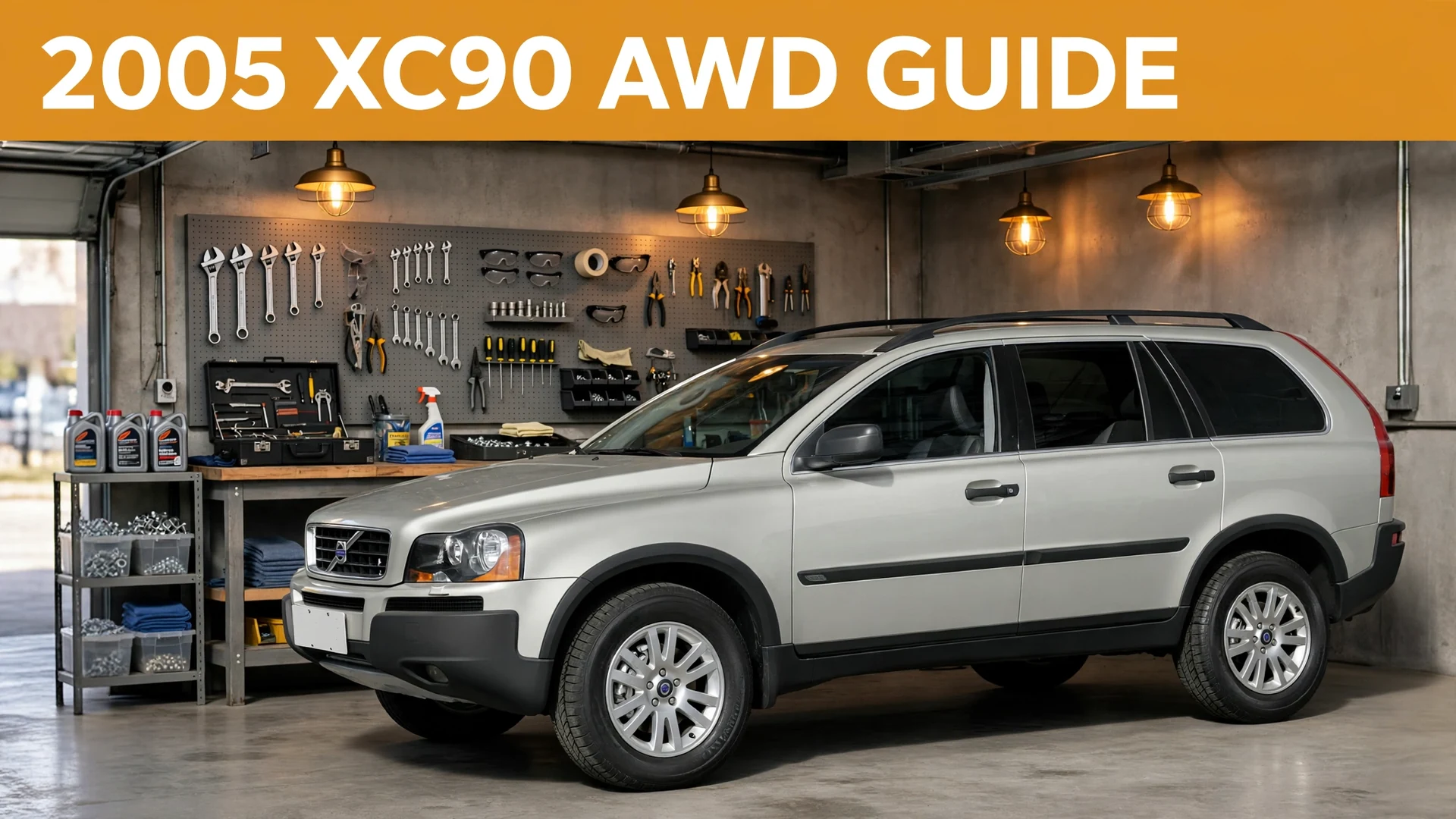
Short answer: you don’t do anything. The 2005 Volvo XC90’s all-wheel-drive system is fully automatic — it watches for wheel slip and sends power to the rear wheels by itself, in about one-seventh of a wheel rotation. There are no buttons to press, no levers to pull, and no modes to select. The real question owners should ask isn’t how to use it, but how to know it’s still working — because these systems do fail with age. This guide covers both.
How the 2005 XC90’s AWD works
Every AWD 2005 XC90 uses a Haldex electronically controlled all-wheel-drive system — the same technology Volvo introduced on the XC90 in 2002. An electronically controlled clutch pack sits ahead of the rear differential. Under normal cruising it sends nearly all power to the front wheels for efficiency; the instant the fronts begin to slip, the clutch pack locks and routes up to about half the engine’s torque rearward. The whole decision happens without any input from you, coordinated with the ABS and stability control.
The V8 model introduced an enhanced version with Haldex PreX, which pre-loads the clutch for even faster engagement and sharper handling. Either way, from the driver’s seat the experience is identical: you just drive.
Which 2005 XC90s have AWD?
Three engines were offered for 2005, and AWD availability differs between them:
| Engine | Horsepower | Torque (lb-ft) | AWD |
|---|---|---|---|
| 2.5T (2.5L turbo 5-cyl) | 205 | 236 | Optional (FWD standard) |
| T6 (2.9L twin-turbo 6-cyl) | 268 | 280 | Standard |
| V8 (4.4L V8) | 311 | 325 | Standard |
If you’re shopping for a used one: the 2.5T is the reliability sweet spot (proven five-cylinder, conventional Aisin 5-speed automatic). Think twice about the T6 — its GM-sourced 4-speed automatic is a well-documented weak point with failures reported at low mileage. The V8 is a strong, generally solid engine, but expect V8 fuel bills and more expensive parts.
Is your AWD actually working? Diagnose it
Because the system is invisible when healthy, failures go unnoticed for months — many owners only discover their AWD is dead the first time they need it in snow. Tap your symptom:
AWD maintenance: the fluid service everyone skips
The Haldex unit has its own oil and filter. Volvo originally called it sealed, but two decades of experience say otherwise: old, contaminated fluid kills the Haldex pump, and the dead pump then fries the DEM control module — the exact $1,500+ failure above. Many Volvo specialists recommend a Haldex fluid and filter change roughly every 50,000 miles. It’s a few hundred dollars of prevention against a four-figure repair, so if your XC90 has no service record for it, put it at the top of the list.
The verdict
Using the AWD in a 2005 XC90 means doing nothing at all — it’s one of the most transparent systems ever fitted to an SUV. Your job as the owner is simpler and more important: verify it works (slippery-surface test, watch for the anti-skid message) and service the Haldex fluid before neglect turns a maintenance item into a $1,500 module replacement.
Frequently asked questions
How do I turn on AWD in a 2005 Volvo XC90?
You don’t — there is nothing to turn on. The 2005 XC90’s Haldex all-wheel-drive system is fully automatic: it monitors wheel slip and engages the rear wheels on its own, in about one-seventh of a wheel rotation. There are no buttons, levers, or drive modes.
Does the 2005 Volvo XC90 have full-time AWD?
Effectively yes, when equipped. The Haldex system is always active and can send up to about half the engine’s torque to the rear wheels whenever the fronts start to slip. Note that the base 2.5T came standard with front-wheel drive — AWD was optional on it and standard on the T6 and V8.
How can I tell if my XC90’s AWD is working?
The easiest test: on a slippery surface (snow, wet grass, gravel), accelerate gently. If the car pulls away without the front wheels spinning helplessly, the rear wheels are engaging. A dashboard message saying “anti-skid service required” is the telltale sign it has failed.
What does “anti-skid service required” mean on an XC90?
It means the stability/AWD control system has detected a fault — most commonly a failed Haldex pump or a dead DEM (differential electronic module). The car remains drivable as a front-wheel-drive vehicle, but you have no all-wheel drive until it’s repaired.
How much does it cost to fix XC90 AWD?
A failed Haldex pump and DEM module typically costs $1,500 or more at an independent Volvo shop, and more at a dealer. A simple Haldex fluid and filter service — the preventive maintenance that avoids this — costs a fraction of that.
Which 2005 XC90 engine is the most reliable?
The 2.5T five-cylinder is the durable, well-proven choice. The T6’s GM-sourced 4-speed automatic is a known weak point with expensive failures. The 4.4L V8 is strong and generally solid, but more complex and thirstier to run.