Is the Volvo XC60 Reliable? Generational Breakdown, Costs & Recalls

When shopping for a midsize luxury crossover, the Volvo XC60 represents one of the most compelling alternatives to the ubiquitous German trio of the BMW X3, Audi Q5, and Mercedes-Benz GLC. Renowned for its world-leading passive safety engineering, serene Scandinavian cabin ergonomics, and refined minimalist aesthetics, the XC60 has served as Volvo’s global best-selling nameplate for over a decade. Yet prospective buyers—particularly those considering pre-owned or out-of-warranty models—frequently face a crucial question: Is the Volvo XC60 genuinely reliable over the long haul, or is it an expensive electronic money pit?
The Volvo XC60 delivers solid luxury crossover reliability, ranking 4th out of 11 luxury midsize SUVs on RepairPal with an average annual maintenance cost of $746 (significantly cheaper than BMW X3 at $1,034 or Audi Q5 at $928). However, reliability varies dramatically by generation: first-generation P3 models (2010–2017) with 3.0L T6 inline-six engines are virtually bulletproof workhorses capable of 250,000+ miles, while early second-generation SPA models (2018–2020) suffer from ERAD electric rear axle bearing failures on T8 PHEVs, AC evaporator leaks, and early Sensus infotainment glitches.
3.5 out of 5.0 (Above Average)
$746 / year (vs. $859 luxury average)
2013–2015 3.0L T6 & 2021+ B5 / T8 ERAD v2
2015–2016 Drive-E oil rings & early T8 ERAD
The factual answer requires looking beyond simplistic one-size-fits-all reliability rankings. The XC60 has spanned two distinct architectural generations over a 15-year production run: the rugged, heavy-duty P3 platform (2010–2017) and the technologically cutting-edge, lightweight SPA platform (2018–2025). Depending on the model year, engine code, and transmission you choose, the XC60 can either be a bulletproof 300,000-mile highway cruiser or an engine plagued by early piston ring defects and high-voltage hybrid complexities. This comprehensive report breaks down real-world reliability data, generational failure rates, common owner complaints, and critical pre-purchase inspection items.
Generational Breakdown: First Gen (P3) vs. Second Gen (SPA)
To understand XC60 reliability, you must identify which vehicle platform and engine family is under the hood. Volvo underwent a massive mechanical transformation between 2015 and 2018 that completely reshaped its reliability profile.
| Generation & Platform | Model Years | Primary Engines | Transmission | Reliability Rating | Primary Strengths & Weaknesses |
|---|---|---|---|---|---|
| First Generation (P3) | 2010–2014 | 3.2L Inline-6 (NA) / 3.0L T6 Turbo (B6304T4) | Aisin TF-80SC 6-Speed Auto | 8.6 / 10 (Outstanding) | Legendary mechanical durability, iron sleeves, timing chain. Weaknesses: READ bearing noise, heavy fuel consumption. |
| First Gen Transition (P3) | 2015–2017 | 2.0L Drive-E 4-Cyl (Early) vs 3.0L T6 | Aisin TG-81SC 8-Speed Auto | 6.5 / 10 (Mixed Risk) | 3.0L T6 remained flawless; early 2.0L Drive-E suffered severe piston oil ring failures (TJ 31216). |
| Second Generation (SPA Early) | 2018–2020 | 2.0L Drive-E T5 (Turbo) / T6 (Twincharged) / T8 PHEV | Aisin TG-81SC 8-Speed Auto | 7.5 / 10 (Above Avg) | Piston rings redesigned; exceptional safety. Weaknesses: Early T8 ERAD whine, AC evaporator leaks, Sensus lag. |
| Second Generation (SPA Late / AAOS) | 2021–2025 | 2.0L B5 Mild Hybrid / B6 / T8 Extended Range | Aisin TG-81SC 8-Speed Auto | 8.2 / 10 (Very Good) | Refined 2nd-gen ERAD, Google AAOS over-the-air updates, 48V start-stop smoothness. Minor TCAM antenna glitches. |
8.6 / 10
3.2L NA / 3.0L T6 Turbo
Bulletproof inline-6, timing chain
READ bearing, oil trap box
6.5 / 10
Early 2.0L Drive-E vs 3.0L T6
Mixed; T6 excellent, Drive-E risky
Piston ring oil consumption defect
7.5 / 10
T5 / T6 / T8 Twin Engine
Solid engine, complex electronics
ERAD whine, AC evaporator, Sensus
8.2 / 10
B5 / B6 / T8 Extended Range
Very high; mature platform
TCAM software updates, 48V battery
Interactive Evaluation: Volvo XC60 Year & Powertrain Reliability Tool
Select your prospective model year, engine configuration, and current mileage below to generate a tailored dependability score and personalized maintenance checklist:
Customize the vehicle profile to reveal historical failure rates and critical service vulnerabilities:
Major Known Issues by Model Year & Platform
Every automotive platform has specific engineering pain points. For the Volvo XC60, these are the four major known issues that technicians and long-term owners document most frequently:
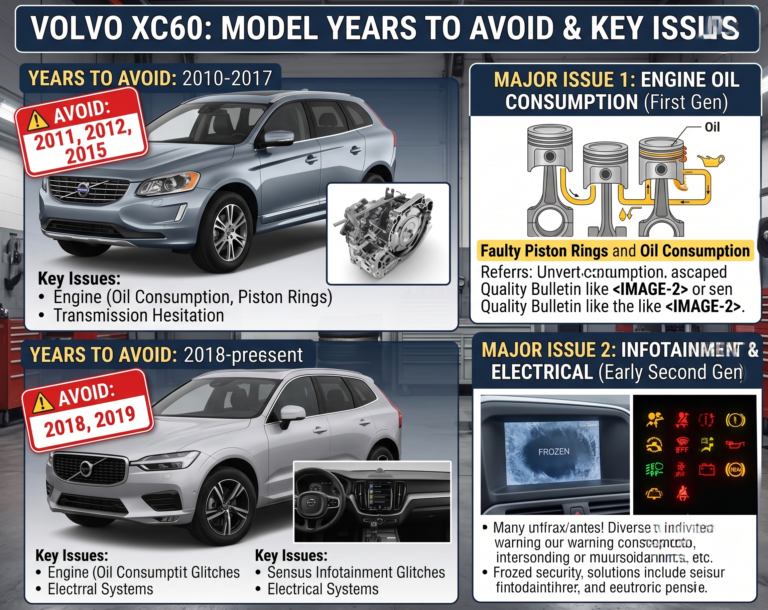
1. Piston Ring Oil Consumption on Early Drive-E (2015–2016)
When Volvo phased out the inline-six and five-cylinder engines in favor of the all-aluminum 2.0-liter Drive-E family, the earliest production batches (engine serial numbers prior to 1501327) were fitted with low-tension oil control rings that lacked adequate oil drain back holes. Over 50,000 to 80,000 miles, combustion blow-by and oil varnishing cause these rings to seize into the piston grooves. The engine begins consuming 1 quart of oil every 500 to 1,000 miles without any external leaks or smoke from the tailpipe.
If left unaddressed, the oil starvation fouls spark plugs, burns exhaust valves, and can catastrophically score the cylinder walls. Volvo issued Technical Journal TJ 31216 and ultimately settled a class-action lawsuit extending engine warranty coverage. For anyone buying a 2015–2016 XC60 Drive-E, obtaining proof of updated pistons and rings is mandatory.
2. ERAD (Electric Rear Axle Drive) Bearing Noise on T8 Hybrids (2018–2020)
On early SPA-platform XC60 T8 Plug-in Hybrids, the rear electric drive motor (ERAD) incorporates internal reduction gears and high-speed bearings. On pre-2021 builds, internal fluid seals could allow minute moisture or coolant ingress, or mechanical tolerances caused the high-speed input pinion bearing to fail. Symptoms include a distinct high-pitched whistling, jet-engine whine, or groaning vibration from the rear cargo floor above 30 mph under electric drive. Replacing the entire ERAD assembly out of warranty costs between $4,500 and $5,800 at a Volvo dealer. Volvo introduced a revised Gen 2 ERAD in late 2021 with upgraded seals and bearings that resolved this failure mode.
3. Air Conditioning Evaporator Core Leaks (2018–2021 SPA)
One of the most labor-intensive known repairs on early SPA vehicles involves the cabin air conditioning evaporator core located deep inside the climate control box behind the dashboard. Aluminum tubing in the evaporator can develop pinhole refrigerant leaks due to galvanic corrosion. When the refrigerant drops, the AC blows lukewarm air and emits a faint hissing sound from the center vents. Because replacing the evaporator core requires completely removing the steering column, center console, and entire structural dashboard assembly (12 to 14 hours of technician labor), dealership repair estimates range between $2,500 and $3,500.
4. TCAM (Telematics & Connectivity Module) Moisture Ingress (2021–2023)
Modern Volvos equipped with Google Android Automotive OS rely on the TCAM unit mounted beneath the roof shark-fin antenna to handle LTE connectivity, GPS navigation, Volvo Cars app communication, and keyless fob reception. On early production runs, the exterior rubber antenna gasket could allow rainwater to seep down the mounting bolt directly onto the TCAM backup battery and circuit board. Symptoms include sudden loss of GPS navigation, “SOS Call Service Required” warnings on the driver display, and unresponsive key fobs. Volvo released updated sealed shark-fin assemblies and improved drain channels under warranty campaign service actions.
Pre-Purchase Inspection (PPI) Checklist for Used XC60 Buyers
If you are evaluating a pre-owned Volvo XC60 at a dealership or private sale, take this physical inspection checklist with you:
- Electronic Oil Level Verification: Warm the engine to full operating temperature, turn it off on level ground, wait 2 minutes, and check the digital oil level readout in the center screen. If it is low, check service records for excessive consumption history.
- Rear Axle Sound Check (T8 Models): On T8 PHEVs, select Pure (Electric) drive mode. Accelerate smoothly from 20 to 60 mph. Listen carefully from the back seat for any high-pitched whine or grinding resembling a jet engine spooling up.
- AC Blow Temperature: Set climate control to LO on both sides. Use a digital thermometer in the center vent. It should read between 38°F and 44°F within 3 minutes. If blowing warm, budget for an evaporator core or condenser leak.
- Sunroof Drain & Carpet Inspection: Press your hand firmly into the passenger and driver footwell carpet under the floor mats. Any dampness indicates clogged sunroof drain tubes that will eventually short out the Central Electronic Module (CEM).
- Timing Belt Replacement Sticker: On 2.0L Drive-E engines with over 100,000 miles or older than 8 years, check the plastic timing cover for a certified service sticker. If not replaced, factor $800 to $1,200 into your purchase negotiations immediately.
Frequently Asked Questions About Volvo XC60 Reliability
Generational Powertrain Reliability: SI6 Inline-6 vs Drive-E 4-Cylinder
To accurately evaluate the long-term reliability of the Volvo XC60, one must distinguish between the first-generation (2010–2017) and second-generation (2018–present) platforms. The mechanical failure profiles of these two generations are vastly different:
First Generation (2010–2017): The Bulletproof SI6 Inline-6 Era
First-generation XC60 models equipped with the 3.2-liter naturally aspirated Short Inline-6 (SI6 / B6324S) and the 3.0-liter turbocharged T6 (B6304T4) are widely regarded as some of the most mechanically robust engines Volvo ever built. Features include a heavy-duty timing chain (no timing belt to snap) and cast-iron cylinder liners. Common failure points are primarily external: the Rear End Ancillary Drive (READ) gear assembly bearings (can whine after 150k miles), the oil filter housing PCV diaphragm, and front lower control arm hydraulic bushings.
Second Generation (2018–2025): Drive-E 2.0L Modular Engines
Second-generation XC60 models exclusively utilize the Drive-E 2.0-liter all-aluminum 4-cylinder engine (in T5 turbo, T6 turbo+supercharged, and B5/B6 48V mild-hybrid configurations):
- Piston Ring Redesign (Week 46, 2016 Cutoff): Early 2015–2016 Drive-E engines suffered from excessive oil consumption due to poor oil scraper piston ring tension. For late 2016 and all 2017+ production (engine serial number 1501327 and higher), Volvo redesigned the piston crowns and oil control rings, completely eliminating the oil burning issue.
- Supercharger Clutch & Snout Seals (T6 Models): The twin-charged T6 features both an Eaton Roots-type supercharger (for low-end boost) and a turbocharger. The magnetic supercharger engagement clutch and belt idler pulley require inspection around 90,000 to 110,000 miles.
- Timing Belt Interval: Unlike the SI6 inline-6, the Drive-E 2.0L utilizes a rubber timing belt that must be replaced every 150,000 miles or 10 years. This is an interference engine; belt failure results in catastrophic valve-to-piston impact.
T8 Twin Engine Plug-In Hybrid Reliability: ERAD Motor & HVCH
For buyers considering the high-performance XC60 Recharge T8 Plug-In Hybrid, two specific electrified components require close monitoring:
- Electric Rear Axle Drive (ERAD) Motor: Early 2016–2018 T8 models experienced issues with the internal planetary gearset and fluid seals in the 65 kW rear motor, leading to high-pitched whining or drivetrain errors. In late 2021, Volvo introduced the upgraded 107 kW ERAD motor with reinforced bearings and improved thermal sealing, which has proven exceptionally reliable.
- High-Voltage Coolant Heater (HVCH): Responsible for warming the cabin and battery during pure-electric driving in winter. Early batches suffered internal electrical insulation breakdown (throwing DTC
BECM-P0AEE00). Volvo issued an extended warranty bulletin covering replacement of the HVCH unit for up to 10 years / 150,000 miles.
Frequently Asked Questions