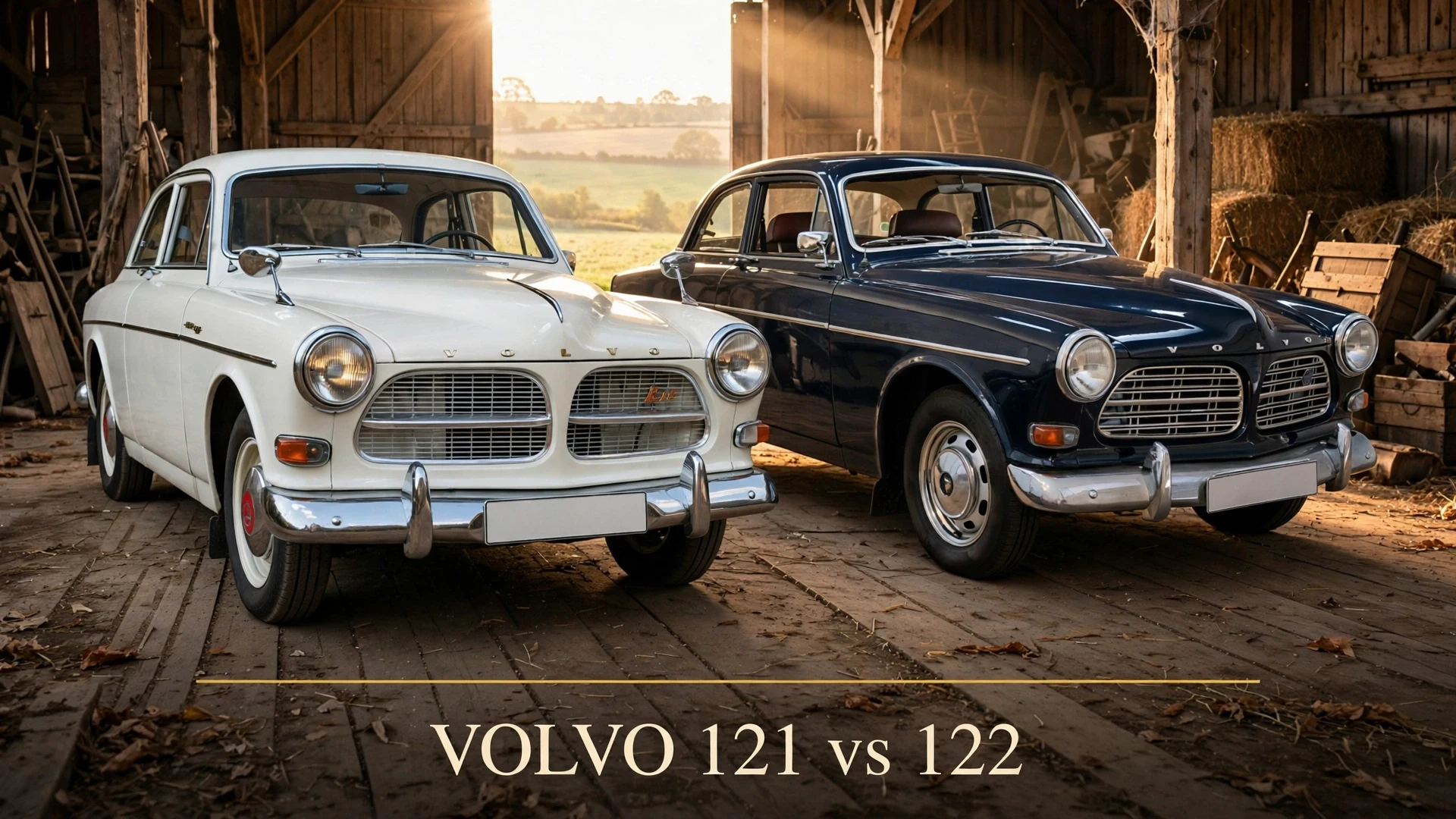
Volvo 121 vs 122: The Complete Swedish Amazon History & Comparison

Few classic automobiles in history are as deeply beloved, mechanically bulletproof, or socially consequential as the Volvo Amazon (120 Series). Penned by a 23-year-old design prodigy named Jan Wilsgaard—who drew inspiration from 1950s American sedans, Italian Alfa Romeos, and aircraft styling—the Amazon transformed Volvo from a niche Scandinavian manufacturer into a globally revered automotive powerhouse. It was also the car that changed automotive safety forever when Volvo engineer Nils Bohlin made the three-point safety seatbelt standard equipment on the Amazon in 1959.
The Volvo Amazon (120 Series, 1956–1970) cemented Volvo’s worldwide reputation for indestructible engineering and introduced the three-point seatbelt to humanity in 1959. Within the model family, the 121 was the domestic baseline economy car featuring a single carburetor (B16A, B18A, B20A producing 60–82 hp), modest interior appointments, and 4-wheel drum brakes on early runs. The 122 (universally badged 122S) was the legendary export and sport model, equipped with twin SU or Zenith-Stromberg carburetors (B16B, B18B, B20B producing 85–118 hp), front disc brakes, an optional Laycock de Normanville electric overdrive, and dual chrome side moldings.
Single Carburetor (B16A/B18A/B20A) – 60 to 82 hp
Twin Carburetors (B16B/B18B/B20B Twin SU) – 85 to 118 hp
1959 Amazon was 1st car in history with standard 3-point seatbelts
122S Two-Door (132) & Amazon Estate Wagon (221/222)
Yet when diving into classic Volvo registries, classified listings, and historic rally results, enthusiasts constantly encounter two primary nameplates: the Volvo 121 and the Volvo 122 (universally known as the 122S). What is the difference between these Swedish siblings? Was the 121 merely an underpowered economy car, or did the 122S represent a true sports saloon capable of beating Alfa Romeos and MGs on European rally circuits? Below is the definitive historical and mechanical guide to the Amazon 121 vs. 122S.
Naming Decoded: 121 vs. 122S vs. Body Codes
Volvo’s post-war numbering system followed a logical three-digit code during the 1960s:
- First Digit (1): Designates the model generation (100 Series / Amazon).
- Second Digit (2 or 3): Designates the body style (2 = 4-door sedan early on; later 3 = 2-door sedan/couve; 2 = 5-door station wagon in 220 series).
- Third Digit (1 vs. 2): 1 = Single Carburetor (Standard Model); 2 = Twin Carburetors (Sport Model / 122S).
| Model Badge | Engine Code & Displacement | Carburetor Induction | Horsepower / Torque | Braking & Transmission Highlights |
|---|---|---|---|---|
| Volvo 121 (B16) | 1.6L Inline-4 (B16A – 1,583 cc) | Single Zenith Down-draft | 60 hp @ 4,500 RPM / 87 lb-ft | 6-Volt electrical system, 4-wheel hydraulic drum brakes, M30 3-speed or M40 4-speed. |
| Volvo 122S (B16) | 1.6L Inline-4 (B16B – 1,583 cc) | Twin SU Sidedraft Carburetors | 85 hp @ 5,400 RPM / 87 lb-ft | High-compression head, sports camshaft, dual exhaust manifold, export specification. |
| Volvo 121 (B18) | 1.8L Inline-4 (B18A – 1,778 cc) | Single Zenith-Stromberg 175 CD | 75 hp @ 4,500 RPM / 103 lb-ft | 12-Volt electrical system, indestructible 5-bearing crankshaft, M40 4-speed manual. |
| Volvo 122S (B18) | 1.8L Inline-4 (B18B – 1,778 cc) | Twin SU HS6 Sidedraft | 90 – 100 hp @ 5,400 RPM | Standard Front Girling Disc Brakes, optional Laycock electric overdrive (M41). |
| Volvo 122S (B20) | 2.0L Inline-4 (B20B – 1,986 cc) | Twin Zenith-Stromberg 175 CD-2SE | 118 hp @ 5,800 RPM / 123 lb-ft | High-lift camshaft, dual-circuit power disc brakes, the fastest factory Amazon produced. |
60 – 75 HP
Single Zenith / Stromberg
Economy, low maintenance
Domestic Swedish workhorse
85 – 118 HP
Twin SU HS6 Sidedraft
Front Disc Brakes Standard
Legendary export & rally icon
Interactive Tool: Volvo Amazon 121 vs. 122S Specification Tool
Select an engine displacement era and model variant to inspect carburetor setups, horsepower curves, and collector significance:
Compare mechanical configurations across the Amazon’s 14-year production run:
Mechanical Superiority of the 122S: Why Enthusiasts Crave It
While the single-carburetor 121 was beloved for its simple, low-maintenance tuning, the 122S was the machine that built Volvo’s reputation as a performance contender:
- Twin SU HS6 Carburetors: The dual constant-velocity SU sidedraft carburetors allowed the B18 and B20 engines to breathe freely at high RPMs, producing a glorious, guttural intake roar and delivering an instantaneous 25% jump in horsepower.
- Front Disc Brakes (1962+): Beginning with the 1962 model year, all 122S models were fitted with heavy-duty British Girling solid front disc brakes. At a time when American sedans and British family cars relied on fade-prone 4-wheel drums, the Amazon offered sports-car stopping power.
- Laycock de Normanville Electric Overdrive: Equipped on M41 transmissions, a delicate switch on the steering column activated an electro-hydraulic planetary overdrive gear in 4th gear, dropping cruising engine RPM by 22% for relaxed 80-mph motorway touring.
Frequently Asked Questions About the Volvo 121 and 122S
The Volvo Amazon Legacy: 121 vs 122S Nomenclature Origins
Introduced in 1956 and manufactured through 1970, the Volvo 120 series (widely known by its Swedish market moniker, the Volvo Amazon) is the vehicle that transformed Volvo from a regional Scandinavian car builder into a globally respected automotive powerhouse. Designed by the visionary Jan Wilsgaard, the Amazon drew styling inspiration from contemporary American sedans while retaining bulletproof Nordic construction.
The distinction between the Volvo 121 and the Volvo 122 (122S) represents the divergence between economy transportation and sporty grand touring:
- Volvo 121 (Standard Economy Model): The baseline passenger sedan, engineered primarily for domestic Swedish, Scandinavian, and European buyers seeking indestructible, affordable family transport.
- Volvo 122S (Sport Model): The high-performance export flagship, engineered specifically to satisfy the power demands of the lucrative North American market and European rally competitors.
Carburetion & Valvetrain Breakdown: Single Zenith vs Twin SUs
The mechanical heart of the 120 series is Volvo’s legendary B16, B18, and B20 cast-iron 4-cylinder Redblock engines. The engine specifications illustrate the performance gap:
| Mechanical Specification | Volvo 121 (B18A / B20A Engine) | Volvo 122S (B18B / B20B Sport Engine) |
|---|---|---|
| Carburetor Configuration | Single Zenith / Stromberg 36VN Downdraft | Twin SU (Skinners Union) HS6 Side-Draft |
| Compression Ratio | 8.5:1 (Tolerates low-octane regular fuel) | 10.0:1 (Requires high-octane premium) |
| Camshaft Profile | Volvo ‘A’ Cam (Low-lift, broad torque) | Volvo ‘C’ or ‘D’ Sport Cam (High-lift) |
| Exhaust Manifold | Single cast-iron downpipe manifold | Dual-outlet cast header into dual exhaust |
| Horsepower Output (B18) | 75 HP @ 4,500 RPM | 90 – 100 HP @ 5,400 RPM |
| Top Speed | 145 km/h (90 mph) | 165 km/h (103 mph) |
1959: The Three-Point Seatbelt That Saved 1,000,000 Lives
In 1959, the Volvo Amazon made history when Volvo Chief Safety Engineer Nils Bohlin patented the world’s first modern three-point lap-and-shoulder safety belt. Volvo made the 3-point seatbelt standard equipment on all Volvo 121 and 122S models—marking the first time in automotive history that any manufacturer delivered dedicated upper-torso occupant restraint as standard equipment.
In an act of unprecedented corporate humanitarianism, Volvo Car Corporation immediately released the patent to all competing automakers for free, believing that human life took precedence over corporate profits. Transportation safety analysts calculate that Nils Bohlin’s 3-point safety belt has saved well over one million lives worldwide to date.
Factory Valve Adjustment & Ignition Dwell Angle Specifications
Maintaining optimal performance on classic Volvo 121 and 122S models requires familiarizing oneself with traditional mechanical ignition and valvetrain tuning parameters:
| Engine Tuning Parameter | Volvo 121 (B18A / B20A Single Carb) | Volvo 122S (B18B / B20B Twin SU Carbs) |
|---|---|---|
| Valve Clearance (Hot Engine) | 0.40 – 0.45 mm (0.016 – 0.018 in) Intake & Exhaust | 0.40 – 0.45 mm (0.016 – 0.018 in) Intake & Exhaust |
| Distributor Contact Breaker Gap | 0.40 mm (0.016 in) | 0.40 mm (0.016 in) |
| Dwell Angle | 59° to 65° | 59° to 65° |
| Initial Ignition Timing | 15° – 17° BTDC @ 1,500 RPM (Vacuum disconnected) | 19° – 21° BTDC @ 1,500 RPM (Vacuum disconnected) |
| Carburetor Synchronization | Single unit; adjust idle mixture screw to 3.5% CO | Dual SU HS6; synchronize airflow using Unisyn / flow meter |
| Dashpot Damper Oil | N/A (Zenith / Stromberg) | 20W motor oil or 3-in-1 oil in SU damper caps |
Synchronizing the twin SU HS6 carburetors on the 122S is an art form: loosen the throttle interconnection linkage clamps, adjust each idle speed screw until both carburetors draw identical CFM airflow on a Unisyn gauge, and tune the jet mixture nuts until lifting the damper piston by 1/16th of an inch causes the engine RPM to rise momentarily and settle smoothly.
Motorsport Pedigree: European Rally Championship Victories
The Volvo 122S proved its mechanical invincibility on the world rally stage: factory works driver Gunnar Andersson won the 1963 European Rally Championship piloting a tuned 122S, and Sylvia Österberg won the Ladies’ Trophy in the grueling Acropolis Rally, proving Swedish durability across punishing Greek boulders.
Frequently Asked Questions