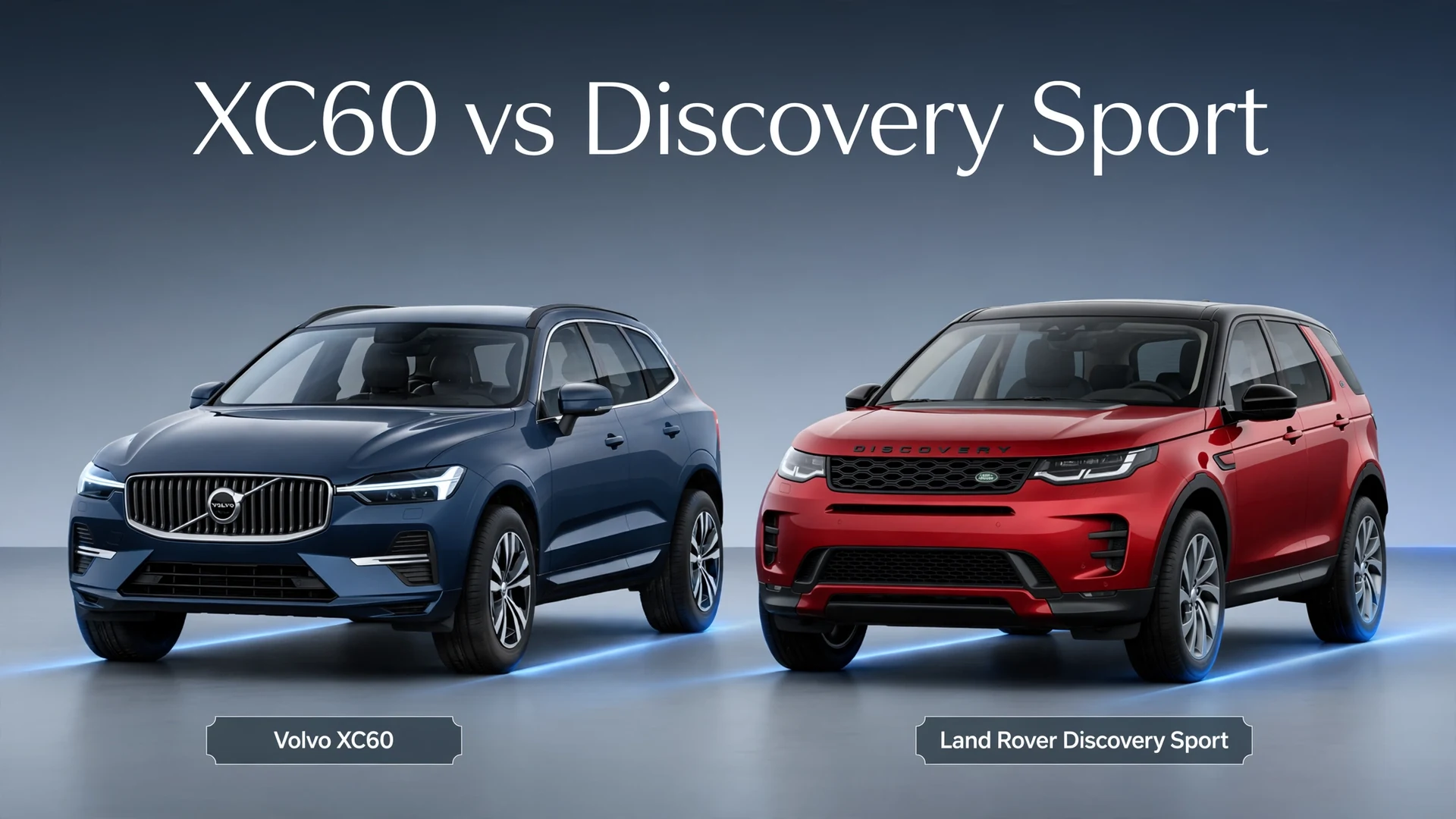
Volvo XC60 vs Land Rover Discovery Sport?

Volvo XC60 vs Land Rover Discovery Sport?
The premium family SUV with a split personality test: the Land Rover Discovery Sport P250 ($48,900) offers genuine off-road hardware — 8.4 inches of ground clearance, low-speed all-terrain tech, and an optional third row — while the Volvo XC60 B5 ($47,050) offers a quieter cabin, better fuel economy (26 vs 20 mpg combined), and a plug-in hybrid option. Verdict: buy the Discovery Sport only if you’ll actually use its off-road ability and seven seats; for everyone else, the XC60 is more refined, cheaper to run, and less risky to own.
- Price: Discovery Sport P250 S $48,900 / Dynamic SE $53,100 vs XC60 B5 Core $47,050 / T8 Plus $62,600.
- Power: near-identical — Discovery Sport P250 246 hp/269 lb-ft vs XC60 B5 247 hp/266 lb-ft.
- Off-road: Discovery Sport: 8.4-in clearance, 25° approach, terrain tech. XC60: a soft-roader, full stop.
- Economy: XC60 B5 26 mpg combined (T8: 35-mi EV range) vs Discovery Sport 20 mpg combined.
- Reliability: Land Rover’s record is the industry’s weakest; budget for extended warranty or buy the Volvo.
- Space: Discovery Sport offers an optional third row and 32.2 cu ft of cargo; the XC60 counters with refinement.
The Off-Road Question: Genuine Capability vs Marketing
This is the only comparison in this series where the answer depends on a question most buyers never ask: will you actually go off-road? The Discovery Sport is a genuine Land Rover underneath — 8.4 inches of ground clearance, 25-degree approach and 28-degree departure angles, Terrain Response 2 with modes for mud, sand, and rock crawl, hill descent control, and an available wade-sensing system. Reviewers who’ve taken it on proper trails confirm it embarrasses every other SUV here when the pavement ends.
The XC60 is a soft-roader in the honest sense: standard all-wheel drive, decent traction in snow and on gravel, and not much more. Take it down a rutted farm track and it’ll cope; take it rock-crawling and you’ll break things. For the 95% of buyers whose “off-road” means a muddy school run or a snowy commute, the XC60’s AWD is sufficient — and its on-road manners are far superior. The Discovery Sport rides firmly and steers with less precision; it’s tuned for terrain, not tarmac.
There’s a middle ground worth acknowledging: the XC60 handles winter properly. Ground clearance around 8.5 inches, standard AWD with decent torque distribution, and Volvo’s stability systems make it a confident snow car — arguably all the capability most suburban buyers will ever need. The Discovery Sport’s extra hardware only pays off beyond the plowed road. Be honest about which driver you are before paying the Land Rover’s fuel and reliability penalty for capability you’ll never use.
Specs Compared
| Specification | Volvo XC60 B5 / T8 | Discovery Sport P250 |
|---|---|---|
| Engine | 2.0L turbo MHEV / turbo PHEV | 2.0L turbo MHEV |
| Power / torque | 247 hp / 266 lb-ft (455/523 T8) | 246 hp / 269 lb-ft |
| Transmission | 8-speed automatic | 9-speed automatic |
| EPA combined | 26 mpg (B5); T8 + 35-mi EV range | 20 mpg |
| Ground clearance | 8.5 in (approx.) | 8.4 in + terrain tech |
| Max towing | 3,500 lb | 4,409 lb |
| Cargo (seats up / max) | 17.1 cu ft / ~63 cu ft | 32.2 cu ft / 60.0 cu ft |
| Seating | 5 | 5 + optional 7 |
| Length | 185.4 in | 180.9 in |
Daily Driving: Where the Volvo Pulls Away
On pavement — where both will spend 95% of their lives — the XC60 is simply the better car. Its ride is more settled, its steering more precise, its cabin dramatically quieter at highway speed. The B5’s 8-speed automatic shifts more smoothly than the Discovery Sport’s 9-speed, which has a long-documented habit of hesitant low-speed behavior. The Volvo’s Google-based infotainment is more intuitive than JLR’s Pivi Pro, and Pilot Assist remains the segment’s best semi-autonomous highway system.
The Discovery Sport isn’t bad on road — it’s composed and comfortable enough — but it always feels like what it is: a vehicle optimized for something else. Its 20 mpg combined EPA rating (19/23/20) is poor for the class and reflects the aerodynamic and mechanical cost of its off-road hardware. If your driving is 100% on-road, you’re paying for capability in fuel, refinement, and reliability risk without ever cashing the check.
Seven Seats — With an Asterisk
The Discovery Sport’s party trick is its optional third row — something no XC60 offers. But go in with realistic expectations: in a 180.9-inch vehicle, the third row is strictly for children on short trips, and using it all but eliminates the cargo area. It’s an occasional-use solution, not a minivan replacement. That said, for a family of five plus grandparents twice a year, it’s genuinely useful — and the 32.2 cu ft of cargo behind the second row dwarfs the XC60’s 17.1.
The XC60’s cabin, meanwhile, is simply nicer: quieter, better materials, more comfortable seats, and superior infotainment. The Discovery Sport’s Pivi Pro system is a big improvement over old JLR infotainment, but Volvo’s Google-based setup remains more intuitive. Five-passenger comfort goes to the Volvo by a clear margin.
Reliability: The Elephant in the Room
Land Rover’s reliability record is the industry’s punchline — consistently bottom or near-bottom in J.D. Power dependability studies, with the Discovery Sport’s Ingenium petrol engines (note: the US P250 is petrol, not the troublesome early diesel) drawing complaints about coolant loss, electrical faults, and oil consumption. The 9-speed automatic has its own history of rough shifting. None of this means every Discovery Sport breaks; it means the odds are worse than average and the repair bills are premium-sized.
The XC60 isn’t perfect — the T8’s ERAD and battery-recall issues are documented — but the B5 is a proven, simple powertrain, and Volvo’s dependability scores sit well above JLR’s. The practical advice: if you buy the Discovery Sport, buy it new with the full warranty or certified pre-owned with Land Rover’s CPO coverage, and budget for an extended warranty. If you buy the XC60 B5, just maintain it.
One more consideration: parts and specialist availability. Volvo’s US dealer network is smaller than the German brands’ but stable, and independent Volvo specialists are common. Land Rover dealers are fewer, service experiences vary widely by dealer, and out-of-warranty JLR repairs are notoriously expensive — a failed infotainment unit or air-conditioning compressor can run into four figures. This is the hidden cost that turns a cheap used Discovery Sport into an expensive one.
Prices and Ownership Costs
Base prices are close: $48,900 for the Discovery Sport P250 S versus $47,050 for the XC60 B5 Core. But the ownership math diverges quickly. The Discovery Sport’s 20 mpg combined versus the XC60’s 26 means roughly $800 more in fuel per year at 15,000 miles; JLR servicing costs more; insurance is higher; and depreciation is steeper — Land Rovers typically retain 45–50% after three years against the XC60’s 50–55%.
| Cost factor | XC60 B5 | Discovery Sport P250 |
|---|---|---|
| Base price | $47,050 | $48,900 |
| Annual fuel (15k mi, $3/gal) | ~$1,730 | ~$2,250 |
| 3-year retained value (typical) | ~50–55% | ~45–50% |
| Servicing | Premium, but stable network | Higher; variable dealer quality |
| Warranty recommendation | Standard coverage fine | Extended warranty strongly advised |
Used-Buying Verdict
Used Discovery Sport inspection checklist: full JLR service history, coolant system health, all electronics functional (test everything — windows, cameras, terrain modes), transmission shift quality when cold, and confirmation of all recalls. For the XC60: B5s need the standard checks (software, roof drains); T8s need battery-recall and ERAD verification.
Verdict: Horses for Courses
The Discovery Sport is the right answer to a specific question: “I want a premium SUV that seats seven in a pinch, tows 4,409 lb, and can genuinely go off-road.” Nothing else at this price does all three. If that’s your life — rural property, boat ramp, ski trips down unplowed roads — buy it, and buy the warranty.
For everyone else, the Volvo XC60 is the better SUV: more refined, more economical (26 vs 20 mpg, plus the T8’s electric range), cheaper to own, and less likely to ruin your month. Off-road credibility is worth paying for only if you use it.
Shopping used? The 2020 facelift brought meaningful improvements to interior quality and the infotainment system, so it commands a premium worth paying. On diesels, check the DPF and EGR service history — short-journey cars are where the expensive problems live — and on any Discovery Sport, verify every terrain-response mode and the powered tailgate on the test drive. These are complex cars with dealership-priced parts, so a comprehensive warranty isn’t optional equipment; it’s part of the purchase price. Buy the newest, best-documented example your budget allows, and keep something in reserve for the things the warranty doesn’t cover.
Sources
- autoblog.com — 2025 Discovery Sport: P250 246 hp/269 lb-ft, 9-speed AWD, 19/23/20 mpg, 4,409-lb towing, 32.2–60.0 cu ft cargo, 180.9-in length.
- landroverpasadena.com — 2025 Discovery Sport pricing: P250 S $48,900, Dynamic SE $53,100; 8.4-in clearance, approach/departure angles.
- carbuzz.com / truecar.com — 2025 XC60: B5 $47,050, 247 hp/266 lb-ft, 26 mpg combined, 3,500-lb towing, 17.1 cu ft cargo; T8 $62,600–$75,200, 455 hp, 35-mi EV range.
- carscoops.com — March 2025 Volvo PHEV battery recall (~73,000 vehicles).
- insideevs.com — Volvo ERAD failure explainer.
Frequently Asked Questions
Can the Volvo XC60 go off-road like the Discovery Sport?
No. The Discovery Sport has 8.4 inches of clearance, terrain-response electronics, and genuine trail ability. The XC60 is an all-weather soft-roader — fine for snow and gravel, not for rock-crawling or deep mud.
Is the Discovery Sport reliable?
It’s below average. Land Rover ranks near the bottom of dependability studies; the Discovery Sport’s petrol Ingenium engines have known coolant and electrical issues. Buy with full warranty coverage and budget for maintenance.
Which is cheaper to run, XC60 or Discovery Sport?
The XC60: 26 mpg combined vs 20 mpg, cheaper servicing, better residuals. The Discovery Sport costs roughly $800 more per year in fuel alone at 15,000 miles.
Does the Discovery Sport seat seven?
Optionally, yes — a third row is available. But it’s child-sized and eliminates most cargo space when in use. The XC60 seats five only.
Which tows more, XC60 or Discovery Sport?
The Discovery Sport: 4,409 lb versus the XC60’s 3,500 lb. Combined with its terrain ability, it’s the stronger tow vehicle for boats and trailers on rough access roads.
Should I buy a used Discovery Sport?
Only with warranty. 2021–2023 models under $30,000 are tempting, but insist on full JLR service history, a specialist inspection (cooling, electronics, transmission), and remaining warranty coverage.