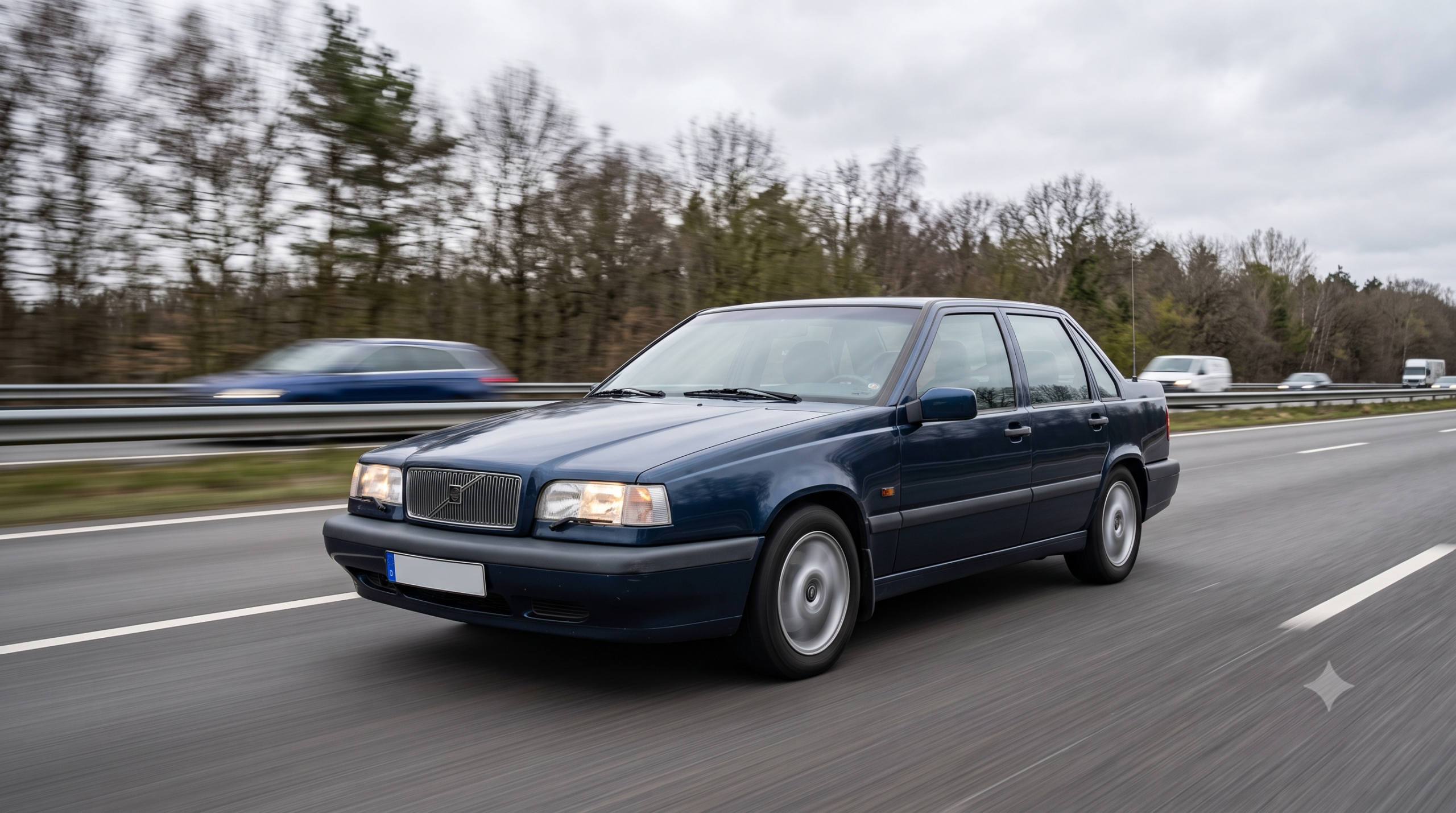
Volvo 850 Review: A Classic Swedish Game-Changer (1991–1997)

In the late 1980s, Volvo faced an existential crossroads. While the venerable rear-wheel-drive 240 and 740 series continued to sell on the strength of their tank-like crash protection, modern automotive engineering was moving rapidly toward front-wheel-drive packaging, multi-valve overhead-cam powerplants, and aerodynamic design. In response, Volvo greenlit the most audacious industrial undertaking in Swedish corporate history: Project Galaxy. Costing an astounding 15 billion Swedish Kronor (over $2.2 billion USD), Galaxy produced a car that fundamentally saved and redefined the company: the Volvo 850 (1991–1997).
Launched in 1991 under the codename ‘Project Galaxy’ with an astounding 15 billion SEK investment, the Volvo 850 (1991–1997) was the most radical industrial gamble in Swedish history. It discarded traditional rear-wheel drive in favor of a transverse all-aluminum 5-cylinder engine, Delta-link semi-independent rear suspension with passive rear steer, and the world’s first Side Impact Protection System (SIPS). Spanning from reliable naturally aspirated 2.5L family cruisers to the homologated 240-hp 850 T-5R and 250-hp 850R co-developed with Porsche, the 850 shattered Volvo’s frumpy image and created an enduring touring car racing legend.
15 Billion SEK ($2.2B USD) – Largest Swedish industrial investment
Transverse 5-cyl, Delta-link suspension, SIPS, auto-seatbelts
1995 850 T-5R (Cream Yellow, 240 hp) & 1996–1997 850R (250 hp)
1994 BTCC 850 Estate wagon driven by Rydell & Lammers
When CEO Pehr Gyllenhammar unveiled the 850 GLT in Stockholm under the slogan “A dynamic car with four world-first breakthroughs,” the global automotive press was stunned. Gone was the ponderous, agricultural handling of traditional Swedish iron. In its place stood an athletic, front-wheel-drive sports saloon powered by a singing all-aluminum 5-cylinder engine, riding on a sophisticated passive rear-steer Delta-link suspension, and cloaked in a world-first Side Impact Protection System (SIPS). Below is our definitive review of the 850’s engineering genius, motorsport heroics, and collector immortality.
The Four World-First Breakthroughs of the Volvo 850
Volvo’s 15-billion-Kronor investment yielded four revolutionary automotive innovations that are standard across the industry today:
| Innovation Breakthrough | Engineering Architecture | How It Worked & Industrial Significance |
|---|---|---|
| 1. Transverse 5-Cylinder Modular Engine | All-aluminum block with centrifugally cast iron liners | Volvo mounted the 5-cylinder engine transversely (sideways) between the front strut towers. This freed up maximum cabin crush space while delivering the silky harmonic balance of a 6-cylinder with the fuel efficiency of a 4-cylinder. |
| 2. Delta-Link Semi-Independent Rear Suspension | Twin trailing arms linked by flexible cross-members | Allowed independent rear wheel movement while incorporating elastomeric bushings that created passive rear-wheel steering under high cornering loads, completely eliminating front-wheel-drive understeer. |
| 3. SIPS (Side Impact Protection System) | Reinforced B-pillars, sill beams, and transverse floor tubes | In a side-impact T-bone collision, energy is transferred through structural cross-car tubes underneath the front seats directly to the opposite side of the vehicle, pushing passengers away from the crushing door. |
| 4. Self-Adjusting Front Seatbelt Reels | Automatic inertia reel height tensioners | Mechanically adjusted the upper B-pillar shoulder anchor point automatically to fit the occupant’s height, ensuring optimal belt placement across the collarbone. |
World First
All-aluminum transverse 5-cyl
Immense crush space & 6-cyl smoothness
World First
Passive rear-wheel steering
Sharper cornering, zero understeer
World First
Cross-car floor energy transfer
Pushes occupants away from side hits
Interactive Tool: Volvo 850 Model, Engine & Collector Value Explorer
Select an 850 variant below to explore factory horsepower ratings, transmission hardware, and modern collector market valuations:
Compare models from naturally aspirated cruisers to the Porsche-tuned T-5R:
The Legends: The 1995 850 T-5R and 1996–1997 850R
In late 1994, Volvo did the unthinkable: they launched a fire-breathing, limited-edition halo super-wagon co-engineered with Porsche: the 1995 Volvo 850 T-5R. Finished in electric Cream Yellow (known affectionately as T-Gul), the T-5R produced 240 horsepower on temporary overboost from its 2.3-liter turbocharged 5-cylinder, sprinting from 0 to 60 mph in 5.8 seconds—faster than contemporary BMW 540i sedans. It rode on dark anthracite 17-inch “Titan” five-spoke alloy wheels, lowered sports suspension, and featured dark Amaretta (Alcantara) and leather upholstery.
For 1996 and 1997, Volvo made the performance package permanent as the Volvo 850R. Manual transmission models were fitted with a larger Mitsubishi TD04HL-16T turbocharger pushing 250 horsepower, paired exclusively with a heavy-duty M59 5-speed manual featuring a viscous limited-slip differential (LSD). Today, the 850 T-5R and 850R are among the most fiercely pursued modern classic European collector cars in the world, with pristine low-mileage examples commanding upwards of $35,000 to $50,000.
The 1994 BTCC Racing Sensation: The Flying Estate Wagons
Perhaps no motorsport campaign has ever captured the public imagination quite like Volvo’s entry into the 1994 British Touring Car Championship (BTCC). Partnering with Tom Walkinshaw Racing (TWR), Volvo entered two full-sized 850 Estate wagons piloted by Rickard Rydell and Jan Lammers. The sight of long-roof grocery-getter wagons bumping door handles with Alfa Romeo 155s and BMW 318i sedans, lifting two wheels high in the air through Thruxton’s chicane, dominated television highlight reels worldwide. The racing wagon campaign instantly destroyed Volvo’s dowdy, boring image and cemented the 850 as an enduring pop-culture performance icon.
Frequently Asked Questions About the Volvo 850
Project Galaxy: The $2 Billion Engineering Revolution
Unveiled in June 1991 under the marketing banner “A Dynamic Car with Four World-First Breakthroughs”, the Volvo 850 was the result of Project Galaxy—the largest, most expensive industrial development program in Swedish history, costing over $2 billion (15 billion SEK). It completely redefined Volvo from a conservative rear-wheel-drive builder into a modern front-wheel-drive engineering leader.
The 850 introduced four revolutionary engineering world firsts:
- Transverse 5-Cylinder Modular Aluminum Engine: Co-developed with Porsche engineering consultants in Weissach, Germany. The all-aluminum 20-valve inline-5 produced silky power with an unforgettable, throaty off-beat acoustic exhaust growl.
- Side Impact Protection System (SIPS): Reinforced cross-members beneath the floor, tubular B-pillar deflectors, and energy-absorbing honeycomb door pads designed to divert side-crash energy away from occupants into the vehicle floor and roof.
- Self-Adjusting Front Seatbelt Reels: Integrated pyrotechnic seatbelt pretensioners calibrated to take up shoulder slack in milliseconds during impact.
- Delta-Link Semi-Independent Rear Suspension: Patented rear trailing arms with flexible rubber-metal pivot bushings that provided passive rear-wheel steering under hard cornering, eliminating high-speed lift-off oversteer.
The Motorsport Legend: Flying Wagons in the British Touring Car Championship
In 1994, Volvo and Tom Walkinshaw Racing (TWR) shocked the international motorsport world by entering the Volvo 850 Estate (Wagon) into the British Touring Car Championship (BTCC). Piloted by Swedish ace Rickard Rydell and former F1 driver Jan Lammers, the racing wagon was aerodynamically superior to sedans due to extended roofline downforce.
Watching a bright white racing station wagon fly sideways over the curbs at Brand Hatch and Silverstone became one of the most iconic sights in modern motorsport history, permanently destroying the stodgy “boring wagon” stereotype and establishing Volvo as a high-performance lifestyle brand.
The Homologation Hero: 850 T-5R & 850R Market Collectibility
To celebrate its racing success, Volvo unleashed the limited-edition 1995 Volvo 850 T-5R. Featuring an upgraded Bosch Motronic 4.3 ECU, a Mitsubishi TD04HL-15G turbocharger, and a temporary 30-second overboost function, the 2.3-liter 5-cylinder pumped out 240 horsepower and 243 lb-ft of torque:
- Finished in iconic T-Gul (Cream Yellow) paint with dark graphite 17-inch “Titan” five-spoke alloy wheels.
- Accelerated from 0 to 60 mph in 5.8 seconds, making it faster than contemporary BMW M3 (E36) and Porsche 968 coupes in rolling 50-to-70 mph passing acceleration.
- Today, pristine low-mileage 850 T-5R sedans and estates command between $35,000 and $65,000 at premier classic car auctions (such as Bring a Trailer), solidifying their status as blue-chip modern classics.
Factory Cylinder Compression & Valvetrain Specifications
When conducting a pre-purchase mechanical inspection on an iconic Volvo 850 (B5254 naturally aspirated or B5234T turbo):
Perform a warm engine cylinder compression test. Healthy cylinders should produce between 155 and 175 psi (10.7 to 12.0 bar) of cranking pressure across all five cylinders, with no more than 10% variance between the highest and lowest cylinder. Spark plugs should be gapped to exactly 0.028 inches (0.7 mm) using genuine Volvo three-ground-electrode copper spark plugs (Part # 8692071) or NGK BKR6EIX iridium plugs.
Replacing the Stripped VDO Odometer Gear
The failure of the mechanical odometer in the Volvo 850 is universally caused by the softening of a tiny 15-tooth polyurethane stepping gear inside the VDO speedometer gauge pod. Aftermarket replacements molded from durable Delrin or acetal plastic permanently restore odometer tracking for under $25 in DIY parts.
Frequently Asked Questions