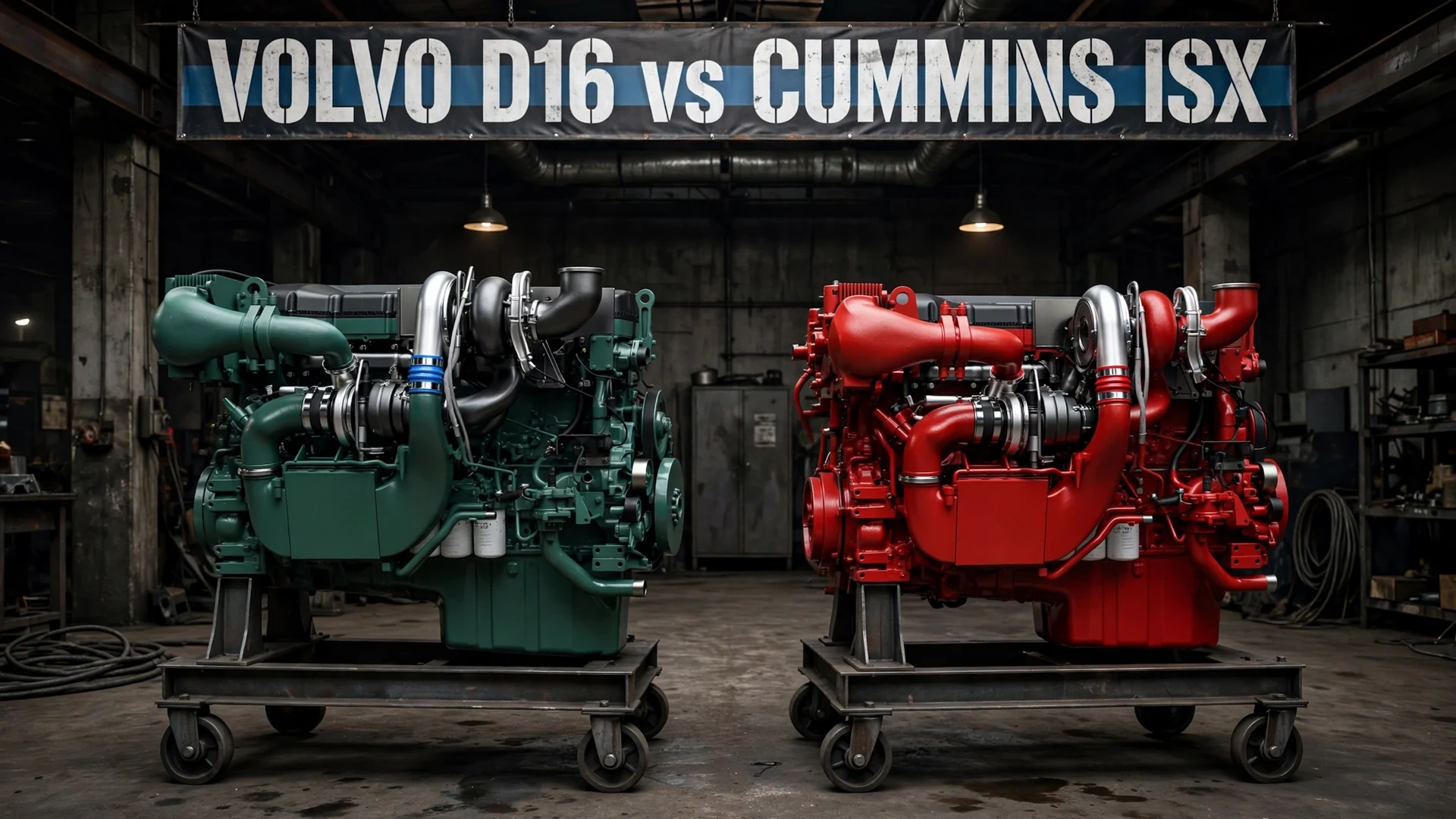
Volvo D16 vs Cummins ISX?

Volvo D16 vs Cummins ISX?
This is a heavyweight question in every sense. The Volvo D16 — a 16.1-liter inline-six — was Volvo Trucks North America’s biggest engine, aimed squarely at heavy-haul and severe-duty work. The Cummins ISX15 — a 14.9-liter inline-six — was the default big-bore choice across the North American industry, fitted to trucks from nearly every manufacturer. If you are shopping for a used big-bore tractor today, these two engines represent two very different philosophies: maximum displacement versus maximum parts-and-service availability.
Both engines are now discontinued, which shapes everything about buying one today. This guide compares them on verified specifications, history, and the realities of owning a legacy big-bore engine.
- Both are legacy engines. Volvo stopped producing the D16 in North America in January 2017; Cummins replaced the ISX with the X15 for the 2017 model year.
- D16: 16.1L, up to 600 hp and 2,050 lb-ft, dry weight around 3,134 lb. Maximum displacement — built for the heaviest loads.
- ISX15: 14.9L, up to 600 hp and 2,050 lb-ft in top ratings, dry weight around 2,964 lb. Lighter, and fitted to far more trucks.
- Service reality: Cummins’ independent service network is vastly larger; D16 support runs through Volvo dealers and Mack channels.
- Verdict: the D16 suits a Volvo-specific legacy heavy-haul setup; the ISX15/X15 is the more practical used-market choice for almost everyone else.
The D16: Volvo’s Biggest Engine — and Its Short North American Life
The D16 was Volvo Trucks North America’s flagship powerplant, offered in the VNL and VNX tractors with ratings from 500 to 600 hp and torque up to 2,050 lb-ft. Its party trick was displacement: at 16.1 liters (984 cubic inches), it was simply bigger than anything else in a Volvo, and Volvo marketed it for heavy-haul, logging, and severe-service applications where every cubic inch counts.
But big wasn’t what the market wanted. In January 2017, Volvo informed dealers that it would immediately discontinue the D16 — along with the Mack MP10 (its corporate cousin) and the Mack Titan tractor — citing diminishing demand as fleets shifted toward lighter, more fuel-efficient engines. The D16 had been in North America since 2005, giving it a relatively short run. Volvo pledged continued aftermarket support for existing engines, but no new D16-powered trucks have been built since.
A technical note for shoppers: the D16’s design was a joint Volvo/Mack effort based on the European D16C architecture, with a bore of 144 mm and stroke of 165 mm. It featured Volvo’s I-VEB engine brake rated at up to 600 hp of retarding power at 2,200 rpm — serious stopping hardware for heavy loads.
The ISX15: The Industry Default
The Cummins ISX15 needs little introduction. At 14.9 liters, it powered trucks from Freightliner, Peterbilt, Kenworth, International, and Volvo itself (Volvo offered Cummins power in the VNL alongside its own engines). Ratings spanned 400 to 600 hp with peak torque up to 2,050 lb-ft — essentially matching the D16’s headline numbers from 1.2 fewer liters.
For the 2017 model year, Cummins rebranded the ISX as the X15: the X15 Efficiency (400–500 hp, up to 1,850 lb-ft) targeted line-haul fuel economy, while the X15 Performance (485–605 hp, up to 2,050 lb-ft) carried the big-power torch. If you are shopping for a used tractor today, “ISX” generally means a 2010–2016 truck and “X15” means 2017 or newer — same engine family, different emissions generation.
Head-to-Head Specifications
| Specification | Volvo D16 | Cummins ISX15 |
|---|---|---|
| Displacement | 16.1 L (984 cu in) | 14.9 L |
| Configuration | Inline six | Inline six |
| Horsepower range | 500–600 hp | 400–600 hp |
| Peak torque | Up to 2,050 lb-ft | Up to 2,050 lb-ft |
| Dry weight | ~3,134 lb | ~2,964 lb |
| Bore x stroke | 144 x 165 mm | 137 x 169 mm (approx.) |
| Engine brake | I-VEB, up to 600 hp retarding | Variable-geometry turbo brake |
| Aftertreatment | DPF + SCR | DPF + SCR |
| Production status | Discontinued Jan 2017 (NA) | Replaced by X15 for 2017 |
| Applications | Volvo VNL, VNX only | Nearly all Class 8 OEMs |
Fuel Economy and Weight: Where the ISX Wins
The market’s verdict in 2017 was really about fuel. The D16’s extra 1.2 liters and ~170 lb of additional dry weight cost fuel on every mile, and fleets — which buy on total cost of ownership — voted with their orders for smaller, more efficient engines. The ISX15, and particularly the X15 Efficiency that followed it, was designed around that reality: single overhead cam, lighter rotating mass, and ratings tuned for line-haul economy.
For an owner-operator or fleet buyer today, the practical difference is that an ISX/X15-powered truck is simply easier to run economically, and its lighter engine leaves more payload capacity on weight-sensitive loads.
Service, Parts, and the Real Cost of Rarity
This is where the comparison gets decisive for most buyers. Cummins engines are serviced by one of the largest independent diesel service networks in North America — thousands of shops, distributors, and parts outlets. The D16, by contrast, is a Volvo-proprietary engine supported primarily through Volvo and Mack dealers, with a much smaller installed base (the D16 sold in limited numbers even before its 2017 discontinuation).
That means three practical disadvantages for the D16: fewer technicians who know it, longer waits for less-common parts, and a thinner used market — which also means less pricing transparency when you buy. None of this makes the D16 a bad engine; it makes it a specialist engine, one that rewards buyers who already have a relationship with a Volvo dealer and a nearby service point.
Reliability: What the Record Shows
Neither engine has a clean-sheet reputation, because neither generation of emissions-controlled big-bore diesel does. On the ISX side, the widely reported trouble spots of the EGR era are well documented in the trade press and owner forums: EGR components, variable-geometry turbo actuators, and fuel-system issues on certain model years (particularly the CM2250 generation around 2010–2012). Later ISX and X15 engines are generally regarded as improved.
The D16 had a shorter, lower-volume run, so its record is thinner — which itself is a data point. Early D16s had injector and EGR-related teething issues that were largely addressed in later production. With both engines, the honest rule is the same: buy on condition, maintenance records, and oil/coolant analysis — not on brand reputation. A well-maintained ISX with full records beats a neglected D16 every time, and vice versa.
Which One Fits Your Operation?
Verdict
For almost every used-truck buyer: the Cummins ISX15 (or its X15 successor) is the more practical choice — lighter, more fuel-efficient, fitted to more trucks, and backed by a far larger service network. The Volvo D16 is the specialist’s engine: maximum displacement and a superb engine brake for genuine heavy-haul work, but only if your operation is Volvo-based, your service support is secured, and the individual truck checks out on inspection. Buy the truck’s condition and records first; the badge second.
Frequently Asked Questions
Is the Volvo D16 still in production?
No. Volvo Trucks North America discontinued the D16 in January 2017, citing diminishing demand as the market shifted toward lighter, more fuel-efficient engines. Aftermarket parts and service support for existing engines continued.
What replaced the Cummins ISX?
The X15. For the 2017 model year, Cummins rebranded the ISX as the X15, split into the X15 Efficiency (400–500 hp, up to 1,850 lb-ft) for line-haul economy and the X15 Performance (485–605 hp, up to 2,050 lb-ft) for heavy applications.
How much horsepower does a Volvo D16 have?
North American D16 ratings ranged from 500 to 600 hp, with peak torque up to 2,050 lb-ft depending on the specific rating. Its defining trait was displacement: 16.1 liters, larger than the 14.9-liter Cummins ISX15.
Which is more reliable: D16 or ISX15?
There is no clean winner. The ISX had well-documented EGR, turbo-actuator, and fuel-system issues on certain model years (notably around 2010–2012), while the D16 had a shorter, lower-volume production run with less data behind it. Buy on the individual engine’s condition, maintenance records, and fluid analysis.
Can you still get parts for a Volvo D16?
Volvo pledged continued aftermarket support when it discontinued the engine, and parts remain available through Volvo and Mack dealers. But the installed base is small, so expect fewer stocking locations and potentially longer waits than for Cummins parts.
Which trucks came with the D16?
In North America, the D16 was available in the Volvo VNL and VNX tractors. Unlike the Cummins ISX15, which was offered across nearly every Class 8 manufacturer, the D16 was exclusive to Volvo trucks.
Sources
- TruckingInfo — “Volvo, Mack to Discontinue 16-Liter Diesel Immediately” (January 2017): https://www.truckinginfo.com/news/volvo-mack-to-discontinue-16-liter-diesel-immediately
- Overdrive — “Engine Spotlight: Volvo’s D16” (technical reference): https://www.overdriveonline.com/business/article/14874797/engine-spotlight
- Cummins — ISX15 2013 official specifications: https://www.cummins.com/en-na/engines/products/isx15-2013?page=7&title_2=&v=676
- FleetOwner — “Cummins Unveils X15 and X12 Engines” (X15 ratings): https://www.fleetowner.com/equipment/powertrain/article/21694040/cummins-unveils-x15-and-x12-engines