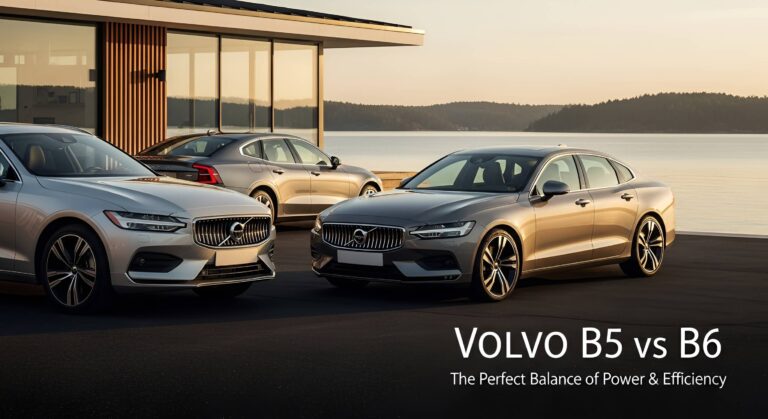

Volvo Diesel vs Petrol: Which Powertrain Is Right for You? Full Guide

Volvo Diesel vs Petrol: Which Powertrain Is Right for You? Full Guide
If you are shopping for a brand-new Volvo in 2026, the diesel-versus-petrol debate is already settled for you: Volvo built its last diesel car in March 2024. Every new Volvo rolling off the line today runs on a mild-hybrid petrol engine, a plug-in hybrid powertrain, or pure electricity. Diesel versus petrol is now a used-car question — and on the used market it is still one of the most consequential choices a Volvo buyer can make, affecting fuel bills, towing ability, maintenance, and even which cities you can drive into.
This guide compares the two engines that defined Volvo’s recent history — the D5 twin-turbo diesel and the B5 mild-hybrid petrol — with verified specifications, real fuel-economy figures, and honest guidance on which one suits your driving.
- No new diesel Volvos exist. Production ended in early 2024 after 45 years; the final diesel cars were a V60 (Ghent, February 2024) and an XC90 (Torslanda, March 2024).
- D5 diesel (used): 235 hp and a muscular 480 Nm of torque, with real-world economy around 5.6–6.0 L/100 km in an XC60. The torque king and the long-distance champion.
- B5 petrol (new and used): 247–250 hp and 350 Nm with 48V mild-hybrid assistance, EPA-rated at 25 mpg combined in the XC60. Smoother, quieter, and simpler to own.
- Running costs: the diesel typically wins on fuel cost per mile, but the petrol asks for premium unleaded and avoids diesel emission-system maintenance.
- Verdict: high-mileage drivers and towers should hunt down a well-kept D5; everyone else is better served by the B5.
Diesel Is Dead at Volvo: What Actually Happened
Volvo’s relationship with diesel stretched back to 1979, when the 244 GL D6 became one of the first passenger cars in the world with a six-cylinder diesel. The brand built its own five-cylinder D5 in 2001, and for a long stretch diesel was Volvo in Europe: between 2012 and 2016, half of all Volvos sold globally ran on diesel, and as recently as 2019 the majority of Volvos sold in Europe were diesels. Since 1991, Volvo has built more than nine million diesel vehicles.
Two forces killed it. The 2015 Dieselgate scandal poisoned diesel’s reputation and triggered far stricter real-world emissions testing, and the electric transition then accelerated faster than almost anyone predicted — Volvo’s fully electric sales jumped 70 percent in 2023 alone. Volvo announced the end at Climate Week NYC in September 2023 and followed through: the last diesel V60 left Ghent, Belgium, in February 2024, and the final diesel XC90 rolled out of Torslanda, Sweden, in March 2024. That last XC90 now sits in Volvo’s museum in Gothenburg.
What this means for you: the D5 and its siblings (D4, D3) are now used-market-only engines. They are plentiful — millions were built — but the supply is finite and shrinking.
D5 vs B5: By the Numbers
The fairest comparison pits the last great Volvo diesel against its direct petrol replacement, as fitted to the same car — the XC60:
| Specification | XC60 D5 (diesel) | XC60 B5 (petrol) |
|---|---|---|
| Engine | 2.0L twin-turbo diesel (D4204T23) | 2.0L turbo petrol + 48V mild hybrid |
| Power | 235 hp @ 4,000 rpm | 247–250 hp |
| Torque | 480 Nm @ 1,750–2,250 rpm | 350 Nm (258 lb-ft) |
| 0–100 km/h | 7.2 sec | ~6.9 sec |
| Combined consumption | 5.6–6.0 L/100 km | ~9.4 L/100 km (25 mpg EPA) |
| CO2 | 147–158 g/km | ~180+ g/km |
| Fuel required | Standard diesel | Premium unleaded (recommended) |
| Drivetrain | AWD, 8-speed automatic | AWD, 8-speed automatic |
| Availability | Used only (2017–2021 approx.) | New and used (2019–present) |
The headline figures tell the classic story: the diesel gives up a little peak power but counters with nearly 40 percent more torque, delivered low in the rev range where you actually use it. The petrol answers with broader availability, slightly brisker acceleration, and none of diesel’s emissions-system complexity.
Fuel Economy and Real-World Running Costs
On paper the diesel’s advantage is enormous — roughly 35–40 percent better fuel economy in like-for-like driving. In practice, the gap narrows or widens depending on how you drive:
- Motorway cruising: this is where the D5 earns its reputation. A diesel XC60 will genuinely return under 6 L/100 km at a steady cruise, giving over 1,100 km of range from its 71-litre tank. The B5 cannot touch that.
- City driving: the gap shrinks. Stop-start traffic blunts the diesel’s advantage, and short trips prevent the diesel particulate filter (DPF) from regenerating properly — the single biggest ownership caveat for diesel buyers.
- Fuel price: the B5 is specified for premium unleaded, which costs more per litre than regular petrol in most markets. Diesel fuel pricing varies, but the D5’s consumption advantage usually outweighs per-litre differences for high-mileage drivers.
How They Drive
Numbers aside, these engines feel completely different. The D5’s 480 Nm arrives at just 1,750 rpm and stays flat to 2,250 rpm, so the car surges forward with barely a rise in engine speed — relaxed, unstressed, and superb for towing (the XC60 D5 is rated to tow up to 2,400 kg depending on specification). It is, however, audibly a diesel at idle and under load.
The B5 is the more refined all-rounder. The 48V integrated starter-generator smooths out stop-start operation and fills in torque just off idle, throttle response is keener, and the engine is noticeably quieter. It needs more revs to do the same work, and it will drink when pushed — but for mixed everyday driving it is the more pleasant companion.
Reliability and Maintenance: The Honest Version
Volvo’s Drive-E D5 is generally regarded as a strong engine, but diesel ownership in the 2020s comes with conditions. The DPF, EGR system, and AdBlue/SCR hardware add maintenance exposure that the petrol simply does not have — and they punish the exact use case many buyers imagine: short urban trips. A D5 that never gets hot will clog its DPF and punish you with warning lights and forced regenerations. Buy a D5 only if your driving regularly includes 20-plus-minute runs at operating temperature.
The B5’s mild-hybrid system is comparatively simple — a belt-driven starter-generator and a small 48V battery — with no plug-in complexity. Servicing is conventional petrol fare. Neither engine has a widespread catastrophic failure pattern documented in the sources we checked, but the diesel’s emissions hardware is simply more that can go wrong, and replacement DPF or EGR work is expensive.
Which One Should You Choose?
Verdict
For most buyers in 2026: buy the B5 petrol. It is available new and nearly new, smoother, simpler to maintain, and immune to the tightening city-emissions rules that increasingly target diesels. For high-mileage drivers and towers: the used D5 diesel remains the rational champion — its torque and economy are unmatched, provided your driving keeps the emissions hardware healthy. There is no bad engine here; there is only the wrong engine for your usage.
Frequently Asked Questions
Does Volvo still make diesel cars?
No. Volvo built its last diesel car in March 2024 — an XC90 at the Torslanda plant in Sweden, following the final diesel V60 from Ghent, Belgium, in February 2024. The announcement was made on March 27, 2024, ending 45 years of Volvo diesel production.
Can I still buy a diesel Volvo?
Yes, but only used. The D5, D4, and D3 diesels were fitted to the XC60, XC90, V60, V90, S60, and S90 through roughly the 2017–2021 model years depending on market. Millions were built, so used supply is plentiful for now.
Were diesel Volvos ever sold in the United States?
Not in the modern era. Volvo’s recent US lineup has been petrol, hybrid, and electric only; the D5 and its diesel siblings were sold in Europe, the UK, and other diesel-friendly markets. American buyers choosing between used Volvos will almost always be choosing between petrol powertrains.
Is the Volvo D5 diesel reliable?
The D5 engine itself is generally well regarded, but its emissions hardware — diesel particulate filter, EGR system, and AdBlue injection — needs regular longer journeys to stay healthy. A D5 used mainly for short urban trips is a risky buy; one with motorway miles and full service history is a strong one.
Which is cheaper to run: D5 diesel or B5 petrol?
On fuel alone, the D5 usually wins — roughly 35–40% better economy in mixed driving. But the B5 avoids DPF/EGR/AdBlue maintenance, and the comparison flips for low-mileage drivers once diesel emission-system repairs enter the picture.
Will diesel Volvos be banned from city centers?
It depends on your city. Diesel passenger cars already face stricter treatment than petrol cars under schemes like London’s ULEZ and various European low-emission zones. Rules are tightening, not loosening — check your local regulations before buying a diesel for primarily urban use.
Sources
- Volvo Cars — “Dear diesel, it’s time to say goodbye” (March 27, 2024): https://media-downloads.volvocars.com/36c59957-0334-427a-8b80-b35f00d90a02/dear-diesel-its-time-to-say-goodbye-2025-09-21-131008-148.pdf
- Autotrader UK — “Volvo builds its last ever diesel car” (March 28, 2024): https://www.autotrader.co.uk/content/news/volvo-builds-its-last-ever-diesel-car
- Carscoops — “End Of An Era: Last Diesel Volvo Ever Rolls Off The Line” (March 2024): https://www.carscoops.com/2024/03/end-of-an-era-last-diesel-volvo-ever-rolls-off-the-line/
- Auto-Data.net — Volvo V90 2.0 D5 (235 hp) full specifications: https://www.auto-data.net/en/volvo-v90-2016-2.0-d5-235hp-awd-automatic-22762
- FuelEconomy.gov — 2024 Volvo XC60 B5 AWD fuel economy (22/28/25 mpg): https://www.fueleconomy.gov/feg/noframes/46738.shtml
- Edmunds — 2024 Volvo XC60 B5 Core specs: https://www.edmunds.com/volvo/xc60/2024/st-401984476/features-specs/