Volvo Dynamic vs Premier: Mid-2010s Trim Decoder & Used-Buying Guide

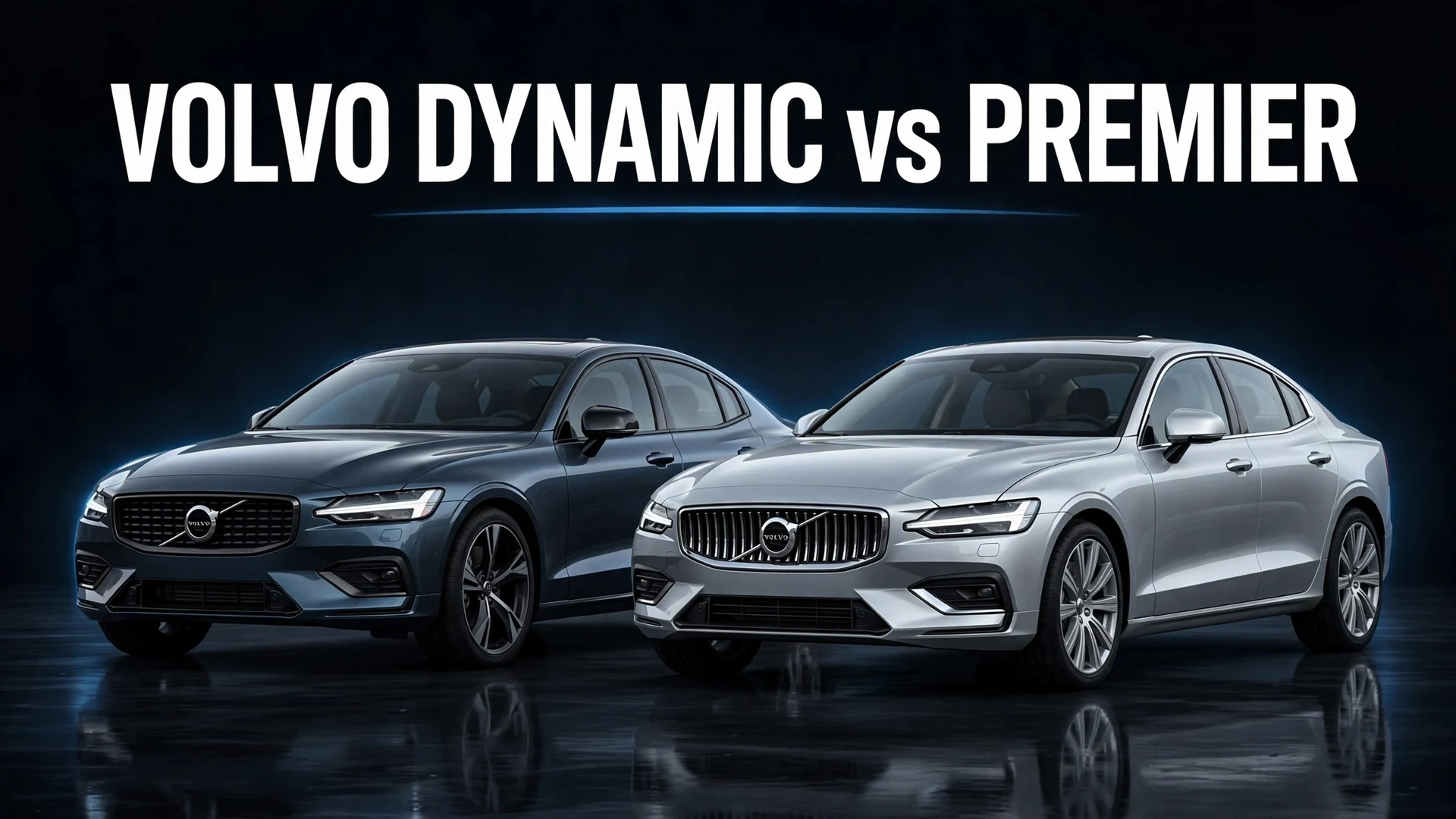
Scroll through used Volvo listings for a 2015, 2016 or 2017 S60 or V60 and you will keep hitting the same two words: Dynamic and Premier. They are not quite opposites, and not quite the same thing either. Dynamic was a trim; Premier was a sub-trim level of the Inscription line. Both vanished from the lineup years ago, yet both still show up in every used listing worth a second look.
This guide decodes exactly what each name bought you when new — features, pricing, positioning on Volvo’s mid-2010s ladder — and what it means for you as a used buyer in 2026.
Choose Dynamic if you want the sportier-looking car: 18-inch alloys, paddle shifters, detail exterior styling, sport seats and (on many builds) active dual xenon headlights — the enthusiast’s middle rung. Choose Premier (usually badged Inscription) if you want the comfort-and-tech route: standard leather seating, Sensus navigation, silver roof rails and the auto-dimming mirror. Same engine, same gearbox, same Volvo safety story — the difference is personality, not hardware. And since both are discontinued, trim-for-trim condition matters more than the badge.
- Dynamic was a trim; Premier was a sub-trim. On the 2017 S60, T5 came as Dynamic or Inscription, and Inscription itself came in Premier or Platinum flavor — so “Dynamic vs Premier” is really “sport trim vs comfort-spec Inscription.”
- Premier meant comfort tech as standard: leather seating surfaces, Sensus navigation with MapCare, integrated silver roof rails and the auto-dimming mirror.
- Dynamic meant sport styling as standard: 18-inch alloy wheels, steering-wheel paddle shifters, detail exterior styling, sport seats and milled-aluminum cabin inlays.
- New pricing was close: a 2017 S60 T5 FWD Dynamic started at $33,950; the T5 Inscription at $36,800. The real gap was in options, not sticker.
- Both are gone from new Volvos. Volvo moved to Momentum/Inscription/R-Design and then to Core/Plus/Ultra — Dynamic and Premier are used-market terms only.
Where Dynamic and Premier sat on the ladder
Volvo’s trim vocabulary changed roughly every generation in the 2010s, which is why used listings read like a foreign language. For the 2017 S60 — the car most of these “Dynamic vs Premier” questions are about — the structure was:
Premier and Platinum were not standalone trims — they were equipment levels of the Inscription trim.
The base T5 covered the fundamentals: 2.0-liter turbocharged Drive-E four with 240 hp and 258 lb-ft of torque, an 8-speed Geartronic automatic, front-wheel drive (all-wheel drive was a $2,000 option), a 7-inch touchscreen with Bluetooth, power front seats, cruise control, auto headlights and wipers, a sunroof and LED running lights. Everything else was a fork in the road.
Dynamic was the sport-leaning fork — for drivers who wanted the car to look quicker without paying for the 302 hp T6 R-Design. Inscription Premier was the comfort fork — leather, navigation and the cabin tech bundled from the factory. Platinum sat above Premier, adding the Harman Kardon audio system and active dual xenon headlights, plus the Convenience and Technology packages.
One more wrinkle: the 2017 V60 wagon used slightly different badging. Its T5 was offered in standard, Premier, Platinum and Dynamic — Premier and Platinum appeared as standalone labels rather than under an Inscription umbrella. So if the listing is a V60, “Premier” is the trim and “Inscription” may not appear at all. Same features, different naming skin.
Feature comparison: what each one actually added
Remember that options blur the lines on the used market — always confirm against the specific car’s build sheet.
| Feature | T5 Inscription · Premier | T5 Dynamic |
|---|---|---|
| Leather upholstery | Standard (leather seating surfaces) | Available; sport seats on many builds |
| Navigation | Standard — Sensus with MapCare | Optional package |
| Roof rails | Integrated silver roof rails | Not included by default |
| Auto-dimming mirror | Standard (inner mirror) | Available via options |
| Alloy wheels | 17–18 in. depending on build | 18-in. alloys standard (e.g. Tucan) |
| Paddle shifters | Not included | Standard — steering-wheel gear paddles |
| Exterior styling | Understated luxury trim | Detail styling pack, R-Design exhaust tips |
| Headlights | Halogen with LED running lights | Active dual xenon headlights (many builds) |
| Cabin trim | Classic wood inlays | Milled-aluminum inlays, sport steering wheel |
| Suspension | Touring chassis | Dynamic chassis option common |
| Comfort packages | Rear park assist camera, rear sensors standard | Available via Vision/Convenience packages |
| Engine | 2.0L turbo, 240 hp / 258 lb-ft | 2.0L turbo, 240 hp / 258 lb-ft |
| Transmission | 8-speed automatic | 8-speed automatic |
Based on 2017 US equipment lists; individual cars vary with options. The powertrain is identical — the split is styling and equipment, not engineering.
The price story, then and now
When new, the gap was modest. A 2017 S60 T5 FWD Dynamic listed at $33,950; the T5 Inscription started at $36,800. Add all-wheel drive — a popular choice on both — and the Dynamic rose to $35,950. But a lightly optioned Dynamic could quickly outrun a bare Inscription: period reviews noted that Technology ($1,500), Vision ($1,950), navigation/Harman Kardon ($2,300) and heated seats ($500) stacked up fast, with one tested T5 AWD Dynamic reaching $44,195 as equipped.
In 2026 the numbers have compressed dramatically. Expect roughly:
New prices are 2017 US MSRPs (destination excluded); used prices are typical asking ranges observed in 2026 and vary with mileage and condition.
The takeaway for used shoppers: at this age, condition and options swamp the original trim gap. A fully loaded Dynamic and a one-owner Premier at similar money are the same decision wearing different clothes. Pay for service history and condition, not the badge.
What they are actually like to live with
Both trims share the same bones — the Drive-E 2.0-liter turbo, the 8-speed automatic, the same safety cage with City Safety, WHIPS whiplash protection and SIPS side-impact airbags — so the ownership experience overlaps heavily. The differences that surface in daily life are subtler than the brochures suggest.
The Dynamic drives a touch sharper and looks the part. The 18-inch wheels and lower-profile rubber (235/45R18) fill the arches better and turn in slightly more crisply than the base 17s. The paddle shifters genuinely work — the 8-speed’s manual mode is responsive — though reviewers admitted they rarely felt the need to use them in normal driving. The milled-aluminum inlays and sport seats age well visually, and the active dual xenons (where fitted) are a real nighttime upgrade over halogen. The price is a slightly busier ride over broken pavement; period reviews of the related sport-chassis cars noted the ride could get busy on rough surfaces.
The Premier/Inscription is the quieter luxury play. Standard leather (in place of the base trim’s cloth-trimmed seats), standard navigation, the auto-dimming mirror and silver roof rails make it feel like a finished product rather than a car that needs optioning. Fuel economy is identical — 25 city / 36 highway mpg on the FWD T5, 23/31 with all-wheel drive — because the hardware is identical.
Reliability-wise, there is no meaningful trim split. The Drive-E T5 is well documented: the 8-speed is generally robust, and the common watch items for this generation are the same regardless of badge — the A/C evaporator (a labor-intensive dashboard-out job), front suspension bushings and tire wear on the 18s, rear caliper seizure from lack of use, and the usual sunroof drain maintenance. Check that the navigation maps have been updated (older Sensus units can be left behind), that both key fobs work, and that the parking sensors and camera — standard on the Premier, optional on the Dynamic — actually function.
Which one should you buy?
Pick the buyer you most resemble — each pane names a trim and the single biggest thing to check.
2026 used-buying checklist for Dynamic and Premier cars
Both trims are discontinued, so you are buying on condition. Run through this before money changes hands:
- Confirm the trim against the VIN/build sheet. Volvo’s trim names changed more than once; listings mislabel Premier cars as “Inscription” and vice versa. The dealer can pull the original equipment list from the VIN.
- Test every feature the badge promised. Premier: leather condition, navigation boot-up, auto-dimming mirror, rear camera and sensors. Dynamic: paddle shifters in manual mode, xenon washers (if fitted), sport seat bolsters.
- Service history over badge. Timing-belt interval on the Drive-E (every 10 years / 150k miles on the 2.0 — confirm for the car in front of you), gearbox fluid changes, and brake fluid history.
- Tires and wheels. The Dynamic’s 18s eat tires faster and cost more to replace; mismatched or aged rubber is a negotiation point.
- Electronics sweep. Sunroof, heated seats, keyless entry, BLIS (if optioned), parking sensors and the infotainment screen — all of it, before you sign.
Verdict
Buy the T5 Inscription Premier if you want the most complete car out of the box — leather, navigation, roof rails and the dimming mirror standard, with the quiet-luxury feel Volvo did best in this era.
Buy the T5 Dynamic if you want the sharper-looking, slightly more engaged car — 18-inch wheels, paddles, detail styling and sport seats — without stepping up to the harder-riding, pricier T6 R-Design.
Buy either if the example in front of you is the well-kept one. A decade on, a one-owner Premier with full records beats a neglected Dynamic with the nicer wheels, every time.
Frequently asked questions
What is the difference between Volvo Dynamic and Premier trims?
Dynamic was the sport-leaning trim: 18-inch alloy wheels, paddle shifters, detail exterior styling, sport seats and milled-aluminum inlays. Premier was a comfort/tech equipment level (usually of the Inscription trim) that added standard leather seats, Sensus navigation, silver roof rails and an auto-dimming mirror. Same engine and gearbox either way.
Are Dynamic and Premier still available on new Volvos?
No. Dynamic and Premier were used on mid-2010s models such as the S60 and V60. Volvo moved through Momentum, Inscription and R-Design naming, and current models use Core, Plus and Ultra. Both names are used-market terms only now.
Which is better, Dynamic or Premier?
Neither is objectively better — it is a comfort-versus-style choice. Premier suits comfort-first buyers who want leather and navigation standard; Dynamic suits drivers who prefer the sportier look and 18-inch wheels. On the used market, condition matters more than the badge.
Does the Dynamic trim include leather seats?
Leather was a defining standard feature of the Premier/Inscription cars; on the Dynamic, sport seats were standard and full leather upholstery depended on the build and options. Check the specific car rather than assuming from the badge.
What replaced the Dynamic and Premier trims?
Volvo transitioned to Momentum, Inscription and R-Design trims, and more recently to Core, Plus and Ultra for current models. The current Plus trim is the closest spiritual successor to what Premier offered — comfort equipment bundled as standard.