Volvo 340 vs 360: DAF Variomatic CVT vs Redblock 5-Speed Showdown

Volvo 340 vs 360: DAF Variomatic CVT vs Redblock 5-Speed Showdown
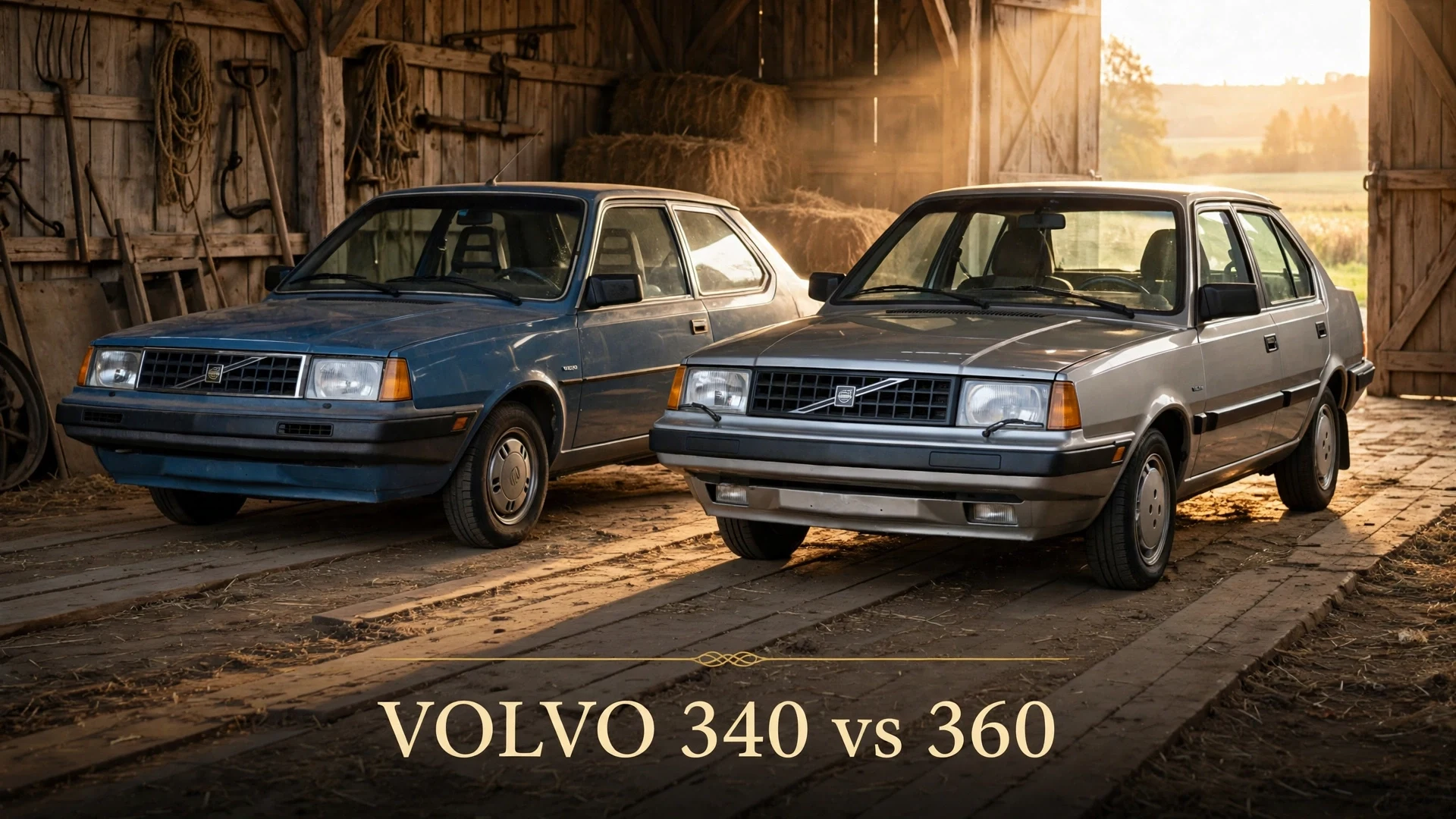
The Volvo 340 and 360 look like the same car because, underneath the badges, they nearly are. Both were built in Born, Netherlands, on the DAF-derived 300-series platform with rear-wheel drive and a rear transaxle. The difference is philosophical: the 340 (1976–1991) is the economy car of the pair — Renault 1.4 power, often paired with the Variomatic belt-drive CVT — while the 360 (1982–1989) is Volvo’s attempt to make the same platform respectable, with a proper 2.0-litre redblock engine, a 5-speed manual, and GLT trim. If you’re shopping for a cheap classic Volvo, the 360 is the driver’s car and the 340 is the curiosity.
- Same platform, different mission: the 360 was created in 1982 to give the better-equipped, more powerful 300-series cars “a profile of their own,” in Volvo’s own words.
- Engines: 340 = Renault 1.4 (64–72 hp, later 1.7 with 82 hp); 360 = Volvo 2.0 redblock up to 115 hp with Bosch fuel injection.
- Transmissions: the 340 is famous for the DAF-derived Variomatic CVT; the 360 got a conventional 4/5-speed manual.
- Performance gap is huge: 0–100 km/h in 18.4 s (340 Variomatic) versus about 10.5 s (360 GLT).
- Buy the 360 GLT if you want to drive it; buy a 340 Variomatic only if you specifically want the CVT novelty.
Shared Roots: A Dutch Volvo With DAF DNA
Neither car is a “real” Swedish Volvo in the Gothenburg sense. The 300-series began life as the DAF 77 (Project P900), developed by the Dutch carmaker DAF before Volvo bought its car division in the mid-1970s. Production stayed in Born, Netherlands, for the model’s entire 1976–1991 run, during which Volvo built about 1.14 million 300-series cars. (You’ll sometimes see “1.3 million” quoted; every sourced figure lands at 1.13–1.14M, so treat 1.3M with skepticism.)
The DAF inheritance is visible in the engineering. All 300-series cars are rear-wheel drive with the gearbox mounted at the rear axle as a transaxle, driving through a De Dion tube — an unusual, sophisticated layout for a small economy car, chosen partly because the Variomatic CVT’s belt drive lived at the back. On 2.0-litre cars the driveshaft runs inside an enclosed torque tube. It was clever packaging, and it gave the little Volvos genuinely good weight distribution.
Badging evolved over time: the range launched as the 343 (3-door) and 345 (5-door) in 1976, became the 340 in autumn 1982, and the 360 badge appeared the same year for the upmarket 2.0-litre versions. A 4-door 340 saloon joined around 1983–84 (79,964 built), and the 360 was offered as a 3-door hatch, 5-door hatch, and 4-door sedan.
Specs at a Glance
| Specification | Volvo 340 | Volvo 360 |
|---|---|---|
| Production | 1976–1991 | 1982–1989 |
| Engine | Renault 1.4 OHV (1,397 cc); later 1.7 (82 hp), 1.6 diesel (54 hp) | Volvo 2.0 redblock SOHC (1,986 cc) |
| Power | 64–72 hp (1.4) | Up to 115 hp (B19E/B200E, injected) |
| Torque | 105 Nm (1.4) | 157 Nm @ 4,200 rpm |
| Transmission | Variomatic CVT or 4-speed manual | 4/5-speed manual |
| Drive layout | RWD, rear transaxle, De Dion axle | RWD, rear transaxle, De Dion axle, torque tube |
| Curb weight | ~950 kg (early 1.4) | ~1,110–1,113 kg |
| 0–100 km/h | 18.4 s (Variomatic) | ~10.5 s (GLT) |
| Top speed | 143 km/h (Variomatic) | >180 km/h (GLT) |
| Fuel economy | Modest (small engine, light car) | 8.4 L/100 km avg, ECE (GLT, press figure) |
| Body styles | 3/5-door hatch, 4-door saloon | 3/5-door hatch, 4-door sedan |
Power Compared: 70 hp vs 115 hp
The performance gulf between these two is one of the largest you’ll find between two cars that share a platform. The chart below uses Volvo’s own press figures:
The Variomatic CVT: The 340’s Claim to Fame
The 340’s party trick is a transmission most drivers have never experienced. The Variomatic is a belt-drive continuously variable transmission inherited directly from DAF, which pioneered CVTs for cars in the 1950s. There are no gears and no clutch pedal in the traditional sense — just two variable-diameter pulleys and a rubber/steel belt that seamlessly varies the ratio. It was decades ahead of its time conceptually, and it made the little Volvo genuinely easy to drive in town.
In practice, it’s an acquired taste. The engine holds constant rpm while road speed rises — the “rubber band” sensation modern CVT drivers know — and the 1.4’s 70 hp means progress is leisurely: 18.4 seconds to 100 km/h and a 143 km/h top speed. Belts are a wear item and need proper adjustment; a neglected Variomatic slips, shudders, and eventually strands you. Specialists still exist, particularly in the Netherlands and the UK, but budget for a belt service on any car without recent records. Buy a 340 for this transmission as a historical curiosity, not as transport.
The Redblock 5-Speed: The 360’s Claim to Fame
The 360 is a fundamentally more serious car. Its 2.0-litre redblock — the B19 initially, then the low-friction B200 from around 1985 — is one of Volvo’s great engines: an iron-block, SOHC workhorse known for six-figure mileages with basic maintenance. In GLT trim with Bosch fuel injection it made 115 hp and 157 Nm, enough for 0–100 km/h in about 10.5 seconds and a top speed over 180 km/h. Respectable then; usable now.
Volvo didn’t just drop in a bigger engine. The 360 GLT got 14-inch alloy wheels with 60-series low-profile tires, a front spoiler with two auxiliary driving lamps, a discreet boot-lid spoiler, tinted glass edged in matt-black trim, remote-control door mirrors, and a lowered sportier suspension with gas rear shock absorbers. It was a coherent warm hatch/sedan package — and with the 5-speed manual and rear-wheel drive, it’s genuinely fun on a back road in a way the 340 never is.
Where the 360 Wins
Almost everywhere that matters for actually using the car. It’s roughly twice as quick, the redblock is vastly more durable and easier to service than the Renault 1.4 (parts for the B200 remain easy to find through the Volvo classic network), and the manual gearbox is a known quantity any mechanic understands. The GLT trim gives it real presence, and values reflect it: 360s — especially GLT hatches and sedans — are the collectible 300-series cars, while 340s remain cheap.
Rarity cuts both ways. Volvo built 33,535 three-door, 66,207 four-door, and 76,281 five-door 360s — modest numbers, so clean survivors are genuinely scarce. But the shared 300-series platform means most mechanical parts interchange, and the Dutch/British enthusiast scene supports these cars well.
Where the 340 Still Makes Sense
Three reasons to consider a 340: price, weight, and novelty. They’re the cheapest route into classic Volvo ownership — often a fraction of 360 money. At around 950 kg, the early 1.4 cars are light, simple, and economical runabouts. And the Variomatic is a genuine piece of automotive history: a DAF-designed CVT in series production decades before the technology went mainstream. For a collector who already has drivers and wants something unusual, a well-kept 340 Variomatic is a conversation piece that still putters to cars-and-coffee under its own power.
The later 1.7-litre (82 hp) 340s from late 1984 on are the pragmatic pick of the 340 range — meaningfully livelier than the 1.4 without the 360’s price premium. Avoid the 1.6 diesel (54 hp) unless your idea of fun is being overtaken by trucks.
Which Should You Buy?
Verdict: The 360 Is the Car; the 340 Is the Story
Buy the 360 GLT if you want a classic Volvo you can actually drive and enjoy — the redblock engine, 5-speed manual, and sport chassis make it a real car by any era’s standards. Buy the 340 if you’re drawn to the Variomatic’s place in transmission history or you want the cheapest possible entry into the marque. They’re not really competitors; they’re two answers to different questions wearing similar sheet metal. For most buyers asking “340 vs 360,” the 360 is the answer.
Sources
- Volvo Cars heritage press releases (via Cision) — 360 production years (1982–1989), 2.0L engine details, body-style production splits, “profile of their own” positioning statement.
- Volvo 340/360 press material (via volvoclub.org.uk) — GLT output (115 hp / 157 Nm), 0–100 km/h ~10.5 s, 8.4 L/100 km economy, GLT equipment list.
- RTA repair manual data (via tmbbooks.com) — 340 production span, engine variants and outputs.
- 1981 Volvo UK range brochure (via automobilisto.de) — B14 1,397 cc specifications (70 hp DIN, 105 Nm).
- Carfolio / ultimatespecs — 360 GLE weight and performance aggregates (third-party; flagged where used).
- Wikipedia “Volvo 300 Series” — 1.14M total production, Born plant, transaxle/De Dion layout.
Frequently Asked Questions
What is the Volvo Variomatic transmission?
A belt-drive continuously variable transmission inherited from DAF, offered on the Volvo 340/343/345. It uses variable-diameter pulleys and a belt instead of gears, giving seamless ratio changes — the conceptual ancestor of modern CVTs.
What engine does the Volvo 340 have?
Mostly the Renault Cléon 1.4-litre (1,397 cc) with 64–72 hp depending on year, later joined by a Renault 1.7 (82 hp) and a 1.6 diesel (54 hp). The 360 instead uses Volvo’s own 2.0-litre redblock with up to 115 hp.
How fast is a Volvo 360 GLT?
Volvo’s press figures claim about 10.5 seconds to 100 km/h and a top speed over 180 km/h for the fuel-injected 115-hp GLT — roughly twice as quick as a 340 Variomatic.
Are Volvo 340 and 360 parts interchangeable?
Largely, yes for chassis, suspension, brakes, and body panels — they share the 300-series platform. Engines, gearboxes, and 2.0-specific drivetrain parts (torque tube) differ.
Where were the Volvo 340 and 360 built?
Born, Netherlands, at Volvo’s Dutch plant — the former DAF car factory. The 300-series was developed from DAF’s Project P900 (the DAF 77).
Which is more collectible, the 340 or 360?
The 360, particularly GLT models — fewer were built, they’re genuinely enjoyable to drive, and the market recognizes it. Clean 340s remain cheap except for well-kept Variomatic cars, which trade on novelty.